Try it on your room

According to Sleep Foundation UK, children aged 3 to 10 take 10 to 20 minutes longer to fall asleep in bedrooms painted in bright reds, hot pinks or strong yellows. In 2026, UK paint merchants report a clear shift away from primary-coloured feature walls towards playful but calming palettes: soft butter yellows, dusty blues, heritage pinks and meadow greens from Farrow & Ball, Little Greene and Dulux Heritage.
This guide ranks the top 15 child's bedroom paint colours for UK homes in 2026, with exact codes, scrubbable finishes, mural strategy and a growth-room framework that lets a scheme age gracefully from age 3 through 10 and into the teens. Total cost: £180 to £420 per bedroom. Sources: Farrow & Ball, Little Greene, Dulux Heritage, Sleep Foundation UK.
For full pricing, see our complete UK cost guide.
The 15 best child's bedroom paint colours in the UK for 2026
These 15 colours share three non-negotiable qualities: a mid-saturation palette (stimulating enough for daytime play, soft enough for evening wind-down), availability in a scrubbable finish (Dulux Easycare, Crown Clean Extreme, Farrow & Ball Modern Emulsion, Little Greene Intelligent Matt), and longevity: each shade survives the jump from toddler to tween without looking babyish.
| Colour | Brand & Code | Mood | Best for |
|---|---|---|---|
| Babouche | Farrow & Ball No.223 | Soft butter yellow | North-facing playroom / bedroom |
| Great White | Farrow & Ball No.2006 | Warm chalky off-white | Ceiling, trim, three-wall base |
| Dead Salmon | Farrow & Ball No.28 | Muted heritage pink | Girl's room, shared siblings |
| Setting Plaster | Farrow & Ball No.231 | Warm blush pink | Growth room, all four walls |
| Pavilion Blue | Farrow & Ball No.252 | Soft dusty duck-egg | Unisex, nursery to age 10 |
| Sweet Tarr | Little Greene 3 | Warm chalky cream | Small loft / cottage bedroom |
| Celestial Blue | Little Greene 101 | Gentle dusty blue | Boy or unisex, ages 3-10 |
| Rose Pink | Little Greene 220 | Deeper heritage pink | Feature wall, age 5 upwards |
| Meadow | Dulux Heritage Green | Soft gardens-green | Unisex growth room, any aspect |
| Slaked Lime | Little Greene 105 | Bright chalky off-white | Mural wall base, small rooms |
| French Grey Pale | Little Greene 161 | Cool pale warm-grey | Teen-proof base, ages 8+ |
| Pointing | Farrow & Ball No.2003 | Warm neutral white | Gender-neutral nursery carry-over |
| Mizzle | Farrow & Ball No.266 | Misty grey-green | Calm wind-down, ages 6-12 |
| Livid | Little Greene 263 | Dusty denim blue | Feature wall, ages 7 upwards |
| Buttermilk | Dulux Heritage | Creamy soft yellow | Shared sibling room, all ages |
Try it on your house
No photo? Try a sample
Why playful does not mean loud: the UK 2026 palette shift
For two decades, British parents defaulted to strong colour blocks for children's bedrooms: sky blue for boys, candy pink for girls, primary-red accent walls. The 2025-2026 John Lewis and Dulux trend reports both flag a firm reversal: parents now want rooms that feel warm, creative and calm rather than over-stimulating.
The Sleep Foundation UK's evidence is the driver. Bright reds raise cortisol for roughly 40 minutes post-exposure. Strong yellows (not buttery Babouche, but full saturation canary) provoke similar alertness. Both delay sleep onset in children under 10 by 10 to 20 minutes on average, a meaningful loss across 365 school nights.
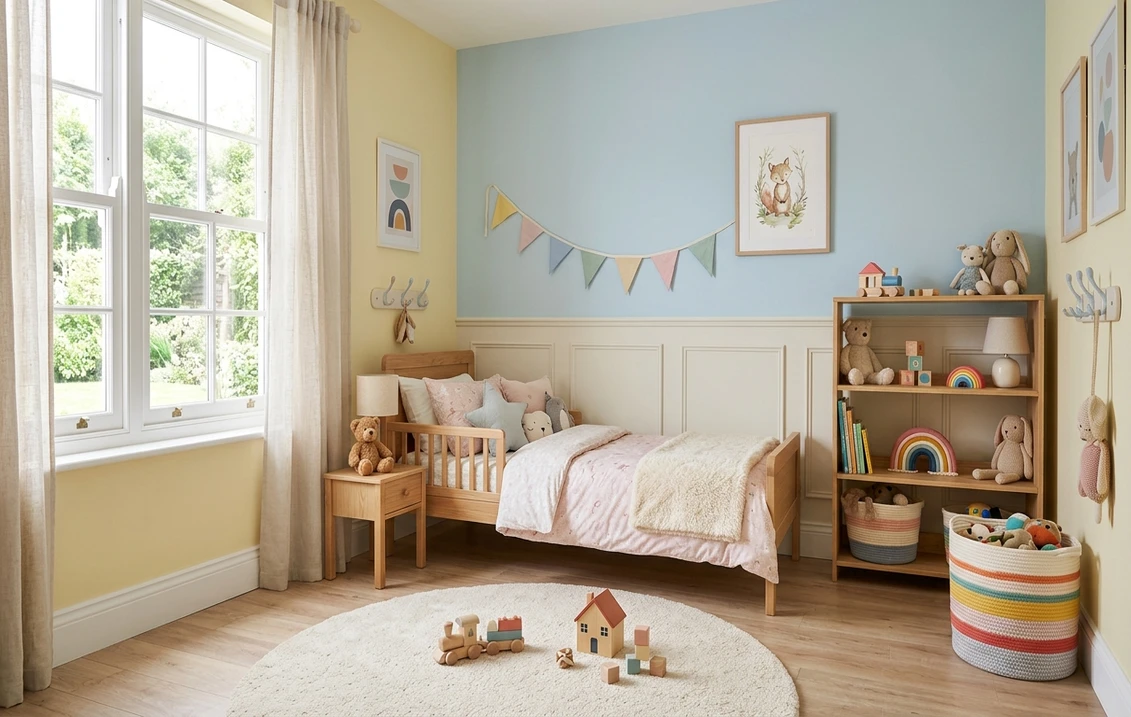
The 2026 playful-but-calming palette solves this with mid-saturation shades: Babouche (not canary), Pavilion Blue (not royal), Dead Salmon (not hot pink), Meadow Green (not lime). The child's eye still reads these as cheerful; the nervous system reads them as safe.
Growth room: choose colours that age with the child from 3 to 10 to 15
The single most expensive mistake in UK child bedrooms is painting for the current age. A Peppa Pink nursery becomes embarrassing at age 6. A Paw Patrol mural is peeled off at age 8. Each repaint costs £180 to £420 and a weekend of disruption. The growth room strategy, championed by UK child-room designers since 2023, eliminates this.
The principle: choose a base colour that holds across three life-stages, then let removable elements (decals, posters, bedding, rugs) carry the age-specific personality. Four growth-room base colours proven to span ages 3 through 15:
- Farrow & Ball Setting Plaster No.231: reads as playful blush at 4, heritage pink at 10, sophisticated rose at 15. Sits beautifully against unicorn decals, then K-pop posters, then framed prints.
- Farrow & Ball Pavilion Blue No.252: the ultimate unisex dusty duck-egg. A 3-year-old reads it as sky, an 8-year-old reads it as calm, a 14-year-old reads it as grown-up. Rarely dated.
- Dulux Heritage Meadow Green: a gardens-green that pairs with toddler wooden toys, then pre-teen bedroom plants, then teen dark wood desks. Never shouts.
- Little Greene French Grey Pale 161: a warm grey that serves as a neutral canvas. At 4 it sits under rainbow bunting, at 10 under Lego displays, at 15 under vinyl records and fairy lights.
The growth-room framework saves UK families £400 to £900 across a child's primary-school years by eliminating two avoidable repaints. It also helps children develop attachment to their space without the emotional reset of a wholesale redecoration every 3 years.
Upload your child's bedroom photo, test Babouche, Pavilion Blue and Setting Plaster in 30 seconds
Wall mural strategy: contained drama, not permanent commitment
Full-wall hand-painted murals (woodland scenes, seascapes, space themes) are back in UK 2026 child's bedrooms, but with new rules learned the hard way by a generation of parents who painted elaborate Disney murals their children outgrew in 18 months.
Three mural approaches that work in 2026:
- Arch mural behind bed: paint a single arch or semicircle in Celestial Blue or Meadow Green on a Slaked Lime base wall. Frames the headboard without engulfing the whole room. Age 3 to 10, easily repainted flat in a weekend if tastes change.
- Half-wall colour block: Babouche or Dead Salmon up to dado-height (approximately 90 cm from the floor), with Great White or Pointing above. Feels deliberate at every age, easy to refresh.
- Removable wallpaper + painted border: John Lewis, H&M Home and Hibou Home sell peel-and-stick murals (woodland, savanna, map of the world) that survive 5 to 7 years and remove cleanly. Surround with Setting Plaster or Pavilion Blue walls rather than white for a softer effect.
Avoid painting scenes directly from current cartoons, specific licensed characters, or anything your child requested while aged under 5. The rule: nothing on the wall that a 12-year-old would refuse to show a friend. If in doubt, keep the attachment to removable, not painted.
Scrubbable finish mandatory: the non-negotiable specification
Children's walls collect fingerprints, pen marks, splashes, scuffs from toys and the occasional flung yoghurt. A standard matt emulsion shows every incident and cannot be cleaned without leaving a paler patch. In 2026, UK decorators universally specify a scrubbable finish in any child's bedroom, usually one of four products:
- Dulux Easycare: stain-repellent matt, around £38 per 2.5L at Screwfix / B&Q. Withstands thousands of wipe cycles per Dulux lab testing. Broadest colour library.
- Crown Clean Extreme: matt, £42 per 2.5L, excellent resistance to marker pen and food splashes. Crown's in-house testing claims 10,000 wipe cycles.
- Farrow & Ball Modern Emulsion: 7 percent sheen matt-eggshell hybrid, £58 per 2.5L. Wipeable but not as stain-repellent as Easycare; best combined with dado-height panelling on high-traffic walls.
- Little Greene Intelligent Matt: £54 per 2.5L, similar performance to Modern Emulsion. Marketed as child-friendly, low-VOC and washable.
Colour match the Farrow & Ball and Little Greene heritage shades into Dulux Easycare via Dulux's in-store colour matching service (£5 surcharge) if budget is tight. The match is rarely 100 percent identical but is usually acceptable for child bedrooms where the scrubbable performance matters more than the exact F&B pigment.
Colours to avoid in a UK child's bedroom
Not every trendy shade translates to a 4-year-old's bedroom. Four colour families consistently underperform:
- Bright reds (pillar box, poppy, fire engine): raise cortisol, delay sleep, and dominate the room visually. Sleep Foundation UK ranks bright red bedrooms in the bottom 5 percent for child sleep quality.
- Strong yellows (canary, sunflower): cause over-stimulation and, according to older colour-psychology studies, correlate with increased crying in pre-schoolers. Swap for buttery Babouche or creamy Buttermilk.
- Hot pinks (fuchsia, Barbie pink): age-limit themselves rapidly (embarrassing by age 7), reflect harshly under warm bulbs, and stain eggshell with visible handprints. Use Setting Plaster or Dead Salmon for longevity.
- Pure brilliant white: shows every scuff, feels clinical, and photographs flat. Warm it to Great White, Pointing or Slaked Lime.
Total cost per child's bedroom in UK 2026: £180 to £420
A typical 8-12 m² UK child's bedroom costs between £180 and £420 to paint in 2026, depending on brand, whether you DIY, and whether a mural or feature wall is included.
| Scope | Paint cost | Labour | Total |
|---|---|---|---|
| DIY, Dulux Easycare, 4 walls + ceiling | £80 - £110 | £0 | £180 - £220 |
| DIY, F&B Modern Emulsion, 4 walls + arch mural | £130 - £170 | £0 | £240 - £300 |
| Decorator, Dulux Easycare, 4 walls + ceiling | £80 - £110 | £180 - £260 | £280 - £370 |
| Decorator, Little Greene + half-wall colour block | £130 - £170 | £220 - £280 | £340 - £420 |
A standard 10 m² single bedroom typically needs 2.5L of wall paint (two coats), 1.25L of ceiling paint, and 0.75L of eggshell for skirting and architrave. Buy sample pots (£5-£7) before the full tins: test on two walls, view at 7am, midday and 7pm for 48 hours before committing.
How light orientation changes the palette
A colour that looks perfect on a Farrow & Ball swatch in the shop can read completely differently in your child's actual bedroom. Four rules of thumb for UK rooms:
- North-facing: cool bluish light year-round. Warm the room with Babouche, Dead Salmon or Setting Plaster. Avoid cool greys and cold blues which will read flat and depressing.
- South-facing: generous warm light. Pavilion Blue, Celestial Blue, Mizzle and Meadow Green glow here without going cold. Strong warm yellows can read brash under peak summer sun.
- East-facing: bright mornings (useful for breakfast-time energy), cooler afternoons. Dusty blues and greens shift pleasantly across the day. Avoid dark feature walls that lose depth in afternoon shadow.
- West-facing: cool mornings, golden evenings. Rose Pink, Setting Plaster and Livid all peak at dusk, which is exactly the wind-down hour before bedtime.
Shared sibling bedrooms: one palette, two identities
Where siblings share a room, the 2026 UK approach is a shared neutral base (Pointing, Great White or French Grey Pale) with two accent walls or two accent zones, each one child's chosen heritage shade. A girl-boy shared room might pair Dead Salmon above the bunk of one child and Celestial Blue above the bunk of the other, both anchored in Pointing on the remaining two walls and ceiling.
This solves the classic sibling-room tension: each child owns a defined visual zone, the overall room still reads as coherent, and the scheme matures well as the children grow. Avoid splitting the room down the middle in contrasting colours; it looks forced and ages badly.
Frequently asked questions on UK child's bedroom paint colours
What is the best paint colour for a 5-year-old's bedroom in the UK?
The UK 2026 consensus favours mid-saturation shades that age with the child: Farrow & Ball Setting Plaster No.231 (warm blush), Pavilion Blue No.252 (dusty duck-egg) or Dulux Heritage Meadow Green. These stay relevant from age 3 through 10 and pair with age-appropriate decals, bedding and artwork. Avoid bright reds, hot pinks and canary yellows, which over-stimulate and delay sleep by 10 to 20 minutes according to Sleep Foundation UK.
Which paint finish is scrubbable enough for a child's bedroom?
The four UK industry-standard scrubbable finishes in 2026 are Dulux Easycare (matt, around £38 per 2.5L), Crown Clean Extreme (matt, £42), Farrow & Ball Modern Emulsion (7 percent sheen, £58) and Little Greene Intelligent Matt (£54). All withstand repeated wiping with a damp cloth. Dulux Easycare is the most stain-repellent; Modern Emulsion and Intelligent Matt are preferred by decorators for period homes where hairline cracks need a slightly softer sheen.
How do I choose a colour that will still suit my child at age 10 or 15?
Apply the growth room framework: choose a mid-saturation heritage base colour (Setting Plaster, Pavilion Blue, Meadow Green or French Grey Pale) that reads age-appropriate across three life stages. Carry age-specific personality through removable elements: decals, bedding, posters, rug, curtains. The base stays for 8 to 12 years; the removable layer refreshes every 2 to 3 years at low cost. This saves a typical UK family £400-£900 by eliminating two avoidable repaints during primary school.
Should I paint a mural on my child's bedroom wall?
Yes, but with restraint. The 2026 UK approach favours contained drama: a single arch mural behind the bed, a half-wall colour block to dado-height, or removable peel-and-stick wallpaper from John Lewis or Hibou Home. Avoid hand-painting specific licensed characters or scenes your child chose under age 5 - they will be outgrown in 18 months. The rule: nothing on the wall that a 12-year-old would refuse to show a friend. Keep the attachment to removable, not painted.
Free - No sign-up - 100+ F&B, Little Greene & Dulux Heritage shades
The right child's bedroom colour balances play, sleep science and a 10-year lifespan. Before committing to 2.5 litres of Setting Plaster or Pavilion Blue, visualise the shade on your own bedroom photo with our free AI interior colour visualiser, then order A4 sample pots from Farrow & Ball or Little Greene. Sources: Farrow & Ball, Little Greene, Dulux Heritage, Sleep Foundation UK.
Trademarks mentioned (Sherwin-Williams, Benjamin Moore, Behr, Caparol, Brillux, Sto, Alpina, Valspar, PPG, Glidden, Dulux, Crown Trade, Sandtex, Farrow & Ball, Johnstone's, Leyland) are property of their respective owners. FacadeColorizer is independent and not affiliated with any of them. Nominative fair use under Lanham Act §1125.