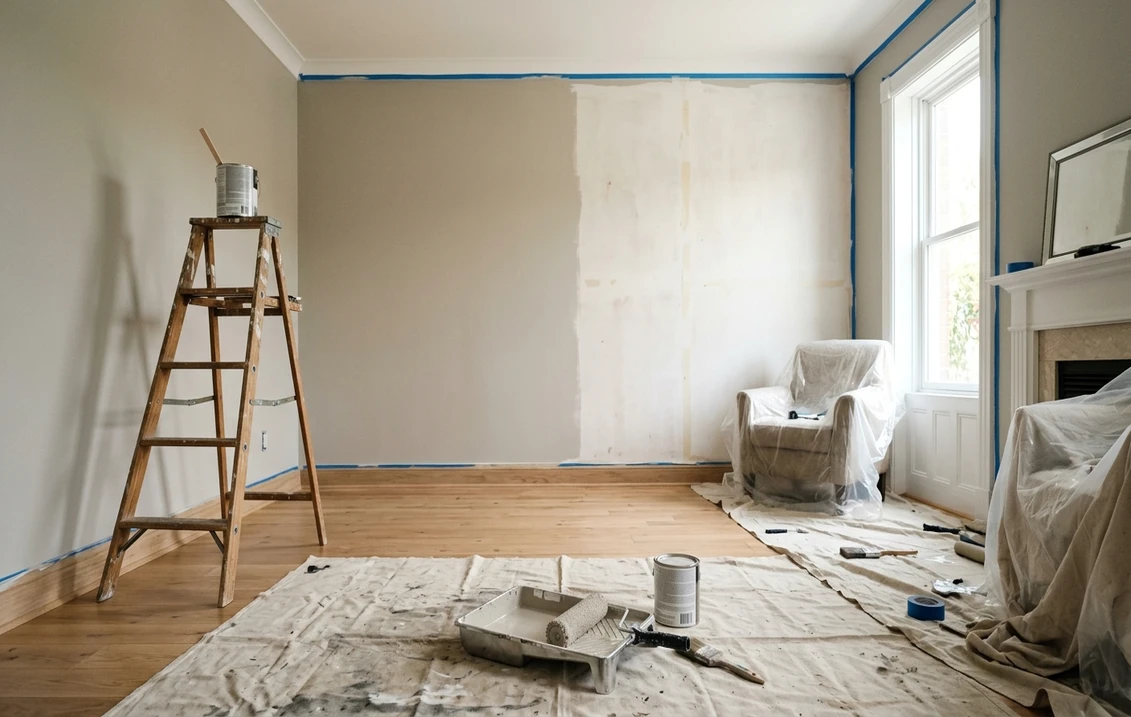
Try it on your room

Planning to redecorate your home? Whether you need a painter and decorator to refresh a single bedroom or transform every room in a Victorian terrace, understanding real 2026 costs is the first step to budgeting accurately. This complete guide covers day rates, cost per room, cost per m², wallpaper hanging, woodwork, period properties, and the best paint brands, so you can get fair quotes and avoid nasty surprises.
Before settling on a colour scheme, try our free AI interior colour visualiser to see how any shade will look on your actual walls, no sample pots required.
Day Rates & Cost Per Room in 2026
The day rate for a qualified interior decorator in the UK ranges from £180 to £350 per day in 2026, depending on experience, region, and the complexity of the work. London decorators sit firmly at the top of that range, with inner-city jobs able to exceed £350, while rates in the North of England, Scotland, and Wales tend to fall between £150 and £230 per day. Hourly rates typically run £20–£35/hour for experienced decorators.
Those figures cover interior work only. Outside work is priced on a different basis, because scaffold hire, weather windows and masonry paint specification sit on top of the labour, so an interior per-room rate will underprice an exterior job every time. Our guide to the cost of exterior house painting uk carries the separate ranges by property type and region, which is the comparison to use if you are budgeting inside and out in the same year.
Most decorators quote by room rather than by the day for straightforward interior painting jobs. Below are typical 2026 price ranges for labour only (paint and materials are additional unless otherwise agreed):
| Room / Job | Size | National Average | London |
|---|---|---|---|
| Bedroom | Small (box room) | £250 – £380 | £350 – £500 |
| Bedroom | Standard double | £350 – £550 | £480 – £750 |
| Living room / lounge | Average (20–25 m²) | £450 – £700 | £620 – £950 |
| Kitchen painting | Average | £350 – £600 | £500 – £800 |
| Bathroom painting | Small–medium | £200 – £400 | £300 – £550 |
| Hallway & landing | Standard terrace | £350 – £600 | £500 – £850 |
| Whole house (3-bed) | Semi-detached | £2,000 – £3,500 | £3,000 – £5,000 |
| Cost per m² (walls only) | Standard finish | £8 – £18 | £14 – £25 |
| Day rate (labour only) | Experienced decorator | £180 – £280 | £280 – £350+ |
Try it on your house
No photo? Try a sample
Price tip
Always ask for an itemised quote that separates labour, paint, surface preparation, and materials. Decorators who quote a single lump sum make it very hard to compare like-for-like. Get at least three quotes before committing.
Decorator Day Rates by UK City in 2026
Location is the single biggest reason two otherwise identical jobs come back with very different quotes. A decorator working in central London carries far higher overheads (travel, parking, congestion and ULEZ charges, and the cost of simply living in the capital) than one in a market town in the North or in South Wales. The table below shows typical 2026 day rates for an experienced solo painter and decorator, labour only. Treat these as a sense-check on the quotes you receive rather than as a fixed tariff: an individual decorator's skill, finish quality, and availability all move the figure within (and occasionally beyond) these bands.
| City / Region | Typical Day Rate (2026) | Notes |
|---|---|---|
| Central London | £280 – £400+ | Highest in the UK; ULEZ, parking and access add cost |
| Greater London & commuter belt | £240 – £340 | Surrey, Herts and Kent track close to London rates |
| Brighton & South Coast | £200 – £300 | Period-heavy stock keeps skilled decorators in demand |
| Bristol & Bath | £200 – £290 | Georgian terraces command a heritage premium |
| Birmingham & Midlands | £170 – £260 | Mid-range; strong supply of qualified tradespeople |
| Manchester & Leeds | £170 – £260 | Fast-growing cities; rates rising year on year |
| Newcastle & North East | £150 – £230 | Among the most affordable in England |
| Edinburgh & Glasgow | £170 – £270 | Edinburgh tenements add access and stairwell time |
| Cardiff & South Wales | £150 – £230 | Lower cost base than English cities of similar size |
| Belfast & Northern Ireland | £140 – £220 | Typically the lowest day rates in the UK |
Two practical points worth knowing in 2026. First, a two-person team (a decorator plus a labourer or apprentice) will quote a higher combined day rate, often £300 to £500, but finishes a large job in fewer days, which can work out cheaper overall once you account for the disruption of having the work drag on. Second, many decorators apply a small travel surcharge or a higher rate for jobs more than 20 to 30 minutes from their base, so a local tradesperson is often better value than a highly rated one two counties away.
Cost by Room: What to Budget All-In for 2026
The labour table above shows what a decorator charges for their time. Most homeowners, though, want to know the total they will hand over once paint and materials are added. The table below gives realistic 2026 all-in budgets per room (labour plus trade paint and sundries), split into three tiers. "Budget" assumes a sound, modern wall in a standard Dulux Trade or Crown emulsion; "Premium" assumes careful preparation, two top coats, and a heritage paint such as Farrow & Ball or Little Greene with woodwork repainted in satinwood.
| Room | Budget (all-in) | Mid-range (all-in) | Premium (all-in) |
|---|---|---|---|
| Box room / small bedroom | £300 – £420 | £420 – £600 | £600 – £850 |
| Double bedroom | £420 – £620 | £620 – £900 | £900 – £1,300 |
| Living room / lounge | £550 – £800 | £800 – £1,200 | £1,200 – £1,900 |
| Kitchen (walls & ceiling) | £420 – £650 | £650 – £950 | £950 – £1,400 |
| Bathroom | £260 – £420 | £420 – £620 | £620 – £900 |
| Hallway, stairs & landing | £450 – £700 | £700 – £1,100 | £1,100 – £1,800 |
| Home office / study | £320 – £480 | £480 – £700 | £700 – £1,050 |
Hallways and stairwells are consistently the most expensive room per square metre to decorate, which surprises a lot of homeowners. The reason is access: painting a stairwell safely often means a decorator working off scaffold boards, a combination ladder, or a specialist platform, and that slow, careful work eats into the day. If your budget is tight, a hallway is the room where it pays most to get the preparation right once rather than repaint a scuffed, high-traffic space every couple of years.
What Drives a Decorator's Quote Up or Down
Two decorators can stand in the same room and quote figures that are hundreds of pounds apart, and both can be fair. The gap usually comes down to a handful of variables. Understanding them lets you read a quote properly, spot where you could save, and recognise when a low number is actually a corner being cut. These are the factors that push a 2026 quote in each direction.
Factors that push the price up:
- Heavy preparation, flaking paint, water-stained ceilings, blown plaster, woodchip wallpaper to strip, or filling and sanding a wall full of old fixings. On tired walls, prep can be 30 to 40% of the labour, so a thorough decorator who quotes more for prep is often the one who will give you a finish that lasts.
- Dark or strong colours over a light base, deep navies, plum, and rich greens frequently need an extra coat (sometimes a tinted primer) to cover evenly, adding time and paint cost. Going the other way, light over dark, can be just as demanding.
- Premium paint specified by you, asking for Farrow & Ball or Little Greene raises the materials line considerably, and some finishes are slower to apply, which adds labour too.
- Detailed woodwork and period features, panelled doors, deep skirting board, coving, dado rail, and sash window frame painting all take far longer than plain modern surfaces.
- Access and height, stairwells, high ceilings, conservatories, and rooms that need scaffold or platforms cost more because the work is slower and the safety setup takes time.
- Occupied, furnished rooms, masking, moving and protecting furniture, and working around your daily life is slower than painting an empty room. Clearing the space yourself genuinely lowers the quote.
- Tight timescales, asking a decorator to slot you in this week, or to finish before a fixed date, can attract a premium because it disrupts their schedule.
Factors that pull the price down:
- Sound, modern walls, smooth plasterboard in good condition needs little more than a wash, a light sand, and two coats.
- Empty rooms and a clear run, decorating a whole house before you move in, or while you are away, lets a decorator work quickly without resetting the room each day.
- Bundling rooms together, booking several rooms (or a whole house) at once almost always earns a better per-room rate than one room at a time, because the decorator saves on set-up, travel, and mobilisation.
- Sticking to one colour and a standard finish, fewer colour changes mean less cutting-in, less masking, and less wasted paint.
- Booking in the quiet season, late winter and early spring (January to March) are traditionally slower for decorators, so you have more room to negotiate than in the busy pre-Christmas and summer periods.
- Doing the easy prep yourself, clearing the room, taking down curtains and fittings, and filling minor holes ahead of time can shave hours off the labour bill.
Paint Types: Emulsion, Eggshell & Gloss Explained
Choosing the right paint finish is just as important as choosing the right colour. Here is a quick guide to the most common finishes used in UK interior decorating:
- Matt emulsion paint, the standard finish for ceilings and living room walls. Hides imperfections well and gives a flat, chalky look. Less washable than other finishes; not ideal for kitchens or bathrooms. Most Dulux Trade and Crown ranges include matt emulsions.
- Eggshell, a low-sheen finish (roughly 10–20% sheen) that is harder wearing and more washable than matt. Excellent for bedroom and living room walls where you want a subtle lustre. Farrow & Ball Modern Emulsion has a similar low-sheen appearance and is a popular choice for period interiors. Little Greene also offers a superb oil-based eggshell range.
- Satinwood, the trade standard for woodwork including skirting board, dado rail, coving, door frames, and window frame painting. More durable than eggshell with a mid-level sheen. Available in water-based quick-drying and oil-based formulations.
- Gloss, high sheen finish traditionally used on woodwork and front doors. Oil-based gloss gives the hardest, most durable finish but takes longer to dry and has higher VOC content. Water-based quick-drying gloss has improved enormously and is now widely preferred for its low-VOC credentials and ease of application.
- Undercoat & primer, essential on bare plaster, new MDF skirting, or any surface being repainted in a significantly different colour. A good undercoat or primer ensures better coverage and adhesion.
- Mist coat, a diluted emulsion (typically 80% paint / 20% water) applied directly to bare plaster as a first coat. Allows the plaster to absorb paint evenly before full coats are applied. Skipping the mist coat is a common DIY mistake that leads to peeling.
Wallpaper Hanging Costs 2026
Wallpaper hanging is a specialist skill and commands a higher labour rate than standard painting. In 2026, expect to pay:
- Labour per roll: £35 – £60 depending on pattern repeat and wall condition
- Labour per m²: £10 – £20 (hanging only); £18 – £30 if old paper must be stripped first
- Full room (hanging only): £350 – £600 labour
- Feature wall: £100 – £250 labour depending on width and pattern matching
- Lining paper (before wallpapering or painting): £150 – £300 per room
A feature wall in a bold wallpaper is one of the most cost-effective ways to transform a room. A good decorator will advise you on pattern placement and whether lining paper is needed for a smooth finish on older walls. On period property walls, particularly Victorian terraces with uneven plaster, lining paper is almost always recommended before wallpapering.
Surface Preparation: The Foundation of a Good Finish
Professional surface preparation is what separates a long-lasting decorating job from one that starts flaking within a year. A skilled interior decorator will typically follow this process before a single drop of paint is applied:
- Cleaning with sugar soap, removes grease, nicotine, and surface dirt. Sugar soap is essential for kitchens, bathrooms, and any room that has been smoked in.
- Sanding, key for woodwork, old gloss surfaces, and walls with flaking paint. Sanding provides a key for new paint to grip.
- Filling, hairline cracks, screw holes, and gaps are filled with a flexible filler. Larger cracks in plaster may need a bonding agent first.
- Caulking, flexible acrylic sealant applied along the junction between skirting board, coving, dado rail, and wall. Caulking prevents paint from cracking along these joins.
- Laying dust sheets, professional decorators cover all furniture, flooring, and fixtures with dust sheets before beginning.
- Primer or mist coat, applied to bare plaster or new surfaces before top coats.
On older properties, preparation can easily account for 30–40% of the total job time. Never accept a quote that does not itemise preparation work separately, it is the most important part of any decorating project.
Period Properties: Victorian & Edwardian Homes
Victorian (1837–1901) and Edwardian (1901–1910) homes make up a huge proportion of UK housing stock and present unique decorating challenges, and opportunities. These period property features require careful preparation and specialist products:
- Coving and cornices, elaborate plaster coving is a defining feature of Victorian and Edwardian reception rooms. Painting it neatly requires a steady hand and patience; expect to pay a 10–15% premium over a plain-ceiling room. Always use caulking at the wall–coving junction to prevent cracking.
- Dado rail, typically found at roughly 90 cm from the floor in hallways and reception rooms. Traditionally painted in satinwood or eggshell, often in a contrasting colour to the wall above and below.
- Skirting board, Victorian skirting can be 15–25 cm tall and intricately profiled. Painting it properly, with thorough sanding, filling, and two coats of satinwood or gloss, is time-consuming but makes an enormous visual difference.
- Door painting and window frame painting, panelled Victorian doors and sash windows have many more surfaces than modern equivalents. Door painting (both sides plus frame) can take 1.5–2 hours per door, while window frame painting on original sash windows requires careful preparation to avoid sticking the sashes.
- Old paint layers, Victorian properties often have decades of oil-based paint on woodwork. Stripping this back to bare wood before repainting can add a full day or more to the project cost, but gives a far superior finish.
For a typical four-bedroom Victorian terrace requiring full interior redecoration, walls, ceilings, all woodwork, and a hallway with original coving, budget £4,000 – £7,000 nationally and £6,000 – £10,000 in London for labour alone. Add £800 – £2,000 for quality paints such as Farrow & Ball or Little Greene.
Popular Paint Brands for UK Interiors
The right paint makes all the difference. Here is an honest guide to the major brands used by professional decorators across the UK:
- Dulux Trade, the most widely used trade paint brand in the UK. Excellent coverage, a vast colour library, and reliable consistency across all finishes including matt emulsion paint, eggshell, satinwood, and gloss. Dulux Trade Diamond Matt is particularly popular for hallways and high-traffic areas due to its washable, scrubbable finish. Dulux also offers a full low-VOC range.
- Farrow & Ball, the premium choice for homeowners who want rich, complex colours with a distinctly British feel. More expensive than trade brands (£60–£70 for 2.5 litres of estate emulsion), but the depth of colour and chalky matte finish is unmatched. Particularly suited to period property interiors. Popular 2026 shades include Jitney, Hay, and Railings.
- Crown, a solid mid-range trade brand. Crown Trade Clean Extreme is highly regarded for kitchens and bathrooms; its quick-drying formulation allows two coats in a day. Many decorators use Crown to colour-match Farrow & Ball shades at a lower cost.
- Little Greene, an independent British brand offering an exceptional range of heritage and contemporary colours. Particularly popular for Victorian and Edwardian interiors. Their oil-based eggshell and gloss for woodwork are considered among the best available. Little Greene paints are formulated with a high pigment load and excellent low-VOC credentials.
- Benjamin Moore, gaining popularity with UK decorators, particularly the Aura Interior range. Known for exceptional hide and colour accuracy. Available through specialist stockists.
- Zoffany, a luxury brand popular for bespoke interiors. Zoffany paints are mixed to order and command a premium, but the colour depth and durability are exceptional for high-end projects.
UK Interior Colour Trends 2026
The leading British paint brands have spoken: 2026 is the year of warmth, depth, and carefully considered colour consultation. Here are the defining trends shaping UK interiors this year:
- Deep blues & navy, dark, inky blues are dominating living rooms and home studies. Dulux named its 2026 Colour of the Year palette "The Rhythm of Blues", featuring Mellow Flow (grey-based blue), Free Groove (rich cobalt), and Slow Swing (deep navy). Little Greene's Royal Navy remains a perennial bestseller.
- Warm neutrals & sandy tones, Farrow & Ball Jitney (a relaxed sandy neutral) is predicted to be one of the biggest colour consultation requests of 2026. These warm, earthy neutrals pair beautifully with natural materials and work across bedrooms, hallways, and living rooms.
- Butter yellows, Farrow & Ball Hay is the standout shade: a soft, chalky yellow that brings warmth without shouting. Perfect as a feature wall colour in north-facing rooms that lack natural light.
- Rich greens & olive, greens continue to hold their place as the most popular "statement" colour in UK interiors. Dulux Willow Tree (a light olive green) and Farrow & Ball Calke Green are particularly popular for kitchen painting.
- Deep plum & dark reds, for those willing to be bold. Little Greene's 2026 Adventurer collection centres on sunset tones including Ashes of Roses, Nether Red, and Beauvais Lilac. Ideal for cosy dining rooms and feature wall treatments.
- The sixth wall (ceiling colour), one of the boldest trends of 2026 is painting the ceiling the same colour as the walls or even darker. When combined with painted coving and woodwork, this creates a dramatic, enveloping effect that suits both modern and period property interiors.
Not sure how a colour will look in your home? try our free AI interior colour visualiser to test any shade on your actual walls, ceiling, or woodwork before committing.
How to Find a Good Interior Decorator in the UK
Finding a trustworthy, skilled painter and decorator takes more than a quick Google search. Here is what to look for in 2026:
- Use verified review platforms, Checkatrade, MyBuilder, and Bark all carry verified customer reviews. Look for decorators with 30+ reviews and an average rating of 4.5 stars or above. Read the negative reviews as carefully as the positive ones.
- Ask for public liability insurance, a professional decorator should hold at least £1–2 million public liability cover. Ask to see the certificate before work begins.
- Membership of the Painting & Decorating Association (PDA), PDA members are vetted and must carry appropriate insurance. It is a reliable quality indicator.
- Get an itemised written quote, a proper quote should list labour days, surface preparation work, number of coats, paint brand, and whether materials are included. Avoid verbal agreements and vague lump sums.
- Ask about colour consultation, many experienced decorators offer colour advice as part of the service. Some work alongside qualified colour consultants, which is particularly valuable for complex period property schemes.
- Avoid upfront cash requests, a small deposit (10–20%) is standard for materials on larger jobs, but never pay in full upfront. Pay the balance only when you are satisfied with the finished work.
The Get-Three-Quotes Checklist
Three quotes is the sweet spot: one tells you nothing, two leaves you guessing, and four or more is usually overkill. The trick is to make sure all three decorators are pricing exactly the same job, otherwise you are comparing numbers that cannot be compared. Use this checklist to brief each decorator identically and to read the quotes that come back.
Before they visit, write down the brief:
- Exactly which rooms and surfaces (walls, ceilings, woodwork, doors, window frame) are in scope
- The number of coats you expect (two is standard; dark colours may need three)
- The paint brand and finish you want, or ask them to recommend and price it
- Who is supplying the paint, you or the decorator
- Whether you will clear and protect the rooms yourself
- Your ideal start date and any fixed deadline
When the quotes come back, check each one shows:
| Line item to look for | Why it matters |
|---|---|
| Labour, itemised | Days and day rate, so you can sense-check it against the city table above |
| Surface preparation | Listed separately; a quote with no prep line is a red flag |
| Number of coats | One coat to save money will look patchy and fail sooner |
| Paint brand & finish | Confirms everyone priced the same product, not a cheaper substitute |
| Materials & sundries | Filler, caulk, masking, dust sheets: included or extra? |
| VAT | VAT-registered firms add 20%; sole traders below the threshold may not charge it |
| Payment schedule | Small deposit at most; balance on satisfactory completion |
| Insurance & references | Public liability cover and recent jobs you can look at or call |
One last point: the middle quote is not automatically the right one, and the cheapest is rarely the bargain it looks like. If one number comes in far below the others, ask what is different. Usually it is fewer coats, thinner preparation, a cheaper paint, or VAT left off. The decorator you want is the one whose quote you understand line by line, who answers those questions comfortably, and whose previous work you have actually seen.
Visualise Your Colour Scheme Before You Commit
With so many beautiful paint colours available from Farrow & Ball, Little Greene, Dulux, and Zoffany, choosing the right shade can be overwhelming. Before buying sample pots, try our free AI interior colour visualiser, upload a photo of your room and test any colour instantly. It is the fastest way to narrow down your shortlist and have a productive conversation with your decorator.
Room-by-Room Interior Decorating Costs & Colours
Pricing varies by room, but so does the colour palette. Before booking your interior decorator, explore our dedicated room guides for the best 2026 paint colours, finish recommendations, and decorating tips, all in British English with Dulux, Farrow & Ball, Crown, and Little Greene shade suggestions:
- Hallway paint colours UK 2026
- Kitchen paint colours UK 2026
- Bathroom paint colours UK (anti-mould)
- Bedroom paint colours UK 2026
- Living room paint colours UK 2026
- Dining room paint colours UK 2026
- Home office paint colours UK 2026
- Snug paint colours UK (cosy palette)
- Utility room paint colours UK
- Conservatory paint colours UK (durable)
- Small bedroom paint colours UK 2026
- Child's bedroom paint colours UK
- Nursery paint colours UK (baby-safe)
- Loft conversion paint colours UK
- Dulux Heritage vs Farrow & Ball
- Farrow & Ball vs Little Greene
- Crown Paint vs Dulux interior
- Tudor interior colour schemes
Frequently Asked Questions
How much does an interior decorator charge per day in the UK?
In 2026, a qualified painter and decorator charges between £180 and £280 per day nationally, rising to £280–£350+ in London. Hourly rates run £20–£35 for experienced decorators. The day rate covers labour only, emulsion paint, primer, undercoat, and materials are usually charged separately. For a standard double bedroom, most decorators will take 1.5–2 days including surface preparation, so budget £350–£550 nationally for labour alone.
How much does it cost to paint a room per m² in the UK?
The cost per m² for interior wall painting in the UK is typically £8–£18 nationally and £14–£25 in London for labour. This includes surface preparation (filling, sugar soap wash, sanding) and two coats of emulsion paint. Add £3–£8/m² for materials if the decorator is supplying paint. Higher-sheen finishes such as eggshell or specialist brands like Farrow & Ball may command a slight premium due to longer application times.
How much does wallpaper hanging cost in the UK?
Professional wallpaper hanging costs £35–£60 per roll for labour (excluding the wallpaper itself), or £10–£20 per m² for hanging only. If old wallpaper must be stripped first, add £8–£15/m². A full room costs £350–£600 in labour; a single feature wall costs £100–£250. Lining paper is often recommended on older walls to create a smooth base, budget an additional £150–£300 per room. Pattern-matching wallpapers take longer and will cost more per roll.
Why does decorating a period property cost more?
Victorian and Edwardian homes feature intricate coving, deep skirting board profiles, dado rail, panelled doors, and sash window frame details, all of which take significantly longer to paint neatly than modern equivalents. Old layers of oil-based paint on woodwork often need stripping or thorough sanding before repainting. Filling and caulking hairline cracks in period plaster adds further time. Altogether, expect to pay 20–40% more for a period property compared to an equivalent-sized modern home.
Is Farrow & Ball worth the extra cost for interior decorating?
Farrow & Ball costs roughly two to three times more than Dulux Trade or Crown, but the colour depth and chalky finish are genuinely distinctive. The complex pigment formulations, many colours contain multiple pigments, produce a richness that is very difficult to replicate with cheaper paints. For period property interiors, heritage reception rooms, or anywhere you spend significant time, the investment is usually worthwhile. For utility rooms, rental properties, or bathroom painting, a washable Dulux Trade or Crown product will perform equally well at a fraction of the cost. Many decorators offer colour consultation to help you decide where to splurge and where to save.
Trademarks mentioned (Sherwin-Williams, Benjamin Moore, Behr, Caparol, Brillux, Sto, Alpina, Valspar, PPG, Glidden, Dulux, Crown Trade, Sandtex, Farrow & Ball, Johnstone's, Leyland) are property of their respective owners. FacadeColorizer is independent and not affiliated with any of them. Nominative fair use under Lanham Act §1125.