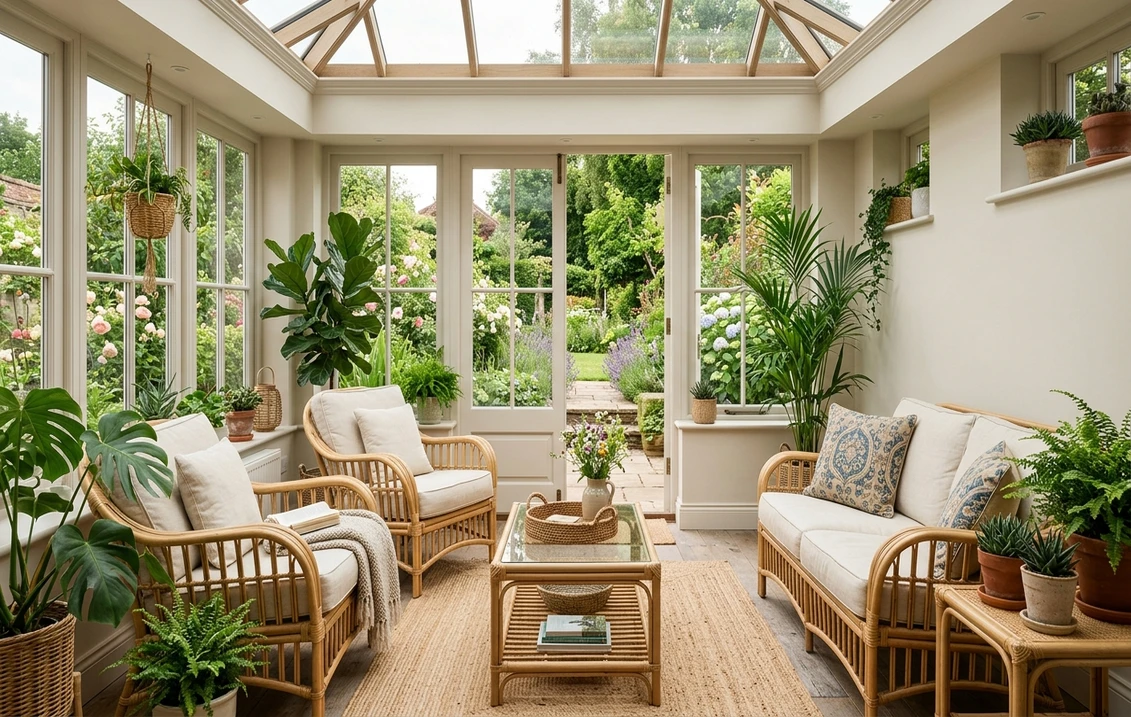
Try it on your room

A conservatory is the hardest room in a British house to paint well, and most of the disappointment comes from treating it like a living room. It is the brightest room, which fades and exposes every colour; the hottest in July and the coldest in January, which works the paint film; and the dampest on a winter morning, when the glass streams and the one solid wall is the surface the condensation runs down to. So the choice of colour comes second. First comes the finish, and the manufacturers are clearer about this than most decorating advice: the retail matt emulsions most people reach for are not meant for rooms with heavy condensation. This guide takes the room's physics from the glazing trade, the finish from the paint makers' own data sheets, then the colours that stay cool and read well in a room with the sky as its ceiling.
Why a conservatory punishes ordinary paint
The Glass and Glazing Federation, the trade body for the people who build the things, is candid about the problem: "with sunlight comes heat", "if this heat becomes trapped overheating can become an issue", and "air trapped in a conservatory is a surefire recipe for overheating" (GGF, how to keep a conservatory cool in summer). The same page lists the fixes, none of which is paint: solar control glass that "allows sunlight to pass through but reflects and radiates away some of the heat", solar control film for existing glazing, "roof and window blinds, shades, awnings, and sails", and ventilation so that "air can circulate easily between the indoors and outdoors", with the advice to "consider all of the above options not just separately but in combination". The paint on the dwarf wall and the house wall has to live with whatever that combination leaves: in a conservatory with a polycarbonate roof and no blinds, that can be summer surface temperatures no interior wall elsewhere in the house ever sees, followed by condensation every clear winter morning.
Three things follow for the paint. The film must tolerate repeated wetting from condensation without softening, marking or growing mould. The colour must survive UV exposure that a north-facing lounge never gets. And the surface should not add heat: a dark wall under a glass roof absorbs the sun and radiates it back into the room in the evening. Before any colour, that points to a washable, mould-resistant finish with a little sheen, and to colours at the lighter end of the chart on the sunny sides.
The finish: what the paint makers say about humid rooms
The brands' own documents separate the matts that cope with condensation from the ones that do not. Dulux Trade's technical data sheet for its everyday Vinyl Matt says plainly that "where frequent heavy condensation is likely, as in some kitchens and bathrooms, Dulux Trade Diamond Eggshell is more suitable" (Dulux Trade Vinyl Matt technical data sheet), and the Dulux Decorator Centre paint guide notes that matt emulsion is "harder to clean than other finishes" and that matt paint "in bathrooms, kitchens and other humid areas isn't recommended because it's not moisture-resistant". A conservatory wall that streams in January is, for the purposes of the data sheet, a bathroom wall.
The premium brands sell a specific product for the job. Farrow & Ball describes Modern Emulsion as "a durable matt finish with the tiniest hint of sheen", "a washable, wipeable wonder" that is "protected against mould" and "suitable for interior walls and ceilings", and pitches it at kitchens and bathrooms; its chalky Estate Emulsion is the one to avoid here. Little Greene's Intelligent Eggshell is described by the brand as "fully washable and scrubbable", combining "primer and topcoat in a single tin", suitable for kitchen or bathroom walls "in the splash zone", and usable on bathroom walls "where condensation may be a problem", with a low sheen of 10 to 15 percent. The pattern across all three makers is the same: for a wall that gets wet, a washable low-sheen finish (eggshell, or a matt engineered to be wipeable and mould-resistant), not a chalky or vinyl matt.
| Surface | What it faces | Finish to specify (makers' own guidance) |
|---|---|---|
| House wall inside the conservatory (brick or plaster) | Condensation, sun, handprints | Washable low-sheen: Dulux Trade Diamond Eggshell, Farrow & Ball Modern Emulsion, Little Greene Intelligent Eggshell |
| Dwarf wall and sills below the glazing | Runs of condensation, plant pots, dogs | Eggshell; mould-resistant formulation; wipe-down tolerance |
| Plastered ceiling or soffit, if any | Condensation collects here first | Mould-resistant eggshell or a bathroom-grade matt, never a cheap ceiling white |
| uPVC frames and polycarbonate roof | Heat, UV, movement | Not emulsion at all: specialist uPVC coatings only, and dark colours with caution on frames that heat up |
Try it on your room
No photo? Try a sample
Colour: light reflectance is the conservatory's second rule
Every paint colour has a light reflectance value, the share of light it bounces back, from near zero for black to the high eighties for brilliant white. In an ordinary room LRV is about brightness; in a conservatory it is also about heat, because a wall that absorbs most of the light falling through a glass roof warms and radiates it back. On the sun-facing side, keep the painted walls light: whites, off-whites, pale stones and pale greys. Mid tones belong on the house wall that stays in shade, and dark colours on a single feature panel at most, in a washable eggshell, where the sun does not sit on them in the afternoon. The second half of the rule is the opposite problem: a conservatory is so bright that pale colours can look washed out at noon, so a white needs a tint (a warm or green-grey cast) to read as a colour rather than as nothing.
| Colour family | Why it works in a conservatory | Where to put it |
|---|---|---|
| Warm off-whites and soft stones | High reflectance, stay cool, flatter plants and rattan | All walls on south and west sides |
| Pale sage and grey-greens | Continue the garden indoors, hide pollen and dust | House wall; dwarf wall under planting |
| Pale blue-greys | Read cooler in strong light; good against white frames | Conservatories used as home offices |
| Mid greens and terracottas | Depth without the heat of a true dark | Shaded house wall only, washable finish |
| Deep greens, navy, charcoal | Dramatic at dusk, hot and fading by day | One panel or the inside of the house door, never the sunny wall |
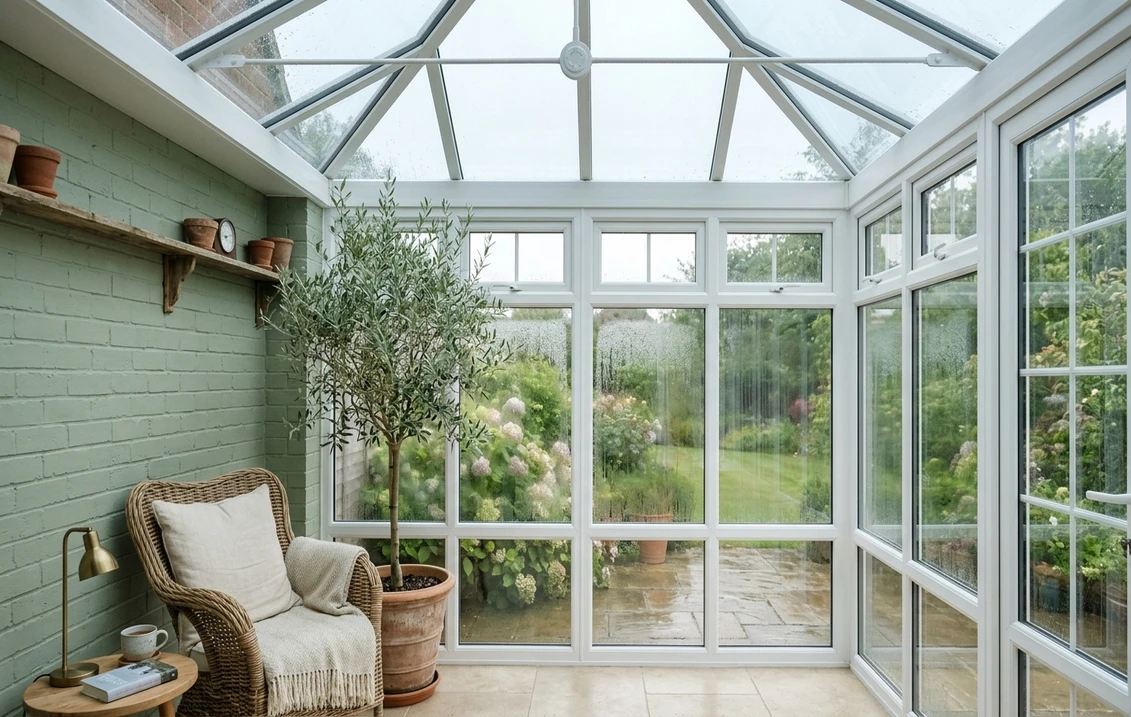
Which wall are you actually painting?
Most British conservatories have one paintable wall, the house wall, plus a dwarf wall under the glazing; the rest is uPVC and glass. That changes the brief. A single wall carries the whole colour scheme, so it can take a tint the room would not tolerate everywhere, and it is also the wall the condensation runs to, so its finish matters most. If the house wall is bare brick, consider leaving it: painting brick is close to irreversible and the brick is already the warmest surface in the room. If it is plastered, treat it as a bathroom wall for the finish and as a feature wall for the colour. The uPVC frames are a different trade entirely: they cannot take emulsion, and dark specialist coatings on frames that already heat up in the sun are a risk the frame maker will have a view on. For the furniture side of the scheme, our guide to living room paint colours covers the adjoining room, which the conservatory should not clash with.
Preparation: the condensation wall needs a bathroom routine
- Kill the mould first. Black spotting in the corners and along the dwarf wall is mould; wash with a fungicidal solution, let it dry, and do not paint over it, because it grows back through the film.
- Fix the drip line. If condensation runs off the glazing bars onto the wall every morning, a strip of sealant or a drip channel at the bottom of the glass does more for the paint than any product.
- Stain-block water marks. Tide marks from old condensation bleed through emulsion; a stain-blocking primer on those patches, then the finish.
- Prime bare plaster with the system's own primer or a mist coat; the self-priming products above still want a sound, sealed surface.
- Two coats, in the right weather. Not on a day the room is baking (the paint flashes and shows roller marks) and not on a damp winter morning (it will not cure). Spring and early autumn, with the vents open.
- Wait before washing. Washable finishes reach full hardness after weeks, not hours; the first wipe-down waits.
The same routine, with the same products, is what the brands recommend for bathrooms; our guide to moisture-resistant bathroom paint colours goes further into the mould-resistant ranges.
Brand by brand: what to ask for at the counter
Dulux: the Trade data sheet's own steer is Diamond Eggshell where heavy condensation is likely; in the retail range, the kitchen and bathroom products are the equivalents. Ask for the washable, moisture-resistant line in the colour you want, not for the standard matt in a nicer tin. Farrow & Ball: Modern Emulsion, in any of the colours; the tiniest hint of sheen it describes is what sheds the condensation. Little Greene: Intelligent Eggshell for the wall that gets wet, Intelligent Matt for a shaded house wall that stays dry. Crown and the big-box own brands: look for the kitchen and bathroom or "clean extreme" style ranges and the words mould-resistant on the tin. For how the premium brands compare on pigment and finish, see our Farrow & Ball vs Little Greene comparison and the Dulux Heritage vs Farrow & Ball guide; and if the colour you want exists only in one brand's chart, our guide to Dulux colour matching explains what an in-store match can and cannot give you in a different finish.
Ceilings, plaster soffits and the inside of the house wall
Two surfaces are often forgotten. Where a conservatory has a plastered ceiling or a solid roof conversion, that ceiling is where warm, moist air collects first and where mould appears before anywhere else; it wants the same mould-resistant, wipeable finish as the wall, not a budget ceiling white, and in a pale colour so that it bounces light down rather than absorbing it. The inside face of the house wall, the one with the door from the lounge, is usually the shaded, dry wall, and it is the place for the stronger colour if you want one: a mid green or a terracotta there, in a washable finish, gives the room depth without sitting under the sun. Keeping the sunny walls light and the shaded wall deeper is the arrangement that stays cool and still looks designed.
Common conservatory painting mistakes
- Standard matt on the condensation wall. The brands' data sheets say it is not moisture-resistant; it marks, softens and grows mould along the dwarf wall within a winter.
- A dark colour under a glass roof. It looks superb in the showroom photo and runs hot and fades on the sunny wall by the second summer.
- Choosing the colour indoors in winter. A conservatory colour has to be judged in the room at noon in summer light and at dusk; a tester patch left up for a week covers both.
- Painting the uPVC with wall paint. It peels. Frames are a specialist coating job or a replacement.
- Ignoring the glazing. If the room overheats, the GGF's list (solar control glass or film, blinds, ventilation) is where the money goes first; paint cannot cool a conservatory.
Test it in the room, at noon and at dusk
No other room changes as much through the day. Photograph the conservatory at midday from the house door, apply two or three candidates to the wall on the photo and compare them against the frames, the floor and the garden beyond the glass; then buy testers of the two finalists in the washable finish, paint two patches on the house wall, one where the sun sits in the afternoon and one in the corner that stays damp, and look at them for a week. Our guide to testing paint colours before buying compares the methods; in a conservatory, the week-long patch is the one that counts.
Sources and references
- Glass and Glazing Federation, How to keep a conservatory cool in summer: why conservatories overheat, solar control glass and film, blinds, ventilation, combining strategies.
- Dulux Trade, Vinyl Matt technical data sheet (PDF): Diamond Eggshell recommended where frequent heavy condensation is likely.
- Dulux Decorator Centre, The ultimate paint guide: matt emulsion harder to clean and not moisture-resistant in humid rooms.
- Farrow & Ball, Modern Emulsion: finish description, washable, mould protection, kitchens and bathrooms.
- Little Greene, Intelligent Eggshell: washable and scrubbable, self-priming, splash zone and condensation, sheen level.
Frequently asked questions
What is the best paint finish for conservatory walls?
What colours keep a conservatory cool?
Can I paint the uPVC frames of my conservatory?
Which Dulux paint is best for a conservatory?
Trademarks mentioned (Sherwin-Williams, Benjamin Moore, Behr, Caparol, Brillux, Sto, Alpina, Valspar, PPG, Glidden, Dulux, Crown Trade, Sandtex, Farrow & Ball, Johnstone's, Leyland) are property of their respective owners. FacadeColorizer is independent and not affiliated with any of them. Nominative fair use under Lanham Act §1125.