Try it on your room

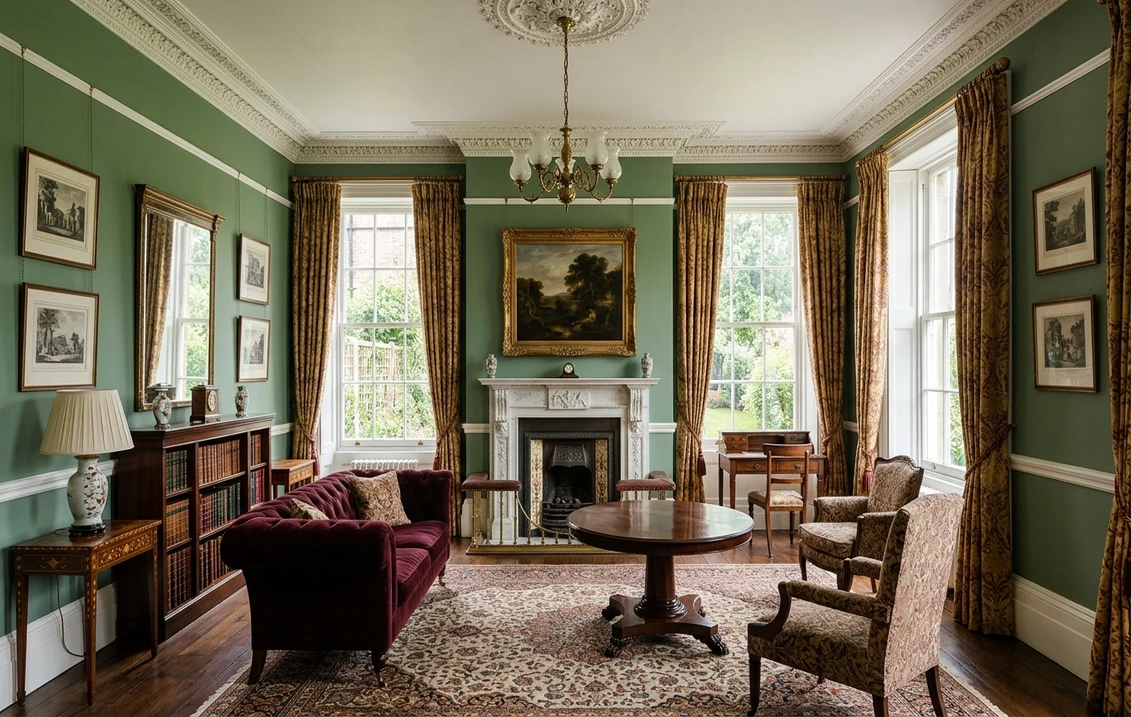
The drawing room is the one space in a British period home where paint does more than decorate: it sets the tone for formal entertaining, flatters a chandelier, and underwrites every gilt picture frame on the wall. Historic England, the Georgian Group and the Victorian Society all caution against the modern brilliant-white default in pre-1914 drawing rooms because it flattens mouldings and kills the depth plasterers spent weeks building. Expect to spend £400 to £980 in materials and labour for a 30 to 40 sqm period drawing room done properly.
This guide covers the authentic historic palettes for Georgian (1714-1830), Regency (1811-1837), Victorian (1837-1901) and Edwardian (1901-1910) drawing rooms, with exact Farrow & Ball, Little Greene and Dulux Heritage codes, chandelier coordination rules, and why heritage eggshell is non-negotiable on the joinery.
For full pricing, see our complete UK cost guide.
Drawing room vs living room: why the distinction matters in 2026
A drawing room is historically the formal reception room into which guests were "drawn" after dinner, distinct from the family living room. In a Georgian or Victorian plan, it sits at the front of the first floor or in the front parlour of a terrace, and carries the most elaborate cornicing, ceiling rose and chimneypiece in the house. Paint specification therefore has to address ornate plaster mouldings, higher ceilings (2.8 to 3.6 m), a central chandelier, and the patina of polished mahogany or walnut furniture.
Treating a period drawing room like a modern open-plan lounge is the single most common mistake in UK interiors: brilliant-white ceilings, cold grey walls and satinwood skirtings will strip out the property's heritage value.
The 15-colour period drawing room palette for 2026
Every shade below is drawn from documented historic ranges: Farrow & Ball Archive, Little Greene National Trust collection, and Dulux Heritage. Codes are the manufacturers' official references so you can order sample pots direct.
| # | Colour | Brand & code | Period | Recommended finish |
|---|---|---|---|---|
| 1 | Card Room Green | Farrow & Ball No.79 | Georgian, Regency | Estate Emulsion |
| 2 | Eating Room Red | Farrow & Ball No.43 | Georgian, Victorian | Estate Emulsion |
| 3 | Dimity | Farrow & Ball No.2008 | Regency, Edwardian | Estate Emulsion |
| 4 | Hague Blue | Farrow & Ball No.30 | Victorian, Edwardian | Modern Emulsion |
| 5 | Wimborne White | Farrow & Ball No.239 | All periods (ceiling/cornice) | Estate Emulsion |
| 6 | Book Room Red | Farrow & Ball No.50 | Georgian | Estate Emulsion |
| 7 | String | Farrow & Ball No.8 | Regency | Estate Emulsion |
| 8 | Pompeian Ash | Little Greene 293 | Regency, Victorian | Intelligent Matt |
| 9 | Regency White | Little Greene | Regency (cornice) | Intelligent Matt |
| 10 | Canton | Little Greene 97 | Georgian | Absolute Matt |
| 11 | Hicks' Blue | Little Greene 208 | Victorian | Absolute Matt |
| 12 | Dulux Heritage Chiswick White | Dulux Heritage DH00212 | All periods (ceiling) | Matt Emulsion |
| 13 | Dulux Heritage Georgian Cream | Dulux Heritage DH00110 | Georgian, Regency | Matt Emulsion |
| 14 | Dulux Heritage Deep Bronze Green | Dulux Heritage DH00205 | Victorian | Heritage Eggshell |
| 15 | Dulux Heritage Soft Cinnamon | Dulux Heritage DH00075 | Edwardian | Matt Emulsion |
Try it on your house
No photo? Try a sample
Georgian drawing rooms (1714-1830)
A Georgian drawing room has the tallest ceilings of any English domestic room: typically 3.0 to 3.6 m, with a deep plaster cornice, central ceiling rose, six-panel doors and 250 to 300 mm skirtings. The authentic 18th-century palette is warmer than most homeowners expect, because 21st-century LED lighting reads colder than the candles and oil lamps the scheme was originally designed around.
Specify one of three canonical Georgian schemes:
- Card Room Green No.79 on walls, Wimborne White No.239 on ceiling and cornice, skirtings and architrave in Estate Eggshell String No.8. The classic Georgian library-drawing room look.
- Book Room Red No.50 on walls, Dulux Heritage Chiswick White DH00212 on ceiling, joinery in eggshell Georgian Cream DH00110 for a softer oxblood scheme.
- Canton from Little Greene on walls, Regency White on ceiling and mouldings. Chinoiserie-adjacent and ideal for rooms with Chinese silk wall hangings or bamboo furniture.
Skirtings should be picked out in a heritage eggshell two shades darker than the wall, never lighter, and never in gloss. Gloss amplifies every imperfection in 18th-century timber and was not used on interior joinery until well into the Victorian period.
One caveat before you carry the scheme through the rest of the house. The Georgian drawing room sat at the top of a deliberate hierarchy and was meant to be the most saturated room on the floor: entrance halls were kept in pale stone or drab, dining rooms in deep ochre because it flattered mahogany and candlelit silver. Repeating Card Room Green in the hall flattens that sequence and the drawing room stops feeling like an arrival. The room-by-room logic, Georgian through Edwardian, is set out in our guide to period property interior colours.
Upload a photo of your drawing room and test all 15 period shades in 30 seconds
Regency drawing rooms (1811-1837)
Regency drawing rooms are lighter, more feminine spaces than their Georgian predecessors: tall sash windows, shallower cornices, and a preference for pale neutrals offset by a single dramatic feature colour (the chimney breast, or an alcove flanking the fireplace). The period's obsession with classical antiquity brought Pompeian reds, Etruscan earths and stone whites into drawing room fashion.
Best 2026 specifications for a Regency drawing room:
- Dimity No.2008 on main walls with Pompeian Ash from Little Greene on the chimney breast. The pale warm white against warm clay creates the textbook Regency balance.
- String No.8 throughout with Regency White picked out on cornice and ceiling rose for a low-contrast scheme that flatters gilded furniture.
- Dulux Heritage Georgian Cream DH00110 on walls with Card Room Green No.79 reserved for the door panels only, a Regency trick that draws attention to the joinery without overwhelming the room.
In a Regency drawing room the cornice is typically smaller and more refined than in a Georgian room, so paint it in the same off-white as the ceiling rather than picking it out in a contrast. This keeps the eye travelling up to the crystal chandelier.
Victorian drawing rooms (1837-1901)
The Victorian drawing room is the most heavily decorated reception room in British architectural history: deeper colours, layered pattern, elaborate ceiling roses, picture rails and heavy mouldings. Ceiling heights vary from 2.7 m in a late Victorian terrace to 3.4 m in a villa. This period embraced saturated crimsons, deep greens, and midnight blues, often accompanied by gilt wallpaper above a dado rail.
Three specification routes that hold up in 2026:
- Eating Room Red No.43 above the dado, Deep Bronze Green DH00205 below, with Wimborne White No.239 on the ceiling and cornice. High-Victorian grandeur, ideal for homes with mahogany furniture.
- Hague Blue No.30 as a full-height drench (walls, door, architrave) with the cornice and ceiling in Chiswick White DH00212. A contemporary take on the 1880s aesthetic movement.
- Hicks' Blue from Little Greene on walls, Regency White above the picture rail and on the ceiling, skirting in Deep Bronze Green DH00205 eggshell. Balances Victorian depth with Regency clarity.
The picture rail is a non-negotiable detail in Victorian drawing rooms. Paint below the picture rail in your main colour (Hague Blue, Eating Room Red, Hicks' Blue) and the frieze above in the ceiling off-white. This makes the ceiling read taller and gives your pictures a properly proportioned field.
Edwardian drawing rooms (1901-1910)
Edwardian drawing rooms reacted against Victorian density with lighter walls, simpler cornicing and classical restraint. Ceilings remain tall (2.7 to 3.0 m) and a marble or timber chimneypiece dominates. The palette favours soft neutrals, warm creams and muted blues.
Two strong Edwardian schemes for 2026:
- Soft Cinnamon DH00075 on walls, Wimborne White No.239 on cornice, ceiling and joinery eggshell. Warm, inviting and flattering to original stripped pine floors.
- Dimity No.2008 on walls, Hague Blue No.30 on door panels and window reveals only. The classic Edwardian "picked-out joinery" look that flatters stained-glass window fanlights.
Ceiling mouldings, cornice and ceiling rose
Plaster mouldings are the defining feature of a period drawing room and they need to be treated as architecture, not decoration. The 2026 consensus among UK period restoration specialists:
- Do not pick out cornice detail in bright white. Mid-20th-century decorators did this and it looks harsh. Use a warm off-white (Wimborne White No.239, Regency White, Chiswick White DH00212) applied at half strength on the cornice to read as a softer tone than the ceiling.
- Ceiling rose same off-white as the cornice. Do not gild it unless you have documentary evidence the original was gilded. Most drawing room roses were painted, not gilded, even in Regency townhouses.
- Avoid coloured cornices except in Victorian rooms with documented original colour schemes. The current fashion for painting the cornice in the wall colour is not period-authentic in Georgian or Regency drawing rooms.
Always use a long-pile mini roller and a small sash brush to cut in around plaster mouldings. Standard-nap rollers clog the detail. Specify heritage matt or Estate Emulsion on the ceiling: any sheen will highlight plaster repairs and cracks.
Coordinating paint with a chandelier
The chandelier or central pendant is the focal point of every period drawing room and the paint scheme has to support it, not compete. Three rules:
- Crystal and clear-glass chandeliers (Georgian, Regency) need a pale ceiling in Wimborne White or Regency White so the crystal catches light and reflects it downwards. Dark ceilings kill crystal.
- Brass and gilt chandeliers (Victorian) sit beautifully against a deeper ceiling. A half-strength Hague Blue ceiling with a gilt 8-arm chandelier is the strongest drawing room ceiling combination in 2026.
- Bronze and painted-metal pendants (Edwardian) work on warm off-white ceilings. Avoid cool greys; they make bronze look dead.
Always switch on the chandelier and wait until dusk before signing off a sample pot. Drawing rooms were designed for evening use, and a colour that reads perfectly at 2 pm in summer can look muddy under candlelight or dimmed LEDs at 7 pm in January.
Why heritage eggshell is mandatory on joinery
Every reputable period decorator in the UK specifies heritage eggshell (not satinwood, not gloss) on skirtings, architraves, door panels and window joinery in a drawing room. Three reasons this is non-negotiable:
- Gloss was not used on interior joinery before the late Victorian period. Painting a Georgian door in gloss is a period-inauthenticity that any surveyor or heritage valuer will note.
- Eggshell hides imperfections in old timber. Pre-1914 skirtings, architraves and doors have movement, nail holes and layers of old paint. Gloss highlights every flaw; eggshell softens them.
- Eggshell can be top-coated in future. Gloss creates a hard shell that is difficult to overpaint without full sanding. Eggshell re-coats cleanly after a light key.
Specify Farrow & Ball Estate Eggshell, Little Greene Intelligent Eggshell, or Dulux Heritage Eggshell. All three offer a 25 to 30 per cent sheen, which is the historically correct level for 18th and 19th-century drawing room joinery.
Cost breakdown for a 30-40 sqm period drawing room (2026)
A typical first-floor drawing room in a Georgian townhouse, Victorian villa or Edwardian terrace measures 30 to 40 sqm of floor area, with 3.0 m ceilings giving 50 to 65 sqm of wall surface. Full decoration includes walls, ceiling, cornice, ceiling rose, skirtings, architraves, two doors (both sides) and window joinery.
| Scope | Paint brand | Materials | Labour (3-4 days) | Total |
|---|---|---|---|---|
| Mid-range heritage scheme | Dulux Heritage | £160-£240 | £240-£380 | £400-£620 |
| Farrow & Ball specification | Farrow & Ball Estate | £280-£380 | £300-£450 | £580-£830 |
| Little Greene specialist | Little Greene Absolute Matt | £300-£420 | £320-£480 | £620-£900 |
| Premium (period decorator, listed building) | Farrow & Ball + F&B Eggshell | £380-£500 | £380-£480 | £760-£980 |
London, Bath, Edinburgh and the Home Counties sit at the upper end of each band; the Midlands, Wales, Yorkshire and Scotland outside Edinburgh tend to 15 to 25 per cent lower. Add £120 to £280 for specialist preparation if the original plaster has cracked cornice sections or flaking lead paint that needs stabilising by a conservation-qualified decorator.
Frequently asked questions
What is the most historically accurate paint colour for a Georgian drawing room?
Farrow & Ball Card Room Green No.79 is the single most specified historically accurate Georgian drawing room colour in the UK. It is drawn from the card rooms of 18th-century country houses and reads as a muted, slightly yellow-based green that flatters mahogany furniture and gilded picture frames. Pair with Wimborne White No.239 on the ceiling and cornice, and String No.8 eggshell on skirtings and architraves for the textbook Georgian scheme.
Should I paint my drawing room cornice in a contrast colour?
In a Georgian or Regency drawing room, no: keep the cornice in the same warm off-white as the ceiling (Wimborne White No.239, Regency White, or Dulux Heritage Chiswick White DH00212), ideally at half-strength to create a softer tonal step. In a high-Victorian drawing room with ornate gilded cornicing you can pick out the detail, but only if there is documentary evidence of an original scheme; modern pick-out work in bright white or gold usually looks dated within five years.
How much does it cost to paint a period drawing room in the UK in 2026?
Budget £400 to £980 for a 30 to 40 sqm period drawing room, depending on paint brand and decorator specialism. A mid-range Dulux Heritage scheme with a general decorator runs £400 to £620. A full Farrow & Ball Estate Emulsion specification with a period decorator runs £580 to £830. A Little Greene Absolute Matt specialist scheme in a listed building, with conservation-grade preparation, runs up to £980. Add 15 to 25 per cent for London, Bath and Edinburgh postcodes.
Why must I use heritage eggshell rather than gloss on period joinery?
Gloss was not used on interior joinery in British homes until the late Victorian period, so painting Georgian or Regency doors and skirtings in gloss is a period-inauthenticity any heritage surveyor will flag. Eggshell (25-30 per cent sheen) is the historically correct finish for pre-1900 drawing room skirtings, architraves and doors. It also hides the movement and nail holes in old timber far better than gloss, which amplifies every imperfection. Specify Farrow & Ball Estate Eggshell, Little Greene Intelligent Eggshell or Dulux Heritage Eggshell.
Can I use Farrow & Ball Hague Blue in a small Victorian drawing room?
Yes, and it is one of the strongest specifications for a small Victorian room because saturated colour on all four walls makes a compact space feel enveloping rather than cramped. Use Hague Blue No.30 as a full colour-drench (walls, door, architrave in eggshell) with Chiswick White DH00212 on the ceiling and cornice. A single gilt or brass chandelier against this scheme catches light beautifully at dusk. Test at sample pot stage on a north-facing wall before committing, as Hague Blue reads noticeably colder in north-facing rooms.
Free - No sign-up - Test Farrow & Ball, Little Greene and Dulux Heritage on your own drawing room photo
A period drawing room repaint that fails to read properly at dusk, with the chandelier lit, is the most expensive mistake in UK interior decorating: a full redo can run £900 or more. Upload a photo of your drawing room to our free AI interior colour visualiser and test all 15 period shades above before you commit to a sample pot. Sources: Farrow & Ball Archive 2026, Little Greene National Trust collection, Dulux Heritage range guide 2026, Georgian Group technical notes, Victorian Society guidance on drawing room decoration.
Trademarks mentioned (Sherwin-Williams, Benjamin Moore, Behr, Caparol, Brillux, Sto, Alpina, Valspar, PPG, Glidden, Dulux, Crown Trade, Sandtex, Farrow & Ball, Johnstone's, Leyland) are property of their respective owners. FacadeColorizer is independent and not affiliated with any of them. Nominative fair use under Lanham Act §1125.