Try it on your room

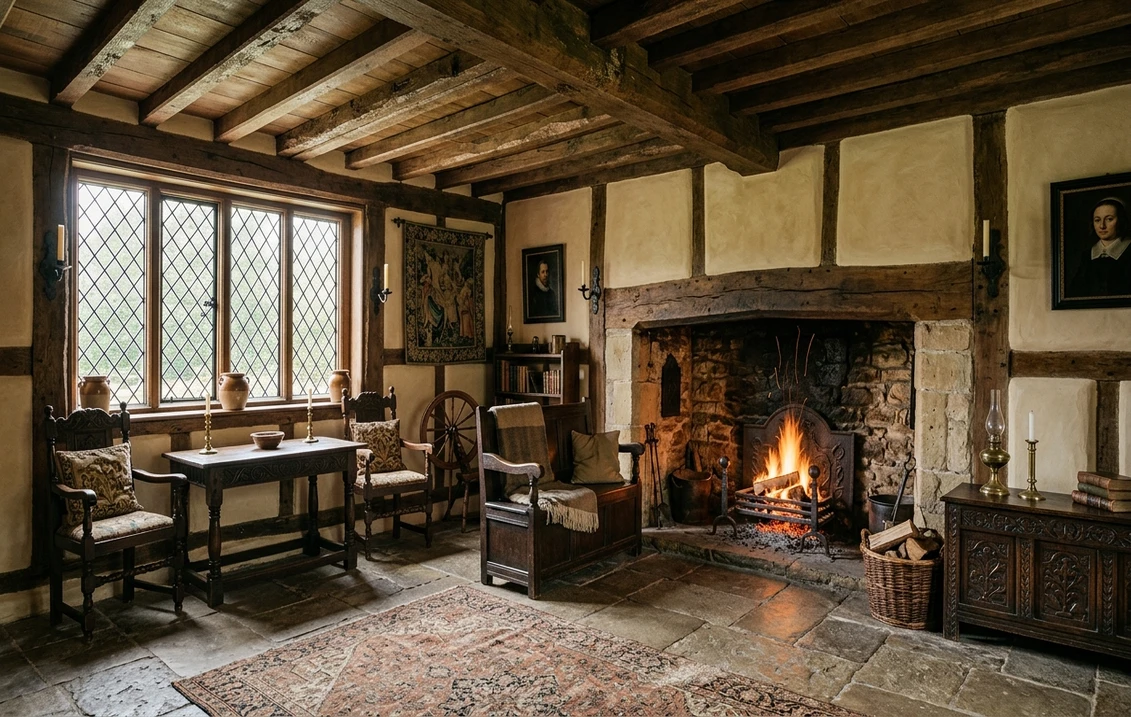
Tudor interiors are two very different beasts in 2026. Authentic Tudor (1485-1603) means hand-adzed oak beams, lime-washed plaster and hand-blocked wallpapers in a small surviving stock of Grade I and Grade II* listed manors. Mock Tudor revival (1900-1940) means stained pine half-timbering, leaded windows and oak panelling in suburban semis from Surrey to Cheshire, and that is the version most British homeowners actually live in.
This guide separates the two clearly: how to colour an authentic Tudor room without wrecking original lath-and-plaster (SPAB lime distemper rules), how to refresh a 1920s-30s Mock Tudor lounge in cream, buff and Tudor red without it looking like a Toby Carvery, and where Farrow & Ball, Edward Bulmer and Earthborn fit into a period-correct palette.
For full pricing, see our complete UK cost guide.
Before you commit to Mahogany 36 on a beam or Eating Room Red 43 on a front door, try our free AI interior colour visualiser to test heritage shades on your own panelling, plaster and timber before buying sample pots.
Authentic Tudor (1485-1603) versus Mock Tudor revival (1900-1940)
The two periods are separated by 300 years and produce very different rooms. Confusing them is the most common reason a heritage scheme falls flat.
An authentic Tudor interior uses dark, irregular oak frames blackened by 400 years of smoke and beeswax, lime-washed plaster panels in soft off-whites, and hand-blocked wallpapers (introduced late, around 1509). Floors are limestone, oak boards or tile. Light is low and yellow because windows are small and leaded. The walls breathe, solid masonry, no cavity, no DPC.
A Mock Tudor revival interior from the 1920s-30s uses sawn pine half-timbering stained dark to look like aged oak, machine-leaded windows, plaster between beams in cream or buff (rarely true off-white), Tudor-red front doors, and oak-effect panelling to dado or picture-rail height. These are masonry-cavity construction with a damp-proof course and chimney breasts that already accept modern emulsion happily.
How to tell which you have
- Beams, irregular hand-adzed marks, pegged mortice joints and live edges = authentic. Sawn-square section, machine-cut, no pegs and identical spacing = Mock Tudor.
- Plaster, soft, slightly undulating, with horsehair visible at chips = pre-1850 lath-and-plaster. Flat, hard, pinkish backing = 20th-century gypsum.
- Walls, solid stone or brick with no cavity tie marks = pre-1850. Cavity wall with regular tie courses = post-1900.
- Windows, small irregular leaded panes set deep in stone mullions = Tudor. Larger, regular leaded panes in steel or timber casements = revival.
- Listed status, Grade I, II* or II almost always = authentic Tudor. Unlisted in a 1920s-30s suburb = Mock Tudor.
If your house is listed, jump to the SPAB and Listed Building Consent section before painting anything. If it is unlisted Mock Tudor, you have far more freedom, keep reading the revival palette below.
Authentic Tudor palette: dark oak, lime-washed plaster, hand-blocked walls
An authentic Tudor scheme rests on three layers: dark exposed beams, lime-washed plaster in soft off-white, and hand-blocked or document wallpaper for principal rooms. Modern emulsion has no place on original 16th-century lath-and-plaster, it traps moisture and the plaster fails behind the paint within five to ten years.
Beams: Mahogany Brown territory
Original Tudor oak beams are almost never black. Centuries of beeswax, candle soot and tannin produce a deep warm brown-black, closer to Farrow & Ball Mahogany 36 than to true black. Avoid the temptation to slap on Tar Black or matt black emulsion, it reads Mock Tudor pastiche, not 1530.
For new or stripped beams, finish with a beeswax-and-turpentine paste or a hard wax oil over a Mahogany-toned stain. Edward Bulmer's Jacobean Brown is also period-correct. Never use modern PU varnish, it goes plastic-shiny within a year and is impossible to reverse on a listed building without specialist stripping.
Plaster panels: Joa's White, Wimborne White, lime distemper only
Between the beams, lime-washed plaster reads as a soft chalky off-white. The closest modern equivalents are Farrow & Ball Joa's White 226 (warm, slightly pink-cream) and Wimborne White 239 (cooler, marginally greener). Both should be specified in limewash, lime distemper or soft distemper on pre-1850 walls, never modern vinyl or acrylic emulsion.
If you want a brand-new tin product that is period-friendly, Earthborn ClayPaint is breathable enough for most listed interiors and comes in heritage-friendly off-whites. For a stricter SPAB-compliant finish, source true lime distemper from Rose of Jericho, Mike Wye or Cornish Lime.
Hand-blocked papers in principal rooms
For grand parlours and great chambers, late-Tudor and Jacobean hand-blocked wallpapers (Adelphi, Hamilton Weston, Watts of Westminster) are the period-correct alternative to plain plaster. Pomegranate and oak-leaf motifs in deep red or sage on a buff ground sit comfortably with original beams without competing with leaded glass.
Test Mahogany, Joa's White and Eating Room Red on your own room - free, no signup
Mock Tudor revival palette: cream, buff, Tudor red, oak panelling
A 1920s-30s Mock Tudor lounge is built around four elements: stained pine half-timbering, cream or buff plaster between beams, a Tudor-red front door, and oak-effect panelling or wood-panel half-walls in the hallway and dining room. Each pulls a specific shade family.
Plaster between revival beams: Slipper Satin and Bone
Authentic Tudor plaster reads white-cream; revival plaster, by 1925, was deliberately more buff and yellow to look "cosier". The two cleanest matches in 2026 are Farrow & Ball Slipper Satin 2004 (warm soft cream, very forgiving in north-light rooms) and Farrow & Ball Bone 15 (deeper buff, ideal where beams are darker stained).
Both work in modern matt emulsion because revival walls are gypsum-plastered cavity construction, there is no SPAB issue here. Use a slightly chalky 2% sheen rather than a high-vinyl finish so the plaster between beams does not look plasticky.
Tudor red front door: Eating Room Red, Picture Gallery Red
The signature Mock Tudor front door colour is a deep oxblood red. Two Farrow & Ball shades nail it: Eating Room Red 43 (slightly browner, more historically accurate) and Picture Gallery Red 42 (cleaner, slightly cooler, more late-Victorian feel). Apply in eggshell or full gloss for the period look. Inside, the same red works on a study door, a dining-room feature wall or the back of a bookcase.
Oak panelling and wood-panel half-walls
Revival oak panelling and dado-height wood panelling should be left waxed where the timber is good, or finished in a Mahogany or Jacobean stain where the original veneer has gone patchy. Painting it white is reversible but rarely sympathetic, once stripped, the soft pine underneath rarely looks period.
For wall-above-panelling in a Mock Tudor dining room, Farrow & Ball Bone 15 or Edward Bulmer Drab sits comfortably with stained oak without going cold.
Era palette table: authentic Tudor vs Mock Tudor revival
Six period-correct colours per era, with the room each one suits and a brand reference. Use this as a quick spec sheet rather than a fashion list.
| Era | Colour | Best room | Brand reference |
|---|---|---|---|
| Authentic Tudor (1485-1603) | Mahogany Brown | Beams, ceiling joists | F&B Mahogany 36 |
| Joa's White (limewash) | Plaster panels, great chamber | F&B Joa's White 226 | |
| Wimborne White (limewash) | Bedrooms, north-light parlours | F&B Wimborne White 239 | |
| Jacobean Brown (beeswax) | Wood-panel half-walls | Edward Bulmer Jacobean Brown | |
| Pomegranate Red (block paper) | Principal parlour | Hamilton Weston / Adelphi | |
| Sage / Verdigris | Solar (private chamber) | Edward Bulmer Verdigris | |
| Mock Tudor revival (1900-1940) | Slipper Satin | Plaster between beams, lounge | F&B Slipper Satin 2004 |
| Bone | Dining room above panelling | F&B Bone 15 | |
| Eating Room Red | Front door, study | F&B Eating Room Red 43 | |
| Picture Gallery Red | Feature wall, bookcase backs | F&B Picture Gallery Red 42 | |
| Mahogany (woodwork stain) | Half-timbering, panelling | F&B Wood Panel range | |
| Drab | Hallway, snug | Edward Bulmer Drab |
Try it on your room
No photo? Try a sample
SPAB lime distemper rule for pre-1850 walls
The single biggest mistake on an authentic Tudor interior is using modern oil-based or vinyl emulsion on original lath-and-plaster. The Society for the Protection of Ancient Buildings (SPAB) is unambiguous: pre-1850 walls were built to breathe, and a sealing modern paint causes failure within a decade.
Why oil and vinyl paints fail original plaster
- Trapped moisture, solid stone walls absorb seasonal damp, and lath-and-plaster is designed to release it back through the surface. A vinyl film stops the vapour, the plaster softens behind the paint, and the whole skim sheets off in patches after five to ten years.
- Salt blooming, historic plasters contain free lime and natural salts. Sealed under modern paint, salts crystallise behind the film and lift it like blistering wallpaper.
- Lath rot, riven oak laths behind the plaster need to dry between damp seasons. Sealing the front face is one of the fastest routes to lath failure and a six-figure plastering bill on a listed building.
What to specify instead
For pre-1850 walls, specify in this order of preference: limewash (most authentic, requires several coats), lime distemper (chalky, traditional, soft to the touch), soft distemper (used historically on ceilings), or Earthborn ClayPaint as a modern breathable compromise where a tin-product finish is needed. Avoid Farrow & Ball Modern Emulsion and any vinyl, acrylic or alkyd emulsion on original plaster.
Listed Building Consent: Grade I, II* and II
If your authentic Tudor home is listed, internal redecoration is not always exempt from consent. The threshold depends on grade and on what you are touching.
- Grade I (about 2.5% of listed buildings), almost any change to historic fabric needs Listed Building Consent (LBC), including stripping paint from beams, applying modern emulsion to original plaster, or removing wood panelling.
- Grade II* (about 5.5%), similar regime to Grade I; consent required for material changes to character.
- Grade II (about 92%), like-for-like redecoration in matching materials usually does not need consent, but stripping panelling, exposing or removing beams, or replacing lath-and-plaster with plasterboard certainly does.
Apply via your local conservation officer or the planning portal. Decisions take eight weeks. Working without consent is a criminal offence and can carry an unlimited fine.
Room-by-room scheme suggestions
Mock Tudor lounge with exposed half-timbering
Beams stained Mahogany, plaster between in Slipper Satin 2004, oak panelling waxed natural, leaded windows kept original, soft furnishings in deep ochre and sage. A single accent wall behind the fireplace in Eating Room Red 43 stops the room going chocolate-box.
Mock Tudor dining room with full panelling
Panelling waxed or stained Jacobean Brown, walls above in Bone 15, ceiling in Slipper Satin, a Tudor-rose pattern carpet or a plain wool runner. Brass picture lights warm the panelling at night.
Authentic Tudor great chamber
Beams left in their original beeswax patina (do not over-restore), plaster panels in lime distemper to Joa's White 226, hand-blocked Adelphi paper on the chimney breast, oak boards waxed not lacquered. Small lamps rather than big pendants, because the room was never lit by chandelier.
F&B, Edward Bulmer and Earthborn shades on your own Tudor or Mock Tudor room
Frequently asked questions
What is the right black for Tudor beams: should I use matt black emulsion?
No. Original Tudor oak beams are not black, they are a deep warm brown-black built up by centuries of beeswax, candle smoke and oak tannin. The closest modern match is Farrow & Ball Mahogany 36 or Edward Bulmer Jacobean Brown, applied as a stain or wash and finished with a beeswax-and-turpentine paste. Matt black emulsion reads instantly as Mock Tudor pastiche and is a tell-tale sign that beams have been over-painted in the last few decades. On a listed building, painting beams matt black would also typically need Listed Building Consent and risks a reinstatement order.
Can I use Farrow & Ball Modern Emulsion on original Tudor lath-and-plaster?
No. SPAB guidance is unambiguous: pre-1850 walls were built to breathe, and modern vinyl or acrylic emulsions seal the surface, trap moisture and cause the historic plaster to fail within five to ten years. On original Tudor lath-and-plaster you should use limewash, lime distemper or soft distemper. Where a tin-product finish is needed, Earthborn ClayPaint is the most breathable mainstream option. Farrow & Ball Estate Emulsion is more breathable than Modern Emulsion but still not recommended for original plaster on a Grade I or II* listed Tudor home.
Do I need Listed Building Consent to repaint a Grade II Tudor interior?
Like-for-like repainting in the same materials (limewash to limewash, distemper to distemper) on a Grade II property usually does not require Listed Building Consent. However, you do need consent for any change that affects historic fabric or character, including stripping paint from original beams, replacing lath-and-plaster with plasterboard, removing or altering wood panelling, or switching from limewash to a sealing modern paint. Always check with your local conservation officer before starting. For Grade I and Grade II* almost any meaningful change needs consent, and unauthorised work is a criminal offence.
What is the difference between Eating Room Red 43 and Picture Gallery Red 42 for a Tudor door?
Both are correct period reds, but they read differently. Eating Room Red 43 is slightly browner and more historically accurate for a 1920s-30s Mock Tudor front door, it sits warmly with stained oak half-timbering and cream plaster. Picture Gallery Red 42 is cooler, slightly cleaner and reads more late-Victorian or Edwardian; it works well on internal feature walls, bookcase backs and study doors where you want a sharper, more formal red. Both look best in eggshell or full gloss; matt finishes flatten the depth of pigment that makes these reds distinctive.
A successful Tudor or Mock Tudor scheme starts with knowing which one you have, then matching the paint chemistry to the wall behind it, limewash on original plaster, modern emulsion on 1920s gypsum. Test Mahogany 36, Joa's White 226, Slipper Satin 2004 and Eating Room Red 43 on your own room with our free AI interior colour visualiser before buying sample pots. Sources: SPAB, Historic England, Farrow & Ball, Edward Bulmer Natural Paint, Earthborn.
Trademarks mentioned (Sherwin-Williams, Benjamin Moore, Behr, Caparol, Brillux, Sto, Alpina, Valspar, PPG, Glidden, Dulux, Crown Trade, Sandtex, Farrow & Ball, Johnstone's, Leyland) are property of their respective owners. FacadeColorizer is independent and not affiliated with any of them. Nominative fair use under Lanham Act §1125.