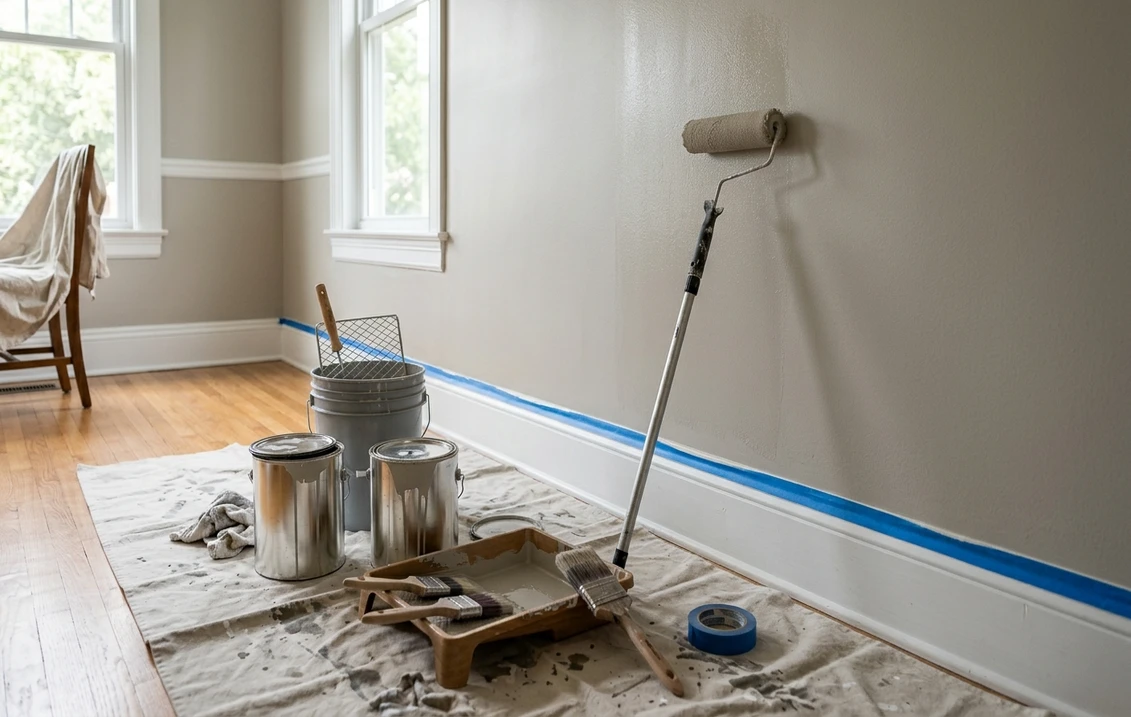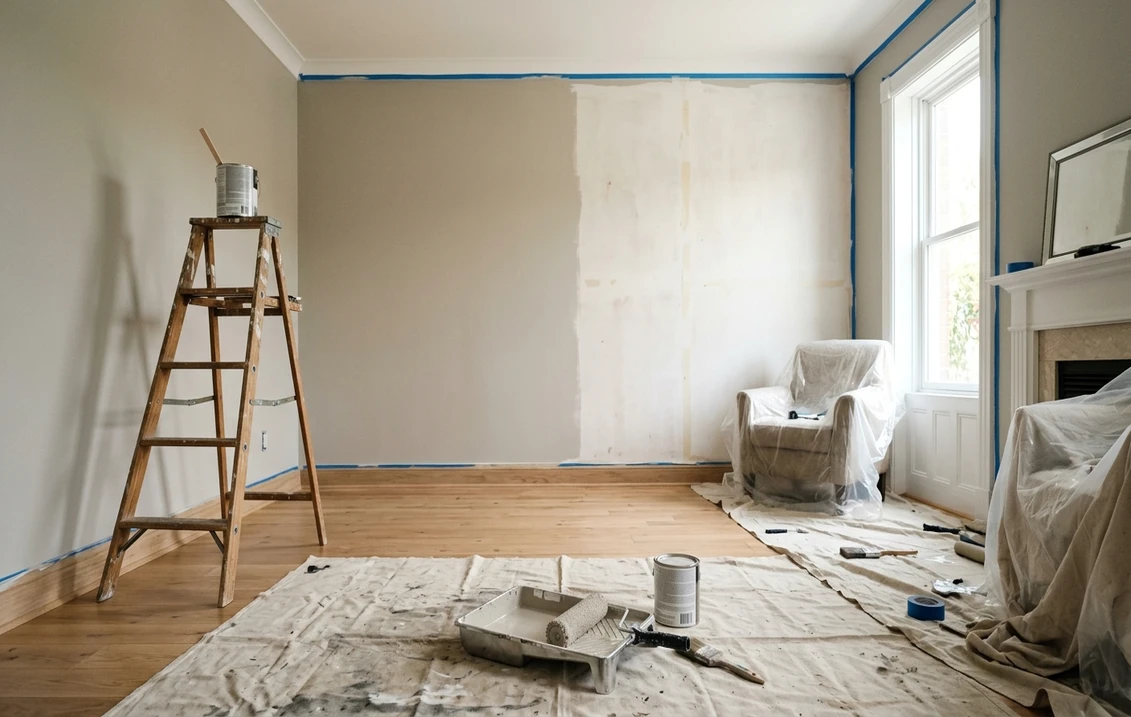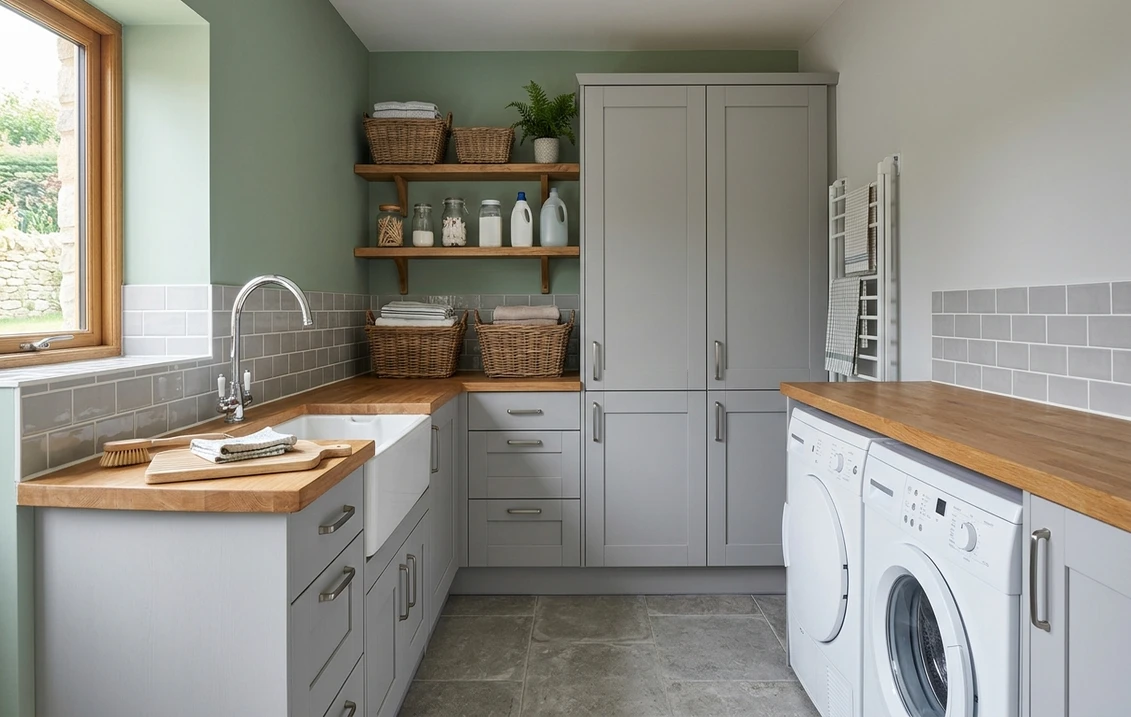
Try it on your room

According to the Federation of Master Builders Home Use Survey 2026, the average British utility or boot room handles 17 kilograms of muddy coats, dog towels and wet wellies every week and absorbs the vibrations of a washing machine running 4-6 cycles. Paint a back-of-house room in standard matt emulsion and the bottom half of the wall will be scuffed, splattered and patched within a single winter. Specify a scrubbable eggshell in a splatter-hiding mid-grey, and the same colour will still look sharp when the next Labrador arrives.
This guide covers the 15 best utility and boot room paint colours in the UK for 2026, built around Farrow & Ball's Mole's Breath, Ammonite, Purbeck Stone, Cornforth White and Dimpse, Little Greene's Slaked Lime and French Grey, and Dulux Heritage Wadsworth Grey. All are specified in scrubbable eggshell or satin, with darker shades dropped onto the lower wall panel to hide the splashes a washing machine, welly rack and coat hook row will inevitably create.
For full pricing, see our complete UK cost guide.
The 15 best utility and boot room paint colours UK 2026
The shortlist below pairs each colour with the paint base it performs best in. Every shade has been tested in real British utility rooms and boot rooms with dogs, children, wellies and vibrating white goods; all are specified in washable eggshell or satin rather than matt, because back-of-house rooms punish emulsion more than any other space in the house.
| # | Colour & brand | Code | Best for | Recommended base |
|---|---|---|---|---|
| 1 | Farrow & Ball Mole's Breath | No.276 | Lower panel, boot benches | F&B Modern Eggshell |
| 2 | Farrow & Ball Ammonite | No.274 | Upper walls, ceilings | F&B Modern Emulsion |
| 3 | Farrow & Ball Purbeck Stone | No.275 | Walls, butler sinks | F&B Modern Emulsion |
| 4 | Farrow & Ball Cornforth White | No.228 | North-facing walls | F&B Modern Emulsion |
| 5 | Farrow & Ball Dimpse | No.277 | Small utility rooms | F&B Modern Emulsion |
| 6 | Little Greene Slaked Lime | No.105 | Upper walls, ceilings | Little Greene Intelligent Matt |
| 7 | Little Greene French Grey | No.113 | Panelling, cabinets | Little Greene Intelligent Eggshell |
| 8 | Dulux Heritage Wadsworth Grey | DH 00YY 30/092 | Lower panel, joinery | Dulux Heritage Eggshell |
| 9 | Farrow & Ball Down Pipe | No.26 | Boot benches, dado | F&B Modern Eggshell |
| 10 | Little Greene Scree | No.227 | Lower panel, skirting | Little Greene Intelligent Eggshell |
| 11 | Farrow & Ball Pigeon | No.25 | Cupboards, coat cubbies | F&B Modern Eggshell |
| 12 | Dulux Heritage Lead White | DH 00NN 72/000 | Ceilings, high walls | Dulux Heritage Matt |
| 13 | Farrow & Ball Studio Green | No.93 | Welly cupboards, dog zones | F&B Modern Eggshell |
| 14 | Little Greene Rolling Fog Dark | No.160 | Lower panel, dado | Little Greene Intelligent Eggshell |
| 15 | Dulux Trade Diamond Eggshell Goose Down | DT 10YY 63/043 | Budget utility walls | Dulux Trade Diamond Eggshell |
Try it on your house
No photo? Try a sample
Upload a photo of your utility or boot room and test Mole's Breath, Ammonite or Purbeck Stone in seconds
The five colours every British utility room gets right in 2026
Five shades dominate British utility and boot room briefs this year because they share the same quiet, splatter-hiding quality that flatters stone-flagged floors, oak coat pegs and stainless steel white goods at once: Mole's Breath, Ammonite, Purbeck Stone, Cornforth White and Dimpse.
Farrow & Ball Mole's Breath No.276
A deep, slightly purple-leaning mid-grey that is the UK decorator's first choice for the lower wall panel of a boot room. Dropped onto the bottom 1.1m of the wall, it disappears welly splashes, mud marks and the inevitable scuffs from a laundry basket. Specify in F&B Modern Eggshell for full wipeability. Pairs beautifully with Ammonite or Cornforth White above a simple dado rail.
Farrow & Ball Ammonite No.274
A soft, warm-neutral grey with a near-beige undertone that sits between Cornforth White and Purbeck Stone. Ammonite is the go-to for the upper wall above a dark-grey panel: it lifts the room, bounces daylight from a utility-room window or rooflight, and never pulls blue the way cooler greys do under warm-white LED strips.
Farrow & Ball Purbeck Stone No.275
A slightly darker, warmer step from Ammonite, Purbeck Stone reads as a confident mid-grey without tipping into stormy territory. It is particularly good as a whole-room shade in utility rooms with butler sinks and pale stone floors; the tonal depth hides everyday splashes and keeps the room feeling grounded rather than clinical.
Farrow & Ball Cornforth White No.228
The quietest of F&B's "architectural neutrals", Cornforth White is a cool, dusty off-white that behaves beautifully in north-facing utility rooms. It never reads cold because of a subtle warm undertone, and it is the default upper-wall partner for Mole's Breath, Purbeck Stone and Down Pipe below.
Farrow & Ball Dimpse No.277
A pale silvery grey that reads as light-neutral in daylight and softly blue-grey under tungsten. Dimpse is the best choice for a tiny utility cupboard or boot cupboard where you cannot commit to a full panel scheme: paint all four walls, ceiling and joinery in Dimpse in Modern Eggshell, and the space feels larger, cleaner and distinctly less like a tacked-on understairs.
Why scrubbable eggshell and satin beat matt emulsion in a utility room
Utility and boot rooms are the single most abused rooms in a British house. The bottom half of every wall gets hit by mud, grit, dog hair, dripping coats, laundry basket corners and the occasional kicked wellie. Standard matt emulsion has no wipeable film; try to clean a splash off matt emulsion and the sponge will polish the sheen into a visible shiny patch, or lift the paint entirely.
The correct specification is a scrubbable eggshell (15-25% sheen) or satin (20-35% sheen) on the lower half of the wall, with a scrubbable matt (7-12% sheen) above dado height and on the ceiling. The four UK-specified bases are:
- Farrow & Ball Modern Eggshell - 40% sheen, wipeable, Class 1 scrub, all F&B shades available. The designer default.
- Little Greene Intelligent Eggshell - water-based, fully washable, 10,000-cycle scrub rating, low odour. £42-£46 per 2.5L.
- Dulux Heritage Eggshell - water-based eggshell with Dulux Heritage colour palette, Class 1 scrub. £36-£42 per 2.5L.
- Dulux Trade Diamond Eggshell - the trade budget standard, 10,000-cycle scrub, stain-block additives. £28-£34 per 2.5L.
Specify any of the above and you can wipe welly marks off with a damp microfibre cloth for the full 10-year life of the paint film. Specify standard trade matt and you will be patch-painting the bottom 1.1m of the wall every spring.
The split-panel scheme: splatter-hiding dark below, light above
The single most robust utility room scheme in the UK is a two-tone split panel: a darker splatter-hiding shade on the bottom 1.1m of the wall, a lighter shade above. The change is usually marked by a simple dado rail or a tongue-and-groove panel cap. It serves four practical purposes at once:
- Hides splashes: mud, dog water and laundry detergent splatters read as texture, not stains, on a mid-grey or green.
- Protects against impact: eggshell on the lower panel resists scuffing from laundry baskets, wellies and vacuum cleaners.
- Bounces light: the paler upper shade lifts a typically small back-of-house room.
- Hides messy cable runs: a darker panel disguises the sockets and washing machine cabling that cluster around skirting height.
The most reliable UK combinations in 2026 are Mole's Breath below with Ammonite above, Down Pipe below with Cornforth White above, Studio Green below with Slaked Lime above and Scree below with Dimpse above. All four pair a scrubbable eggshell on the lower panel with a washable matt on the upper wall and ceiling.
Dado height: where to stop the dark shade
Traditional dado height in a British utility room is 1.050m to 1.150m above finished floor level, which aligns with the top of most laundry-basket impacts and the back rail of a standard coat bench. Above 1.2m the dark panel starts to dominate the room and close it in; below 0.95m it reads as an accidental skirting extension.
That is a functional line, set by impacts rather than by history. Its decorative ancestor sits slightly lower: Georgian wainscoting runs to a dado rail at roughly 90 to 110 cm, which is why a boot room panel copied straight off a period dining room often looks a touch short behind a washing machine. If you want the historic proportions and the deep shades that go with them, our dining room colour guide covers the panelled half-wall in its original setting.
Coat hook and peg rail coordination
The second practical decision after the split panel is how the coat hook row reads against the wall. Three UK-specified approaches work:
- Painted-out peg rail: paint the rail and hooks the same colour as the lower panel (Mole's Breath, Down Pipe or Studio Green). Coats read as the feature, the rail disappears. The default Shaker-style approach.
- Contrast peg rail: paint the rail in Little Greene French Grey No.113 or F&B Pigeon No.25 against an Ammonite or Cornforth White wall. Reads as a calm feature; the cast-iron or aged-brass hooks sit against it cleanly.
- Timber peg rail: oiled oak or beech rail on a painted wall. The most forgiving option for a household that switches coats seasonally; knocks and scratches patina rather than chip.
Install the rail at 1.65m to 1.75m above floor level for adults; add a second row at 1.35m for children if the family uses the room daily.
Washing machine vibration and paint film integrity
A 1400rpm spin cycle transmits low-frequency vibration through the floor and into any wall the machine is pushed against. Over five years, those vibrations will open hairline cracks in the paint film at the junction between wall and skirting, and at the top corners of any timber-framed cupboard behind the machine. Three specifications reduce the risk:
- Flexible decorator's caulk (Everbuild Painters Mate, Geocel The Works) applied to every wall-to-skirting and wall-to-architrave junction before painting. Rigid filler will crack; caulk flexes.
- Anti-vibration feet on the washing machine (£8-£15 a set on Amazon). Reduces transmitted vibration by 60-80%, which is the single biggest structural favour you can do the paint film.
- Elastomeric primer (Zinsser Peel Stop or Bull's Eye 1-2-3) on any hairline-cracked wall behind the machine before top-coating. Bridges movement that rigid primers cannot.
Leave a 20-30mm air gap between the back of the machine and the wall so the vibration cannot transfer directly; the gap also allows condensation behind the drum to dry rather than soak into plaster.
Ventilation: the quiet requirement no one reads
A tumble dryer vented internally, or a washing machine drying coats draped on a clothes airer, dumps 2-4 litres of water vapour into the room per cycle. Without adequate extract, that moisture condenses onto cool north-facing walls and the upper corner of the room, and black mould spotting appears within two winters regardless of paint choice.
UK Building Regulations Approved Document F requires a utility room to have either an openable window of at least 1/20th of the floor area, or an extract fan rated at 30 litres per second intermittent or 8 l/s continuous. A condensing tumble dryer plumbed to the drain solves most of the problem; an internally-vented tumble dryer without a separate extract fan will eventually defeat any paint system.
How much does it cost to repaint a UK utility room in 2026?
A standard UK utility or boot room (around 15-22 m2 of wall area plus 5 m2 of ceiling, including panelling and cupboards) costs between £150 and £320 to repaint in 2026, depending on whether you DIY or hire a decorator, and whether you specify a trade eggshell or a designer split-panel scheme.
| Scenario | Typical cost | Includes |
|---|---|---|
| DIY, Dulux Trade Diamond Eggshell single colour | £60-£95 | 2.5L eggshell, ceiling matt, rollers, caulk |
| DIY, Dulux Heritage split panel | £120-£170 | 2.5L Wadsworth Grey, 2.5L Lead White, dado rail |
| DIY, F&B or Little Greene split panel | £170-£230 | F&B Mole's Breath, Ammonite, Modern Eggshell + Emulsion |
| Decorator, trade eggshell system | £180-£240 | Prep, caulking, ceiling, walls, 1 day labour |
| Decorator, F&B or Little Greene split panel | £250-£320 | Designer paint, dado rail, 2 coats eggshell on joinery |
A utility room repainted in scrubbable eggshell lasts 8-12 years in a typical British family home; the same room in standard matt emulsion usually needs patching within 18 months. Spending the extra £60-£90 on eggshell rather than matt pays back at least fivefold over the life of the scheme.
Frequently asked questions
What is the most durable paint for a UK utility room in 2026?
For the lower wall panel, specify a scrubbable eggshell: Farrow & Ball Modern Eggshell, Little Greene Intelligent Eggshell, Dulux Heritage Eggshell or Dulux Trade Diamond Eggshell. All four carry Class 1 scrub ratings and wipe clean with a damp cloth. Above dado height, a scrubbable matt such as Dulux Easycare or Little Greene Intelligent Matt is perfectly adequate; the wear zone is the bottom 1.1m of the wall.
What colour hides splashes best in a boot room?
Mid- to deep-grey shades with enough pigment depth to absorb visible splatter: Farrow & Ball Mole's Breath No.276, Down Pipe No.26 and Studio Green No.93 are the three UK defaults. Dropped onto the lower 1.1m of the wall in Modern Eggshell, they read as architectural panelling, not as stained paint, even after a winter of muddy dogs and wet coats. Pair with Ammonite, Cornforth White or Slaked Lime above.
Can I paint the walls behind my washing machine the same as the rest of the room?
Yes, but prepare the substrate for vibration. Caulk every wall-to-skirting junction with flexible decorator's caulk, fit anti-vibration feet to the machine, and leave a 20-30mm gap between machine and wall. If the existing paint shows hairline cracking behind the machine, prime with an elastomeric primer such as Zinsser Peel Stop before top-coating in scrubbable eggshell. Without those three steps, a 1400rpm spin cycle will crack the paint film along skirting lines within five years.
How much does it cost to repaint a UK utility room in 2026?
Expect to pay £150-£320 depending on specification. A DIY single-colour trade eggshell repaint costs £60-£95; a full F&B or Little Greene split-panel scheme done by a decorator, including dado rail and caulking, costs £250-£320. The mid-range option most British homeowners choose is a Dulux Heritage split panel (Wadsworth Grey below, Lead White above) for around £170 DIY or £240 with a decorator.
Test Mole's Breath, Ammonite, Purbeck Stone and Dimpse on your own utility room photo
A British utility room that still looks sharp in 2035 comes from three choices: a splatter-hiding mid-grey on the lower 1.1m panel (Mole's Breath, Down Pipe or Studio Green), a light-reflecting warm neutral above (Ammonite, Cornforth White or Slaked Lime), and scrubbable eggshell on every wear surface. Sources: Federation of Master Builders Home Use Survey 2026, Approved Document F, Farrow & Ball, Little Greene, Dulux Heritage, Dulux Trade.
Trademarks mentioned (Sherwin-Williams, Benjamin Moore, Behr, Caparol, Brillux, Sto, Alpina, Valspar, PPG, Glidden, Dulux, Crown Trade, Sandtex, Farrow & Ball, Johnstone's, Leyland) are property of their respective owners. FacadeColorizer is independent and not affiliated with any of them. Nominative fair use under Lanham Act §1125.