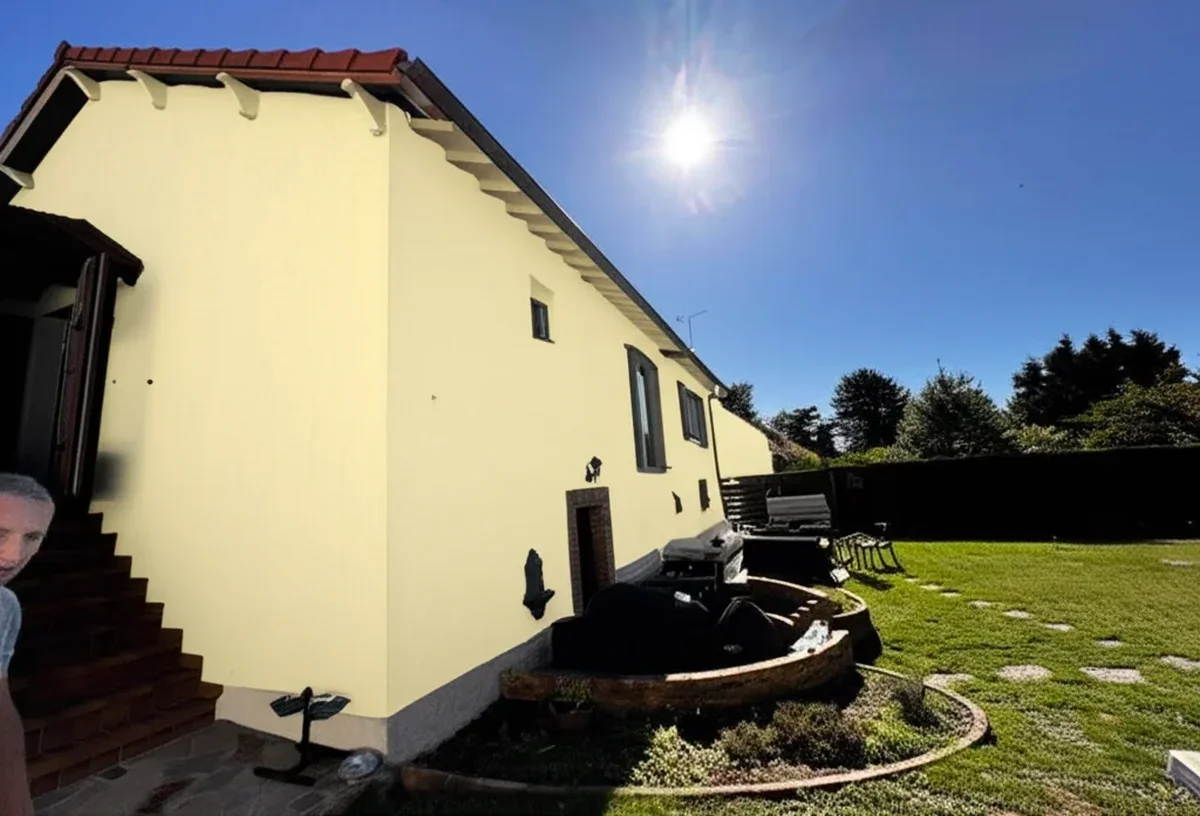
Thinking about rendering your house exterior? Whether you want to modernise a tired pebble-dash semi or protect a new-build with a premium silicone finish, understanding 2026 rendering costs is essential for budgeting. Prices vary enormously depending on the render type, property size, and your region — a traditional cement job on a bungalow can cost under £3,000, whilst a full silicone system on a detached house can exceed £10,000.
This guide breaks down real 2026 prices per m² for every render type, compares the leading brands, and explains when you need planning permission. Before choosing a finish colour, try our free AI colour visualiser to see exactly how your home will look with a new render — no samples needed.
Rendering Costs per m² by Type
The render system you choose is the single biggest factor in overall cost. Here are the average UK prices for 2026, including materials, labour, and scaffolding:
| Render Type | Cost per m² (Installed) | Lifespan | Best For |
|---|---|---|---|
| Traditional cement | £40 – £80 | 20–30 years | Budget renovations |
| Monocouche (K Rend, Weber) | £55 – £90 | 25–35 years | New builds, extensions |
| Acrylic | £70 – £110 | 25–30 years | Colour variety, smooth finish |
| Silicone | £75 – £120 | 30–40 years | Damp climates, low maintenance |
| Lime (heritage) | £60 – £95 | 50+ years | Period properties, listed buildings |
| EWI system (insulated) | £90 – £150 | 25–35 years | Energy efficiency upgrade |
Total Project Costs by Property Type
These figures include scaffolding (£600–£2,200 depending on property height and access), materials, and labour at average UK rates:
| Property | Approx. Wall Area | Cost Range | Duration |
|---|---|---|---|
| 2-bed bungalow | ~60–100 m² | £2,500 – £3,500 | 4–6 days |
| 3-bed semi-detached | ~80–120 m² | £4,200 – £9,000 | 6–9 days |
| 4-bed detached | ~150–300 m² | £6,700 – £10,000+ | 7–14 days |
💡 Expert tip
Labour rates vary significantly by region. Renderers in London charge £220–£300 per day, whilst rates in the North of England, Wales, and Scotland are £160–£210 per day. Get at least three quotes and check reviews on Checkatrade or MyBuilder before committing.
Render Types Explained
Traditional cement render is the most affordable option — a two-coat sand-and-cement mix applied by hand, then painted with masonry paint. It is durable and well-understood by most tradespeople, but requires repainting every 5–8 years. Popular masonry paints include Dulux Weathershield (~£27/5L, 15-year guarantee), Sandtex Trade High Cover (~£27/5L), and the premium Emperor Masonry Paint (~£69/5L with a 25+ year lifespan).
Monocouche render (single-coat, through-coloured) from brands like K Rend and Weber is the most popular choice for new builds and extensions. Applied in one coat with a scratched finish, it does not need painting — the colour runs through the entire thickness. K Rend costs £30–£70/m², whilst Weber is £25–£65/m² and is often preferred by tradespeople for its workability and long-term colour retention.
Silicone render is the premium option for the UK's damp climate. Its hydrophobic surface repels water and has self-cleaning properties — rain washes dirt away naturally. It is more crack-resistant than monocouche, offers a smoother finish, and lasts 30–40 years. The higher upfront cost (£75–£120/m²) is offset by virtually zero maintenance.
Lime render is the go-to choice for period properties and listed buildings. It is breathable, flexible, and compatible with older construction methods. Heritage projects often require lime render to satisfy conservation officers. Expect to pay £60–£95/m², and ensure your renderer has specific lime experience — it requires different skills to cement-based systems.
Planning Permission and Regulations
In most cases, rendering your house falls under permitted development rights, meaning no planning permission is needed. However, you will need formal approval if:
- Your property is in a conservation area, national park, or Area of Outstanding Natural Beauty (AONB)
- Your house is listed (Grade I, II*, or II) — listed building consent is required
- The render materials differ significantly in appearance from the existing exterior
- You are adding external wall insulation (EWI) that extends more than 50mm beyond the original wall face
Always check with your local planning authority before starting work. Even where permission is not required, Building Regulations may apply if you are adding insulation or altering the thermal performance of the walls.
How to Get the Best Price
Rendering is a significant investment, so smart planning pays off. Here are proven ways to reduce costs without compromising quality:
- Get 3–5 written quotes — prices vary up to 40% between renderers for the same job
- Book in winter — demand drops from November to February, and many firms offer 10–15% discounts
- Bundle with neighbours — if your neighbour needs rendering too, shared scaffolding can save £500–£1,000 each
- Choose monocouche over silicone if your walls are in good condition and not heavily exposed — you will save £20–£30/m²
- Consider EWI grants — the Great British Insulation Scheme and ECO4 fund can cover part of the cost for qualifying households
Whatever system you choose, selecting the right colour is crucial. A wrong shade on 100 m² of wall is an expensive mistake. Upload a photo of your home to FacadeColorizer and preview any render colour in seconds — it is free, instant, and far more reliable than a tiny paint swatch.