Try it on your house

The closest match, up front. The Benjamin Moore color most designers reach for when they want Agreeable Gray SW 7029 (LRV 60) is Collingwood OC-28 (approx LRV 62), a warm greige that lands a hair cooler and a touch lighter.
On the Behr side, the widely recommended stand-in is Silver Drop 790C-2 (approx LRV 62), another light warm-neutral that reads slightly cleaner and less beige.
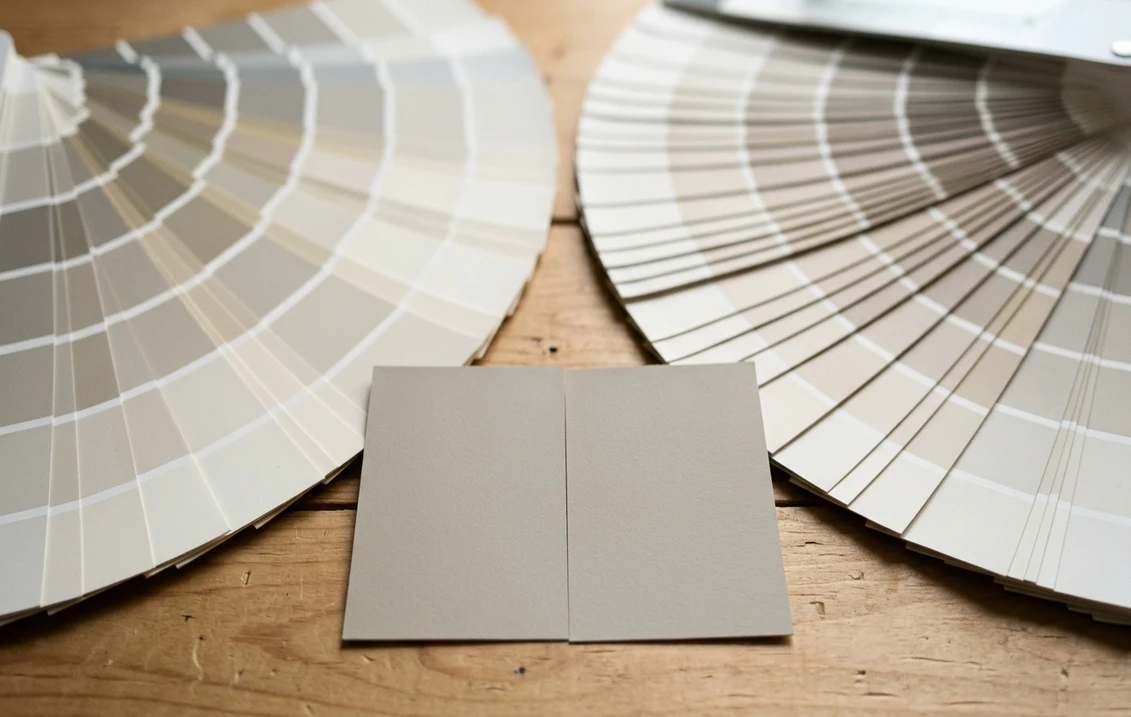
Every one of these deltas is small (two to three LRV points and a subtle undertone shift), which is exactly why a chart cannot settle it. The only way to be sure is to test the match on your own wall.
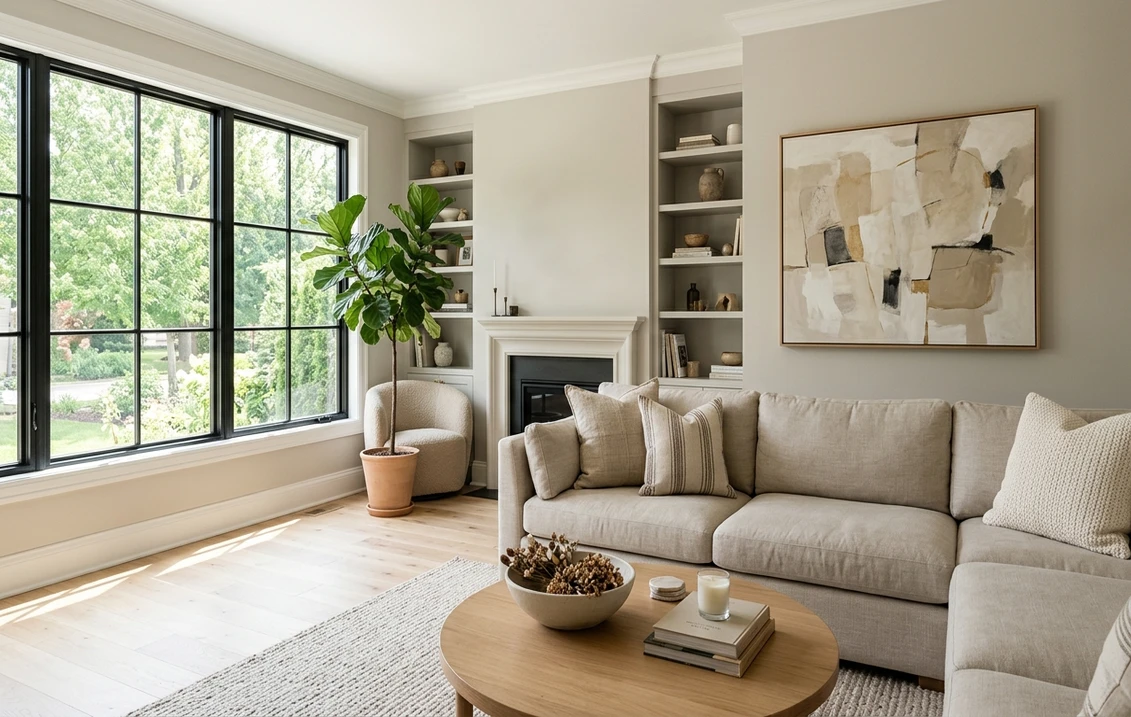
Sherwin-Williams Agreeable Gray (SW 7029) is the most requested warm greige in the country, so the question we hear right behind "should I use it?" is a version of "what is it in Benjamin Moore?" The honest answer starts with a caveat: no paint brand publishes official cross-brand equivalents, and none ever will. Matching a color across decks is not a lookup, it is a judgment call about which chip lands closest on two axes at once: light reflectance value (LRV) and undertone. Agreeable Gray sits at LRV 60 with a soft, beige-leaning warmth, so a good match has to hold both of those together, not just one. For the full method behind any of these calls, start with our guide to how cross-brand paint matching works.
The closest matches, side by side
| Color | Brand and code | Approx LRV | Undertone vs Agreeable Gray | Verdict |
|---|---|---|---|---|
| Agreeable Gray (reference) | Sherwin-Williams SW 7029 | 60 | The benchmark: warm greige, leans beige in soft light (approx hex #D1CBC1, RGB 209, 203, 193) | The color you are matching |
| Collingwood | Benjamin Moore OC-28 | 62 | Very close: a hair cooler and grayer, with a faint violet whisper in dim light (approx hex #CFC9BD, RGB 207, 201, 189) | Closest widely recommended BM match |
| Edgecomb Gray | Benjamin Moore HC-173 | 63 | A touch warmer and lighter, leans a little more beige than Agreeable Gray (approx hex #D6D0C2, RGB 214, 208, 194) | Best BM alternative if you want more warmth |
| Silver Drop | Behr 790C-2 | 62 | Slightly cleaner and cooler, a hint less beige on a full wall (approx hex #D5D0C6, RGB 213, 208, 198) | Closest widely recommended Behr match |
Try it on your house
No photo? Try a sample
LRVs above are approximations of each brand's published figures, and the hex and RGB values are digital renderings that shift with your screen. None of them is authoritative. A physical paint chip, viewed in your own room, is the only reference that decides a match.
Upload one photo, preview Agreeable Gray and its Benjamin Moore match side by side. Free, no signup.
Why there is no exact Agreeable Gray equivalent
Two brands can print two chips that measure the same LRV and still look different on a wall, because LRV only captures how much light a color bounces back. It says nothing about the colorants underneath. Sherwin-Williams and Benjamin Moore mix from different base and tint systems, with different pigments doing the warming, so even a careful match will drift on the undertone axis. Agreeable Gray warms toward beige; Collingwood carries a whisper of violet that can surface in north light; Edgecomb Gray leans a shade more golden. Those are not defects, they are just what happens when you cross decks. The gap is usually a couple of LRV points and one small undertone step, which is invisible on a sample card and obvious on a sunlit wall.
Sheen makes it worse or better. A matte finish mutes undertone and hides small differences; a satin or eggshell in a bright room amplifies them. Add your flooring, your trim color, and the direction your windows face, and the "same" greige can read warm in one room and flat gray in the next. This is why we never call any of these an exact or official equivalent. The right phrase is the closest widely recommended match, and the closest match still has to be tested against the exact light where it will live.
When the Benjamin Moore match works (and when to stay Sherwin-Williams)
- Go with Collingwood or Edgecomb Gray when your contractor already stocks Benjamin Moore, or your trim and ceiling are BM, and you would rather keep one paint system than chase a cross-brand tint.
- Stay Sherwin-Williams when other rooms in the house are already Agreeable Gray. Batch and brand consistency across a whole home beats a two-point LRV preference every time.
- Lean to Edgecomb Gray if your samples of Agreeable Gray felt a touch flat and you want more warmth; lean to Collingwood if the room is already warm and you want the greige to stay balanced rather than tip beige. For how Agreeable Gray behaves by room and exposure, see Agreeable Gray undertones and best rooms.
- Do not expect the BM match to fix an undertone you already dislike. If Agreeable Gray reads too warm in your light, a match that leans the same way will too. If you are torn between warm and cool greige in the first place, our side-by-side comparison of Agreeable Gray and cooler Repose Gray is the better place to start.
Related matches
Matching one greige usually means matching its neighbors too. If you are cross-shopping the cooler side of the family, here is the Benjamin Moore match for Repose Gray. And if your palette is drifting warmer toward beige, we did the same exercise for the Benjamin Moore match for Accessible Beige. Each uses the same LRV-plus-undertone method, and each ends the same way: confirm the finalist on your own wall before you commit a gallon.
One habit does not transfer to the other end of the scale. A pale greige shows its undertone drift in bright light, which is why you sample a greige near a window. A soft black behaves the other way around, and the Benjamin Moore equivalent of Iron Ore makes the point at LRV 6: down there the gap between two brands is amplified in shadow and softened by direct sun. If your scheme pairs greige walls with a near-black door or shutters, sample each one where it will actually live rather than side by side on the same board.
Frequently asked questions
What is the closest Benjamin Moore equivalent of Agreeable Gray?
The closest widely recommended Benjamin Moore match is Collingwood OC-28, at an approximate LRV of 62 against Agreeable Gray's LRV of 60. It is a warm greige that reads a hair cooler and slightly lighter, with a faint violet undertone that can show in dim north light. Edgecomb Gray HC-173 (approx LRV 63) is a close alternative that runs a touch warmer and more beige. Neither is an official or exact equivalent, so treat both as strong starting points to test, not guaranteed twins.
Is there a Behr version of Agreeable Gray?
There is no official Behr version, but the match homeowners most often reach for is Behr Silver Drop 790C-2, at an approximate LRV of 62. It sits very close to Agreeable Gray on lightness while reading slightly cleaner and a hint less beige on a full wall. Because Behr mixes from its own tint system, expect a small undertone shift rather than an identical color, and confirm it with a sample in your own light.
Is Collingwood the same color as Agreeable Gray?
No, they are close cousins, not the same color. Collingwood OC-28 measures about two LRV points lighter and carries a slightly cooler, grayer cast, while Agreeable Gray SW 7029 leans a touch warmer toward beige. On a small chip the difference is nearly invisible; on a sunlit wall it is easy to see, especially next to white trim. That is why we call Collingwood the closest match rather than a duplicate.
Will the Benjamin Moore match look identical to Agreeable Gray on my wall?
Not exactly. Two greiges at nearly the same LRV can still diverge on undertone because each brand uses different pigments, and your lighting, sheen, flooring, and trim all push the result one way or the other. The delta between Agreeable Gray and its Benjamin Moore match is small, but small is not zero. The reliable move is to preview both on a photo of your actual room, or sample them side by side, before you buy.
1 HD render plus 3 free color variations. See the SW color and its BM match on your real wall.
Trademark notice. Sherwin-Williams and Agreeable Gray, Benjamin Moore, and Behr are trademarks of their respective owners. FacadeColorizer is not affiliated with, endorsed by, or sponsored by these companies. Brand and color names are used descriptively (nominative fair use). Hex and RGB values are approximate digital renderings; the only authoritative reference is a physical paint chip.
Trademarks mentioned (Sherwin-Williams, Benjamin Moore, Behr, Caparol, Brillux, Sto, Alpina, Valspar, PPG, Glidden, Dulux, Crown Trade, Sandtex, Farrow & Ball, Johnstone's, Leyland) are property of their respective owners. FacadeColorizer is independent and not affiliated with any of them. Nominative fair use under Lanham Act §1125.