Try it on your house

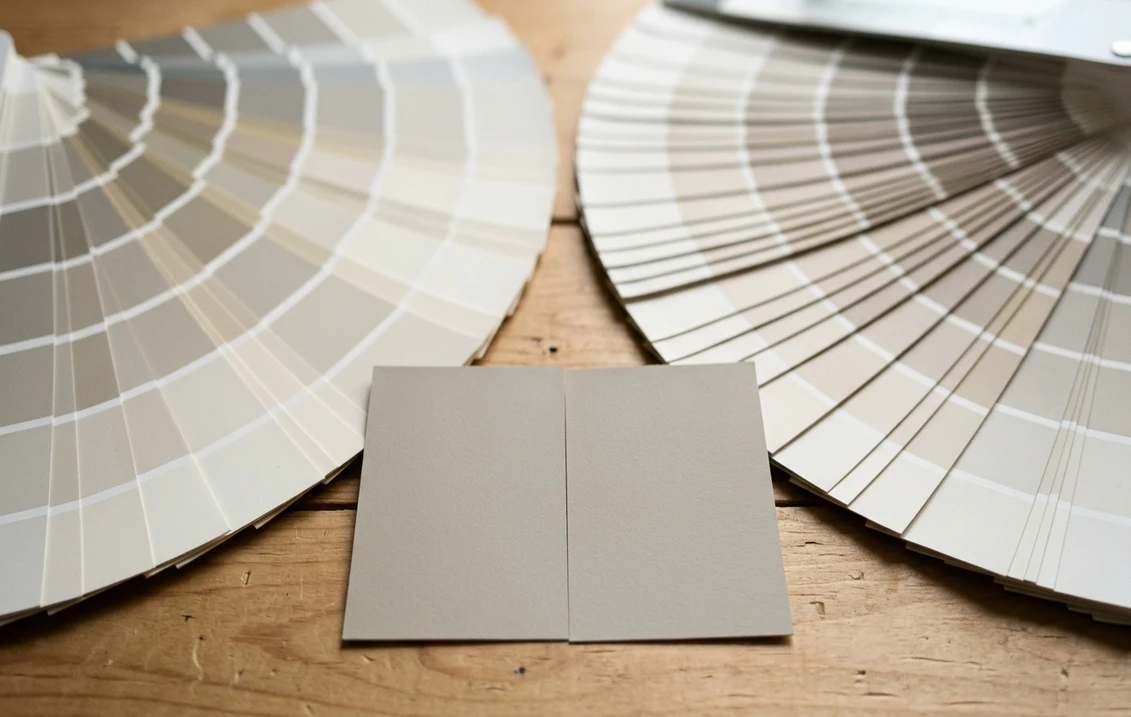
The scenario is always some version of the same story. You fell for Agreeable Gray, but your painter buys everything at a Benjamin Moore dealer. Or your builder used a discontinued color and you need one wall touched up. Or the perfect greige is on a rival's chip and your loyalty card says otherwise. Paint color matching is how you carry a color from one deck, one object, or one photo into the can you are actually going to buy.
This guide is the hub for that problem. It covers what a real match is (and why a perfect one does not exist), the three ways to get close, the cross-brand equivalents Americans ask for most, and the honest way to verify a candidate before committing to gallons. Color-by-color equivalence guides branch off from here as we publish them.
Upload one photo and see the original and its closest equivalent side by side on your actual walls, free.
What counts as a match (and why exact ones are a myth)
A paint color is defined by three measurable things: its hue (where it sits on the color wheel), its lightness (LRV, the 0 to 100 light reflectance scale printed on every technical data sheet), and its chroma (how saturated it is). A useful match keeps all three close, and above all keeps the undertone, the faint secondary color that surfaces at dusk and under warm bulbs.
Why can two brands never nail the exact same color? Because they mix from different proprietary colorant systems on different bases. Even a spectrophotometer match is a recipe rebuilt from different ingredients, so it can agree under one light source and drift under another, an effect called metamerism. Sheen adds another half-shade: the same formula reads darker in matte than in eggshell. The practical bar is therefore not "identical" but "within about 2 LRV points, same undertone family, verified on your wall."
The three ways to match a color
1. The store spectrophotometer. Any Sherwin-Williams, Benjamin Moore, Home Depot, or Lowe's counter can scan a physical sample and compute the nearest recipe in their own system. It works best with a flat, matte, single-color sample at least 1 inch square (a chip, a drawer front, a switch plate cover). It struggles with textured surfaces, sheened paint, small screws of color, and anything faded. Expect a close cousin, not a clone, and always ask for a drawdown card or sample pot before buying gallons.
2. Published equivalents. For famous colors, the crowd has already done the homework: designers and paint stores cite standard "nearest neighbor" pairs across decks. That is the fastest route when your target is a best-seller, and the table below covers the pairs we get asked about most. Each pair still has a personality difference, which we note, because that difference is exactly what you need to check in your own light.
3. Matching from a photo. When the color lives on a wall you cannot chip a sample from (a rental you loved, a hotel, an Instagram save), an app can estimate the nearest branded color from a photo. Accuracy depends heavily on white balance and lighting, so treat the result as a shortlist of candidates. We compared the main options in our guide to paint matching apps.
The cross-brand equivalents people ask for most
These are nearest neighbors, not clones. LRV figures come from the manufacturers' technical data sheets; the delta column tells you what to watch for on the wall.
| If you love | Closest neighbor | LRV | What actually differs |
|---|---|---|---|
| SW Agreeable Gray 7029 | BM Edgecomb Gray HC-173 | 60 vs 63 | Edgecomb runs slightly lighter and more beige; Agreeable holds more gray |
| SW Alabaster 7008 | BM White Dove OC-17 | 82 vs 85 | White Dove reads a hair brighter and grayer in shade; Alabaster is creamier |
| SW Repose Gray 7015 | BM Collingwood OC-28 | 58 vs 62 | Collingwood is lighter and softer; Repose shows more of its violet-taupe side |
| SW Naval 6244 | BM Hale Navy HC-154 | 4 vs 8 | Hale Navy is a step lighter and grayer; Naval goes deeper and inkier at night |
| SW Iron Ore 7069 | BM Wrought Iron 2124-10 | 6 vs 6 | Nearly twins; Wrought Iron leans one shade greener and softer in daylight |
Try it on your house
No photo? Try a sample
Two of these originals have full profiles worth reading before you commit: Agreeable Gray and White Dove. And if you are weighing an original against its neighbor as two live candidates rather than hunting a substitute, that is a duel, and the side-by-side comparison method is the tool for it.
Can the counter just mix the other brand's formula?
Mostly yes, with caveats. Benjamin Moore stores routinely match Sherwin-Williams colors and vice versa, and the big-box counters match both. What you get is that store's nearest recipe in its own colorants, which lands very close on mid-tone neutrals and drifts most on saturated colors, deep navies, and bright whites. Three ground rules from repeated experience: name the color instead of bringing a printed photo (printers lie), ask for the match on a real drawdown card rather than trusting the lid dab, and never approve it under store lighting alone. Whether the paint itself should be SW or BM is a separate question, covered in our Sherwin-Williams vs Benjamin Moore comparison.
One case where matching is the wrong tool: touch-ups on aged paint. Even the identical color and brand will flash against a wall that has faded and burnished for five years. For anything older than a couple of years, repaint corner to corner instead of chasing an invisible patch.
How to verify a match before buying gallons
Step 1: Compare the numbers. Pull both technical data sheets. If LRV differs by more than 2 to 3 points, you will see it; decide whether you can live with the lighter or darker read.
Step 2: Preview both digitally on your room. Upload a photo of the actual space and look at the original and the candidate at full-wall scale. This is the fastest way to catch an undertone mismatch with your floors and trim before any money changes hands.
Free AI visualizer: put the original and the match side by side on your own walls in 30 seconds.
Step 3: Sample the finalists side by side. Two coats, 12-inch patches on the same wall, judged morning, afternoon, and under evening bulbs. The white-paper trick helps here too: tape both chips to bright white paper and the undertone difference jumps out.
Step 4: Match the sheen, then commit. Order the sample in the sheen you will actually use; a perfect eggshell match approved from a matte card is how "the same color" ends up looking different on the last wall. If the room's undertone landscape is what worries you, the interior color families guide explains which families your floors and light will fight.
Frequently asked questions
Can Home Depot or Lowe's match a Sherwin-Williams color?
Yes. Both can look up popular Sherwin-Williams names in their systems or scan a physical chip with a spectrophotometer and mix the nearest recipe in Behr or Valspar colorants. The result is usually very close on mid-tone neutrals and least reliable on saturated colors and bright whites. Always ask for a drawdown card or sample pot and check it in your own lighting before buying gallons.
What is the Benjamin Moore equivalent of Agreeable Gray?
The most-cited nearest neighbor is Edgecomb Gray HC-173. It sits about 3 LRV points lighter (63 vs 60) and leans slightly more beige, while Agreeable Gray holds a touch more gray. In a warm, bright room they read like siblings; in cool north light Agreeable Gray stays grayer. Sample both on the same wall, or preview them side by side on a photo of your room first.
How accurate are apps that match paint color from a photo?
Good enough for a shortlist, not for a final answer. Phone photos carry white-balance and exposure shifts that move a color one or two chips in any direction, so the same wall can return different results morning and night. Use the app to get two or three candidates, then confirm with physical samples or a visualizer preview on a well-lit photo of the actual room.
Is LRV comparable across paint brands?
Yes, and that is what makes it the backbone of cross-brand matching. LRV is a measured physical quantity (the percentage of light a dried color reflects), published by every major US manufacturer on its technical data sheets, so a 60 at Sherwin-Williams and a 60 at Benjamin Moore reflect the same amount of light. What LRV does not capture is undertone, which is why two colors with identical LRV can still clash.
Upload your room or facade photo and see the original and its equivalent on your real walls before you buy.
Disclaimer: Sherwin-Williams, Benjamin Moore, Behr, and Valspar, along with the specific color names and codes referenced here (SW 7029 Agreeable Gray, SW 7008 Alabaster, SW 7015 Repose Gray, SW 6244 Naval, SW 7069 Iron Ore, BM HC-173 Edgecomb Gray, BM OC-17 White Dove, BM OC-28 Collingwood, BM HC-154 Hale Navy, BM 2124-10 Wrought Iron, BM HC-172 Revere Pewter), are trademarks of their respective owners. FacadeColorizer is an independent paint visualization service and is not affiliated with, endorsed by, or sponsored by any paint manufacturer. Equivalents listed are nearest published neighbors, not identical formulas; color reproduction on screens approximates manufacturer chips. LRV figures are drawn from the respective manufacturer technical data sheets (2026). Always confirm with a physical sample before purchase.
Trademarks mentioned (Sherwin-Williams, Benjamin Moore, Behr, Caparol, Brillux, Sto, Alpina, Valspar, PPG, Glidden, Dulux, Crown Trade, Sandtex, Farrow & Ball, Johnstone's, Leyland) are property of their respective owners. FacadeColorizer is independent and not affiliated with any of them. Nominative fair use under Lanham Act §1125.