Try it on your room

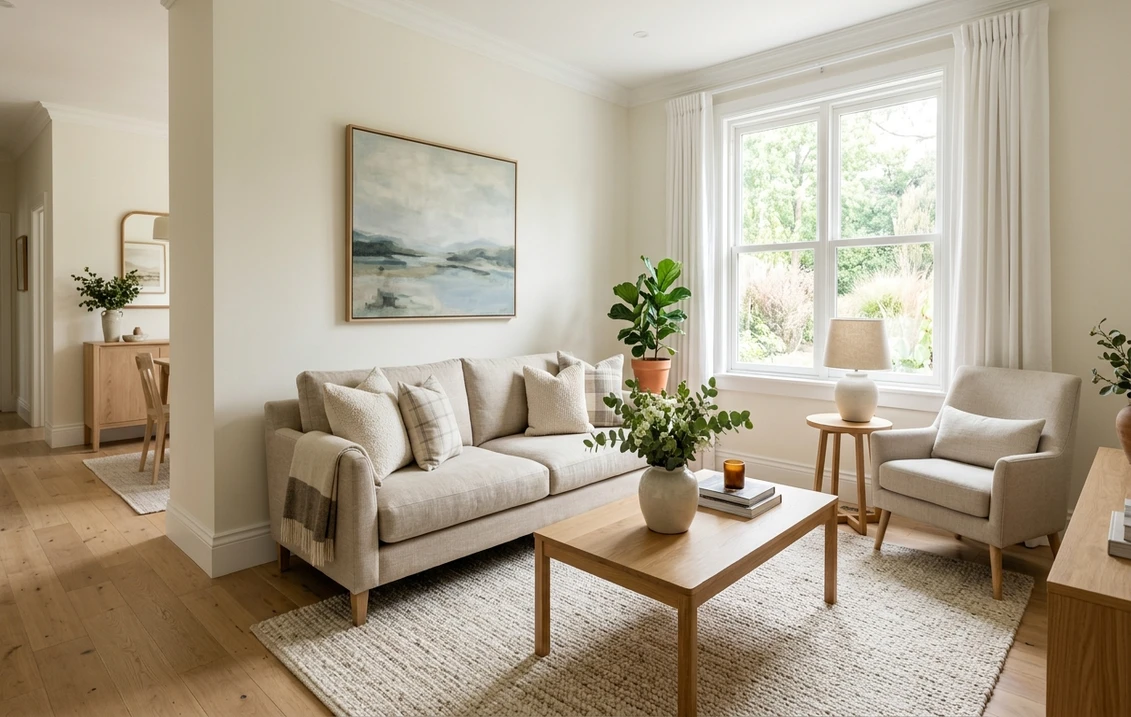
You walk into a freshly painted room and nothing about the white announces itself. It just feels right. Nine times out of ten, that white is White Dove OC-17, the name US interior designers reach for when they want one safe bet. Benjamin Moore's quiet bestseller is a soft warm white with an LRV of roughly 85: enough gray in the base to keep it from going sterile, enough warmth to stay friendly under real-world light. It is the white people reach for when walls, trim, and cabinets should feel calm and timeless rather than builder-grade bright.
But "safe" does not mean "foolproof." White Dove still shifts with your light, your floors, and the whites beside it. This profile breaks down its true undertones, the rooms where it shines, the trim and cabinet pairings designers actually use, and how to test it before you buy three gallons. To weigh it against the rest of the line, start with our Benjamin Moore interior paint colors guide.
Upload a photo of your room and preview White Dove OC-17 under your actual light in about 30 seconds, free.
White Dove OC-17 at a glance
Before the nuance, the numbers and traits that matter, drawn from Benjamin Moore color data and widely documented US designer references:
- Name and code: White Dove, OC-17 (the OC stands for Off-White Collection).
- LRV (Light Reflectance Value): about 85. High enough to read as a clean white, soft enough to avoid the glare of a 90+ bright white. If that number is new to you, here is what LRV (light reflective value) means for this color and how it shapes the way White Dove bounces light.
- Undertone: warm, with a whisper of gray. No strong yellow, no pink, no green. The gray is what keeps it from going creamy.
- Family: soft warm white, squarely in the "greige-adjacent" off-white camp rather than a true bright white.
- Best uses: walls, trim, ceilings, and cabinets, including all four at once for a soft monochromatic envelope.
- Nearest cousins: SW Alabaster (SW 7008) reads a touch creamier; BM Simply White (OC-117) is brighter and more lemon; BM Chantilly Lace (OC-65) is a much cleaner, cooler white.
That single gray note is the whole personality. For where soft whites sit in the spectrum, our interior paint color families guide maps the off-white zone.
Is White Dove warm or cool? The undertone, honestly
White Dove is a warm white, full stop, but one of the most balanced on the market. The warmth is gentle and the gray base holds it in check, so it almost never tips into the obvious cream or vanilla that catches people off guard with softer whites. Think "soft and easy" rather than "buttery."
Just don't expect a crisp, blue-white modern white. Set it beside chrome and glass and it reads soft rather than snappy. For most rooms that calm is exactly the point. But taste varies, and if yours runs sharper, Chantilly Lace (OC-65) is the cleaner pick. Our best interior paint colors of 2026 roundup covers where each white belongs.
How light direction changes White Dove
No paint color is fixed. Every white is the wavelengths it reflects minus whatever the room's daylight failed to supply, and daylight is far from neutral. Here is how White Dove tends to behave by orientation in the Northern Hemisphere; use it as a starting map, then confirm in your space:
| Room orientation | Typical daylight | How White Dove reads |
|---|---|---|
| South-facing | Warm, abundant sun | Soft, slightly creamy warm white at its most flattering |
| North-facing | Cool, indirect light | Quiet soft white; the gray base shows but rarely goes dingy |
| East-facing | Warm early, cooler later | Creamy at breakfast, a clean soft white by afternoon |
| West-facing | Cool morning, warm sunset | Neutral by day, glows warm gold late in the afternoon |
Try it on your room
No photo? Try a sample
Sources: Benjamin Moore OC-17 color data; The Spruce and Benjamin Moore designer references on warm-white behavior by orientation.
The headline is that White Dove is unusually steady. On a north wall, where many warm whites turn flat or faintly green, that touch of gray helps it hold a soft, clean identity, which is why it earns its "set it and forget it" reputation when you cannot test every room. Compare it to a creamier choice like Alabaster, which can read greige in cool northern light, as our SW Alabaster north-facing undertones guide explains.
Free AI paint visualizer. Upload your real room photo to see White Dove under your own daylight before buying samples.
Best rooms for White Dove OC-17
Because it is so even-tempered, White Dove works almost anywhere, but a few rooms are where it genuinely outperforms the alternatives:
Living rooms and open-plan spaces
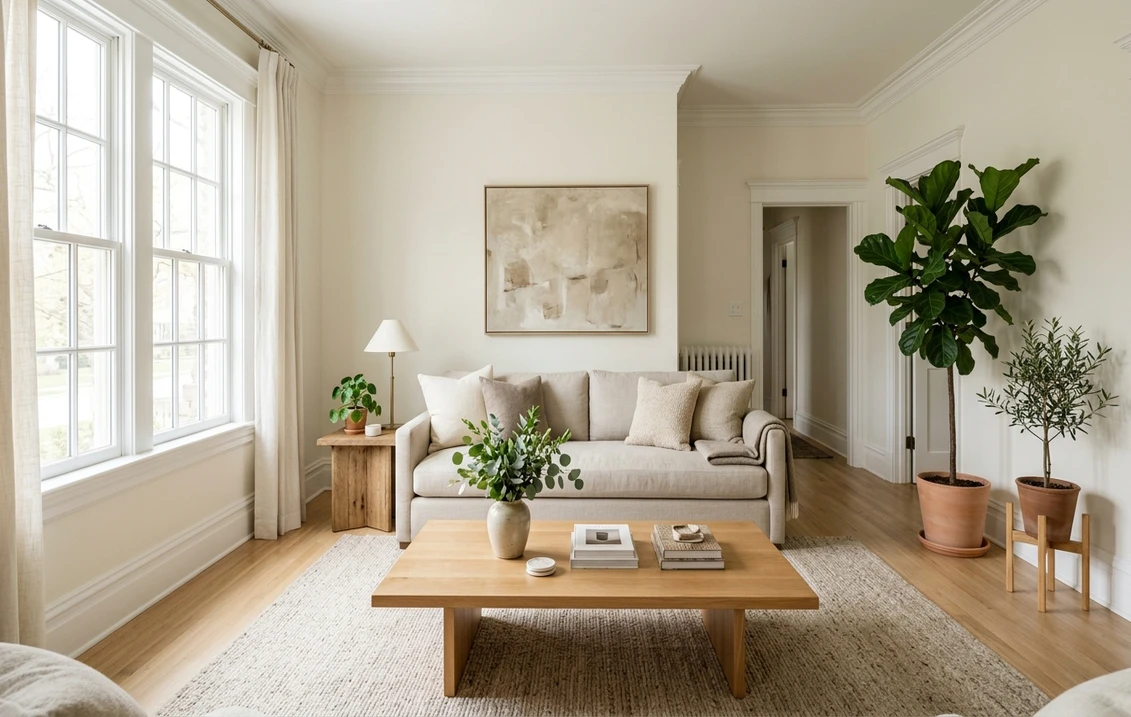
This is White Dove's home turf. The soft warmth makes large, light-filled rooms feel calm and lived-in rather than echoey and white-box cold, and it stays forgiving across the mixed light of an open plan. To anchor a whole living space around it, see our top living room paint colors for 2026.
Bedrooms
The gentle warmth reads cozy and restful in low evening light and does not glare under bedside lamps the way a high-LRV bright white can. Our calming master bedroom paint colors guide shows how soft whites build a restful palette.
Kitchen cabinets
White Dove is arguably the most popular cabinet white in the country. On shaker doors it looks soft and high-end rather than plastic, hides minor wear better than a stark white, and pairs with nearly any countertop, from white quartz to butcher block. For the full cabinet conversation, our complete kitchen cabinet colors guide and our roundup of trending cabinet paint colors set it against the year's other favorites.
Trim and millwork throughout the house
Many designers use White Dove as a whole-home trim color because it flatters almost every wall beside it: soft enough to avoid a jarring bright-white edge against muted greens, blues, and greiges, yet still clearly "the trim." Our room-by-room paint color ideas show where a unifying soft-white trim pulls a home together. The pairing also holds from the wall side: our Edgecomb Gray HC-173 review names White Dove as that greige's default trim white, a gap of roughly 22 LRV points (85 against 63) that reads as gentle separation rather than a hard edge.
Trim, ceiling, and decor pairings
White Dove is happiest in a soft, layered scheme. These are the combinations designers come back to:
- Tonal trim: White Dove walls with White Dove trim in a higher sheen (matte walls, satin or semi-gloss trim) gives a quiet architectural monochrome without a hard line.
- Crisper contrast: to make trim pop, run a cooler, brighter white like Chantilly Lace (OC-65) on the millwork; keep the gap subtle so the walls do not read dingy.
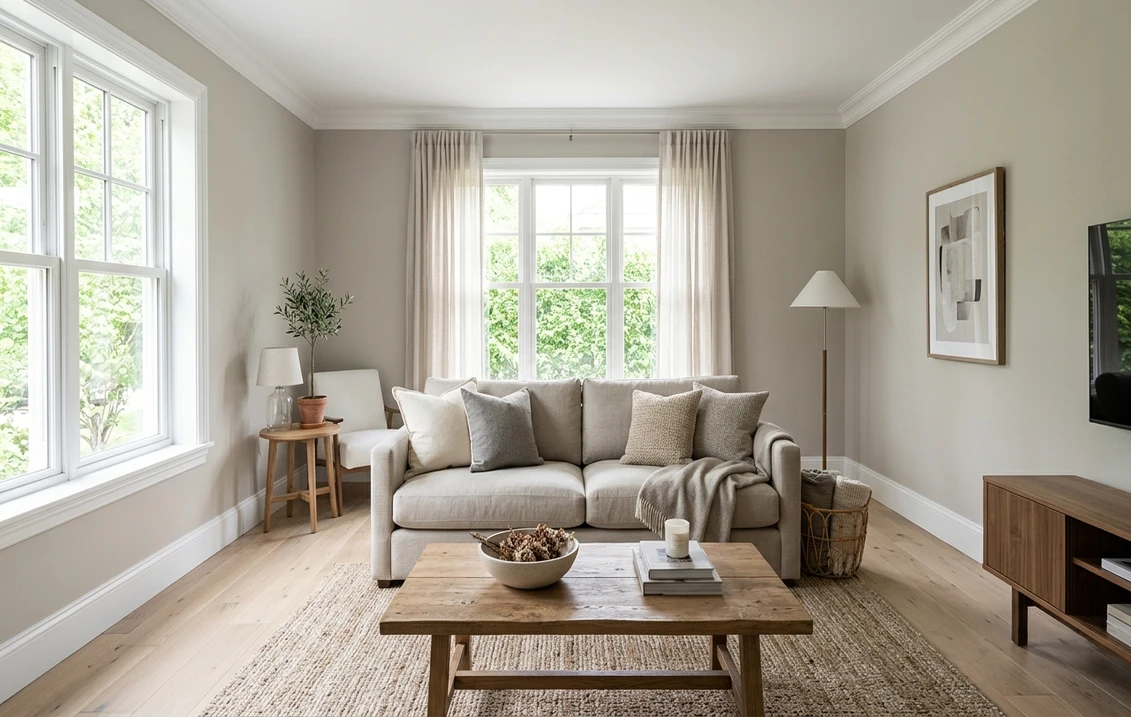
- Greige and warm-neutral walls: White Dove is a natural trim partner for warm grays and greiges. See how those undertones behave in our Agreeable Gray and Accessible Beige guides. Staying inside the Benjamin Moore deck avoids a color-match round trip at the counter, and the usual pick there is Light Pewter 1464 (LRV 68), a soft greige carrying just enough warmth that White Dove trim beside it reads crisp rather than yellow.
- Cooler gray walls: against a soft cool gray like Repose Gray, White Dove trim keeps the room from feeling cold, as our Repose Gray undertones guide shows.
- Floors and wood tone: warm white oak, honey, and walnut bounce friendly light onto the walls; cool gray-washed floors flatten it, so balance them with warm textiles.
- Ceiling: White Dove or a ceiling white in the same warm family keeps the envelope cohesive. A blue-white ceiling can add a contrast you may not want.
White Dove vs the whites people confuse it with
Every "is this the right white?" spiral eventually narrows to the same short list of names. Here is how White Dove stacks up against the rivals it gets confused with most:
- vs Simply White (OC-117): brighter and more clearly yellow; it pops more but can go lemony in warm light. White Dove is softer, grayer, and safer. Our White Dove vs Simply White side-by-side verdict settles the debate room by room.
- vs Chantilly Lace (OC-65): a much cleaner, cooler, crisper white with a higher LRV. Choose it for modern, high-contrast looks; White Dove for soft and warm. See our full White Dove vs Chantilly Lace comparison before you commit.
- vs Cloud White (OC-130): very close, slightly warmer and creamier; easy to mistake on a chip, but White Dove reads a hair grayer on the wall. We break down how to tell them apart in our White Dove vs Cloud White duel.
- vs Sherwin-Williams Alabaster (SW 7008): Alabaster is creamier with a little more green-gray, so it can read greige in cool northern light where White Dove stays cleaner. Torn between brands? Our Sherwin-Williams vs Benjamin Moore comparison lays out the differences, and Behr fans can see our Behr vs Sherwin-Williams comparison and Behr interior paint colors guide for color-matched alternatives.
White Dove indoors vs on the facade
At LRV 83.16, White Dove is in the same exterior band as Pure White (83.957) and Alabaster (82.215), the range that reads white from the street without glare; our guide to the best white exterior paints shows where it fits and which 2026 door and shutter colors pair with it.
This profile is about White Dove inside your home: walls, trim, cabinets, ceilings, and how the undertone reads under interior light. Outdoors it behaves differently, where harsh sun and sky reflection push it brighter and flatten the warmth. Considering it for siding, trim, or a front door? Read its dedicated White Dove OC-17 exterior guide instead. The two pages are complementary: this one owns the indoor story, that one owns the facade.
How to test White Dove before you commit
Reliable as it is, White Dove still earns a real-room test. A tiny fan-deck chip catches only a sliver of the light a finished wall throws back, so it reads lighter and cooler than the rolled result. Here is a sequence that won't let you down:
- Use a large sample. A peel-and-stick swatch or brushed-out poster board beats a tiny chip; place it on two different walls.
- Watch three lighting moments. Morning (8 to 9 a.m.), mid-afternoon (1 to 2 p.m.), and after sunset under your normal bulbs, whose color temperature alone can swing White Dove warmer or cooler.
- Hold it against your trim, floor, and counter. White Dove is relational; it only makes sense beside the materials it will live with.
- Preview it digitally first. Before buying samples, upload a room photo to our visualizer and apply White Dove (and a rival white or two) to narrow the field in minutes.
Planning the wider repaint? Our interior house painting cost guide covers what a full White Dove project realistically runs, from one accent room to a whole-home refresh.
Upload your room photo and preview White Dove OC-17 against your trim, floors, and light, free.
Frequently asked questions
Is Benjamin Moore White Dove warm or cool?
White Dove (OC-17) is a warm white, but a balanced one. A soft gray base holds the warmth in check, so it stays soft and easy rather than obviously creamy or yellow. It is not a crisp blue-white; for a sharp modern white, Chantilly Lace (OC-65) is the better choice.
What is the LRV of White Dove OC-17?
White Dove has a Light Reflectance Value of about 85. That keeps it in the soft white range: bright enough to read as a clean white but lower than a stark white like Chantilly Lace (LRV around 90), which is why White Dove feels calmer and less glaring on large walls.
Is White Dove a good color for kitchen cabinets?
Yes. It is one of the most popular cabinet whites in the United States. Its soft warmth reads high-end rather than plastic on shaker doors, hides minor wear better than a stark white, and pairs with almost any countertop and hardware, which makes it a safe choice when you cannot test the color in your exact kitchen light.
What is the difference between White Dove and Simply White?
Simply White (OC-117) is brighter and more clearly yellow, so it pops more but can read lemony in warm light. White Dove (OC-17) is softer, grayer, and more neutral, the safer pick for whole rooms and trim where you want a quiet, consistent white across changing light.
Can I use White Dove on walls, trim, and ceiling together?
Yes, and many designers do; it creates a soft, cohesive envelope. Use a flat or matte finish on walls and a satin or semi-gloss on trim so the millwork has subtle definition without a hard color contrast.
See White Dove OC-17 and a rival white or two on your actual room before buying a single sample.
Disclaimer: Benjamin Moore, White Dove, and OC-17 are trademarks of Benjamin Moore & Co. Sherwin-Williams and Behr are trademarks of their respective owners. FacadeColorizer is an independent paint visualization service and is not affiliated with, endorsed by, or sponsored by Benjamin Moore, Sherwin-Williams, or Behr. LRV and undertone descriptions reflect publicly published Benjamin Moore color data and widely cited US designer references; on-screen color reproduction approximates the manufacturer's chip, so always confirm with a manufacturer sample before purchase. Sources: Benjamin Moore OC-17 White Dove color data 2026, Benjamin Moore Off-White Collection references, The Spruce warm-white guidance, and US designer undertone references.
Trademarks mentioned (Sherwin-Williams, Benjamin Moore, Behr, Caparol, Brillux, Sto, Alpina, Valspar, PPG, Glidden, Dulux, Crown Trade, Sandtex, Farrow & Ball, Johnstone's, Leyland) are property of their respective owners. FacadeColorizer is independent and not affiliated with any of them. Nominative fair use under Lanham Act §1125.