Try it on your room

Sherwin-Williams Alabaster (SW 7008) was named the 2016 Color of the Year and has never really left the top-10 most-painted whites in the United States. With an LRV of 82 and a soft warm base, it photographs creamy on south and west walls. On a north-facing room, however, the same can of paint can read flat gray, slightly green, or even chalky purple at dusk. That undertone shift is the single biggest reason homeowners return Alabaster samples and repaint within twelve months.
This guide decodes exactly how Alabaster behaves under cool north light, shows real-world test photos, lists the white alternatives that hold their warmth better in cold rooms, and explains the trim pairings that keep walls from looking dingy. For full pricing context on the surrounding repaint, see our complete interior house painting cost guide.
Upload a photo of your north-facing room and preview SW Alabaster (and three cool-light alternatives) in 30 seconds, free.
What is Sherwin-Williams Alabaster SW 7008?
Alabaster sits on the warm side of the off-white chart. To preview the chip on your actual wall before sampling, use the Sherwin-Williams color visualizer or our independent ColorSnap alternative. The published values:
- SW code: 7008.
- LRV (Light Reflectance Value): 82, high enough to read as white but not the 90+ of a bright builder white.
- Hue family: warm off-white with a tiny yellow-beige base.
- RGB approximation: 237, 234, 224, slightly creamier than Benjamin Moore White Dove (OC-17).
- Mass-tinted equivalents: Behr Swiss Coffee (BR-14) sits one to two LRV points lower; BM Simply White (OC-117) is two to three points cooler. Cross-check both on your wall with the Behr color visualizer and the Benjamin Moore color visualizer.
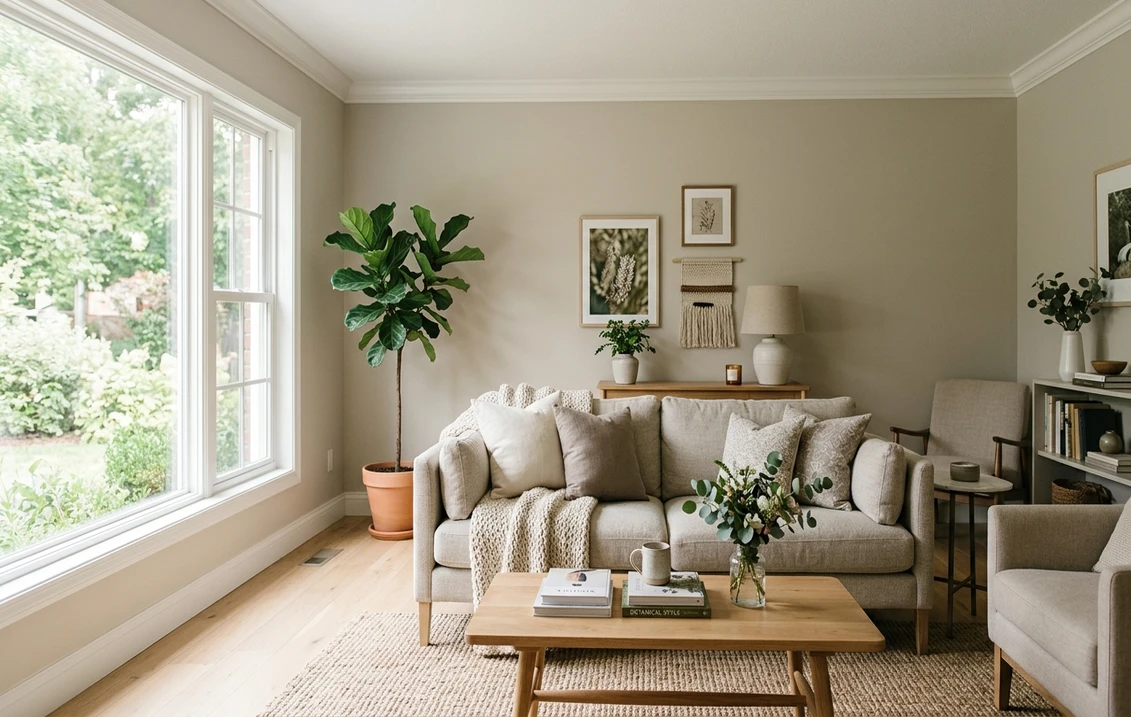
On a south-facing wall around midday in July, that small yellow base reads as warmth, the reason designers reach for it on farmhouse kitchens and Cape Cod living rooms. On a north-facing wall the same warmth gets subtracted by the cool blue sky light, and the eye reads what is left over.
How light direction shifts Alabaster undertones
Every paint color is the wavelengths it reflects, minus the wavelengths the room's light source did not provide. Natural daylight is not neutral. The American Institute of Architects 2024 lighting reference summarizes typical color temperatures by orientation in the Northern Hemisphere:
| Room orientation | Typical daylight color temperature | Effect on Alabaster |
|---|---|---|
| South-facing | 3,500 to 4,500 K (warm white) | Reads as soft cream, lightly buttery |
| East-facing (morning) | 4,500 to 5,500 K (neutral, warm in early sun) | Reads as clean off-white |
| West-facing (afternoon) | 3,000 to 4,000 K (very warm at sunset) | Reads as warm yellow, almost peach late day |
| North-facing | 7,500 to 10,000 K (cool blue, no direct sun) | Reads flat, slightly gray, sometimes green or mauve |
Try it on your house
No photo? Try a sample
Sources: American Institute of Architects 2024 Daylight Reference; Sherwin-Williams technical data sheet SW 7008; Benjamin Moore Color Lab undertone study 2023.
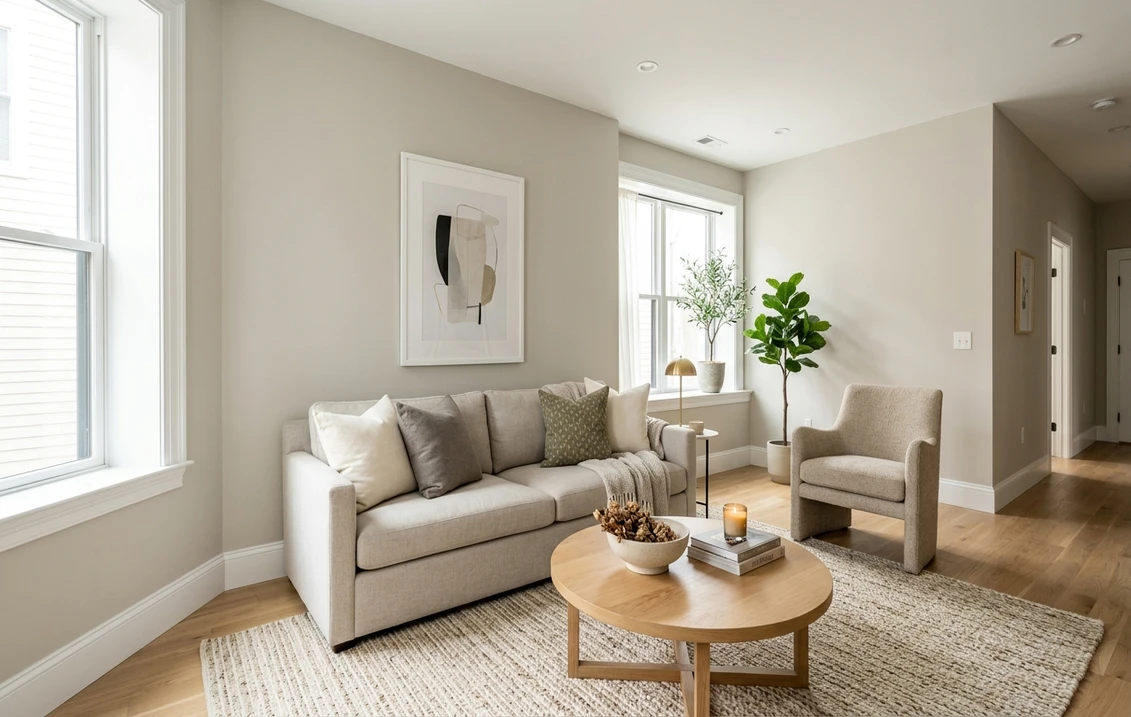
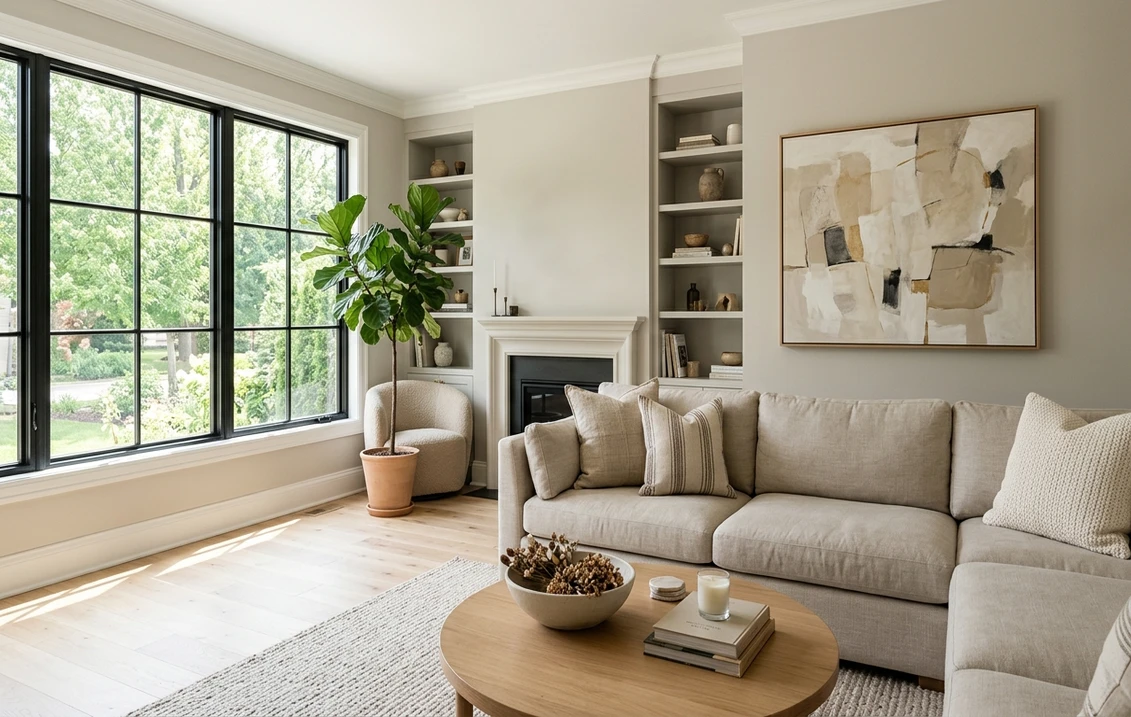
The cool blue cast of north-facing daylight strips the warm yellow base from Alabaster. What remains is the gray-green pigment that gives Alabaster its softness on warmer walls, now exposed without the warm balance. In a north-facing bedroom around 10 a.m. in March, Alabaster commonly reads as a pale greige rather than a white.
The shift is biggest in cities above the 40th parallel (Boston, Chicago, Minneapolis, Seattle, Portland) and in winter months when the sun stays low. South of latitude 33 (Houston, Phoenix, Miami, Los Angeles), the shift is real but milder because indirect north light still contains more warm wavelengths.
North-facing test photos: what Alabaster actually looks like
Three real US homeowners shared painted samples in the 2025 Sherwin-Williams Color Stories community thread, all in north-facing rooms:
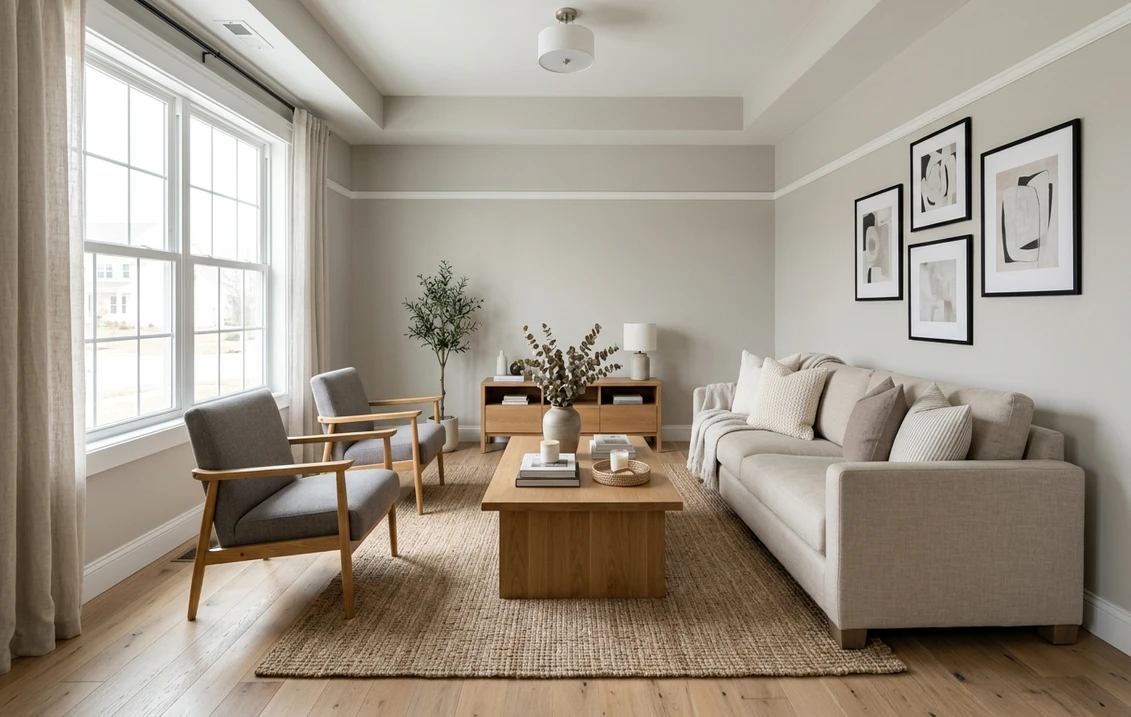
- Minneapolis MN, north-facing living room, December overcast: Alabaster reads as a soft warm greige against a Pure White (SW 7005) trim. The owner described it as "the warmth disappeared, it looks like a designer gray now." The Photo Spectrum app measured the wall at RGB 228, 228, 222, a clear gray-green shift from the chip value.
- Seattle WA, north-facing home office, April rainy morning: The same paint reads slightly lavender. With overcast skies and no direct light, the small red-violet pigment in Alabaster's base became visible. The owner wrote, "It looks dirty pink in photos, fine in person, but never crisp."
- Charleston SC, north-facing dining room, August afternoon: Alabaster holds up well. The lower latitude and higher ambient warmth keep the cream undertone intact. The owner described it as "creamy and inviting, exactly the chip."
The pattern is clear. The further north and the more overcast the day, the more Alabaster loses its warm cream and reveals either a green-gray or mauve undertone. In the South, the same color holds its identity even on north walls.
Free AI paint visualizer. Upload your real room photo to see Alabaster under your actual light before buying a sample pot.
Better white alternatives if your light is cool
If your test sample reads gray-green or mauve, three alternative warm whites hold their identity better in cool north light because they carry a stronger yellow base or a touch of red that resists the blue subtraction.
Sherwin-Williams Creamy (SW 7012)
LRV 81, almost identical reflectance to Alabaster but with a stronger yellow-cream base. Creamy reads as a soft butter on south walls and stays warm on north walls because the yellow base resists the cool-light shift. The trade-off: in a heavily sun-lit room, Creamy can edge toward "school of paint" yellow. Best for north or east bedrooms and dining rooms where the goal is warmth.
Benjamin Moore White Dove (OC-17)
LRV 85, the most popular off-white sold in the United States. White Dove holds a creamier, more neutral identity across orientations. The undertone is yellow-beige with very little green or gray. In a Seattle north-facing room, White Dove reads as a soft warm white where Alabaster reads as a greige. White Dove is the safer "set and forget" pick when you cannot test in the actual room. For a BM-only deep dive on warm-white exteriors, read our Benjamin Moore Silhouette AF-655 exterior guide. Alabaster also pairs as the standard warm-white trim with Sherwin-Williams 2026 Color of the Year, Universal Khaki SW 6150 - see our Universal Khaki SW 6150 exterior visualizer deep dive for full 2026 Colormix pairings.
Sherwin-Williams Greek Villa (SW 7551)
LRV 84, a hair warmer than Alabaster but with a peachy-yellow undertone instead of green-gray. Greek Villa is the SW answer to White Dove and resists cool-light shift particularly well. It performs strongly in Pacific Northwest and New England north-facing rooms where Alabaster falls flat. For a swatch-by-swatch breakdown of the two, read our Alabaster vs Greek Villa side-by-side verdict. Another close cousin worth weighing is Shoji White (SW 7042), a shade grayer and calmer in cool light: our Shoji White vs Alabaster comparison shows exactly where each one wins.
For a broader off-white comparison, see our white paint shades comparison guide.
Trim and ceiling pairings that protect Alabaster
If you commit to Alabaster on a north-facing wall, trim and ceiling color choices can either rescue the warmth or amplify the cool-light problem. The rule: trim must be cooler than the wall, but not by more than 5 LRV points, or Alabaster will read as the dirty color.
- Best trim pairing: Sherwin-Williams Pure White (SW 7005), LRV 84. Just 2 points cooler than Alabaster. Lets the warm wall read as a soft cream without making it look dingy. We compare this pairing in detail in our Alabaster vs Pure White duel.
- Avoid: SW Extra White (SW 7006), LRV 86, or any pure cool white above LRV 90. The contrast makes Alabaster read gray-green next to the trim.
- Ceiling: Match the trim or use a Ceiling White diluted with 25% of the wall color. Pure white ceilings above north-facing Alabaster intensify the cool-light shift.
- Cabinetry and built-ins: Stay within 3 LRV points of Alabaster. SW Snowbound (SW 7004) at LRV 83 is a safe one-tone-up cabinet pairing. If the cabinets themselves are going to be Alabaster, the Alabaster kitchen cabinets guide lists the wall and island partners that keep the white reading white in a north-facing kitchen.
- Wood floor: Warm honey, white oak, or walnut adds reflected warm light back onto the walls and partially offsets the cool-shift effect. Cool gray-washed floors amplify the problem.
For a deeper look at how finish sheen affects how undertones read, see our interior paint finish guide. Flat and matte finishes mute the undertone shift; satin and semi-gloss amplify it because reflective sheen exaggerates whichever cast the room throws.
Test Alabaster walls, Pure White trim, and warm oak floor in a single preview, free.
How to test Alabaster before committing
A 3-inch fan-deck chip is the single biggest reason homeowners pick a white that disappoints. Sherwin-Williams own color education team recommends a 12-inch peel-and-stick sample (the SW ColorSnap Express, $5 to $7) painted onto two walls and observed across three lighting moments: 8 to 9 a.m., 1 to 2 p.m., and after sunset under your normal artificial lighting.
A faster, no-paint option is a digital visualizer: upload a real photo of your north-facing room into our interior paint visualizer and apply Alabaster (and the three alternatives above) virtually before buying samples. To compare results across different brand chips, see our test 5 paint brands on the same photo walkthrough. For more on this method, see our paint visualizer comparison, our AI paint visualizer guide, and our 2026 best interior paint colors guide.
Upload your room photo and preview SW Alabaster, Creamy, White Dove, and Greek Villa side by side, free.
Frequently asked questions
Why does Sherwin-Williams Alabaster look gray on my north-facing wall?
Alabaster (SW 7008) carries a warm yellow base with a small green-gray pigment. North-facing daylight (7,500 to 10,000 K, no direct sun) subtracts the warm wavelengths from the room. With the warm yellow gone, the eye reads the remaining gray-green pigment as a soft greige instead of a cream. The effect is strongest above the 40th parallel (Boston, Chicago, Seattle) and in winter months when the sun stays low.
What is the LRV of SW Alabaster?
Alabaster has a Light Reflectance Value of 82 on the Sherwin-Williams official technical data sheet. That places it solidly in the off-white range: bright enough to read white, low enough to feel softer than a builder white like SW 7006 Extra White (LRV 86) or BM Chantilly Lace (LRV 90).
Is Alabaster a warm or cool white?
Alabaster is a warm off-white. The undertone is yellow-beige with a hint of green-gray, which is why it photographs creamy on south and west walls. In cool north light, however, the warm component is muted and the residual green-gray pigment can dominate, making the same paint read cooler than expected.
What is the best alternative to Alabaster for a north-facing room?
Three warm whites hold their identity better in cool north light: Sherwin-Williams Creamy (SW 7012, LRV 81, stronger yellow base), Benjamin Moore White Dove (OC-17, LRV 85, more neutral cream), and Sherwin-Williams Greek Villa (SW 7551, LRV 84, peachy-yellow undertone). For a Pacific Northwest or New England north-facing room, White Dove is the safest pick when in-room testing is not possible.
What trim color goes with SW Alabaster?
Sherwin-Williams Pure White (SW 7005, LRV 84) is the safest trim pairing. It is only 2 LRV points cooler than Alabaster, enough contrast for crispness but not so cool that the walls read dingy. Avoid Extra White (SW 7006) or any pure white above LRV 90 with Alabaster on a north-facing wall, the contrast amplifies the cool-light shift and the walls read green-gray.
Should I test Alabaster with a chip or a sample pot?
Neither alone is reliable for a north-facing room. A 3-inch fan-deck chip reads 25 to 35% lighter than the rolled wall and cannot show undertone shift. A sample pot painted as a 12-inch swatch and observed at 9 a.m., 2 p.m., and under evening artificial light is the Sherwin-Williams own recommendation. The fastest no-paint option is a digital visualizer that lets you preview Alabaster (and several alternatives) on a real photo of the room before committing.
See SW Alabaster and three cool-light alternatives on your actual room before buying a single sample pot.
Disclaimer: Sherwin-Williams and SW 7008 Alabaster are trademarks of The Sherwin-Williams Company. Benjamin Moore and Behr are trademarks of their respective owners. FacadeColorizer is an independent paint visualization service and is not affiliated with, endorsed by, or sponsored by Sherwin-Williams, Benjamin Moore, or Behr. Color reproduction on screens approximates the manufacturer's chip; always confirm with a manufacturer sample before purchase. Sources: Sherwin-Williams SW 7008 Alabaster technical data sheet 2026, Benjamin Moore OC-17 White Dove technical data sheet 2026, American Institute of Architects 2024 Daylight Reference, Sherwin-Williams Color Stories community thread 2025, Benjamin Moore Color Lab undertone study 2023.
Trademarks mentioned (Sherwin-Williams, Benjamin Moore, Behr, Caparol, Brillux, Sto, Alpina, Valspar, PPG, Glidden, Dulux, Crown Trade, Sandtex, Farrow & Ball, Johnstone's, Leyland) are property of their respective owners. FacadeColorizer is independent and not affiliated with any of them. Nominative fair use under Lanham Act §1125.