Try it on your room

Short answer: the most popular kitchen cabinet colors of 2026 fall into five families: warm whites (Benjamin Moore White Dove OC-17), greige and the new khaki neutrals (Sherwin-Williams Agreeable Gray SW 7029, and Universal Khaki SW 6150, Sherwin-Williams' 2026 Color of the Year), soft and deep greens (SW Evergreen Fog SW 9130), navy (SW Naval SW 6244, BM Hale Navy HC-154) and the near-blacks and espresso browns (SW Iron Ore SW 7069, BM Silhouette AF-655, Benjamin Moore's 2026 Color of the Year). The fifteen shades below carry the light reflectance values the makers publish, so you can pick by how light or dark a full run of doors will read, not by the chip.
Two things decide how a cabinet color looks once it is on twenty doors instead of a two-inch chip. The first is LRV: a color at 60 reads mid-light across a kitchen, one at 30 reads as a definite color, one under 10 reads as dark or almost black. The second is the light: under-cabinet LEDs and north-facing windows push every color cooler. This guide gives both, then covers the enamels pros use on cabinets, the prep that keeps paint on the doors, and how much paint a kitchen needs. For the full family-by-family view, see our complete kitchen cabinet colors guide.
The 15 Trending Kitchen Cabinet Paint Colors for 2026
The list mixes the two 2026 Color of the Year picks, the long-running best-sellers designers keep specifying for cabinets, and the deeper shades that took over islands and lower runs. Every LRV comes from the maker's own color page.
1. Khaki neutral: SW Universal Khaki (SW 6150)
Sherwin-Williams named Universal Khaki its 2026 Color of the Year, "an essential, mid-tone neutral that invites both timeless simplicity and bold color exploration". At LRV 40.478 (RGB 184, 169, 146) it is a mid-tone, not a pale beige: on cabinets it reads as a warm, earthy neutral that sits with wood floors, brass and cream counters. It is the 2026 answer for anyone who wants color without committing to green or blue.
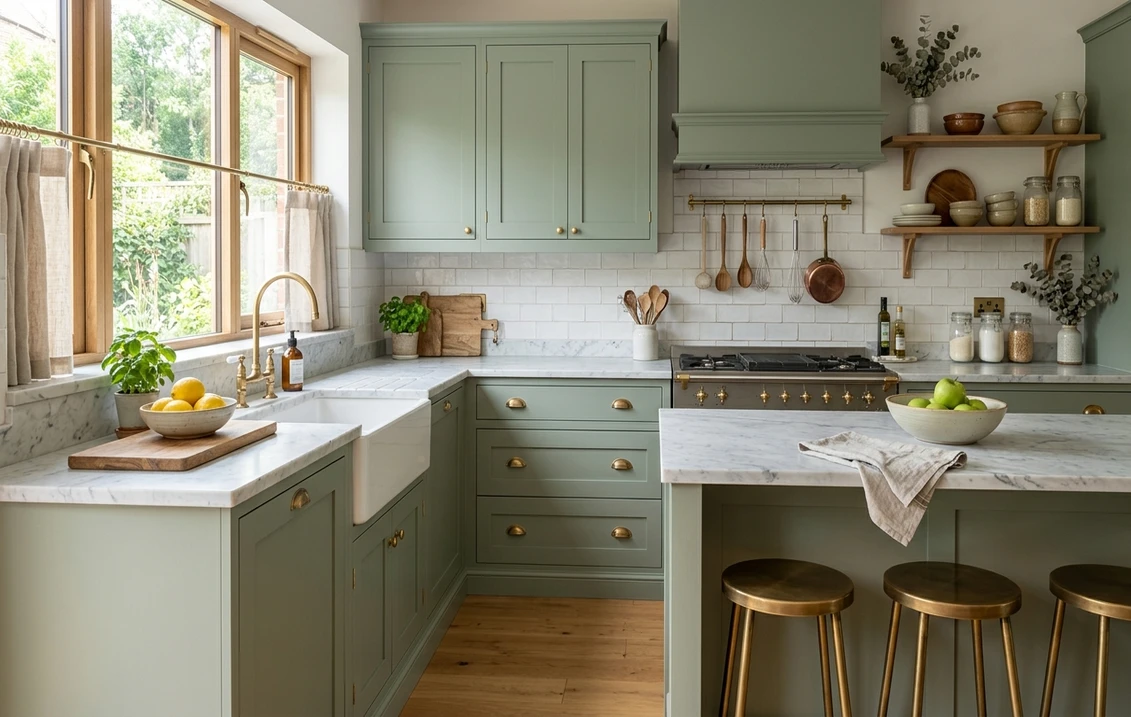
2. Soft green: SW Evergreen Fog (SW 9130)
Evergreen Fog is a gray-green at LRV 30.402 (RGB 149, 151, 138): a mid-tone, not a forest green. Across a full run of doors under kitchen downlights it lands lighter than many people expect from the name. If you want the same family genuinely dark, SW Retreat (SW 6207) sits at LRV 20.869. Our green kitchen cabinet colors ranks the greens lightest to deepest.
3. Classic navy: SW Naval (SW 6244)
Naval is a deep navy at LRV 4.458 (RGB 47, 61, 76), dark enough to read almost black in a dim kitchen and clearly blue in daylight. It hides fingerprints better than white and is at its best on lower cabinets or an island in a kitchen with good natural light.
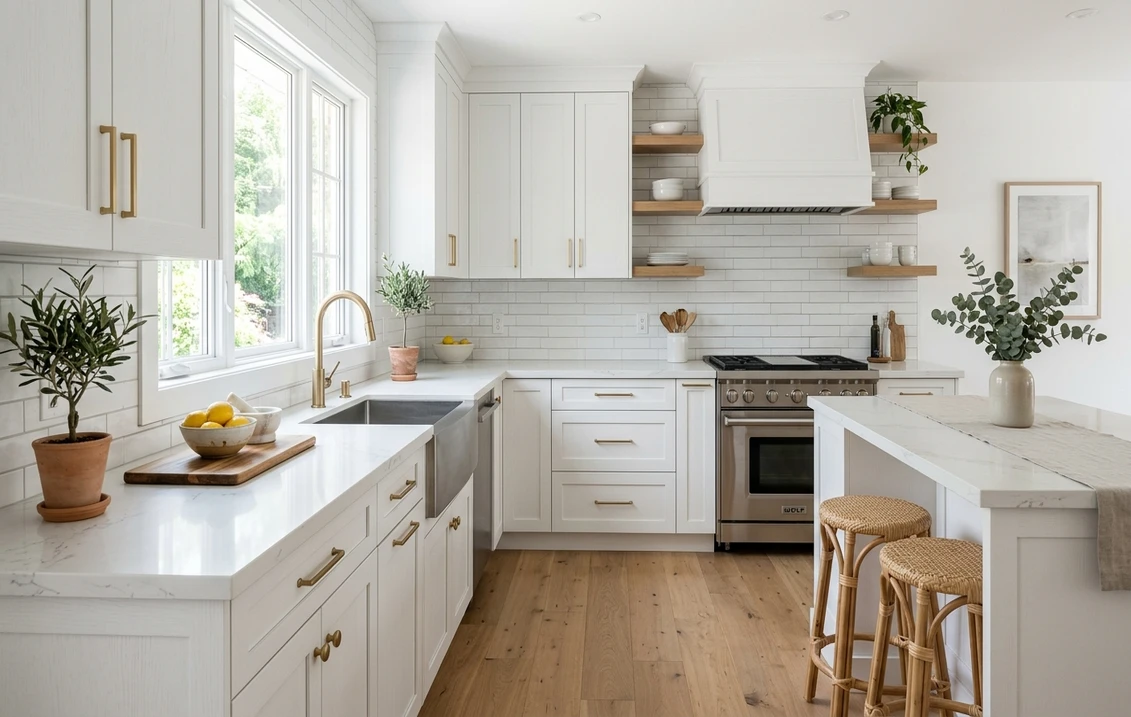
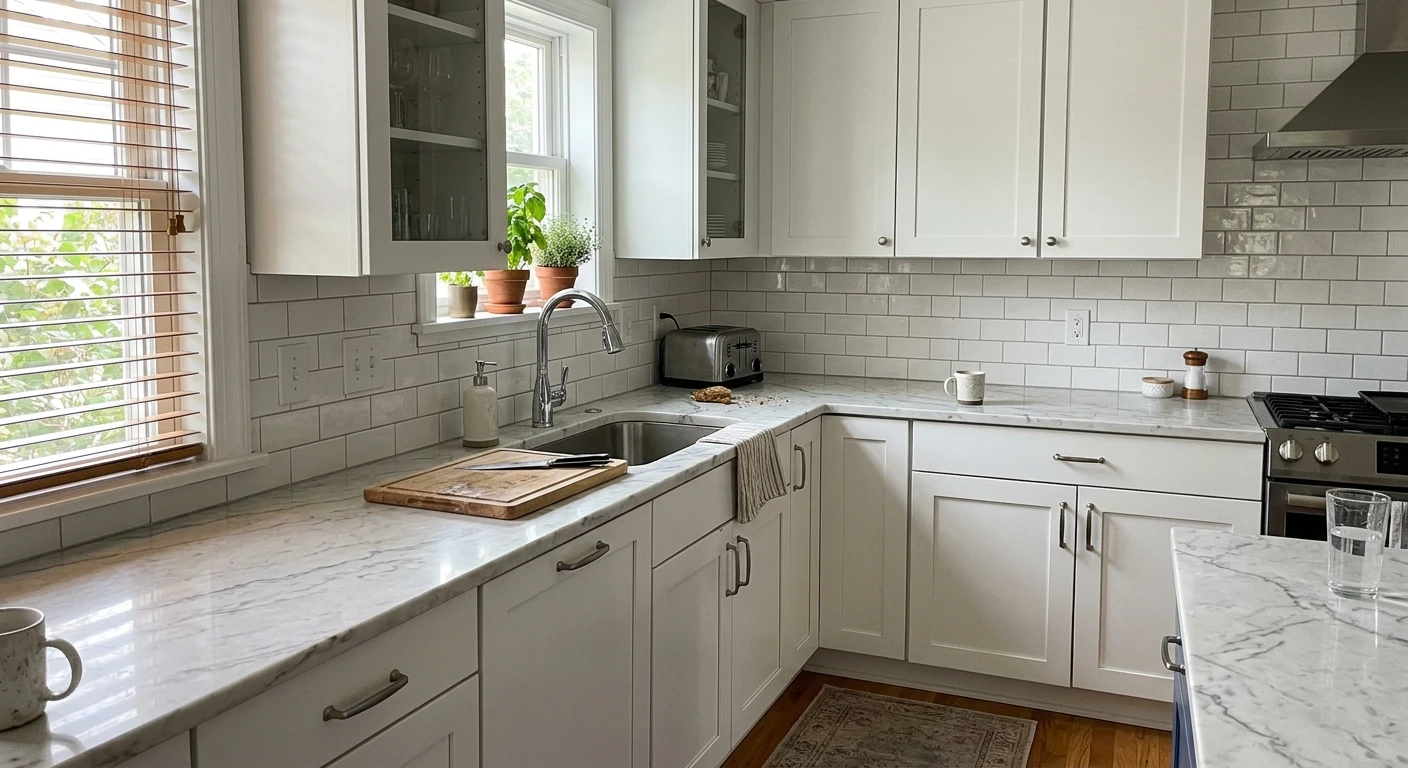
4. Warm white: BM White Dove (OC-17)
White Dove (LRV 83.16) is the warm white cabinet painters reach for when a stark white would look clinical under LED lighting. If you want a cleaner, crisper white, Benjamin Moore's Simply White OC-117 is lighter at LRV 89.52, "the slightest hint of warmth" in the maker's words; our Simply White review compares them.
5. Soft near-black: SW Iron Ore (SW 7069)
Iron Ore (LRV 5.55, RGB 67, 67, 65) is the softer alternative to true black: dark and dramatic, with a whisper of warmth. It is the go-to for a statement island with white quartz.
6. Espresso charcoal: BM Silhouette (AF-655)
Silhouette, Benjamin Moore's 2026 Color of the Year (report), is described by the maker as weaving "rich espresso hues with refined notes of charcoal", at LRV 10.18. On cabinets it reads as a deep brown-charcoal that warms a kitchen the way black does not; the brown kitchen cabinet colors guide covers the rest of the espresso family.
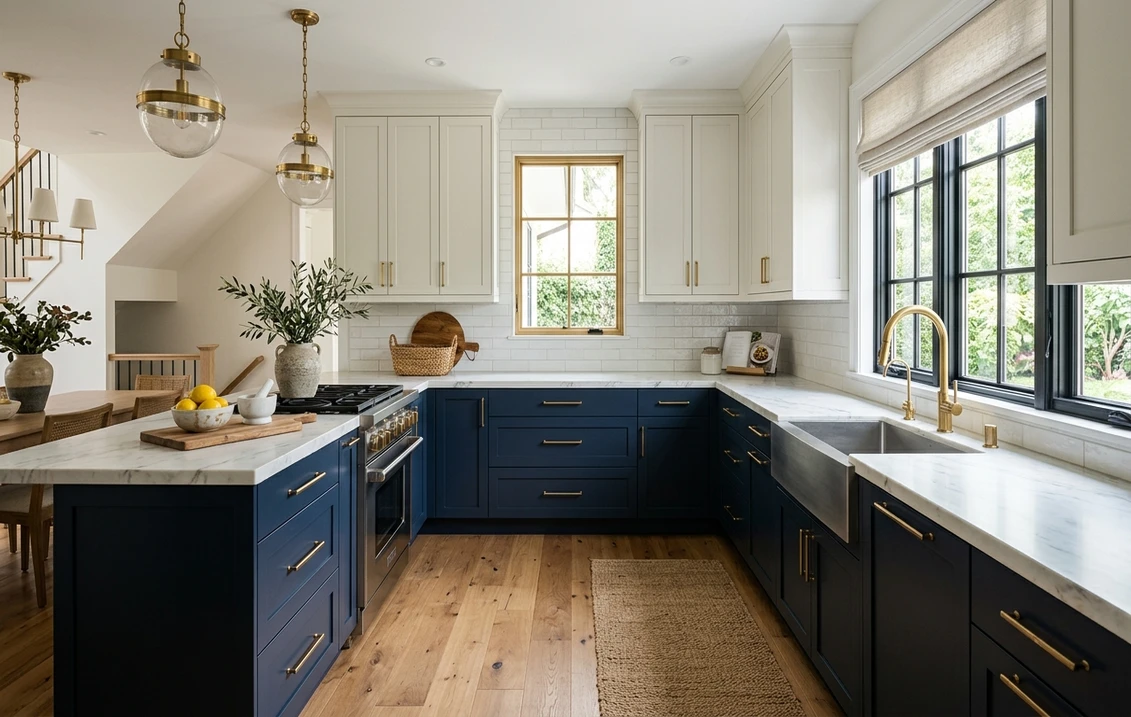
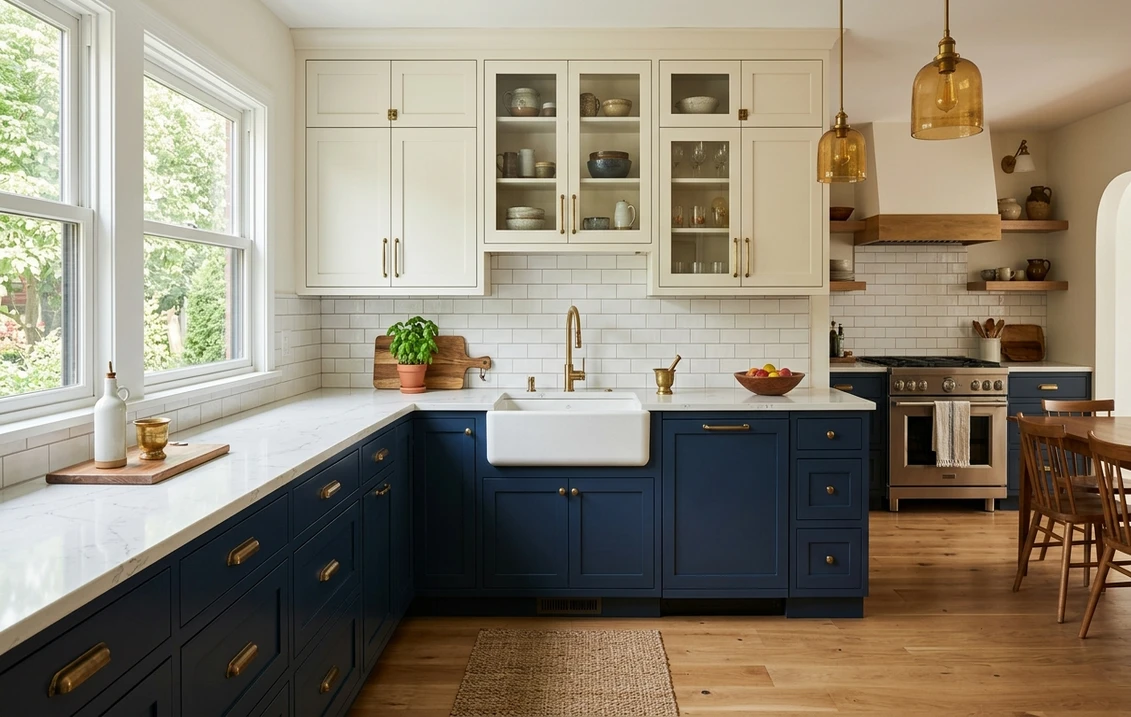
7. Two-tone: White Dove uppers, Naval lowers
Pairing a warm white above with a navy below keeps a small kitchen light at eye level and grounds it at the floor. The LRV gap does the work: 83.16 against 4.458 is a strong, clean contrast. Keep hardware, counters and backsplash neutral so the color split carries the design.
8. True black: SW Tricorn Black (SW 6258)
Tricorn Black sits at LRV 2.849 (RGB 47, 47, 48), effectively undertone-free. It looks sharp in satin or semi-gloss on an island; on every cabinet in a small galley kitchen it absorbs most of the light. Our black kitchen cabinets guide compares the blacks.
9. Natural wood: white oak and walnut
Not paint, but the trend paint competes with: stained or clear-finished oak and walnut doors for a warm, Japandi-style kitchen. If replacing doors is out of budget, a mocha or espresso enamel such as Silhouette reproduces the warmth on the doors you already own, with one honest difference: stain shows the grain, paint covers it.
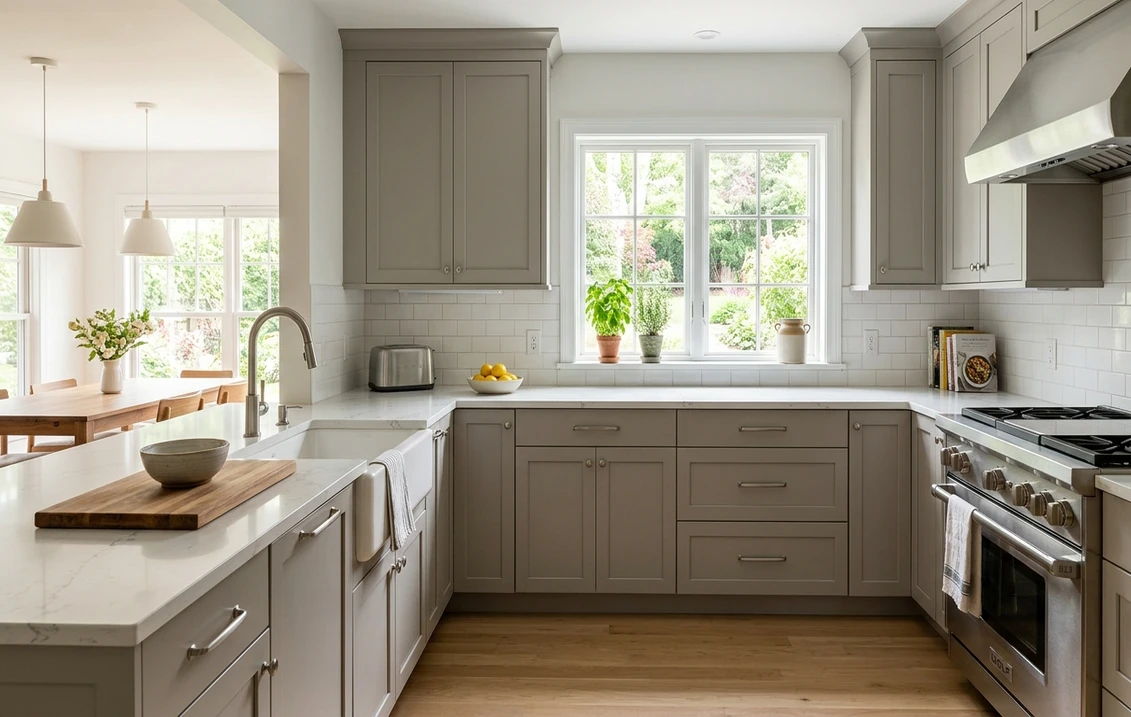
10. Greige: SW Agreeable Gray (SW 7029)
Agreeable Gray (LRV 60.386) is warm enough for wood floors and cool enough for stainless appliances, a low-risk perimeter color with a darker island. Our gray kitchen paint ideas work through which grays survive 4000K lighting.
11. Warm taupe: BM Revere Pewter (HC-172)
Revere Pewter (LRV 55.05) is a deeper greige than Agreeable Gray, earthy and forgiving with brass or matte-black pulls in traditional and transitional kitchens.
12. Muted sage: SW Oyster Bay (SW 6206)
Oyster Bay (LRV 44.121, RGB 174, 179, 169) is the lighter, grayer cousin of Evergreen Fog. It reads blue-green-gray depending on the light and suits kitchens where a deeper green would feel heavy.
13. Navy alternative: BM Hale Navy (HC-154)
Hale Navy is "a use-anywhere shade of navy with a classic maritime feel" at LRV 8.36: lighter than Naval, so it reads bluer in a darker kitchen.
14. Muted terracotta: SW Canyon Clay (SW 6054)
Canyon Clay (LRV 12.726, RGB 133, 89, 79) is a deep, dusty clay red. It gives a Southwest or Mediterranean kitchen character on lower cabinets or a single run of pantry doors without feeling themed.
15. Deep red: BM New London Burgundy (HC-61)
New London Burgundy, "a distinguished deep red with brown undertones" at LRV 9.82, behaves like a dark neutral on an island and pairs with brass and warm wood.
Hardware, Counters and Walls: Pairings by Color Family
Whites (White Dove, Simply White): almost any hardware works; brass reads warm and traditional, matte black reads modern farmhouse. Keep the walls a step away from the cabinet white, or the doors disappear; a pale greige such as Agreeable Gray gives definition.
Khaki and greige (Universal Khaki, Agreeable Gray, Revere Pewter): brass and bronze pulls, butcher block or warm quartz, and a warm white on the walls. These mid-tones are the easiest to live with when the floor is wood.
Greens (Evergreen Fog, Oyster Bay, Retreat): unlacquered brass is the classic match; white quartz and a white or cream backsplash keep the green the focus. The lighter Oyster Bay suits nickel or chrome too.
Navies (Naval, Hale Navy): brass for a club-room feel, polished nickel for a crisp coastal one; white counters make the blue read bluer, gray counters make it read darker.
Near-blacks and espresso (Iron Ore, Tricorn Black, Silhouette): brass glows against all three; on Tricorn Black, matte black hardware nearly disappears, which suits a minimalist kitchen. Pair with a light counter so the room does not lose its light.
Reds and clays (Canyon Clay, New London Burgundy): antique brass, warm wood and creamy counters; avoid cool gray quartz, which makes the reds look muddy.
Quick-Reference Table: All 15 Colors with SW & BM Codes
| # | Color | Code | LRV (maker) | Best on |
|---|---|---|---|---|
| 1 | Universal Khaki | SW 6150 | 40.478 | All cabinets, warm kitchens |
| 2 | Evergreen Fog | SW 9130 | 30.402 | All cabinets, brass hardware |
| 3 | Naval | SW 6244 | 4.458 | Lowers, island |
| 4 | White Dove | BM OC-17 | 83.16 | Uppers, whole kitchen |
| 5 | Iron Ore | SW 7069 | 5.55 | Island, lowers |
| 6 | Silhouette | BM AF-655 | 10.18 | Island, warm wood kitchens |
| 7 | White Dove + Naval | OC-17 / SW 6244 | 83.16 / 4.458 | Two-tone |
| 8 | Tricorn Black | SW 6258 | 2.849 | Island in a large kitchen |
| 9 | White oak / walnut | stain | n/a | New doors |
| 10 | Agreeable Gray | SW 7029 | 60.386 | Perimeter, resale |
| 11 | Revere Pewter | BM HC-172 | 55.05 | Traditional kitchens |
| 12 | Oyster Bay | SW 6206 | 44.121 | North-facing kitchens |
| 13 | Hale Navy | BM HC-154 | 8.36 | Lowers, darker kitchens |
| 14 | Canyon Clay | SW 6054 | 12.726 | Lowers, pantry doors |
| 15 | New London Burgundy | BM HC-61 | 9.82 | Island |
Try it on your house
No photo? Try a sample
A practical rule from the numbers: below about LRV 15, a color reads dark on a full run of cabinets and suits an island or the lower half; between 30 and 60 it reads as a color you can use everywhere; above 80 it reads white. Two-tone kitchens work best with at least 40 points between the two colors.
Best Cabinet Paint Brands: What Pros Actually Use
Cabinets need a finish that levels out brush marks and cures hard enough to take daily handling. That is why cabinet painters use waterborne alkyd or urethane-modified enamels rather than wall paint. Benjamin Moore's ADVANCE Interior Paint is "a premium quality, waterborne alkyd paint" that the maker lists for cabinets, trim and doors: dry in 4 to 6 hours, recoat after 16 hours, return to service after 7 days, 400 to 450 square feet per gallon, soap-and-water cleanup. The long recoat time is the price of the leveling. Sherwin-Williams sells its own urethane-modified Emerald Urethane Trim Enamel for the same job; check the current data sheet at the store for its drying times.
On sheen, satin is the usual compromise for cabinet doors: easier to wipe than eggshell, more forgiving of small flaws than semi-gloss. Dark colors such as Naval or Tricorn Black show every fingerprint in high gloss, and pale ones show every dent.
The DIY Process: Prep, Sanding and Painting
- Remove doors and hardware, label everything. Painting doors flat on stands gives a better finish than painting them hung.
- Degrease thoroughly. Kitchen grease is invisible and kills adhesion; clean every face and edge, rinse and let dry.
- Scuff-sand. A light sanding dulls the old finish so the primer can grip; vacuum and tack off the dust.
- Prime with a bonding primer. Zinsser's data sheet for Bulls Eye 1-2-3 says it has "excellent adhesion to dense glossy surfaces such as enamel paints and varnishes, paneling, laminates, and ceramic tile without sanding or de-glossing", topcoat in 1 hour (Rust-Oleum, Bulls Eye 1-2-3 TDS). Even so, scuffing first is cheap insurance on old varnished oak.
- Two finish coats. Thin coats, brushed or sprayed, respecting the recoat time on the can (16 hours for ADVANCE).
- Let it cure before rehanging. Seven days to return to service for ADVANCE; doors closed too early stick and mark.
If the house was built before 1978, the cabinets may carry lead paint under later coats. The EPA's rule covers "anyone paid to perform work that disturbs painted surfaces in homes, childcare facilities and preschools built before 1978"; homeowners working on their own home are generally not covered but are advised to follow lead-safe work practices (EPA, Lead Renovation, Repair and Painting Program). Test before sanding old finishes.
How Much Paint a Kitchen Needs
Measure rather than guess: add up the area of every door and drawer front, double it for both faces, and add the visible cabinet boxes and face frames. A kitchen with 20 doors averaging 4 square feet each has about 160 square feet of door faces, plus perhaps 60 square feet of frames and end panels, so roughly 220 square feet per coat. At ADVANCE's 400 to 450 square feet per gallon, two coats need about a gallon, with a quart extra for touch-ups and a quart or two of primer. Buy the whole job from one batch so the doors match. For labor and full-room budgets, see our interior painting cost guide, and for the white end of the range, the white kitchen paint ideas.
Sources and references
- Sherwin-Williams, 2026 Color of the Year (Universal Khaki) and color pages for Universal Khaki, Evergreen Fog, Retreat, Naval, Iron Ore, Tricorn Black, Agreeable Gray, Oyster Bay and Canyon Clay: LRV and RGB.
- Benjamin Moore color pages for White Dove, Simply White, Silhouette, Revere Pewter, Hale Navy and New London Burgundy (LRV, descriptions) and ADVANCE Interior Paint (resin, uses, drying, recoat, coverage).
- FOX6 News, 2026 paint colors of the year: Benjamin Moore Silhouette.
- Rust-Oleum, Zinsser Bulls Eye 1-2-3 technical data: adhesion to glossy surfaces and laminates.
- U.S. EPA, Lead Renovation, Repair and Painting Program.
Frequently asked questions
What is the most popular kitchen cabinet color for 2026?
What are the best colors for kitchen cabinets in 2026?
What paint is best for kitchen cabinets?
Do I need to sand cabinets before painting them?
How much paint do I need for kitchen cabinets?
Are two-tone kitchen cabinets still in style?
Trademarks mentioned (Sherwin-Williams, Benjamin Moore, Behr, Caparol, Brillux, Sto, Alpina, Valspar, PPG, Glidden, Dulux, Crown Trade, Sandtex, Farrow & Ball, Johnstone's, Leyland) are property of their respective owners. FacadeColorizer is independent and not affiliated with any of them. Nominative fair use under Lanham Act §1125.