Try it on your room

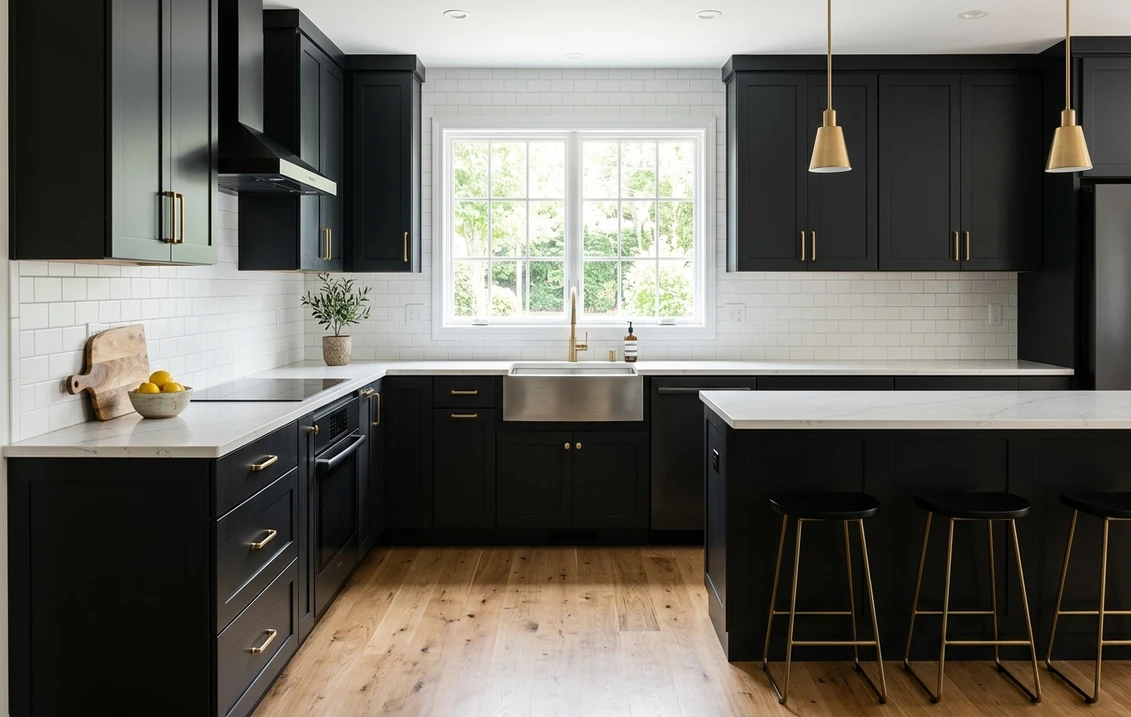
There is no single "black" in a paint deck, and that catches people out. Sherwin-Williams alone publishes more than a dozen colors a homeowner would call black, from a flat, light-swallowing true black at LRV 3 to a soft warm off-black that reads closer to deep charcoal. On black kitchen cabinets, that few-point gap in Light Reflectance Value separates a kitchen that reads crisp and architectural from one that reads heavy, blue, or plain dirty by lunchtime.
Black is the least forgiving cabinet color to guess from a chip, so preview it first: upload a photo of your kitchen to the free cabinet color visualizer and compare a true black against a warm off-black on your own doors.
This guide tests the ten black cabinet colors that hold up in real US kitchens: exact codes, published LRV, each one's undertone, the finish decision that matters more than the color, and the pairings that keep a black kitchen from feeling like a cave. Weighing black against lighter neutrals? Our pillar complete kitchen cabinet color guide compares the major families.
Upload one kitchen photo and preview true black, soft off-black, and warm near-black on your real cabinets in 30 seconds.
True black vs off-black: the decision that comes before color
Between true black and gray sits the neutral charcoal. On the makers' pages, Tricorn Black is LRV 2.849, Iron Ore 5.55 with a whisper of warmth, and Peppercorn 9.681 with perfectly equal RGB values: on an island, Peppercorn reads as a soft charcoal that shows dust less than black, as our Peppercorn guide explains.
Black cabinet colors fall into two camps, and picking the wrong one is the most common regret. A true black (roughly LRV 3 to 4) absorbs almost all light, giving the sharpest, most graphic contrast against white counters and brass. The trade-off: it is unforgiving, so every fingerprint and lap mark shows, and in a small or low-light kitchen it can close the room in.
A soft or off-black (roughly LRV 5 to 10) carries a visible undertone (warm green-brown, charcoal-blue, or brown) that keeps depth in the recesses. These read "almost black" in person, photograph more forgivingly, and feel warmer, which is why the modern-farmhouse kitchens that flooded Pinterest after 2020 leaned on an off-black. Neither camp is "better": a north-facing galley wants an off-black's warmth, while a bright open-plan kitchen can carry a true black. To see why the same can reads so differently wall to wall, our interior paint color families guide breaks down undertones and LRV in plain English.
The 10 best black cabinet paint colors for 2026
These are the blacks US cabinet painters and designers reach for most often. LRV figures come from the manufacturers' published data; on a sprayed satin door, a black typically reads one to two points darker than the chip.
| Color | Code | LRV | Undertone / character |
|---|---|---|---|
| Tricorn Black | SW 6258 | 3 | Near-neutral true black, the crispest of the group |
| Caviar | SW 6990 | 3 | True black with a faint cool blue-violet undertone |
| Black Magic | SW 6991 | 3 | Inky near-black with a subtle warm red-brown depth |
| Iron Ore | SW 7069 | 6 | Warm green-brown off-black, the modern-farmhouse default |
| Peppercorn | SW 7674 | 10 | Soft charcoal-black, reads almost-black, very forgiving |
| Urbane Bronze | SW 7048 | ~8 | Warm brown-black, cozier and less stark |
| Onyx | BM 2133-10 | ~5 | Benjamin Moore true black, clean and graphic |
| Black Beauty | BM 2128-10 | ~5 | Warm off-black with a soft brown undertone |
| Wrought Iron | BM 2124-10 | 6 | Charcoal-blue off-black, the BM answer to Iron Ore |
| Cracked Pepper | Behr PPU18-01 | ~8 | Deep charcoal with a thin cool, slightly blue bias |
Try it on your room
No photo? Try a sample
Sources: Sherwin-Williams, Benjamin Moore, and Behr published technical data sheets, 2026. LRV marked with ~ is the manufacturer's listed approximate value.
The true blacks: Tricorn Black, Caviar, Onyx
Want the sharp, high-contrast, gallery look? Start here. Tricorn Black (SW 6258, LRV 3) is the cleanest, most neutral black Sherwin-Williams sells. There is no obvious blue or brown to throw off white counters, so it is the pick when you want black to just be black. Caviar (SW 6990, LRV 3) is just as dark but carries a faint cool blue-violet undertone that adds depth. Over on the Benjamin Moore side, Onyx (2133-10, LRV ~5) is the equivalent clean true black. Fair warning on all three: they demand good prep and a sprayed finish, because a flat true black shows every imperfection.
The warm off-blacks: Iron Ore, Urbane Bronze, Black Magic, Black Beauty
This is the most popular camp, and the most popular cabinet near-black of recent years. Iron Ore (SW 7069, LRV 6) is the modern-farmhouse default: a warm green-brown undertone keeps it from going cold and pairs naturally with white oak, brass, and creamy whites. Urbane Bronze (SW 7048, around LRV 8), Sherwin-Williams' 2021 Color of the Year, pushes further toward brown, reading more like "deep espresso-bronze," cozy with warm woods and stone. For a true near-black that still feels warm, Black Magic (SW 6991, LRV 3) is an inky black with a subtle red-brown depth, and Benjamin Moore's Black Beauty (2128-10, LRV ~5) is a warm off-black with a soft brown undertone. All four hide daily smudges far better than a flat true black.
The cool and blue-leaning blacks: Wrought Iron, Caviar, Cracked Pepper
A faint cool or blue undertone reads crisp and contemporary, especially alongside stainless and cool-gray quartz. Wrought Iron (BM 2124-10, LRV 6) is the charcoal-blue off-black that plays Iron Ore's role for Benjamin Moore, only cooler. Caviar (SW 6990, LRV 3), covered above, fits here too on the strength of its blue-violet undertone. Behr's Cracked Pepper (PPU18-01, LRV ~8) is a lighter, deep charcoal rather than a true black, with a thin cool, slightly blue bias. Watch all three under warm 2700K bulbs, where the undertone can drift slightly purple at night.
The almost-black for the nervous: Peppercorn
If "true black" feels like a leap, Peppercorn (SW 7674, LRV 10) is the off-ramp. Technically a deep charcoal, in a kitchen it reads as a soft, sophisticated black that still keeps a sliver of light in the grooves of a shaker door. It is the most forgiving color here for fingerprints and uneven light, and a smart pick for a smaller room.
Put Tricorn Black, Iron Ore, and Peppercorn on your photo, free.
Sheen matters more than the color on black cabinets
This is the part most color articles skip. On a black cabinet the finish (sheen) changes the look as much as the color name does, because there is no light color to hide reflections.
- Matte / dead-flat: dramatic and velvety, and the best at hiding flaws. The catch is cleaning. It fights you when you wipe, so reserve it for cabinets that escape greasy hands.
- Satin: what most pro cabinet painters spray, and the safe default. It wipes clean, shrugs off fingerprints reasonably well, and gives a soft low glow rather than a mirror.
- Semi-gloss: tough and easy to clean, but it bounces back every light and shows dust on a black door. Keep it to trim, not large cabinet faces.
Whatever sheen you pick, a sprayed or fine-foam-roller coat of furniture-grade enamel matters, because lap marks that vanish on white telegraph on a dark door. Budgeting the job? Our interior painting cost guide covers cabinet refinishing pricing and where a sprayed finish is worth paying for.
Lighting: which black your kitchen can actually carry
Black absorbs light, so how much light your kitchen gets, and at what color temperature, decides how dark the room feels:
- Bright, multi-window or open-plan kitchen: you can run a true black (Tricorn, Onyx) on full cabinetry without the room going cave-like.
- One window, north-facing, or galley: lean warm off-black (Iron Ore, Urbane Bronze, Peppercorn). The undertone and higher LRV keep the room from closing in, and the warmth counters cool north light.
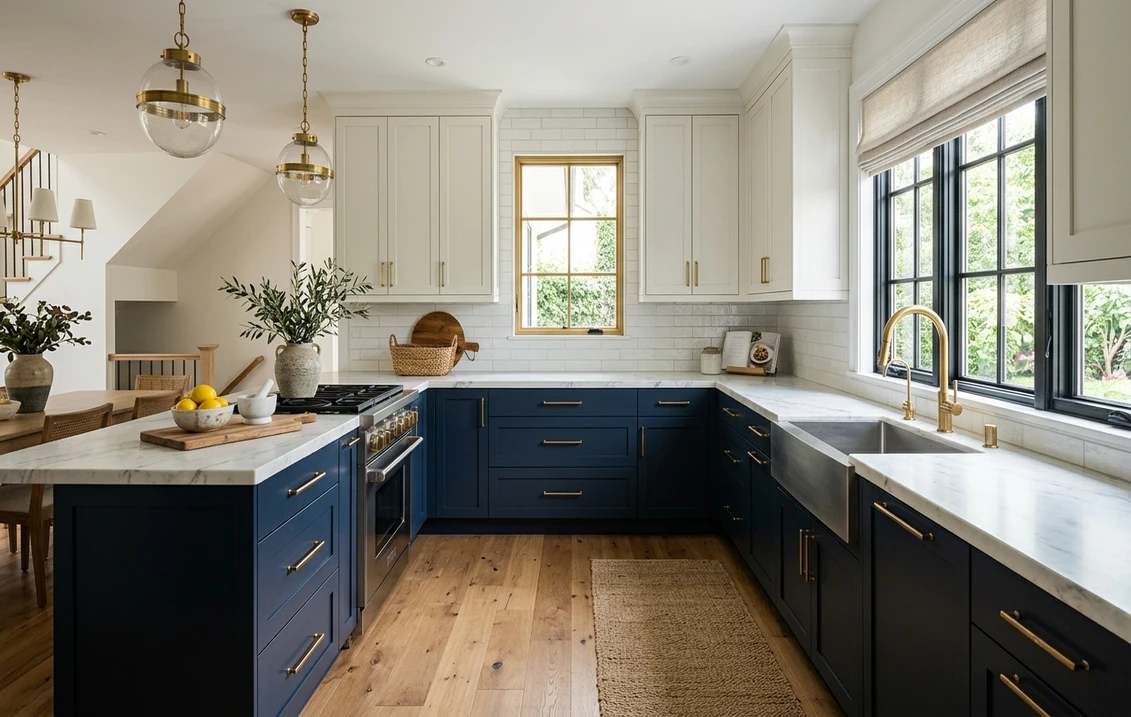
- Black on the island only: the lowest-risk option. Paired with light perimeter cabinets, it grounds the room while keeping it bright in almost any light.
Do not skip the under-cabinet lighting. With black it is close to non-negotiable. Dark faces eat the ambient light that white cabinets would have bounced onto the counter, so without it the worktop sits in shadow.
Countertops, backsplash, hardware, and trim for black cabinets
Black plays nicely with almost anything. What it pairs with is what decides whether the kitchen reads inviting or severe.
- Countertops: a white or warm-white quartz with light veining gives the classic high-contrast look; warm quartzite or honed soapstone leans moody. Skip a busy, multi-color granite that fights the cabinets.
- Backsplash: white subway tile is the safe, room-brightening default and the most forgiving with any black. A dark or green tile reads high-end and tonal but needs strong lighting to avoid going flat.
- Hardware: brushed brass or champagne bronze wins most kitchens, warming up the black where it meets your hand. Matte black reads ultra-modern but tends to vanish into the door, so save it for minimalist schemes. Want it cooler? Polished nickel and stainless do that.
- Trim, walls, and ceiling: a crisp warm white (in the LRV 80s) frames black cabinets cleanly. With a warm off-black like Iron Ore or Urbane Bronze, pick a warm white over a stark cool white so they do not clash with the cabinet's undertone.
Not sure black is your final answer? Compare it against the alternatives. Our guides to white kitchen cabinet colors and gray kitchen cabinet colors cover the lighter neutrals, while blue kitchen cabinet colors covers the deep navies that flirt with near-black. For the popular black-island-over-light-perimeter hybrid, see our white kitchen cabinets with oak guide.
How to test a black before you commit
A black chip is the least reliable swatch in the deck: matte and tiny, it cannot show how a satin sheen reflects, how the undertone behaves across a full door, or how dark the room gets. Test it for real:
- Paint a large sample. Two coats on poster board or a spare door, at least a square foot, in your planned sheen, taped to a real cabinet.
- Look at three moments. Mid-morning, mid-afternoon, and after dark under your evening lights, where the purple shift on cool blacks shows up.
- Judge it next to your real materials. Hold the sample against your countertop, backsplash, and hardware, not a white paint card.
Want a faster read with no paint at all? Use a visualizer. Upload a kitchen photo, drop each black onto your real cabinets, and watch the room go dark (or not). Our Sherwin-Williams vs Benjamin Moore interior comparison covers how the two brands' blacks and enamels differ, and our best interior paint colors for 2026 roundup sets black in the year's wider palette.
Free AI kitchen visualizer: see how dark your room gets before you buy.
Frequently asked questions
What is the best black for kitchen cabinets?
It depends on the look. For a crisp, high-contrast true black, Tricorn Black (SW 6258, LRV 3) is the cleanest and most neutral. For a warmer, more forgiving modern-farmhouse black, Iron Ore (SW 7069, LRV 6) is the most popular choice: its green-brown undertone keeps the cabinets from reading cold and pairs with white oak and brass.
Will black cabinets make my kitchen look small or dark?
Only in a low-light room, because black absorbs light. The fixes: pick a higher-LRV off-black like Peppercorn (SW 7674, LRV 10) over a true black, keep counters and backsplash light, add under-cabinet lighting, or limit black to the island. In a bright kitchen, even a true black stays balanced.
What sheen is best for black kitchen cabinets?
Satin is the practical default: it wipes clean, hides fingerprints reasonably well, and gives a soft low glow. Matte looks most dramatic and hides flaws best but is harder to keep clean. Semi-gloss is the most durable but reflects every light and shows imperfections, so keep it to trim rather than large cabinet faces.
What hardware and countertop go best with black cabinets?
Brushed brass or champagne bronze hardware is the most popular pairing, adding warmth against the black; matte black reads ultra-modern, and polished nickel keeps things cool. For countertops, a white or warm-white quartz with light veining gives the classic high-contrast look, while honed soapstone leans moodier.
Why do my black cabinets look blue or purple at night?
Cool, blue-leaning blacks (such as Wrought Iron, Caviar, or Cracked Pepper) can drift toward blue or purple under warm 2700K LED bulbs after dark, because the warm light exaggerates their cool undertone. To keep black neutral at night, choose a near-neutral true black like Tricorn Black or a warm off-black like Iron Ore, and always test your finalist under your actual evening lighting.
See your kitchen in true black, warm off-black, and soft almost-black, free.
Disclaimer: Sherwin-Williams, Benjamin Moore, and Behr, along with the color names and codes above, are trademarks of their respective owners. FacadeColorizer is an independent paint visualization service and is not affiliated with, endorsed by, or sponsored by Sherwin-Williams, Benjamin Moore, or Behr. Color reproduction on screens approximates the manufacturer's chip; always confirm with a sample before purchase. Sources: Sherwin-Williams, Benjamin Moore, and Behr published technical data sheets (2026 LRV values), and designer color references from The Spruce and Better Homes & Gardens cabinet color roundups.
Trademarks mentioned (Sherwin-Williams, Benjamin Moore, Behr, Caparol, Brillux, Sto, Alpina, Valspar, PPG, Glidden, Dulux, Crown Trade, Sandtex, Farrow & Ball, Johnstone's, Leyland) are property of their respective owners. FacadeColorizer is independent and not affiliated with any of them. Nominative fair use under Lanham Act §1125.