Try it on your room

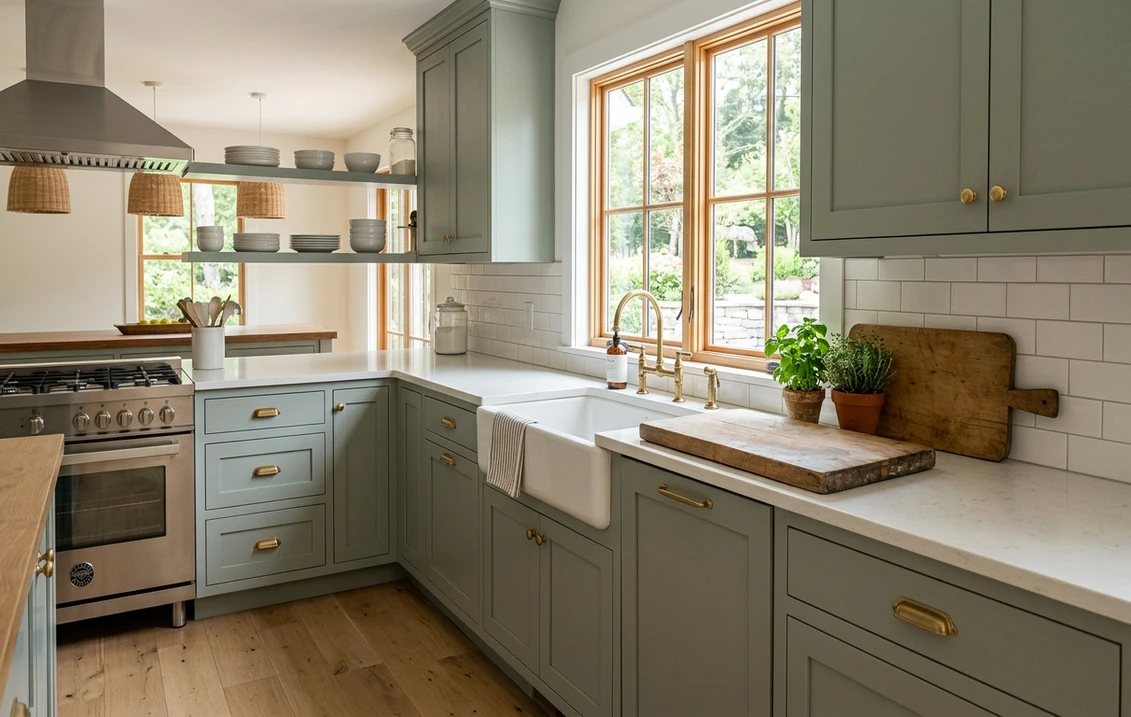
Two cans labeled "sage" can build two completely different kitchens. One reads like a calm, sun-warmed herb garden; the other reads like dishwater under a cloudy sky, or worse, slides straight back into 1970s avocado. The word covers a wide band of muted gray-greens, and the difference between the version that feels timeless and the one that feels tired is often just two or three percent of yellow or gray hiding in the base. That is the whole challenge of sage green kitchen cabinets: the family is forgiving and on-trend, but the specific shade has to match your light.
This profile narrows the field to ten sage and sage-adjacent paints that US cabinet painters actually reach for, each with its code, published Light Reflectance Value (LRV), and true undertone, sorted from palest to deepest. It is the sage chapter of our complete kitchen cabinet color guide.
Upload one photo and preview Evergreen Fog, October Mist, and more on your actual cabinets in about 30 seconds, free.
The 10 best sage green cabinet colors
These are the sages that keep showing up on real US kitchen projects, palest to deepest. Codes and LRV come from the manufacturers' published data; the undertone notes describe how each behaves on a painted door, not just on the chip.
| Color | Code | Approx. LRV | Undertone and lean |
|---|---|---|---|
| SW Sea Salt | SW 6204 | 63 | Palest sage, green-gray with a soft blue lean |
| SW Softened Green | SW 6177 | 49 | Warm herbal sage, yellow lean |
| BM October Mist | 1495 | 47 | Soft silvery sage, gentle gray |
| SW Clary Sage | SW 6178 | 41 | Classic earthy sage, soft warmth |
| SW Svelte Sage | SW 6164 | 35 to 41 | Muted greige-sage, balanced |
| SW Acacia Haze | SW 9132 | 32 | Cool gray-green, faint blue base |
| SW Evergreen Fog | SW 9130 | 30 | Muted gray-green, whisper of warmth |
| SW Retreat | SW 6207 | 21 | Deep muted sage, clear gray |
| BM Cushing Green | HC-125 | 18 | Deep sage, soft gray base |
| SW Pewter Green | SW 6208 | 12 | Deepest sage, smoky slate-green |
Try it on your room
No photo? Try a sample
Sources: Sherwin-Williams and Benjamin Moore published color and LRV data 2026. LRV is approximate and rounded; published figures vary slightly by source, so confirm against the manufacturer's current technical data sheet before purchase.
The two sages most kitchens land on
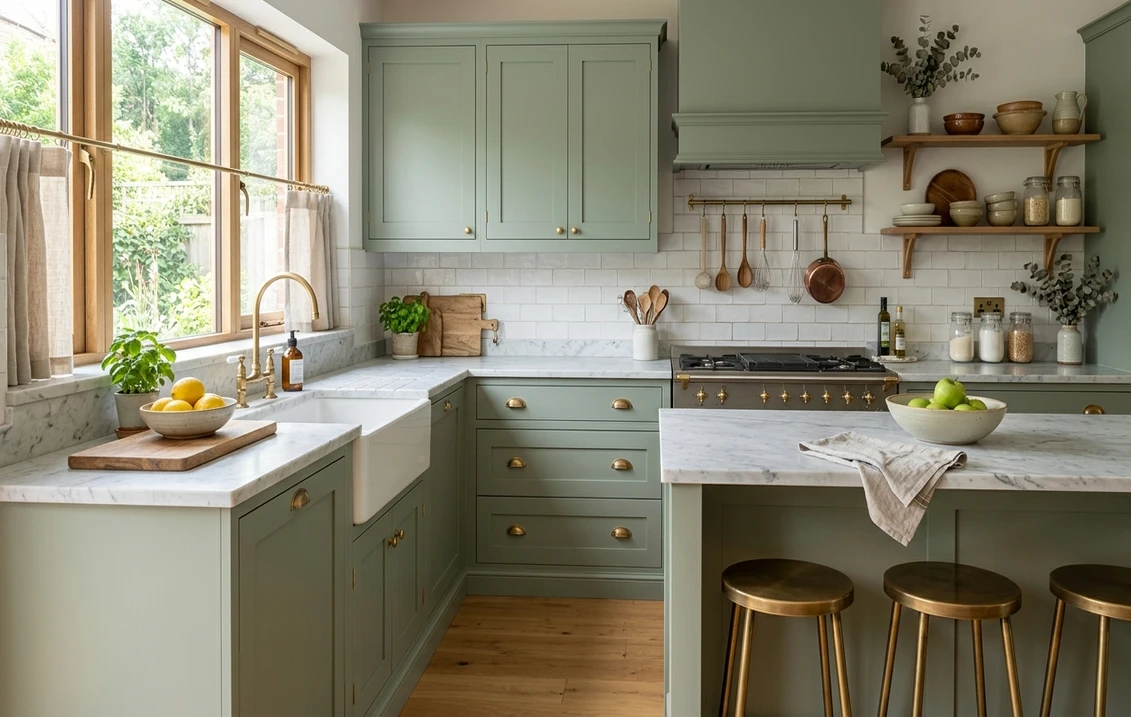
If you only test two, make them these. Sherwin-Williams Evergreen Fog (SW 9130) is the breakout cabinet sage of recent years and a former Color of the Year. At LRV 30 it is dark enough to read as a real decision but soft enough to stay calm in a busy kitchen, and its gray-green base with a faint warmth sidesteps both the cold-slate trap and the avocado trap. Think "sage, but the grown-up version." It plays nicely with white quartz, warm oak, and brass without any fuss.
Benjamin Moore October Mist (1495) is the softer counterpart and a Color of the Year of its own, one of the lightest popular sages here at LRV 47. It barely reads as a color at all. Light enough to keep a small or low-light kitchen open and gently silvery, it is the sage to reach for when you are nervous about committing. If a full kitchen of darker green feels like a leap, this is the gateway shade, and it sits comfortably next to the warm-white tones in our white kitchen cabinet color profile.
Warm sage or gray sage: pick your lean first
Most sage disappointments come from choosing the wrong lean, not the wrong brightness, so decide which direction you want first. (New to undertones? Our interior paint color families guide explains warm versus cool in plain terms.)
Warm, herbal sages lean yellow. They feel organic, a little farmhouse. Softened Green (SW 6177, LRV 49) is the herbal standard, a sage that looks freshly picked in good light, and Clary Sage (SW 6178, LRV 41) is the classic earthy version that dominated the early sage wave. Both glow next to wood and brass, but both are the most likely to tip toward olive in strong afternoon sun, so they need a sanity check under your own light.
Cool, gray sages swap that yellow for gray and a whisper of blue, so they come across quieter and more architectural. Acacia Haze (SW 9132, LRV 32) is the cleanest gray-green of the group, almost mistakable for a soft gray in dim light, while Svelte Sage (SW 6164), in the mid-30s to low-40s LRV depending on the source, splits the difference as a balanced greige-sage. These cooler sages are the safer pick in a sunny south or west kitchen. If a sage starts reading more like a moody neutral than a color, you are drifting into gray cabinet territory, which that profile covers in detail.
Put Clary Sage and Acacia Haze side by side on your real cabinets before buying a sample, free.
Going deeper: sage for islands and two-tone kitchens
The lower-LRV end of the family adds drama without the harshness of a true forest green. SW Retreat (SW 6207, LRV 21) is a gray-based sage that anchors a room without going near-black; BM Cushing Green (HC-125, LRV 18) is a touch deeper, a soft gray-green that still keeps a whole kitchen feeling like color; and SW Pewter Green (SW 6208, LRV 12) is the deepest pick, a smoky slate-green that flirts with charcoal in low light and turns clearly green in sun, built for islands, two-tone lowers, and butler's pantries.
The two-tone move that defines 2026 kitchens is one of these deep sages on the island and lowers with white or warm-white uppers. If your uppers are staying wood, deep sage lowers pair naturally with honey and white oak, the logic we cover in our white cabinets with oak guide.
How your kitchen's light changes sage
Sage is one of the more light-sensitive cabinet colors because it sits so close to neutral, so a small shift in the light can tip it warm, cold, or flat. Match the shade to the orientation you have.
- North-facing kitchens get cool, indirect light that pulls sage toward gray and can drain a muted shade until it reads like dishwater. Lean a step warmer or deeper than the chip; Evergreen Fog and the warm sages hold up, while a very gray sage can go cold.
- South-facing kitchens get warm, abundant light that pushes sage toward yellow, the conditions where warm sages such as Softened Green and Clary Sage most often edge into olive. A cooler, grayer sage stays better balanced and uses the extra brightness well.
- East and west kitchens swing through the day: a mid sage reads warm at breakfast in an east room and calmer by dinner, while a west room's golden late light can over-warm a yellow-based sage at dinnertime, where a gray-balanced sage keeps its composure.
Bulbs matter as much as the window. Warm 2700K bulbs enrich a sage but can push a warm one toward olive after dark; cooler 3500K to 4000K bulbs keep gray sages crisp but can flatten a warm sage at night. The same north-light logic from our best interior paint colors of 2026 roundup applies to sage.
Countertops, hardware, backsplash, and walls
Sage plays well with others. Even so, the finishes around it are what decide whether it reads fresh or muddy, and a few reliable pairings carry almost every shade on this list.
- Countertops: white and warm-white quartz is the default and lets the green stay the star; for warm sages, a creamy quartz or honed marble with soft gray veining looks beautiful. Avoid stark blue-white quartz against a yellow-based sage, where the clash makes both look off.
- Hardware: brass and unlacquered (living) brass are the signature pairing, the warm metal balancing sage's cool side. Matte black reads more modern, especially with deeper sages; polished nickel stays crisp and traditional.
- Backsplash: white subway tile, warm-white zellige, and honed marble all work, ideally with a warm-white grout so the kitchen does not feel stark.
- Walls, trim, and floors: a soft warm white on the walls (LRV 80s) with crisp white trim gives the contrast that makes the green pop. White oak floors are the classic partner; balance a deep sage with lighter surfaces so a small kitchen does not close in.
How to test a sage before you commit
A 2-inch fan-deck chip is the worst way to choose a sage: it reads lighter than a painted door and hides the undertone that decides everything, and painting cabinets is the most expensive color choice in the kitchen to undo. Two better methods, in order of speed:
- Digital preview first. Upload a photo of your kitchen into our paint visualizer and apply several sages virtually. Nothing rules out the wrong leans faster, and you can hold a warm herbal sage against a cool gray-green before spending a cent on samples.
- Then a real sample on the door. Paint a large swatch of your final two on a cabinet door or a movable poster board and check it mid-morning, late afternoon, and after dark under your own bulbs, the only way to catch the olive and flat-gray shifts described above.
To weigh the brands first, our Sherwin-Williams vs Benjamin Moore comparison covers durability, sheen, and how each line handles muted colors, and our interior painting cost guide sets realistic expectations for what a sage refresh costs in 2026. If sage turns out to be a half-step too far, the blue cabinet profile sits right next to it on the wheel.
Skip the wasted sample pots. Preview your top sages on your own kitchen photo, free.
Frequently asked questions
What is the most popular sage green for kitchen cabinets?
Sherwin-Williams Evergreen Fog (SW 9130, LRV 30) is the standout, a muted gray-green with a hint of warmth that reads as a grown-up sage. Benjamin Moore October Mist (1495, LRV 47) is the softer, lighter alternative for first-timers, and Sherwin-Williams Pewter Green (SW 6208, LRV 12) is the deep pick for islands and two-tone kitchens.
How do I keep sage cabinets from looking dated or avocado?
The dated look comes from too much yellow in the base tipping a sage toward 1970s avocado, usually made worse by warm bulbs and strong afternoon sun. Choose a gray-balanced sage such as Evergreen Fog or Acacia Haze rather than a heavily yellow one, pair it with crisp white trim and warm-white counters, and test it under your own evening light. Staying in the muted gray-green band is the surest way to keep it timeless.
What is the difference between a warm sage and a gray sage?
A warm sage carries more yellow and feels herbal and farmhouse (Softened Green, Clary Sage); it glows next to wood and brass but can edge toward olive in strong sun. A gray sage carries more gray and a touch of blue and feels quieter and architectural (Acacia Haze, Evergreen Fog); it stays composed in bright south light but can go cold and flat in a dim north-facing room. Pick the lean before the brightness.
What countertop and hardware go best with sage cabinets?
Brass and unlacquered living brass are the signature hardware pairing, because the warm metal balances sage's cool side; matte black reads more modern, especially with deeper sages like Retreat and Pewter Green. For countertops, white and warm-white quartz is the safe default and keeps sage the focal point. Warmer sages also pair beautifully with creamy quartz or honed marble; avoid stark blue-white quartz against a yellow-based sage.
See Evergreen Fog, October Mist, Clary Sage, and more on your real cabinets before committing to a single can.
Disclaimer: Sherwin-Williams, Evergreen Fog, Pewter Green, Sea Salt, Clary Sage, Softened Green, Svelte Sage, Acacia Haze, Retreat, and related color names and codes are trademarks of The Sherwin-Williams Company. Benjamin Moore, October Mist, Cushing Green, and related color names and codes are trademarks of Benjamin Moore and Co. Behr is a trademark of its owner. FacadeColorizer is an independent paint visualization service and is not affiliated with, endorsed by, or sponsored by Sherwin-Williams, Benjamin Moore, or Behr. LRV values are approximate, rounded, and may differ slightly from the manufacturer's current figure; color reproduction on screens approximates the manufacturer's chip. Always confirm with a physical manufacturer sample before purchase. Sources: Sherwin-Williams and Benjamin Moore published color and LRV data 2026, manufacturer technical data sheets, and designer color references including The Spruce.
Trademarks mentioned (Sherwin-Williams, Benjamin Moore, Behr, Caparol, Brillux, Sto, Alpina, Valspar, PPG, Glidden, Dulux, Crown Trade, Sandtex, Farrow & Ball, Johnstone's, Leyland) are property of their respective owners. FacadeColorizer is independent and not affiliated with any of them. Nominative fair use under Lanham Act §1125.