Try it on your room

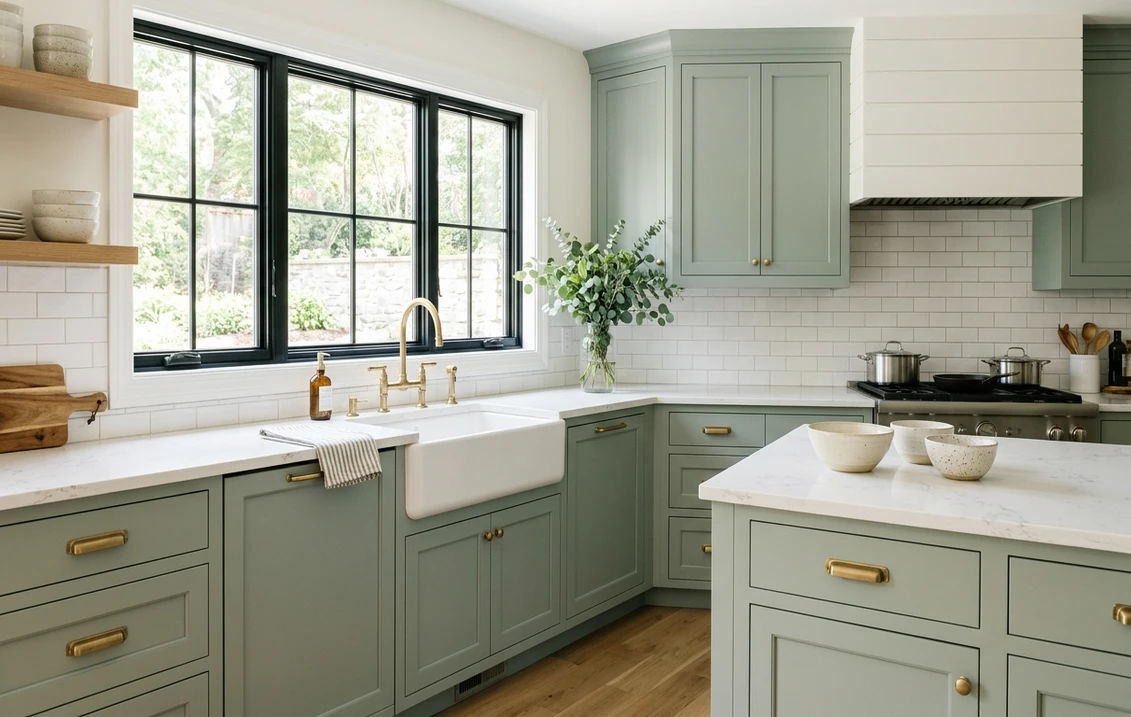
White started to feel too safe, gray too cold, and somewhere in that gap green quietly became the cabinet color of the decade. It brings warmth and life without screaming for attention like a loud accent would. But "green" hides an enormous range. A muddy sage and a saturated forest are both green, yet they build completely different rooms, and the gap between a sophisticated green-gray and a dated avocado is often just a couple of percent of yellow in the base. So the skill was never picking green. It is picking the right green for your light, your countertop, and how bold you want to go.
Below are twelve green and green-gray paint colors that cabinet painters and designers return to season after season, each with its manufacturer code, published Light Reflectance Value (LRV), and true undertone, arranged from palest sage to deepest near-black forest. This is the green chapter of our complete kitchen cabinet color guide. If green turns out to be a half-step too far, the companion profiles on gray cabinets, blue cabinets, and the always-safe white cabinets sit right next to it on the wheel.
Upload a photo of your real kitchen and preview any of these 12 greens in about 30 seconds, free. No sample pots, no painter's tape.
Why green cabinets work (and where they go wrong)
Green sits between blue and yellow on the color wheel, which is exactly why it feels grounded rather than trendy. Slide toward blue for the cool, moody, almost-teal greens that read modern; slide toward yellow for the earthy, herbal sages that read organic and farmhouse. The failure modes live at the extremes: too much yellow tips a sage into 1970s avocado, and too much gray drains the life out until the cabinets look like dishwater under cloudy light.
There is a third reading of that yellow drift, and it is worth checking before you keep hunting for the right sage. If every olive you sample keeps sliding brown in your kitchen light, the room may simply be asking for brown, and the warm earth tones start where sage stops: our profile of the best brown paint for kitchen cabinets runs from pale greige tan to espresso, with the same undertone read on each shade.
LRV decides how heavy the color feels, measuring reflected light on a 0 (black) to 100 (pure white) scale. A pale sage in the high 50s or 60s behaves almost like a soft neutral and keeps a small kitchen open. A mid-tone green in the 20s to 40s reads clearly as color and anchors the room. A deep forest below 12 acts like a near-black: dramatic, but it eats light, so it usually wants an island-only application or serious natural daylight. Match the LRV to the job before you fall for a chip.
The 12 best green cabinet paint colors, lightest to deepest
The list runs from the softest green-grays at the top to the deepest forest greens at the bottom. Codes are each manufacturer's published values, and the LRVs come from their technical data sheets.
| Paint color | Code | LRV | Undertone |
|---|---|---|---|
| SW Sea Salt | SW 6204 | 63 | Pale green-gray, soft blue lean |
| SW Softened Green | SW 6177 | 49 | Warm sage, herbal |
| BM October Mist | 1495 | 47 | Soft sage, gray-green |
| BM Saybrook Sage | HC-114 | 45 | Earthy sage, gentle gray |
| SW Evergreen Fog | SW 9130 | 30 | Muted gray-green, faint warmth |
| SW Retreat | SW 6207 | 21 | Muted mid-green, gray base |
| BM Cushing Green | HC-125 | 16 | Deep sage, soft gray |
| SW Rosemary | SW 6187 | 14 | Deep forest, warm balance |
| SW Pewter Green | SW 6208 | 12 | Deep gray-green, slate lean |
| BM Vintage Vogue | 462 | 12 | Rich teal-green, blue lean |
| BM Tarrytown Green | HC-134 | 10 | Deep pine-green, cool cast |
| BM Hunter Green | 2041-10 | 5 | Near-black forest, classic |
Try it on your room
No photo? Try a sample
Sources: Sherwin-Williams and Benjamin Moore technical data sheets 2026; The Spruce cabinet color references; designer undertone notes. LRV values are the manufacturers' published figures.
Stack a pale sage, a mid gray-green, and a deep forest on the same photo, free.
The three greens everyone is actually painting
Sherwin-Williams Evergreen Fog (SW 9130)
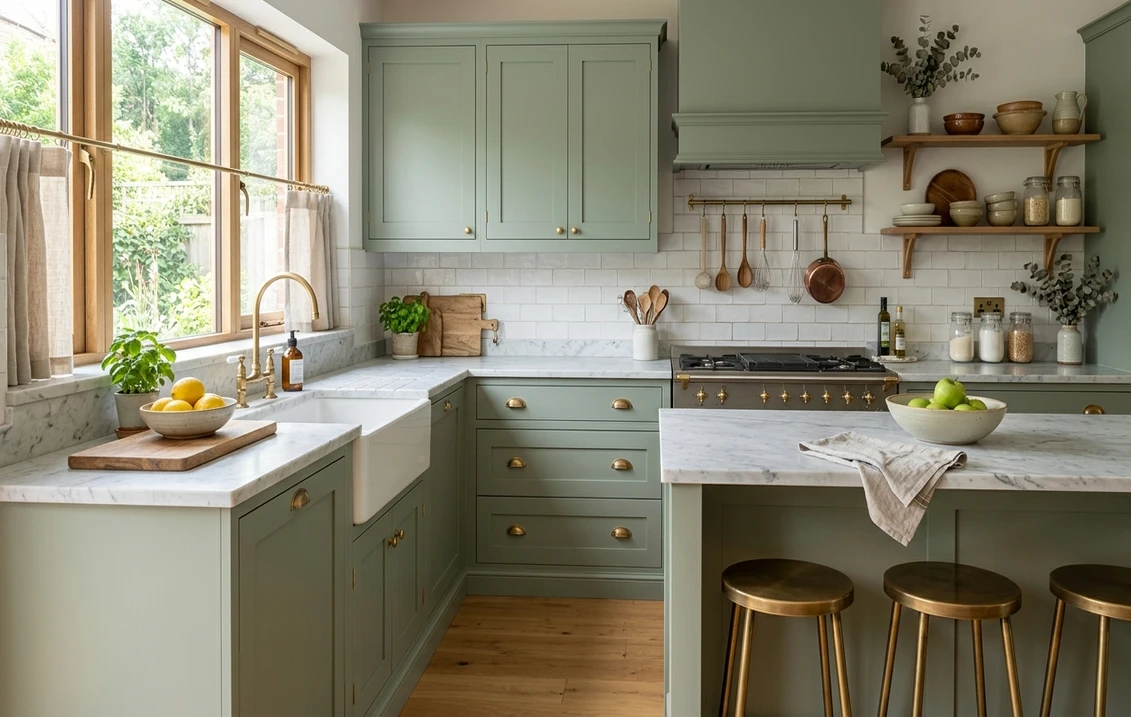
The breakout cabinet green of the last few years and a former Sherwin-Williams Color of the Year. At LRV 30 it is the rare green dark enough to feel like a real choice but soft enough to stay calm in a busy kitchen. The undertone is gray-green with a whisper of warmth, so it dodges both the cold-slate trap and the avocado trap. Think "sage, but grown-up." Pair it with white quartz, warm oak, and brass and it just works.
Benjamin Moore October Mist (1495)
A Benjamin Moore Color of the Year and the softest popular sage on this list at LRV 47. October Mist behaves almost like a colored neutral: light enough to keep a small or low-light kitchen open, green enough to register as intentional. It leans gray-green and very gently silvery, which makes it the safest green for anyone nervous about committing. Scared a full kitchen of darker green is too big a leap? Start here.
Sherwin-Williams Pewter Green (SW 6208)
The moodier pick, at LRV 12. Pewter Green reads as a deep, smoky gray-green that flirts with slate in low light and turns clearly green in sun. Designers love it on islands, on lower cabinets in a two-tone kitchen, and in butler's pantries, where the depth adds drama without darkening the room. With unlacquered brass and white uppers it builds the modern-traditional look that dominates current kitchen design.
How kitchen light changes your green
Green is one of the most light-sensitive families on the cabinet chart, because the eye reads it as the wavelengths reflected minus those the room's light source withholds. The same can shifts noticeably from a north window to a south window, and again under warm LED task lighting. Plan around your dominant light, not the paint-store fluorescents.
- North-facing kitchens (cool, no direct sun) pull green toward gray and blue. A muted sage can go flat or cold, so lean a step warmer or deeper than the chip suggests. Evergreen Fog and Saybrook Sage hold up well; a very gray sage can read like dishwater.
- South-facing kitchens (warm, bright) push green toward yellow. Watch warm sages such as Softened Green, which can edge toward olive in strong afternoon sun. Cooler, grayer greens stay balanced and benefit from the extra light.
- East and west kitchens are more forgiving: east light reads fresh and cool in the morning then warms by midday, while west light turns golden late, flattering warm wood but over-warming a yellow-based sage at dinnertime.
- Artificial light matters too. Warm-white LEDs (around 2,700 K) deepen and warm green; cool daylight bulbs (4,000 K and up) gray it out. Sample under the bulbs you run at night, not just in daylight.
Want the physics behind why a color shifts like this? Our interior paint color families guide breaks down how undertones behave room by room, across every color family.
Countertops, trim, hardware, and floors that flatter green
Green is generous with pairings, but a few combinations do the heavy lifting in real kitchens.
- Countertops: White and warm-white quartz is the default and lets the green stay the star. Warmer sages also flatter creamy quartz or honed marble with soft gray veining. Avoid stark blue-white quartz with a yellow-based sage; the clash makes both look off.
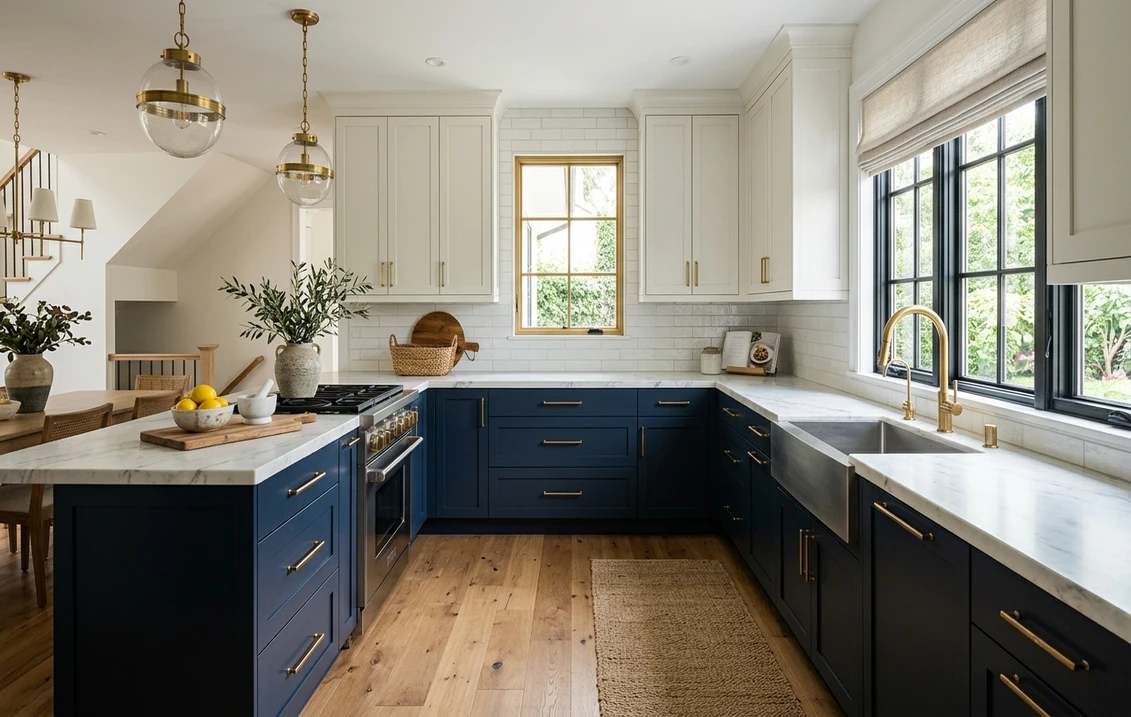
- Hardware and faucet: Brass and unlacquered (living) brass are the signature pairing, the warm metal balancing green's cool side. Matte black reads more modern, especially with deeper greens, while polished nickel keeps things crisp and traditional.
- Trim, walls, and ceiling: A soft warm white keeps green from feeling heavy. Warm whites like BM White Dove or SW Alabaster are the go-to for walls and upper cabinets in a two-tone scheme; reserve crisp bright-whites for cooler, bluer greens.
- Backsplash: White subway tile is the safe classic; zellige (handmade glazed) tile in white or soft green adds texture without fighting the cabinets.
- Floors: Warm oak and white oak are the strongest partners, bouncing warm light back onto the cabinets. Cool gray-washed floors can leave a grayer green looking lifeless.
Green vs gray vs blue cabinets: which one is right
These three families are the usual finalists once white is off the table, and they fail in different directions. Gray is the safest and most neutral, but a poorly chosen gray reads cold or dated; see our gray cabinet color profile for the undertone traps. Blue is crisp, classic, and a little more formal; our blue cabinet guide covers navy through powder. Green splits the difference: warmer and more organic than blue, more alive than gray, and the most forgiving of warm wood tones and brass. With oak floors and a love of nature, green almost always wins; for maximum resale safety, gray or a soft green-gray like October Mist is the lower-risk play.
There is a fourth family that rarely makes this shortlist and probably should: the warm neutrals. Beige and greige cabinets answer the same objection green does, that white feels cold, but they do it without committing the kitchen to a hue, which is why they survive a change of countertop or backsplash better than any of the three above. They are also the natural upper half of a two-tone kitchen with Pewter Green on the lowers, where a stark white upper would read as a hard edge. Our guide to the best beige kitchen cabinet colors covers that family in the same detail.
Worried about brand? It matters less than people think. Both Sherwin-Williams and Benjamin Moore make excellent greens. If you are weighing the two on sheen, durability, and coverage, our Sherwin-Williams vs Benjamin Moore comparison lays out the differences, and the interior painting cost guide covers what a professional cabinet respray actually runs.
How to test a green before you commit
Green punishes the fan-deck chip more than almost any color, because a 2-inch sample cannot show how the undertone behaves across a full run of doors in your light. Two reliable methods:
- Paint a real sample. Roll two coats onto a large poster board or a cabinet door, then move it around the kitchen and check it at three moments: morning, mid-afternoon, and at night under your normal bulbs. A board near the window reads very differently from one beside the range.
- Preview it digitally first. Upload a photo of your actual kitchen into our cabinet visualizer workflow and apply several greens before you spend a cent on sample pots. It narrows twelve candidates to two or three in minutes, so you sample only the finalists. For where green sits among this year's most popular shades, see our 2026 best interior paint colors guide.
Upload your kitchen and see Evergreen Fog, October Mist, and Pewter Green side by side, free.
Frequently asked questions
What is the most popular green for kitchen cabinets right now?
Sherwin-Williams Evergreen Fog (SW 9130, LRV 30) is the standout, a muted gray-green with a hint of warmth that reads as a sophisticated, grown-up sage. Benjamin Moore October Mist (1495, LRV 47) is the softer, lighter alternative for first-timers, and Sherwin-Williams Pewter Green (SW 6208, LRV 12) is the moodier deep pick for islands and two-tone kitchens. Whatever your kitchen lighting throws at them, all three keep their character.
Will green cabinets make my kitchen look smaller or dated?
Not if you match the LRV to the room. A pale to mid sage (LRV 40 and up, like October Mist or Softened Green) keeps a small kitchen feeling open and reads as a soft neutral. Deep forest greens below LRV 12 are dramatic and can shrink a low-light room, so they are usually best on an island or lower cabinets only. The "dated" risk comes from too much yellow in the base, which tips a sage toward 1970s avocado; choosing a gray-balanced green avoids it.
What hardware and countertop go best with green cabinets?
Brass and unlacquered (living) brass are the signature hardware pairing, because the warm metal balances green's cool side; matte black reads more modern, especially with deeper greens. For countertops, white and warm-white quartz is the safe default and keeps green the focal point. Warmer sages also pair beautifully with creamy quartz or honed marble; avoid stark blue-white quartz against a yellow-based sage.
Should I do all green cabinets or just an island?
For lighter and mid-tone greens (LRV 25 and up), a full kitchen of green is very wearable and on-trend. For deep greens like Pewter Green or Hunter Green, an island or lower cabinets paired with white or warm-white uppers is the lower-risk and most popular approach, adding the drama of the deep color without darkening the whole room. Test both layouts on a photo of your kitchen before deciding.
See your top greens on your actual cabinets before you buy a single sample pot.
Disclaimer: Sherwin-Williams, Evergreen Fog, Pewter Green, Sea Salt, and related color names and codes are trademarks of The Sherwin-Williams Company. Benjamin Moore, October Mist, Hunter Green, and related color names and codes are trademarks of Benjamin Moore & Co. Behr is a trademark of its owner. FacadeColorizer is an independent paint visualization service and is not affiliated with, endorsed by, or sponsored by Sherwin-Williams, Benjamin Moore, or Behr. Color reproduction on screens approximates the manufacturer's chip; always confirm with a manufacturer sample before purchase. Sources: Sherwin-Williams and Benjamin Moore technical data sheets 2026, The Spruce cabinet color references, designer undertone notes. LRV values are the manufacturers' published figures.
Trademarks mentioned (Sherwin-Williams, Benjamin Moore, Behr, Caparol, Brillux, Sto, Alpina, Valspar, PPG, Glidden, Dulux, Crown Trade, Sandtex, Farrow & Ball, Johnstone's, Leyland) are property of their respective owners. FacadeColorizer is independent and not affiliated with any of them. Nominative fair use under Lanham Act §1125.