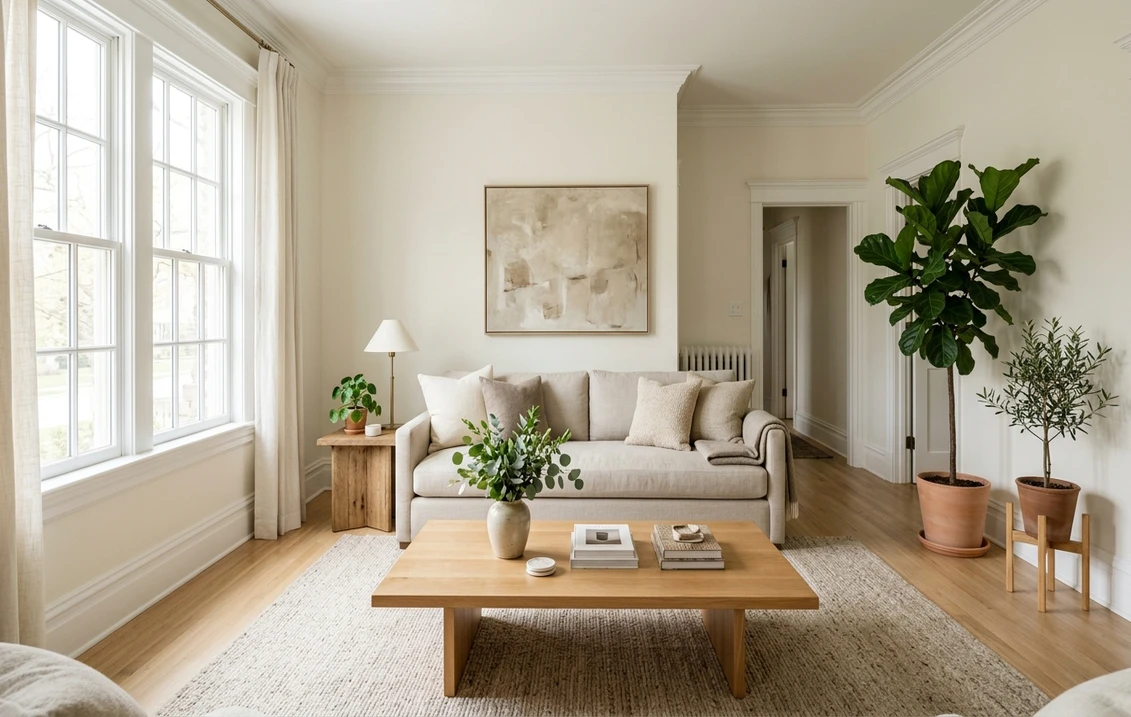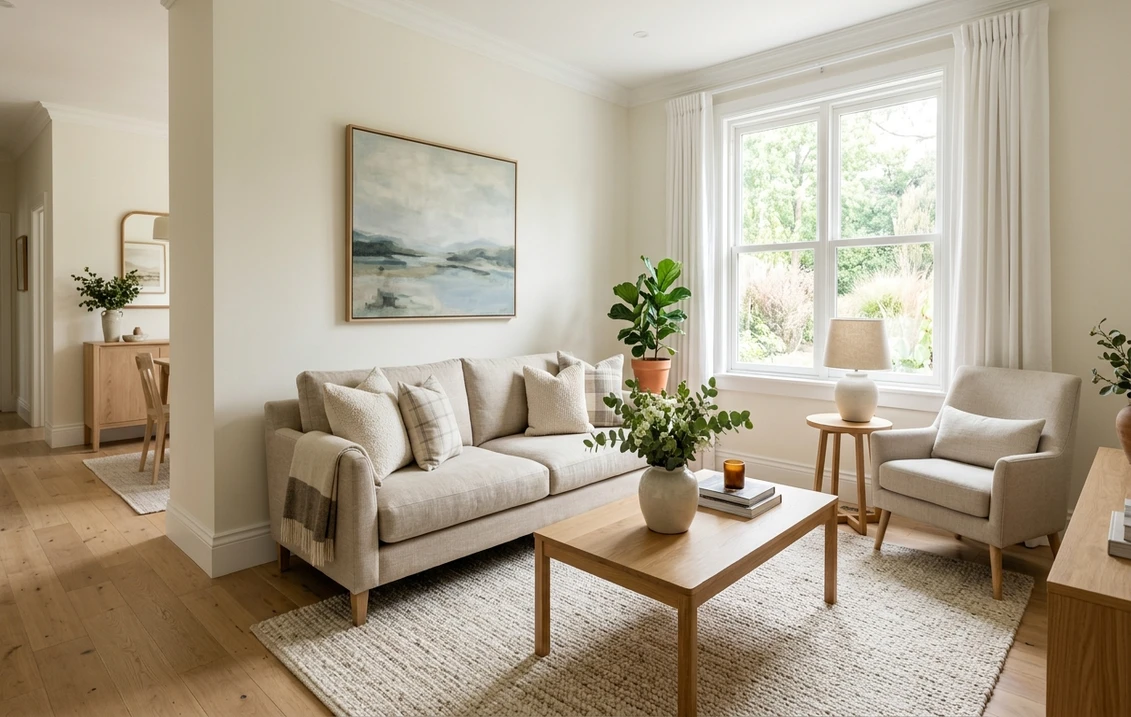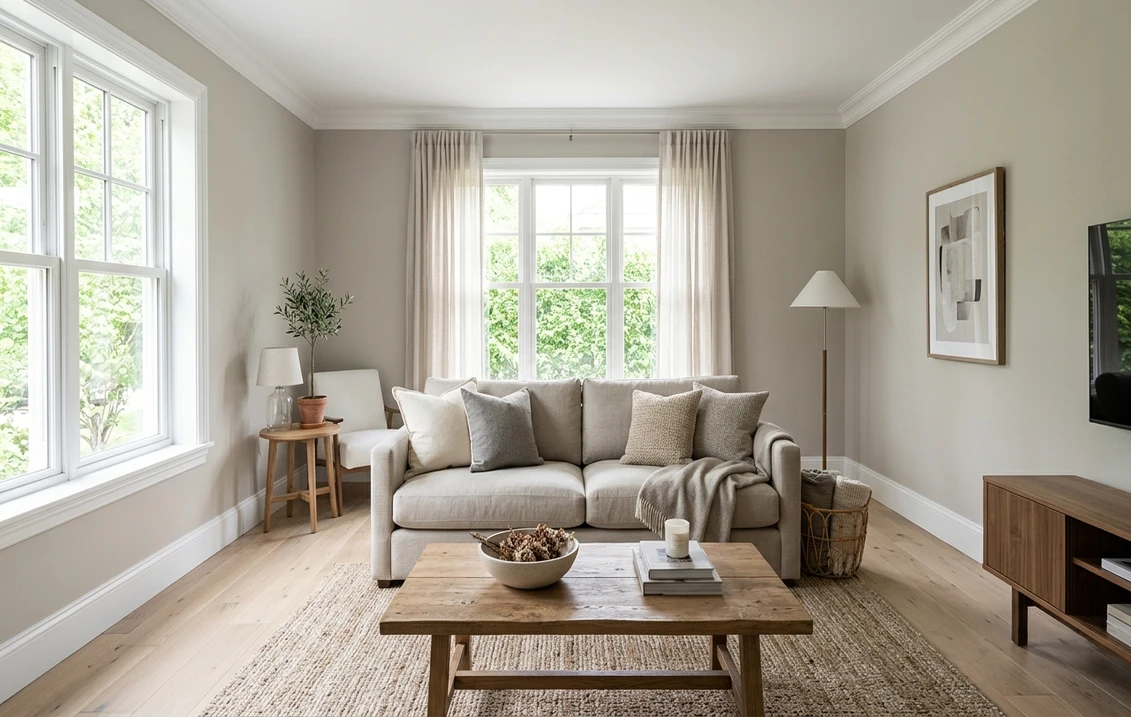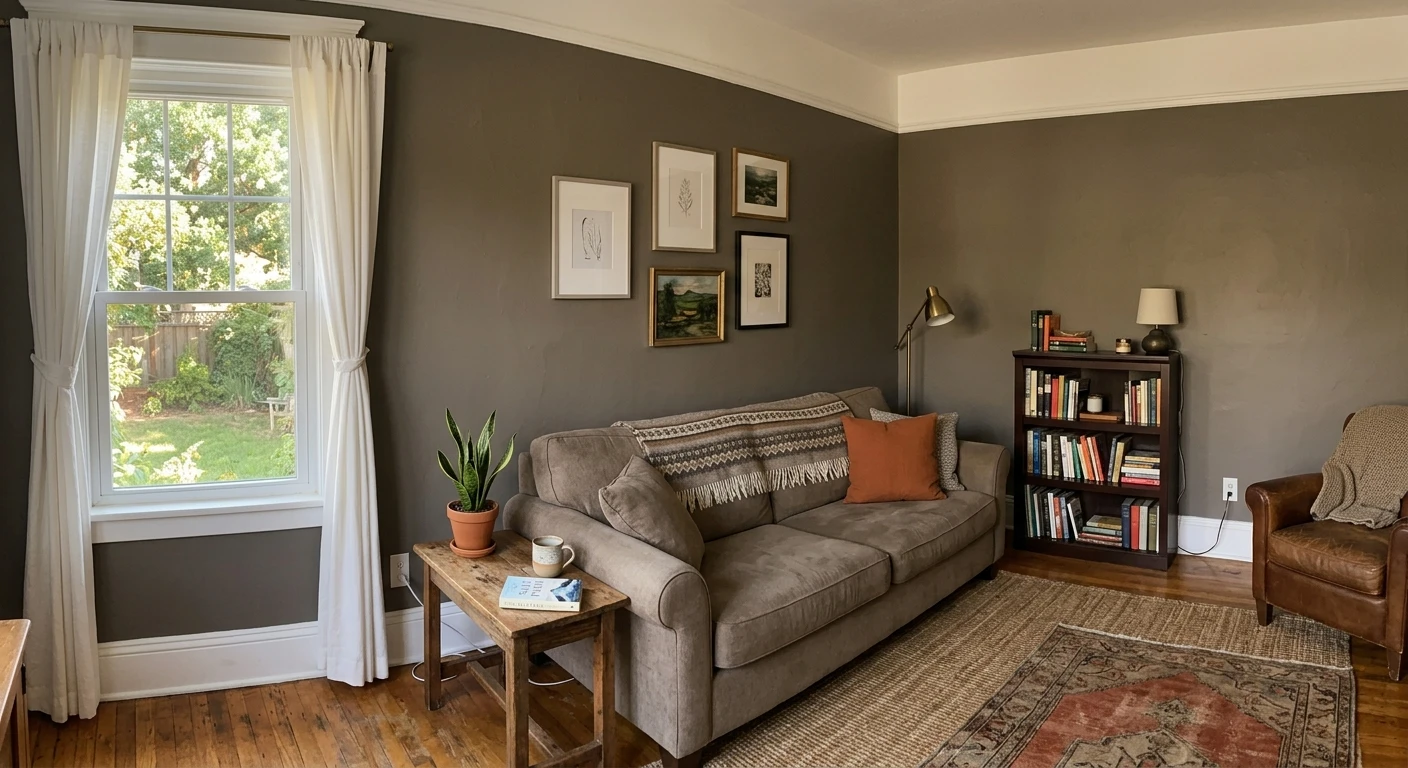
Try it on your room

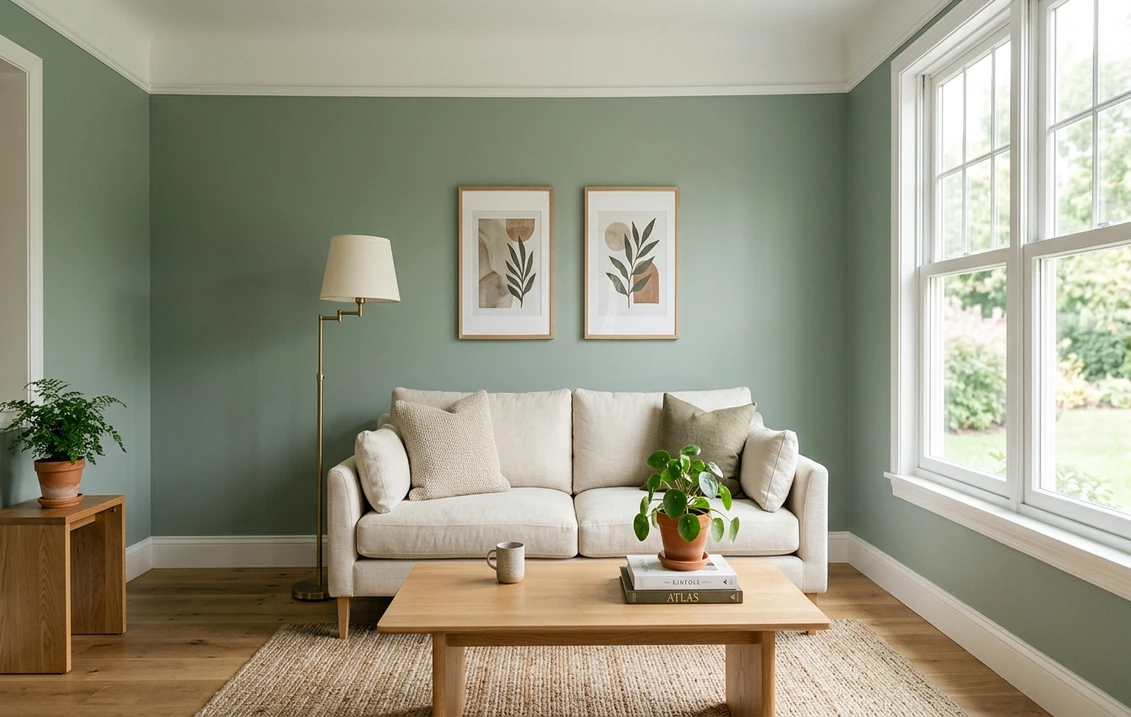
When Benjamin Moore named October Mist 1495 its 2022 Color of the Year, it picked a green almost nobody would call bold. No jewel-tone drama, no statement teal. October Mist is a hushed, slightly grayed sage, the color of a eucalyptus stem seen in shade, and that quietness is the point. It reads as a soft neutral that happens to be green, which is why it keeps turning up on bedroom walls, kitchen cabinets, and trim long after its year in the spotlight ended.
This profile covers October Mist strictly indoors: what its undertones do, how much green you see in different light, the rooms it flatters, and the whites, woods, and metals that finish it well. A soft mid-tone lives or dies on its undertone, so the aim is to show you when it leans fresh and herbal versus when it slides toward gray.
Upload one photo of your room and preview 1495 under your actual light in 30 seconds, free.
October Mist 1495 at a glance
October Mist belongs to Benjamin Moore's Color Preview collection and sits in the soft, grayed-green corner of the green family. The facts worth knowing:
- BM code: 1495, and the brand's 2022 Color of the Year.
- LRV (Light Reflectance Value): roughly 49 on the Benjamin Moore technical data sheet, squarely mid-tone, light enough to keep a room open but deep enough to read as a real color.
- Color family: a soft sage green with a gray base and a faint warm, almost yellow-green lift, which keeps it from going cold.
- HEX approximation: near #B5BBA6, a muted gray-green, far from a saturated grass or mint.
- Closest relatives: Saybrook Sage (HC-114), a touch deeper and more saturated, and the most cross-shopped rival, Sherwin-Williams Evergreen Fog (SW 9130), which is greener-gray and slightly darker.
Mid-tone LRV is the headline. Reflecting close to half the light that hits it, October Mist does not bully a room the way a deep navy does, nor vanish the way a near-white can. It behaves like a colored neutral. The catch with any grayed green is that the gray and the green trade places with the light, so the room's exposure decides which one you mostly see.
The undertones, read honestly
Sage greens fail in two opposite ways. Push the gray and they go flat and dreary; push the green and they turn sharp and minty, which reads cheap on a wall. October Mist is loved because it sits almost dead center, but that balance also makes it a chameleon, so plan for the swing.
In bright, warm light the faint yellow-green base lifts and October Mist reads as a soft, leafy sage. In cool or low light the green recedes and the gray steps forward, so the same wall can look like a warm greige with a whisper of green. It rarely flashes blue or purple, which is part of why designers trust it, but it reads noticeably grayer on a cloudy day than in afternoon sun. The mechanism is the one we describe for warm whites in our White Dove OC-17 review: light adds or subtracts wavelengths, and a muted color shows it more.
How room light changes 1495
With October Mist you are not hunting for a hidden purple or pink the way you would with a tricky greige; you are watching the green-versus-gray balance shift by exposure:
| Room exposure | Light character | How October Mist reads |
|---|---|---|
| South-facing | Bright, warm, sun for much of the day | Greenest and freshest; the leafy sage character is clear |
| West-facing | Cooler morning, warm golden evening | Soft gray-green by day, warmer and more sage at sunset |
| East-facing | Bright early light, flatter afternoon | Fresh and green in the morning, quieter and grayer later |
| North-facing | Cool, indirect, no direct sun | Grayest, most muted read; can edge toward a soft greige |
Try it on your room
No photo? Try a sample
Sources: Benjamin Moore 1495 October Mist technical data sheet 2026; Benjamin Moore Color Lab references; The Spruce paint color guidance.
Want October Mist to read clearly green? Give it a bright south or west room. A north room pulls it toward gray, so if that is your space, lean into the softer, neutral look on purpose. Bulbs matter just as much. Warm 2700K bulbs keep the sage inviting, while cool 4000K and higher bulbs mute the green and gray it down after dark.
Best rooms for October Mist indoors
Calm rather than loud, October Mist suits almost any room, but a few applications are where it genuinely shines:
- Bedrooms: the natural home for a soft sage. October Mist is restful and spa-like, and pairs effortlessly with white linens, warm wood, and rattan.
- Kitchen cabinets and islands: one of its most popular uses. Sage cabinetry is now a default alternative to white and gray, and 1495 stays timeless rather than trendy against brass hardware and a marble counter.
- Bathrooms: a fresh, organic calm, especially with white tile, warm wood vanities, and greenery. In a windowless powder room, plan for the grayer read and warm the lighting.
- Home offices and studies: green is the easiest color on the eye, giving a workspace a focused, natural calm without the heaviness of a dark color.
- Trim, doors, and built-ins: on millwork against a creamy white wall, it reads as a soft, sophisticated accent. Our interior paint color families guide explains how to balance one soft color against your neutrals.
Where to pause: a dim, north-facing room you want bright and crisp, where the gray read flattens it, and any space already heavy with cool gray finishes, where it can look muddy. If you want a true neutral there instead, our Revere Pewter HC-172 review covers the classic warm greige.
Free AI paint visualizer. See October Mist on your own walls and cabinets before you commit.
Trim, ceiling, wood, and metals
A soft sage looks expensive or cheap depending almost entirely on what surrounds it. The whites, woods, and metals do the work:
- Best trim white: a soft warm white keeps October Mist from going cold. Benjamin Moore White Dove (OC-17, LRV 85) is the natural partner, warm enough to echo the sage's faint base; see the White Dove OC-17 review. For a crisper, more modern contrast, a clean white like Chantilly Lace works; see the Chantilly Lace OC-65 review.
- Ceiling: keep it in your trim white to lift the room, or, for a cocooning bedroom, October Mist diluted to about 50 percent overhead wraps the space gently without darkening it.
- Wood tones: warm woods are the magic ingredient. White oak, walnut, rattan, and honey-toned floors make the sage feel organic; cool gray-washed woods pull it toward drab.
- Metals: warm metals flatter it most. Aged brass and antique gold are ideal on sage cabinets; matte black grounds it with a modern edge, while chrome and polished nickel read cooler.
- Accent colors: creamy whites, soft terracotta, caramel, blush, and natural linen all sit beautifully beside it. For a bolder pairing, a deep navy makes the sage feel layered.
That deep navy is a classic foil for sage; our Hale Navy HC-154 review covers the navy that pairs with October Mist best.
October Mist vs other popular sages
Soft sage is crowded right now, and October Mist is constantly compared against a few colors. The quick guide:
- vs Sherwin-Williams Evergreen Fog (SW 9130): the most cross-shopped rival. Evergreen Fog is darker, grayer, and a touch more dramatic; October Mist is lighter and reads more clearly as a calm sage. Choose Evergreen Fog for moody cabinets, October Mist for an airy room. The brand gap runs deeper than one color, as our Sherwin-Williams vs Benjamin Moore interior comparison explains.
- vs BM Saybrook Sage (HC-114): the in-house step up, deeper and more saturated. Pick Saybrook Sage when you want the green unmistakable, October Mist when you want it to whisper. If even Saybrook feels too light for a dark-trim scheme, the next stop is Louisburg Green HC-113, the deeper sage in the Historical Collection.
- vs a warm greige: if your sample reads too gray and you decide you wanted a neutral after all, a greige like Revere Pewter is safer. October Mist earns its keep only when you genuinely want a hint of green.
Our best interior paint colors of 2026 roundup puts October Mist among this year's most-painted interiors, and the Benjamin Moore interior colors hub covers the rest of the BM lineup.
Finish, coverage, and cost
Reach for eggshell or matte on the walls. Both keep a sage soft and hide minor flaws, while satin and semi-gloss belong on trim and cabinetry. Coverage is easy at this LRV, with two coats over a standard primer, so you skip the tinted-primer surcharge deep colors carry. Labor and prep, not paint, drive any repaint budget; our interior house painting cost guide breaks down what a room actually costs.
How to test October Mist before you commit
A fan-deck chip is the worst way to judge a muted green: it looks fresher and greener on a tiny card than across a whole wall, and cannot show the green-versus-gray swing your light creates. Test it properly:
- Paint a large swatch, at least 2 feet by 2 feet, on two walls, one near the window and one on a darker wall, so you see both reads.
- Check it across the day: bright morning, mid-afternoon, and after dark under your normal bulbs. A grayed sage shifts more between a sunny noon and a cloudy evening than most people expect.
- View it next to your real finishes, trim, wood floor, and hardware, not bare drywall, since warm wood pushes it greener and cool gray surroundings pull it drabber.
The fastest no-paint first pass is digital: drop a photo of your room into our free interior visualizer and apply October Mist, then compare it as full walls versus just cabinets or trim. It will not replace a physical swatch for the final call, but in minutes it tells you whether your light flatters the green or grays it out, against your own furniture and floors.
Upload your room and preview 1495 on walls, cabinets, and trim with White Dove, free.
Frequently asked questions
What is the LRV of October Mist 1495?
October Mist has a Light Reflectance Value of about 49 on the Benjamin Moore technical data sheet, solidly in the mid-tone range. That is light enough to keep a room feeling open, but deep enough to read as a genuine color rather than an off-white. At that LRV it usually covers in two coats over a standard primer, without the tinted-primer step very dark colors need.
Is October Mist more green or more gray?
It is a balanced gray-green that shifts with the light, which is why it works as a soft neutral. In bright, warm light, especially a south or west room, the faint yellow-green base lifts and it reads as a fresh, leafy sage. In cool or low light, such as a north-facing or cloudy-day room, the green recedes and it leans toward a warm greige. It rarely flashes blue or purple, so plan for the green-versus-gray swing, not a hidden undertone.
What trim white goes with October Mist?
A soft warm white is the safest pairing, because it echoes the sage's faint warm base and keeps the room from feeling cold. Benjamin Moore White Dove (OC-17, LRV 85) is the go-to. For a crisper, more modern contrast, a clean white like Chantilly Lace works too, though it reads cooler against the sage. Warm woods and brass complete the scheme; cool gray-washed woods make it look drab.
October Mist vs Evergreen Fog, which should I pick?
They are the two most cross-shopped sages. Sherwin-Williams Evergreen Fog (SW 9130) is darker, grayer, and a little moodier, which suits dramatic cabinets and cozy rooms. Benjamin Moore October Mist (1495) is lighter and softer, reading more clearly as a calm, airy sage that behaves like a colored neutral. Choose Evergreen Fog for depth and drama, October Mist for a brighter, more versatile green.
See 1495 with a warm white trim on your actual walls before buying a single sample pot.
Disclaimer: Benjamin Moore and 1495 October Mist are trademarks of Benjamin Moore & Co.; Sherwin-Williams and Behr are trademarks of their respective owners. FacadeColorizer is an independent paint visualization service, not affiliated with, endorsed by, or sponsored by Benjamin Moore, Sherwin-Williams, or Behr. Color reproduction on screens approximates the manufacturer's chip; always confirm with a physical sample before purchase. Sources: Benjamin Moore 1495 October Mist and OC-17 White Dove technical data sheets 2026, Benjamin Moore 2022 Color of the Year materials, Benjamin Moore Color Lab references, and The Spruce paint color guidance.
Trademarks mentioned (Sherwin-Williams, Benjamin Moore, Behr, Caparol, Brillux, Sto, Alpina, Valspar, PPG, Glidden, Dulux, Crown Trade, Sandtex, Farrow & Ball, Johnstone's, Leyland) are property of their respective owners. FacadeColorizer is independent and not affiliated with any of them. Nominative fair use under Lanham Act §1125.