Try it on your room

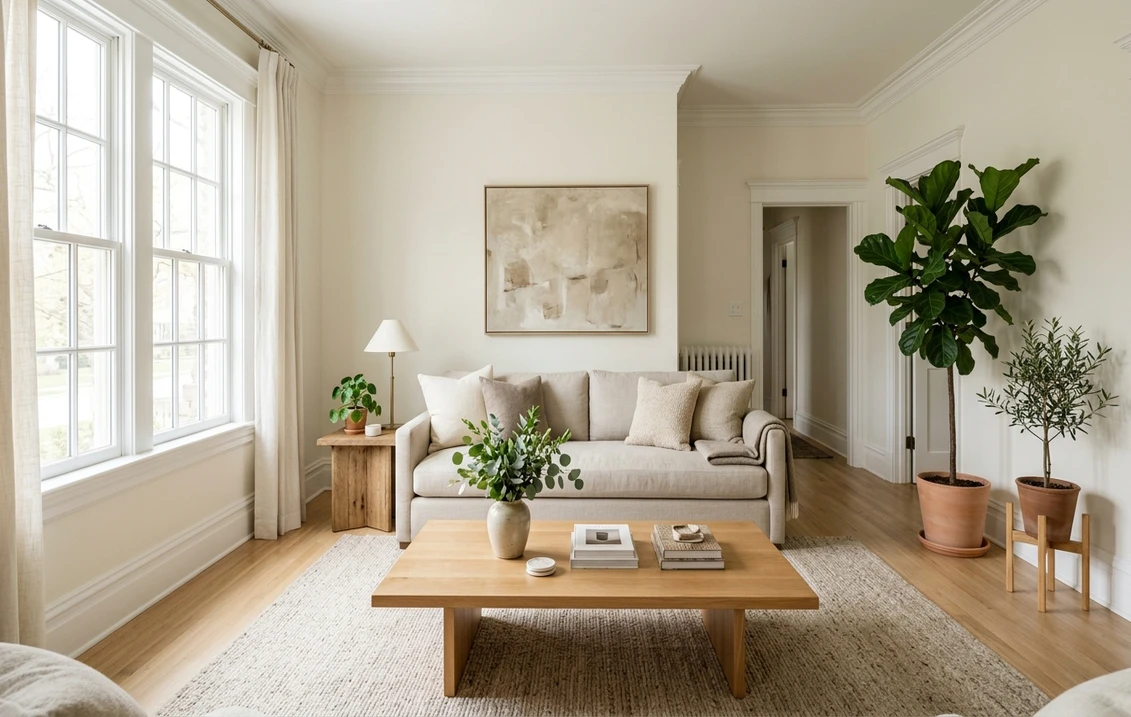
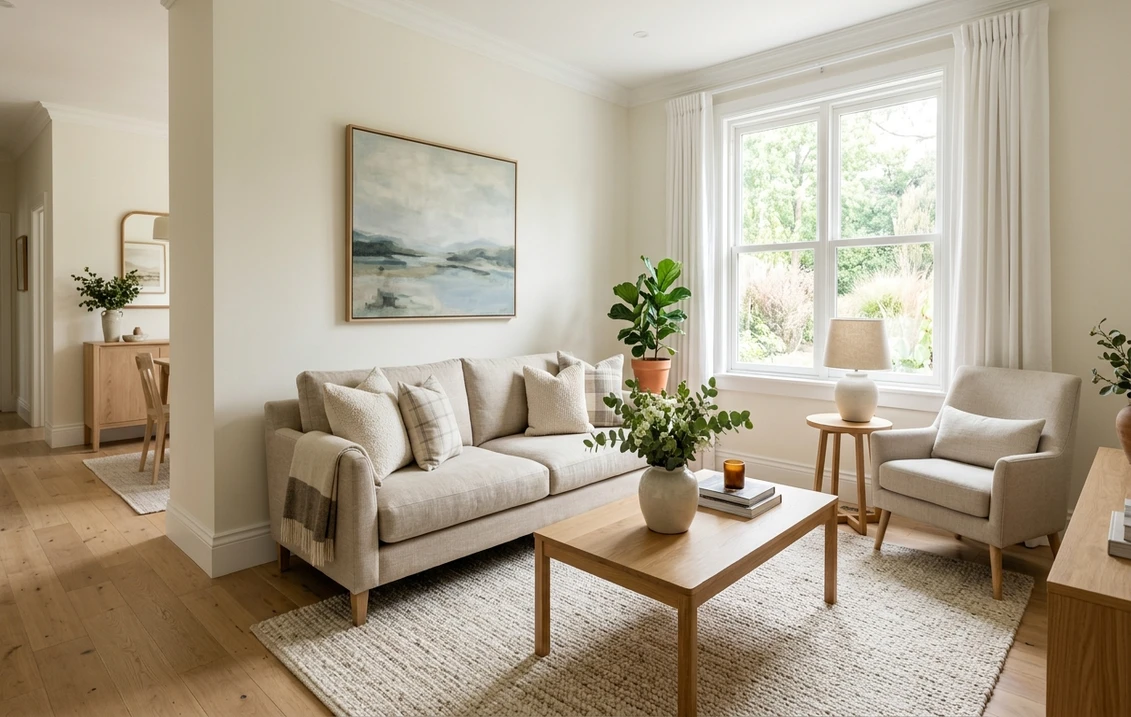
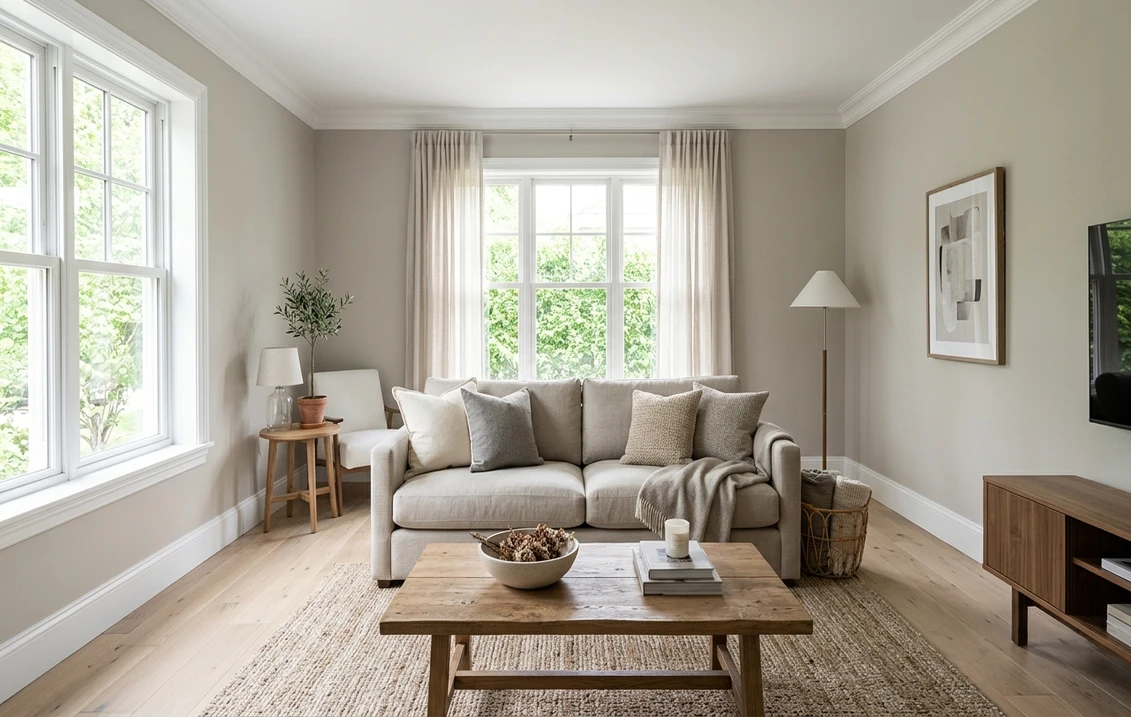
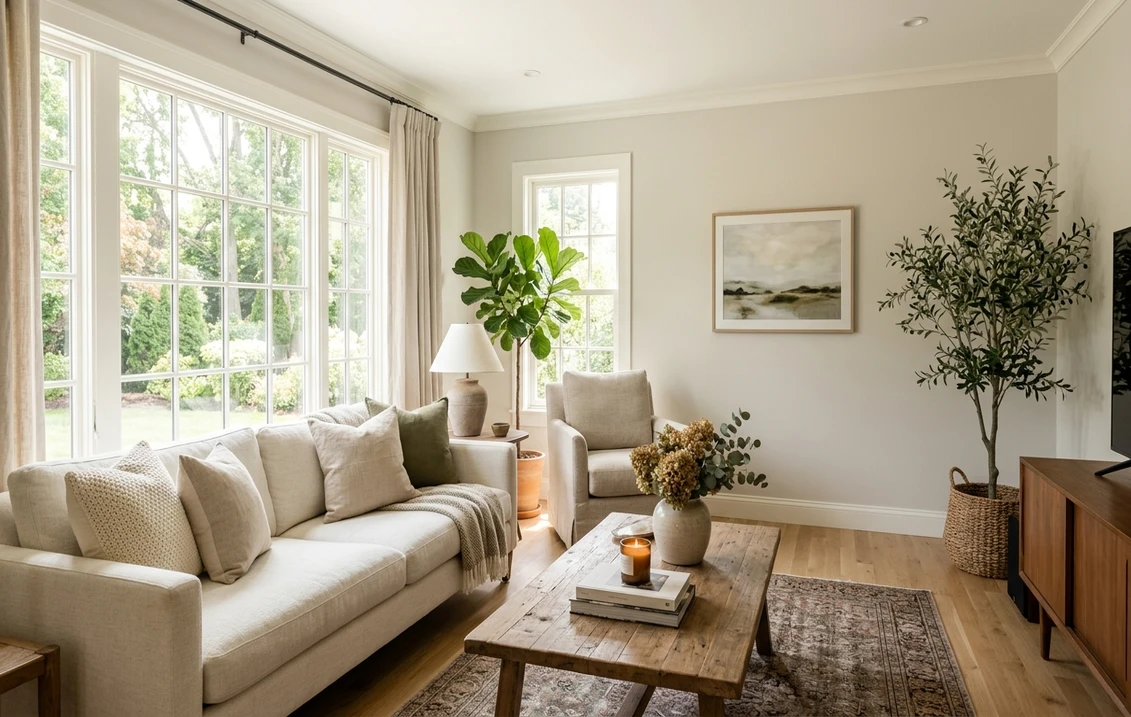
You walk in, and the room just feels settled. No single wall is shouting for attention. That is the job Edgecomb Gray (HC-173) was built for: the neutral you reach for when you want calm, not a statement. It is a light warm greige at an LRV of 63, bright enough to read like a soft off-white across the room and gray enough to keep that off-white from looking yellow. Benjamin Moore designed it as the one-shade-lighter sibling of Revere Pewter, and it has become the default "whole house" beige-gray for anyone who found a deeper greige heavier than expected.
This profile covers HC-173 strictly indoors: what its undertones do on a wall, how much daylight it needs, the rooms it suits, the trim and decor that hold it steady, and how to test it. The same color on siding, stucco, and facade trim under open sky lives in our Edgecomb Gray exterior guide. Same chip, very different behavior on a wall under a roof versus a wall facing the open sky, so we keep the indoor and facade pages separate.
Upload one photo of your room and preview HC-173 under your actual light in 30 seconds, free.
Edgecomb Gray HC-173 at a glance
Edgecomb Gray belongs to Benjamin Moore's Historical Color (HC) Collection, the same palette that holds Revere Pewter, and has stayed a catalog staple for years. The published technical data:
- BM code: HC-173, Historical Color Collection.
- LRV (Light Reflectance Value): 63 on the Benjamin Moore technical data sheet, on the lighter end of the greige range, brighter than a true mid-tone gray but not a white.
- Color family: light warm greige, a gray-beige hybrid that leans softer and more "off-white" than most greiges.
- Primary undertone: warm beige-tan; secondary undertone: a faint cool green-gray that only surfaces in poor light.
- Closest BM neighbor: Revere Pewter (HC-172, LRV 55.51), one step deeper and a touch grayer, for rooms wanting more weight.
- The neighbor in the other direction: Light Pewter (1464, LRV about 68), one step lighter and a shade less beige, for rooms that need to stay open rather than settled.
The number that matters here is the LRV of 63. It is high enough that Edgecomb opens a room up and bounces light around like a soft neutral white. It is also low enough to never read stark or builder-grade. You get the brightness of a warm white, minus the risk of it going buttery yellow.
The undertones, without the sugarcoating
Edgecomb Gray is built on a warm beige-tan base, and in most rooms that warmth is all you will see: a soft, sandy, easy neutral. Sitting underneath, as in almost every greige, is a low level of green-gray from the warm-gray pigment in the mix. The difference is that Edgecomb's high LRV keeps that green diluted, so HC-173 is one of the safer greiges for anyone nervous about an "olive" surprise.
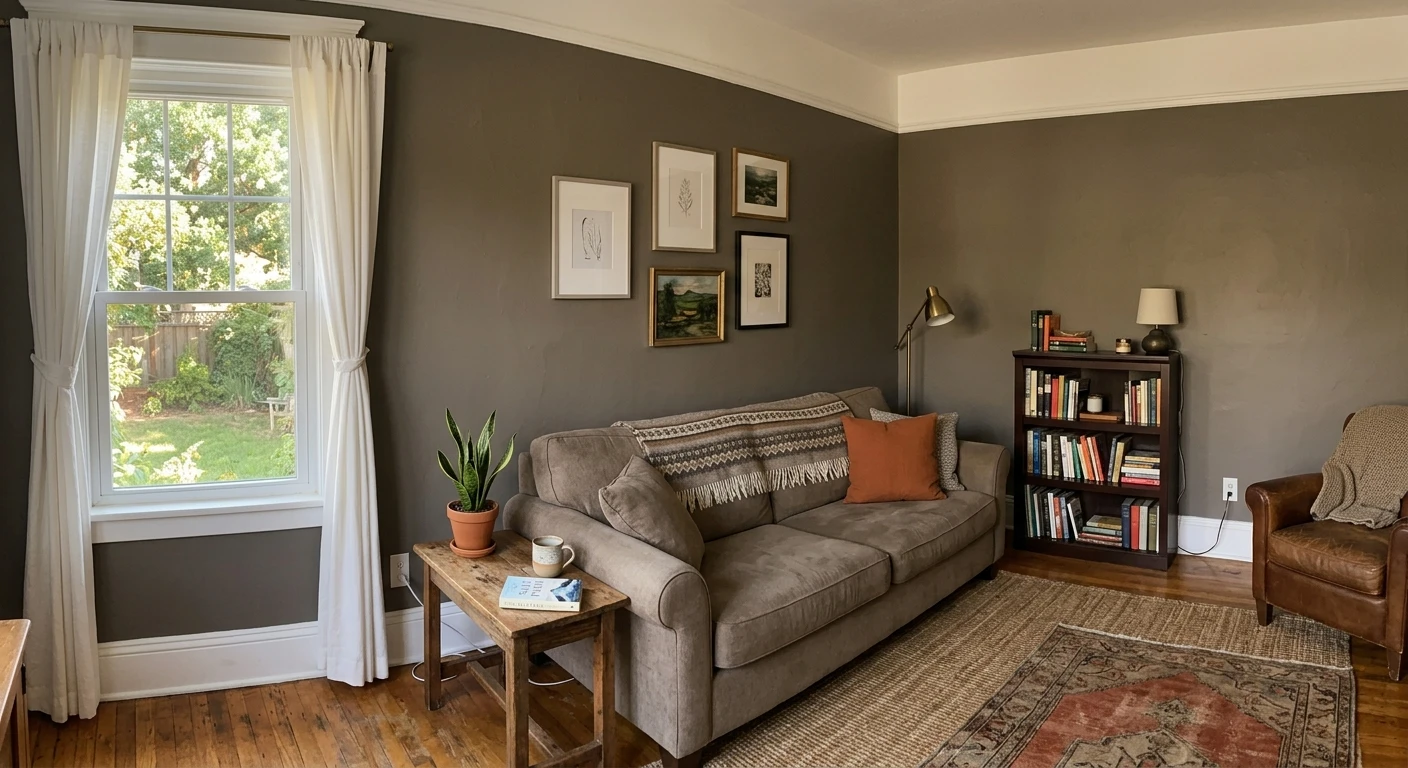
"Safer" is not "immune," though. In a flat, north-facing, or poorly lit room, the warm beige mutes and the green-gray steps forward, reading as a cooler, grayer, faintly drab version of the chip. It is the same thing that happens to any warm neutral, which we get into in the 2026 best interior paint colors guide. Cool light subtracts the warm wavelengths and leaves the pigment that was hiding underneath exposed. The fix is almost always more, or warmer, light, which is why Edgecomb rewards sunny rooms.
How much light does Edgecomb Gray need?
HC-173 is light and warm, so orientation pushes it around less than it would a mid-tone greige. The direction of the shift, though, is identical. Here is how the same can reads by exposure in the Northern Hemisphere:
| Room exposure | Light character | How Edgecomb Gray reads |
|---|---|---|
| South-facing | Warm, bright, sun most of the day | Soft warm "almost white," the chip at its best |
| West-facing | Cool morning, warm golden evening | Light and clean by day, noticeably warmer at sunset |
| East-facing | Warm morning, flatter afternoon | Bright greige early, settles a touch grayer past noon |
| North-facing | Cool, indirect, no direct sun | Coolest reading; grayer and flatter, green can hint |
Try it on your room
No photo? Try a sample
Sources: Benjamin Moore HC-173 technical data sheet 2026; Benjamin Moore Color Lab undertone references; The Spruce paint color guidance.
In short: a south, west, or multi-window room keeps Edgecomb warm and inviting. A north-facing or window-poor room leans it cooler and grayer than the chip suggests, so test it there against a warmer backup like Revere Pewter.
Best rooms for Edgecomb Gray
HC-173 is a textbook whole-home neutral, running from the front door through every connected space without fighting itself, which is why it shows up so often as a flip-house and new-build wall color. Where it performs best:
- Open-plan living and dining: the high reflectance keeps a big space bright and airy while the warmth stops it feeling cold, and it flatters both warm wood and cool gray furniture. The interior paint color families guide shows how to carry one warm neutral across a whole floor plan.
- Small or dim rooms: this is Edgecomb's home turf. Where Revere Pewter can feel heavy in low light, HC-173's brightness keeps things open. It is the standard "size up to lighter" answer when a deeper greige closes a room in.
- Hallways and stairwells: connector spaces that borrow light from several rooms need a neutral that reads consistently, and a light warm greige does that without looking dingy in windowless stretches.
- Bedrooms and bathrooms: calming in good daylight and bright enough to keep a smaller bath from feeling tight. In a windowless bath, pair it with warm bulbs so the green note never gets a foothold.
Where to think twice: a windowless basement or a north room gloomy all day, where any greige loses its warmth. Edgecomb is no exception, though its lightness helps it hold up better than most.
Free AI paint visualizer. Upload your room photo to see Edgecomb Gray under your own light before buying a sample.
Trim, ceiling, and decor pairings
A light greige asks less of its trim than a deep one, but the white still decides whether the walls read crisp or muddy. Because Edgecomb is already bright, you want a trim white clearly cleaner than the wall so the contrast reads.
- Best trim white: Benjamin Moore White Dove (OC-17, LRV roughly 85). A soft warm cream that shares Edgecomb's temperature and gives gentle, livable contrast. We break the white down in our White Dove OC-17 review.
- Crispest trim option: Chantilly Lace (OC-65, LRV 90.04) when you want the walls to read more clearly as a greige against a bright, clean edge. See the full breakdown in our Chantilly Lace OC-65 review. Skip a cool blue-white, which can leave the warm walls looking slightly dirty.
- Ceiling: the trim white, or that white at 50 percent strength, keeps the warmth flowing overhead. A stark builder-white ceiling over a warm greige can read disconnected.
- An accent that pops: Edgecomb is a quiet backdrop for a deep navy. A built-in, island, or feature wall in Hale Navy (HC-154) reads rich and grounded against it; see our Hale Navy HC-154 review.
- Floors, metals, and decor: warm white oak, honey, and walnut floors reinforce the beige; cool gray-washed floors pull HC-173 toward its green-gray side. Aged brass, bronze, and natural fibers flatter it; chrome and cool nickel lean it slightly cooler.
Edgecomb Gray vs the greiges it gets cross-shopped against
Almost nobody decides on Edgecomb in isolation; it is usually weighed against a deeper Benjamin Moore greige and a Sherwin-Williams favorite:
- vs BM Revere Pewter (HC-172, LRV 55.51): the in-house sibling and most common comparison. Edgecomb is lighter, warmer, and airier; Revere is deeper, grayer, and carries more presence. Choose Edgecomb for small or dim rooms and a softer look; choose Revere when you want the walls to feel substantial. Our Revere Pewter HC-172 review covers the deeper option in full.
- vs BM Pale Oak (OC-20, LRV 69.89) and BM Balboa Mist (OC-27, LRV 65.61): the lighter in-house alternatives. If you are torn between the softest options, see the Pale Oak vs Edgecomb Gray side-by-side; if Balboa's subtle violet cast tempts you, the Edgecomb Gray vs Balboa Mist verdict breaks down where each one wins.
- vs SW Agreeable Gray (SW 7029, LRV 60): the closest Sherwin-Williams rival. Agreeable Gray is a hair darker and a touch more neutral-balanced; Edgecomb is slightly lighter and warmer. Want a clearly warm "almost white," go Edgecomb; want a more centered greige, Agreeable Gray. Our full Agreeable Gray vs Edgecomb Gray duel settles the matchup room by room.
For the brand-versus-brand picture, the Sherwin-Williams vs Benjamin Moore interior comparison puts the two head to head, and the Benjamin Moore interior colors hub covers the rest of the BM lineup, from whites to deep accents.
How to test Edgecomb Gray before you commit
A fan-deck chip is the worst way to judge any greige: it reads brighter and warmer than a whole rolled wall and cannot show the slight cool shift low light triggers. A reliable physical test takes one weekend:
- Paint a large swatch, at least 2 feet by 2 feet, on two walls (one near a window, one across the room), ideally on a poster board you can move around.
- Look at it three times: around 9 a.m., around 2 p.m., and after dark under your normal bulbs. If the green-gray is going to show, it shows in the flattest, dimmest light.
- Hold a true white card (or your trim white) against the swatch. Without that white reference, the eye reads HC-173 as plain white and skips right over the greige character. It really is that light.
The fastest no-paint option is digital: upload a photo of your room into our free interior visualizer and apply Edgecomb Gray, plus a warmer or deeper backup, against your real furniture and floors. It does not replace a physical swatch, but it eliminates the obviously wrong picks fast. Budgeting the repaint too? Our interior house painting cost guide covers what a whole-home neutral like this typically runs.
Upload your room and preview HC-173, Revere Pewter, and White Dove trim side by side, free.
Frequently asked questions
Is Benjamin Moore Edgecomb Gray warm or cool?
Edgecomb Gray (HC-173) is a warm light greige. Its dominant undertone is a soft beige-tan, which is why it reads gentle and inviting in good light. It carries a faint cool green-gray underneath, but because the color is so light (LRV 63) that note stays diluted and rarely shows. In a sunny south or west room it reads its warmest; in a dim north room it leans cooler and grayer.
What is the LRV of Edgecomb Gray HC-173?
Edgecomb Gray has a Light Reflectance Value of 63 on the Benjamin Moore technical data sheet. That places it on the lighter side of the greige range: bright enough to open a room up and read like a soft warm off-white, but low enough that it never goes stark or builder-grade. It is roughly eight points lighter than its sibling Revere Pewter (LRV 55.51).
What is the difference between Edgecomb Gray and Revere Pewter?
They are siblings in the same Historical Color Collection with similar warm-greige DNA, but Edgecomb Gray (HC-173, LRV 63) is lighter, warmer, and airier, while Revere Pewter (HC-172, LRV 55.51) is deeper and grayer with more visual weight. Pick Edgecomb for small, dim, or whole-home spaces where you want brightness; pick Revere Pewter when you want the walls to feel more substantial.
What trim color goes with Edgecomb Gray?
Benjamin Moore White Dove (OC-17, LRV roughly 85) is the classic partner: a soft warm cream that shares Edgecomb's temperature and gives gentle, livable contrast. For a brighter, crisper edge that makes the walls read more clearly as a greige, Chantilly Lace (OC-65, LRV 90.04) works well. Avoid a cool blue-white trim, which can leave the warm walls looking slightly dirty.
See HC-173 and a warmer backup on your actual walls before buying a single sample pot.
Disclaimer: Benjamin Moore and HC-173 Edgecomb Gray are trademarks of Benjamin Moore & Co. Sherwin-Williams and Behr are trademarks of their respective owners. FacadeColorizer is an independent paint visualization service and is not affiliated with, endorsed by, or sponsored by Benjamin Moore, Sherwin-Williams, or Behr. Color reproduction on screens approximates the manufacturer's chip; always confirm with a physical manufacturer sample before purchase. Sources: Benjamin Moore HC-173 Edgecomb Gray technical data sheet 2026, Benjamin Moore HC-172 Revere Pewter technical data sheet 2026, Benjamin Moore OC-17 White Dove technical data sheet 2026, Benjamin Moore Color Lab undertone references, The Spruce paint color guidance.
Trademarks mentioned (Sherwin-Williams, Benjamin Moore, Behr, Caparol, Brillux, Sto, Alpina, Valspar, PPG, Glidden, Dulux, Crown Trade, Sandtex, Farrow & Ball, Johnstone's, Leyland) are property of their respective owners. FacadeColorizer is independent and not affiliated with any of them. Nominative fair use under Lanham Act §1125.