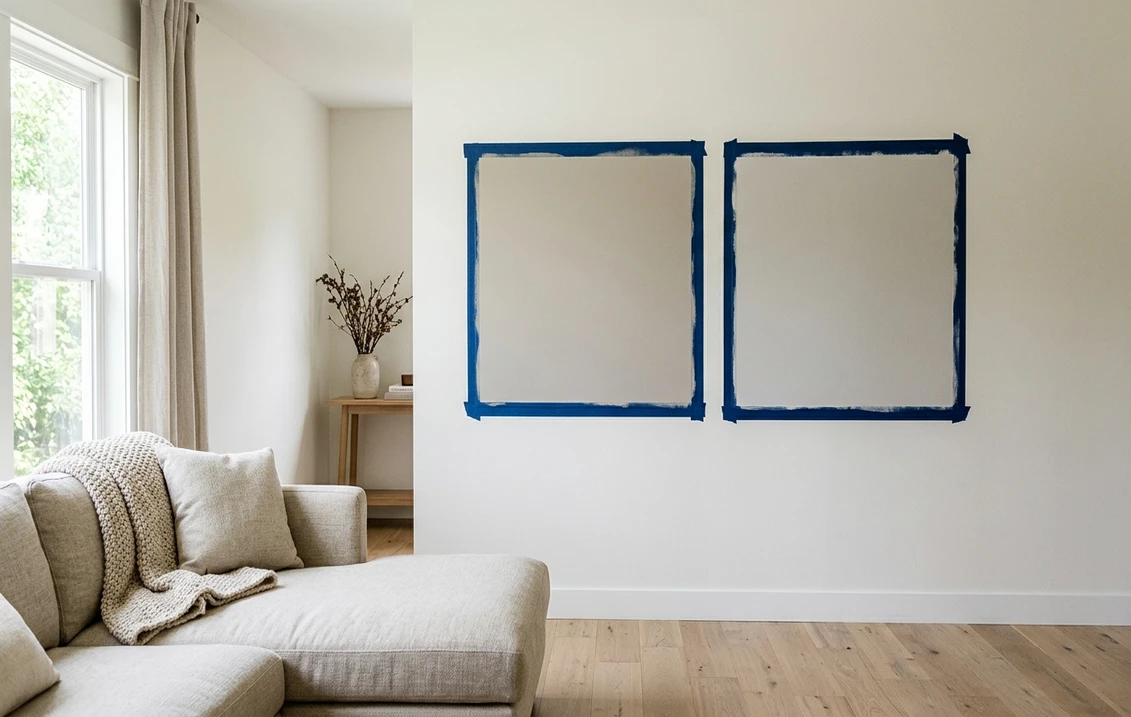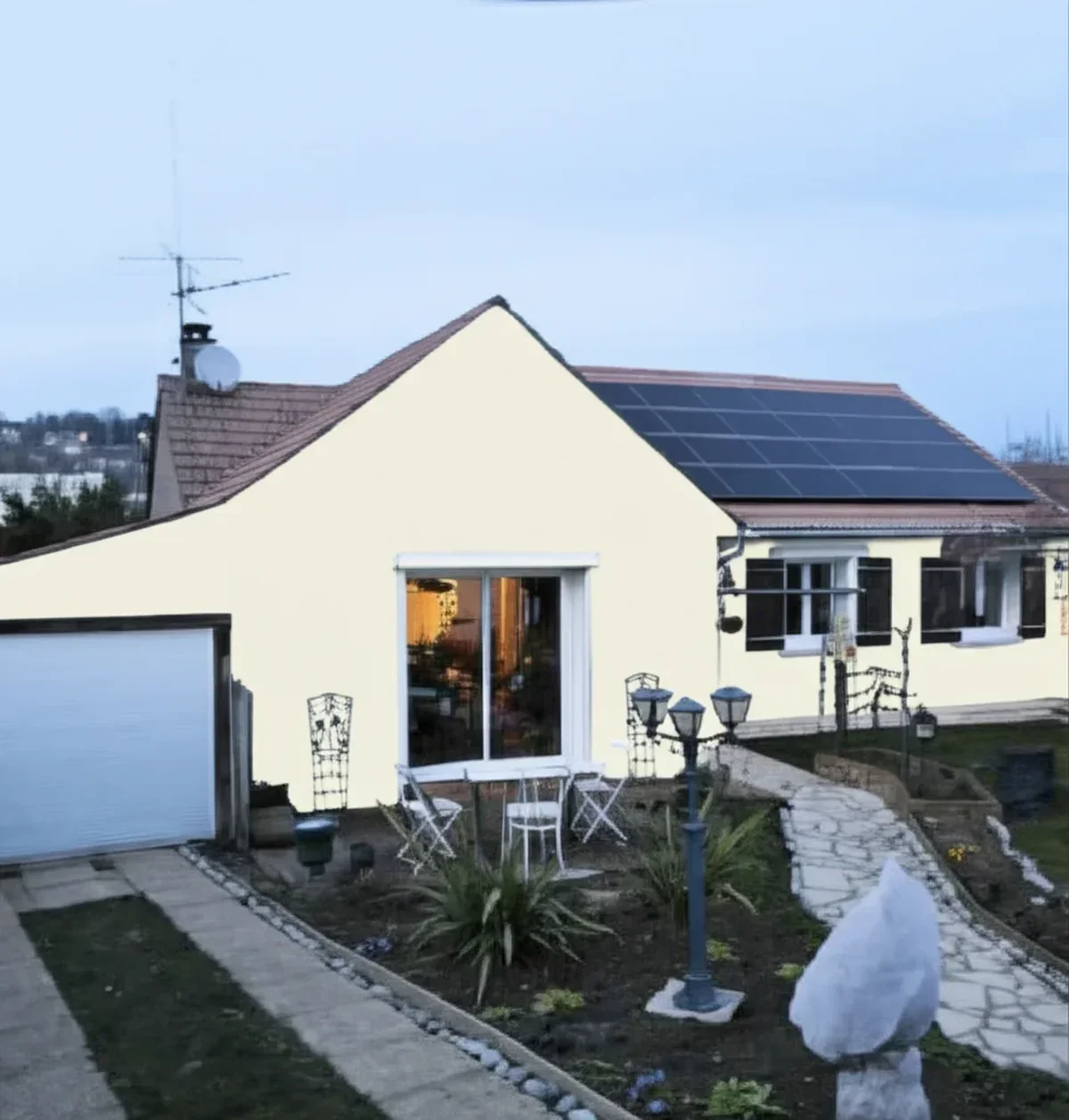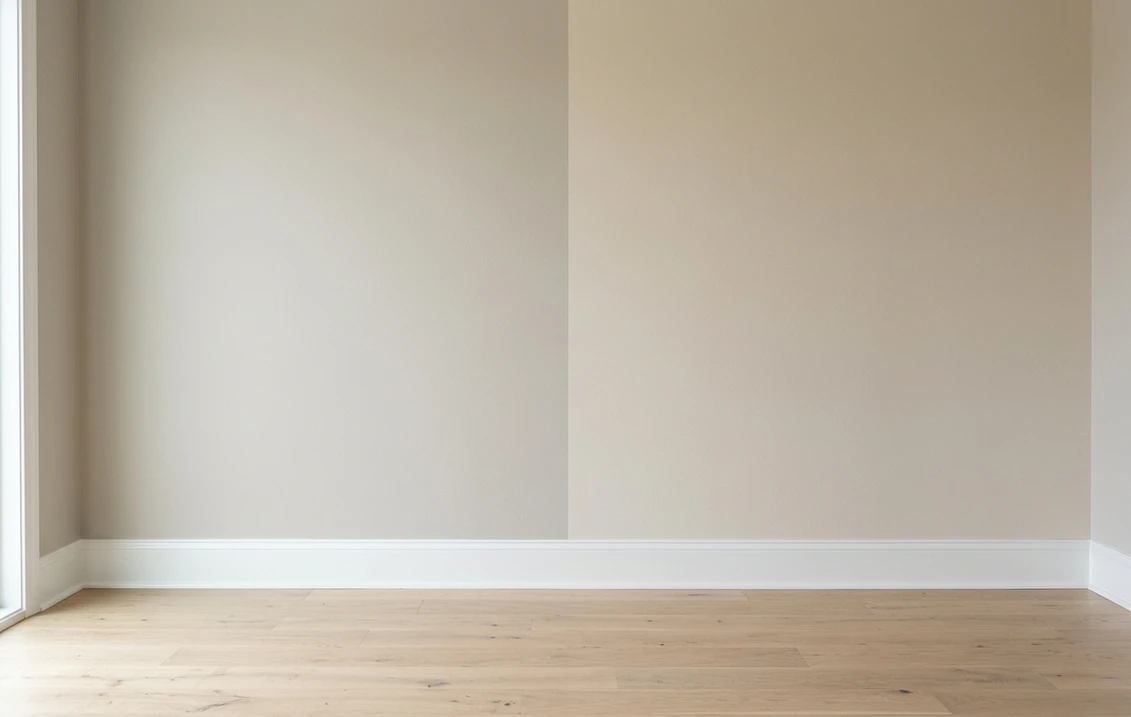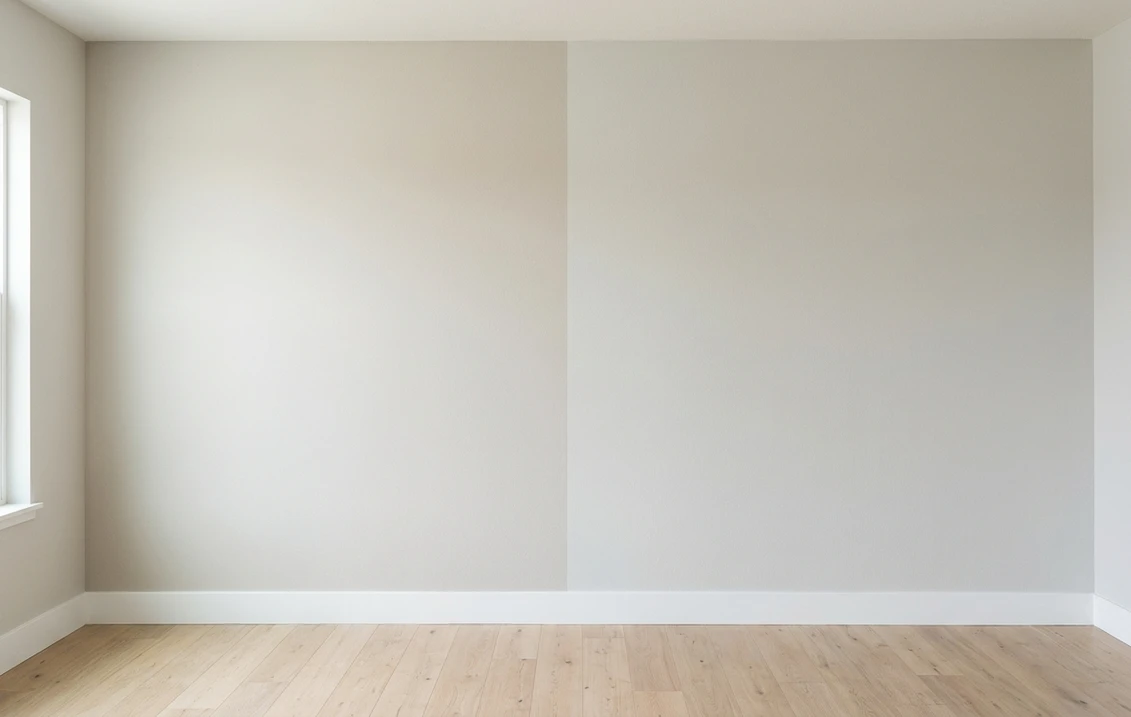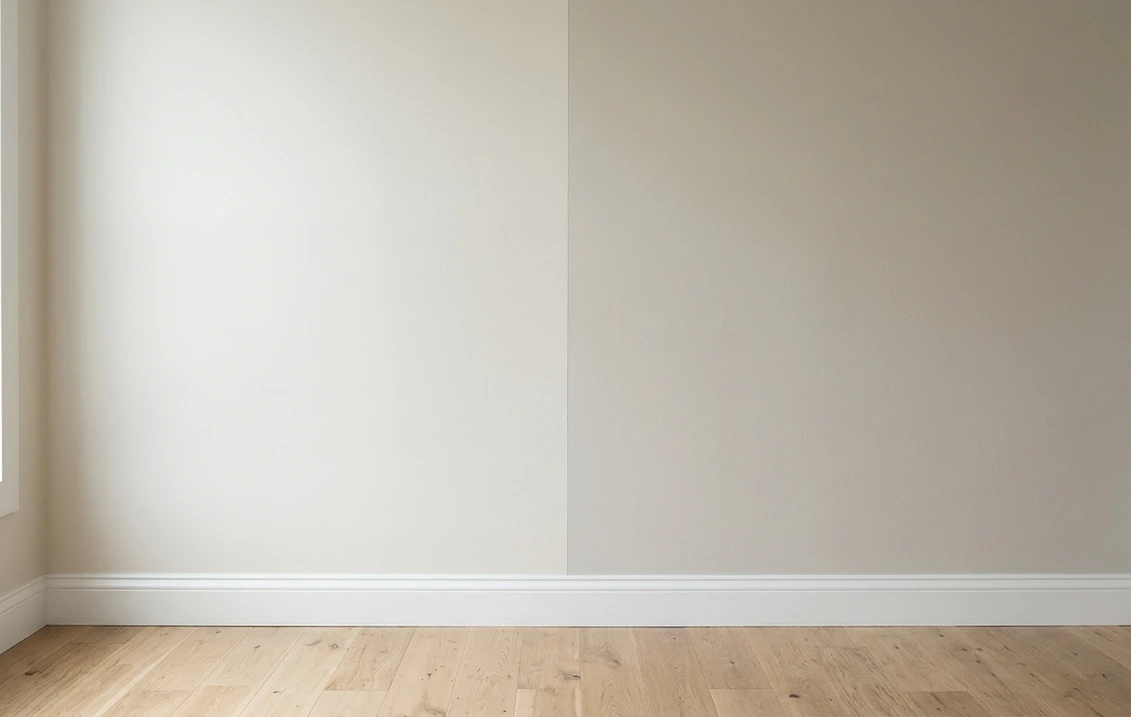
Try it on your house

The verdict in three lines. Pale Oak OC-20 (LRV about 70) is the lighter contender: a pale warm greige that behaves almost like a softened off-white and keeps rooms airy.
Edgecomb Gray HC-173 (LRV about 63) is the fuller contender: a light warm greige with enough pigment to read as a real wall color against white trim.
Both share the same warm beige-gray DNA, so this duel is decided by depth and presence, not warm versus cool. The honest tiebreaker is seeing both on a photo of your own room.
Benjamin Moore Pale Oak (OC-20) and Edgecomb Gray (HC-173) are two of the most sampled light greiges in the Benjamin Moore deck, and they land on the same shortlist constantly. On chips they look like near twins. On a full wall they do not: one behaves like a barely-there off-white, the other like a proper light neutral. This head-to-head puts the numbers side by side, runs the duel room by room and exposure by exposure, and tells you exactly when each color wins. For the general method behind any two-color decision, start with our side-by-side method for comparing paint colors.
The numbers side by side
| Attribute | Pale Oak OC-20 | Edgecomb Gray HC-173 |
|---|---|---|
| Family | Pale warm greige, near off-white | Light warm greige |
| LRV | About 70 | About 63 |
| Approximate hex | #DEDACF | #D9D3C4 |
| Approximate RGB | 222, 218, 207 | 217, 211, 196 |
| Undertone | Soft taupe-gray warmth, can flash a faint pinkish cast in some light | Earthy beige-gray, steady and grounded |
| Loves | White oak floors, cream textiles, soft brass, airy minimalist rooms | White trim and cabinets, walnut, linen, earthy accent colors |
| Watch out for | Can bleach to plain white in strong sun, or flash pinkish taupe in warm evening light | Can look muddier and grayer in dim, cool light |
| Overall vibe | Airy, quiet, walls that recede | Cozy, established, walls with presence |
Try it on your house
No photo? Try a sample
LRV values are rounded from Benjamin Moore's published figures. Hex and RGB are approximate digital renderings; the authoritative reference is a physical Benjamin Moore chip or sample.
Read that table once and the shape of the duel is clear. Undertone is close to a tie: both colors sit in the same warm beige-gray family, and neither will ever read cold or blue. Everything that matters happens in the LRV row. A gap of about seven points is genuinely visible on a wall: Pale Oak reflects so much light that most people perceive it as a warmed-up white, while Edgecomb Gray keeps enough pigment to register as an actual greige. Hold each chip against a plain sheet of white printer paper and you will see it in seconds: Pale Oak nearly disappears into the paper, Edgecomb Gray clearly stands apart from it. That white-paper trick, plus the two-coat sample rule, comes straight from the comparison method in the pillar guide linked above.
Upload one photo, get a photorealistic render, then swap to Edgecomb Gray in one click. Free, no signup.
Room by room, exposure by exposure
Because the undertones are cousins, the same room crowns its winner based on light levels and on how much wall presence you actually want. Here is how the duel typically plays out across the most common situations.
| Situation | Usual winner | Why |
|---|---|---|
| Dark room you want to brighten | Pale Oak | The higher LRV bounces noticeably more light; Edgecomb keeps more shadow in corners |
| Bright south-facing room | Edgecomb Gray | Strong sun can bleach Pale Oak to plain white; Edgecomb holds its greige character |
| Open-plan whole-main-floor color | Edgecomb Gray | A proven whole-house neutral with enough body to define walls against white trim |
| Warm minimalist or Scandinavian look | Pale Oak | Reads as a softened white and keeps large, spare spaces airy instead of stark |
| Kitchen with white cabinets | Edgecomb Gray | Enough contrast that the walls do not melt into the cabinet fronts |
| Bedroom with wood and linen | Either, pick by depth | Both flatter warm textiles; choose by how much wall presence you want behind the bed |
If Edgecomb Gray makes your shortlist, it probably is not its only duel. It also faces the most popular Sherwin-Williams greige in our Agreeable Gray vs Edgecomb Gray verdict, and its own deeper cousin in the Revere Pewter vs Edgecomb Gray head-to-head.
When to choose Pale Oak
- You want almost-white, not a color. Pale Oak is the pick when true white feels sterile but you still want walls that read light, quiet, and nearly colorless.
- The room is small or starved of daylight. With an LRV near 70, it reflects most of the light that reaches it and keeps compact rooms from closing in.
- Your palette is warm minimalist. White oak floors, cream boucle, soft brass, and unbleached linen all sit comfortably inside Pale Oak's gentle taupe warmth.
- You want walls that recede. If art, furniture, or a view should carry the room, Pale Oak steps back and lets them.
For its full undertone breakdown, lighting behavior, and best rooms, see the dedicated Pale Oak OC-20 undertones and rooms profile.
When to choose Edgecomb Gray
- You want walls that read as a real color. Edgecomb Gray is light, but it is unmistakably a greige, not a tinted white, and it photographs that way too.
- You need one neutral for the whole house. It is a classic whole-house pick from Benjamin Moore's Historical Color collection, steady across rooms and exposures.
- Your trim and cabinets are bright white. The extra depth draws a clean line between wall and woodwork where Pale Oak can blur into it.
- You plan warm, earthy accents. Olive, terracotta, walnut, and aged leather all land more convincingly on Edgecomb Gray's grounded base.
The full room-by-room treatment, including trim pairings and companion shades, lives in the Edgecomb Gray HC-173 room-by-room profile.
There is an arithmetic version of the "blurs into the trim" problem, and it is worth running before you rule Pale Oak out. Against Chantilly Lace OC-65 (LRV 90) Pale Oak keeps a gap of about 20 points and still reads as a wall color; against White Dove OC-17 (LRV 85) the gap falls to roughly 15 and the wall starts merging with the woodwork. Edgecomb Gray survives either. If your trim is already painted, settle White Dove versus Chantilly Lace first, because it decides this duel more often than the wall color does.
Run the same arithmetic at the dark end and it stops being arithmetic. Against a charcoal island, door or feature wall both greiges clear more than fifty points of separation, so contrast is never in doubt and the decision moves to temperature. Iron Ore SW 7069 dips its blue channel just below red and green and stays faintly warm, which keeps a Pale Oak or Edgecomb room coherent; Peppercorn SW 7674 runs dead-even channels and will read cooler than the walls it sits against. Peppercorn vs Iron Ore puts the two side by side with hex values and room-by-room winners. Both of those are Sherwin-Williams, which means a color-match trip to the other counter when the walls are Benjamin Moore. The same choice exists inside the BM deck: Wrought Iron 2124-10 at LRV 6 is the green-leaning near-black, while Kendall Charcoal HC-166 at about 12 reflects roughly twice as much light, keeps its texture in a dim room, and is the one that sits comfortably with wood and brass beside a warm greige. Our Benjamin Moore Wrought Iron vs Kendall Charcoal duel settles that pair.
Same wall, both greiges, your actual light. Free render in about 30 seconds.
Frequently asked questions
What is the real difference between Pale Oak and Edgecomb Gray?
Depth, not undertone. Both are warm greiges from the same beige-gray family, but Pale Oak OC-20 (LRV about 70) reads almost like a softened off-white while Edgecomb Gray HC-173 (LRV about 63) reads as a true light greige. That gap of roughly seven LRV points is clearly visible on a full wall.
Is Pale Oak lighter than Edgecomb Gray?
Yes, noticeably. Pale Oak's LRV of about 70 versus Edgecomb Gray's roughly 63 means Pale Oak reflects meaningfully more light. In practice Pale Oak behaves like a warm near-white that brightens a room, while Edgecomb Gray keeps enough pigment to give walls visible color and presence.
Which works better in a north-facing room, Pale Oak or Edgecomb Gray?
It depends on the goal. If the room feels dark and you want maximum brightness, Pale Oak's higher LRV wins. If you want the room to feel intentionally cozy rather than washed out, Edgecomb Gray's extra depth holds its greige character better in flat, cool light. Sample both on the actual wall before committing.
Can I use Pale Oak and Edgecomb Gray together in the same house?
Yes, and they pair unusually well because they share the same warm base. A common plan is Edgecomb Gray in the main living areas for presence, with Pale Oak in halls, bedrooms, or upstairs spaces as the lighter partner. The step in depth reads as deliberate tone-on-tone layering, not a mismatch.
Settle it on your photo
Chips lie, screens lie, and a sample patch on someone else's wall tells you nothing about your light. The fastest honest answer to Pale Oak vs Edgecomb Gray is to test both colors on a photo of your actual room and let your own trim, floor, and windows pick the winner. If the duel widens into a longer shortlist, the 2026 Benjamin Moore interior color guide maps the rest of the deck.
1 HD render plus 3 free color variations. Start with Pale Oak, swap to Edgecomb Gray in one click.
Trademark notice. Benjamin Moore®, Pale Oak®, Edgecomb Gray®, Balboa Mist® and Revere Pewter® are trademarks of Benjamin Moore & Co. FacadeColorizer is not affiliated with, endorsed by, or sponsored by Benjamin Moore & Co. Brand and color names are used for descriptive and editorial purposes only, consistent with nominative fair use. Hex and RGB values are approximate digital renderings; the only authoritative reference is a physical Benjamin Moore color sample.
Trademarks mentioned (Sherwin-Williams, Benjamin Moore, Behr, Caparol, Brillux, Sto, Alpina, Valspar, PPG, Glidden, Dulux, Crown Trade, Sandtex, Farrow & Ball, Johnstone's, Leyland) are property of their respective owners. FacadeColorizer is independent and not affiliated with any of them. Nominative fair use under Lanham Act §1125.