Try it on your house

The verdict in three lines. Agreeable Gray SW 7029 (LRV 60) is the grayer, slightly deeper greige: walls read as a definite color, with enough body to frame white trim.
Edgecomb Gray HC-173 (LRV 63.88) is the lighter, softer greige: it drifts toward a warm off-white and keeps small or dim rooms feeling airy.
This is also a Sherwin-Williams versus Benjamin Moore duel, so the tiebreaker is rarely the chip alone: it is depth, brand logistics, and how each one behaves in a photo of your own room.
Sherwin-Williams Agreeable Gray (SW 7029) and Benjamin Moore Edgecomb Gray (HC-173) are the flagship warm greiges of America's two biggest paint brands, and the pair people most often try to swap for each other. They are close cousins, not twins: both warm, both light, both proven whole-house neutrals, yet one is visibly grayer and the other visibly lighter once they hit a full wall. This head-to-head puts the published numbers side by side, walks the duel room by room, and shows when each color wins. For the general method behind any two-color decision, start with our method for comparing two paint colors side by side.
The numbers side by side
| Attribute | Agreeable Gray SW 7029 | Edgecomb Gray HC-173 |
|---|---|---|
| Brand | Sherwin-Williams | Benjamin Moore (Historical Collection) |
| Family | Warm greige | Light warm greige, near off-white |
| LRV | 60 | 63.88 |
| Approximate hex | #D1CBC1 | #D9D3C4 |
| Approximate RGB | 209, 203, 193 | 217, 211, 196 |
| Undertone | Beige warmth over a real gray base | Soft beige, more muted, less gray in the mix |
| Loves | White trim, oak floors, brass, gray-leaning decor | Creamy whites, linen, rattan, warm wood tones |
| Watch out for | Can drift beige in warm evening light | Can wash out to plain off-white in bright sun |
| Overall vibe | Grounded, transitional, defined | Airy, organic, quietly warm |
Try it on your house
No photo? Try a sample
LRV values are the published Sherwin-Williams and Benjamin Moore figures. Hex and RGB are approximate digital renderings; the authoritative reference is a physical chip or peel-and-stick sample from each brand.
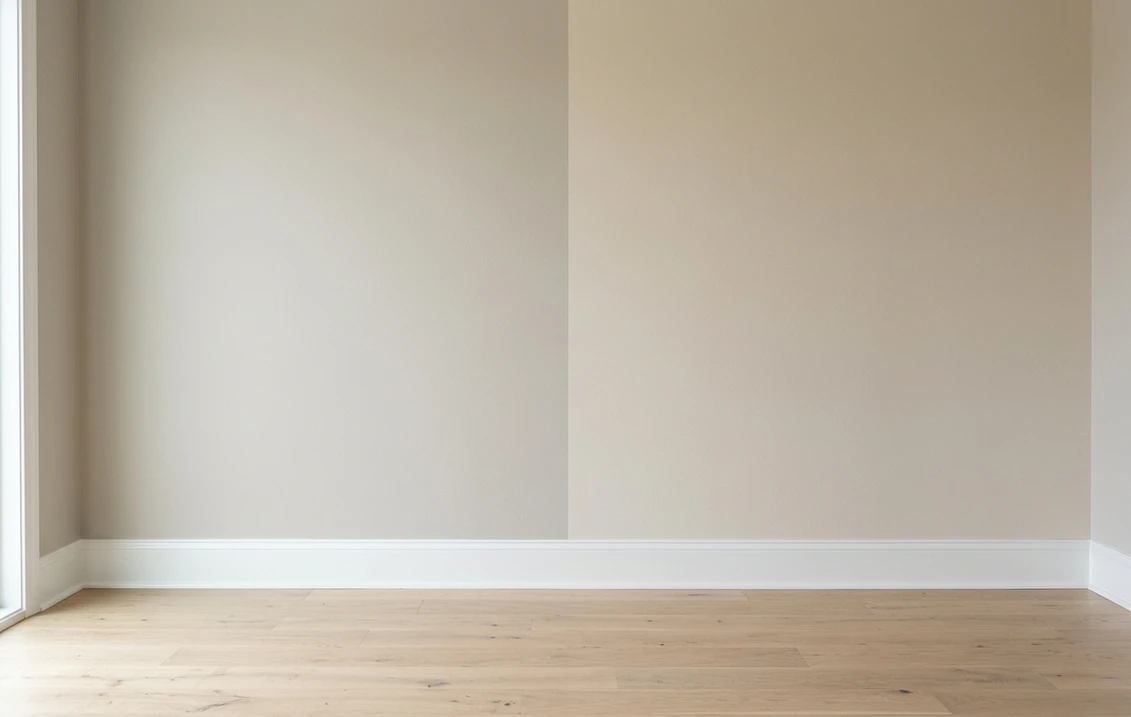
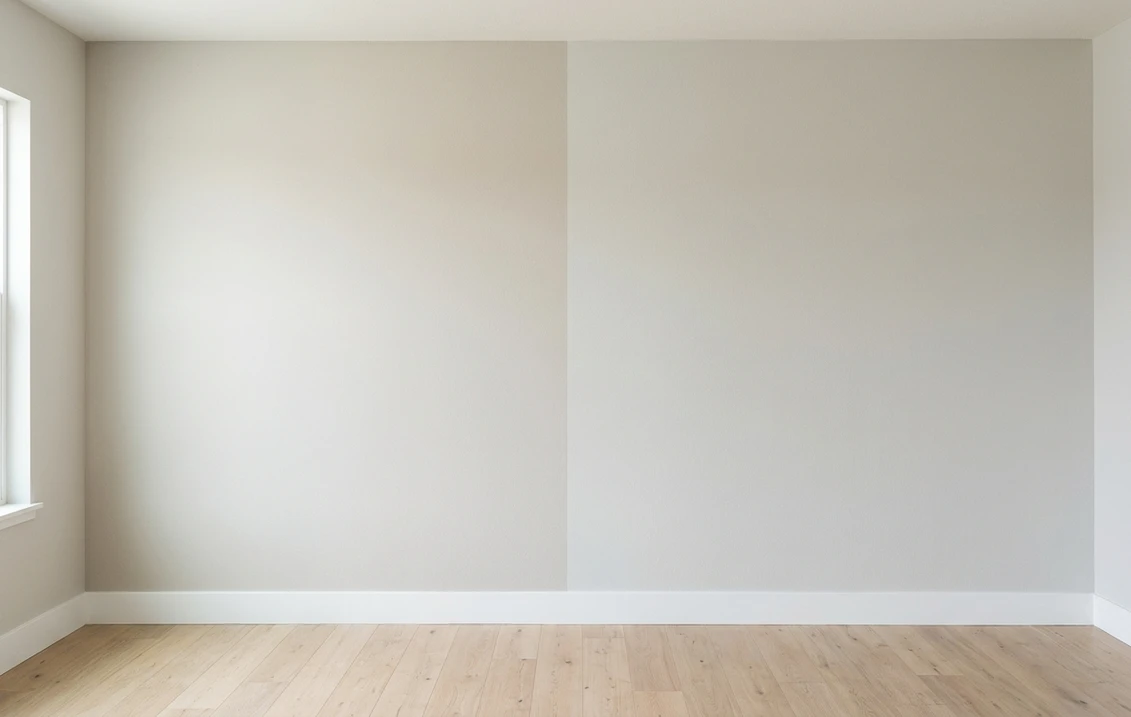
Unlike an in-brand duel, this one has a real depth gap. Nearly four points of LRV separate the two, and on a full wall that gap shows: Edgecomb Gray reads a clear step lighter and creamier, while Agreeable Gray keeps more pigment and more gray in the base. That is exactly why this pair sits at the top of our cross-brand paint color matching guide: they are the closest famous greiges the two brands offer, yet neither is a drop-in substitute for the other. This duel is about choosing, not matching.
Upload one photo, get a photorealistic render, then swap to Edgecomb Gray in one click. Free, no signup.
Room by room, exposure by exposure
Because the two colors differ in depth as well as brand, the winner shifts with room size and light. Here is how the duel typically plays out.
| Situation | Usual winner | Why |
|---|---|---|
| Small or windowless room, hallway | Edgecomb Gray | The higher LRV keeps tight spaces bright without going stark white |
| Bright south-facing room | Agreeable Gray | Full sun can bleach Edgecomb toward plain off-white; Agreeable keeps its color |
| North-facing living room | Either, sample both | Both stay warm in cool light; pick by how much depth the room can carry |
| Open-plan whole-main-floor color | Either, pick by finishes | Both are proven whole-house neutrals; match the undertone to floors and trim |
| Walls that must frame bright white trim | Agreeable Gray | Its extra depth creates visible contrast; Edgecomb can blur into the trim |
| Exterior body color | Either, sample outside | Daylight lightens both; each has a dedicated exterior guide linked below |
Outdoors the same logic applies with harsher light, and both colors jump roughly a shade lighter in full sun. If your shortlist is for siding rather than walls, the Agreeable Gray exterior guide and the Edgecomb Gray exterior guide cover orientation, trim pairings, and siding materials for each color in full.
When to choose Agreeable Gray
- You want walls that read as a color. Agreeable Gray has enough depth to look deliberately greige rather than vaguely off-white, especially against bright white trim and ceilings.
- The room is large or flooded with light. Big sunny spaces eat light colors; Agreeable Gray's extra pigment keeps it from disappearing at noon.
- Your palette leans gray. Charcoal sofas, black metal, cool stone: the grayer base ties them to warm floors without a clash.
- Your painter or store is Sherwin-Williams. Staying in-brand means the chip, the sample, and the gallon all agree; a cross-brand match adds one more variable.
For its full undertone breakdown, best rooms, and trim pairings, see the dedicated Agreeable Gray undertones and best rooms profile.
When to choose Edgecomb Gray
- You want light and airy without white. At LRV 63.88, Edgecomb Gray bounces noticeably more light than Agreeable Gray while still reading warmer and softer than a true white.
- The space is small, dim, or low-ceilinged. Hallways, north bedrooms, and basements stay open and calm instead of shrinking under a deeper neutral.
- Your finishes are creamy and organic. Off-white trim, linen, rattan, and honey-toned wood sit naturally beside its muted beige base.
- You are already in the Benjamin Moore ecosystem. It anchors the Historical Collection and layers cleanly with classic BM partners like White Dove trim.
The full room-by-room treatment, including its lighting behavior and companion shades, lives in the Edgecomb Gray HC-173 complete review. Whichever greige wins the walls, the next decision is usually the door and the shutters, and it is the same cross-brand bracket at the opposite end of the scale: Benjamin Moore Hale Navy against Sherwin-Williams Naval, LRV about 8 versus about 4, where the gap decides whether the accent still reads blue after dark.
Same wall, both brands, your actual light. Free render in about 30 seconds.
Frequently asked questions
What is the real difference between Agreeable Gray and Edgecomb Gray?
Depth and character. Agreeable Gray SW 7029 (LRV 60) is deeper and keeps more gray in its base, so walls read as a definite greige. Edgecomb Gray HC-173 (LRV 63.88) is nearly four points lighter and more muted, drifting toward a warm off-white. Both are warm neutrals; the choice is body versus airiness.
Is Edgecomb Gray lighter than Agreeable Gray?
Yes, and visibly so. Benjamin Moore publishes Edgecomb Gray at LRV 63.88 versus 60 for Agreeable Gray. On a chip the gap looks minor; across a full wall Edgecomb Gray reads a clear step brighter and creamier, which is why it wins in small or dim rooms and can wash out in strong sun.
Can I get Agreeable Gray mixed in Benjamin Moore paint, or Edgecomb Gray in Sherwin-Williams?
Most stores will scan or look up a competitor formula, but the result is an approximation: base tints and finishes differ between brands, so the match can drift warmer or cooler on the wall. If brand flexibility matters, decide on the exact chip first, then have that brand's own store mix its own color and sample it before committing.
Which is better for a north-facing room, Agreeable Gray or Edgecomb Gray?
Both handle cool north light well because both are warm greiges. The deciding factor is depth: Edgecomb Gray keeps a dim room feeling brighter and more open, while Agreeable Gray gives the same room more definition and coziness. Sample both on the darkest wall, or render both on a photo of the room, before buying a gallon.
Settle it on your photo
Chips lie, screens lie, and a cross-brand duel adds the extra trap of two different store visits just to compare samples. The fastest honest answer to Agreeable Gray vs Edgecomb Gray is to test both on a photo of your actual room and let your own trim, floor, and windows pick the winner. If this match settles only one side, keep going: the Agreeable Gray vs Repose Gray duel tests the Sherwin-Williams champion against its cooler sibling, while the Revere Pewter vs Edgecomb Gray comparison pits Benjamin Moore's two Historical greiges against each other.
1 HD render plus 3 free color variations. Start with Agreeable Gray, swap to Edgecomb Gray in one click.
Trademark notice. Sherwin-Williams®, Agreeable Gray® and Repose Gray® are trademarks of The Sherwin-Williams Company. Benjamin Moore®, Edgecomb Gray®, Revere Pewter® and White Dove® are trademarks of Benjamin Moore & Co. FacadeColorizer is not affiliated with, endorsed by, or sponsored by either company. Brand and color names are used for descriptive and editorial purposes only, consistent with nominative fair use. Hex and RGB values are approximate digital renderings; the only authoritative reference is a physical color sample from each brand.
Trademarks mentioned (Sherwin-Williams, Benjamin Moore, Behr, Caparol, Brillux, Sto, Alpina, Valspar, PPG, Glidden, Dulux, Crown Trade, Sandtex, Farrow & Ball, Johnstone's, Leyland) are property of their respective owners. FacadeColorizer is independent and not affiliated with any of them. Nominative fair use under Lanham Act §1125.