Try it on your house

The verdict in three lines. Sherwin-Williams Iron Ore SW 7069 (LRV 6) is the warmer soft black: it reads a touch blacker on a full wall and flatters oak floors, brass, and cream whites.
Benjamin Moore Wrought Iron 2124-10 (LRV 6) is a breath softer and cooler: a faint slate cast that can whisper green keeps it charcoal rather than black, gentler in dim north light.
The LRV numbers are identical, so undertone and your own light decide this duel. The only honest tiebreaker is a photo of your actual wall.
Iron Ore SW 7069 and Wrought Iron 2124-10 are the most popular "soft black" chips in their respective decks, cross-shopped constantly because they solve the same brief: a dramatic near-black that never turns flat or harsh. On sample chips they look interchangeable. On a full wall or a whole facade, they split apart in a predictable way. This duel puts the numbers side by side and tells you exactly when each color wins. For the general method behind any two-chip decision, start with our side-by-side method for comparing paint colors.
This article is the head-to-head only. For everything Iron Ore does on its own, see the full Iron Ore undertone and room guide. For Wrought Iron's solo treatment, see the complete Wrought Iron 2124-10 exterior guide.
The numbers side by side
| Attribute | Iron Ore SW 7069 | Wrought Iron 2124-10 |
|---|---|---|
| Brand | Sherwin-Williams | Benjamin Moore |
| LRV | 6 | 6 (datasheets print it a hair above) |
| Approximate hex | #434341 | #4A4B4C |
| Approximate RGB | 67, 67, 65 | 74, 75, 76 |
| Undertone | Warm, faint brown lean | Cool slate, faint green-gray whisper |
| Reads as | Soft black | Deep charcoal |
| Feels at home with | Oak, brass, cream whites | Marble, black steel, crisp whites |
| Signature uses | Cabinets, islands, siding, doors | Shutters, doors, siding, accent walls |
Try it on your house
No photo? Try a sample
LRV values per Sherwin-Williams and Benjamin Moore published color data. Hex and RGB are approximate digital renderings.
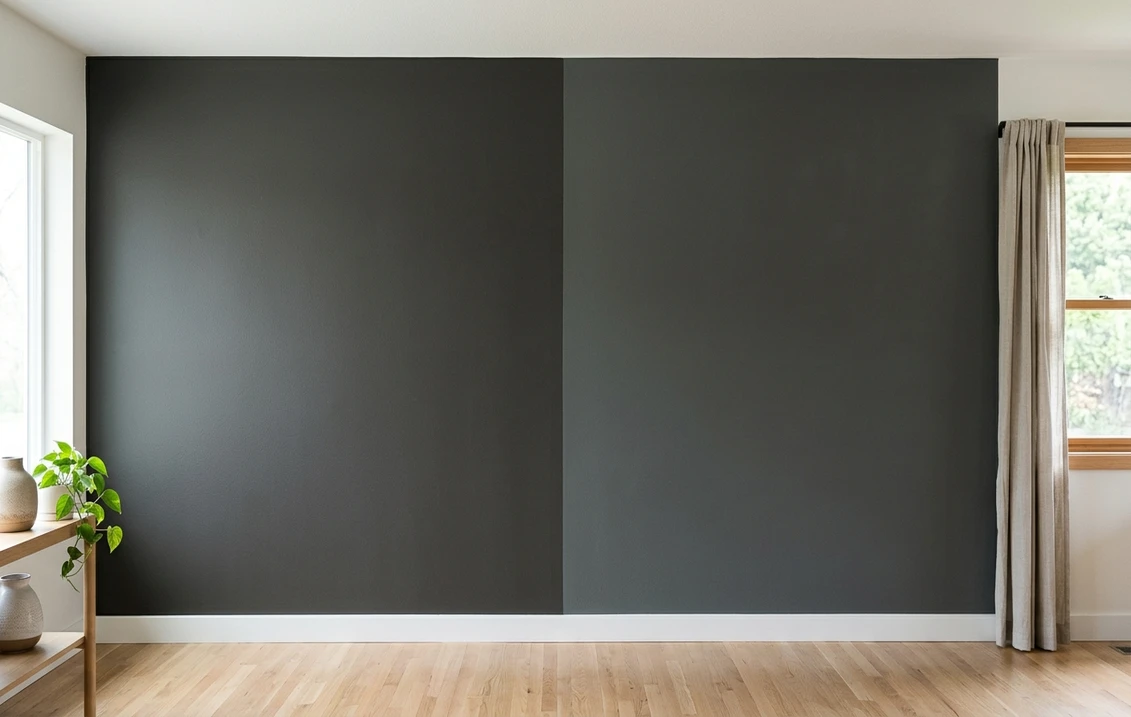
The RGB rows tell the whole story. Iron Ore's channels sit lower with blue weakest, so it reads a touch blacker and warmer. Wrought Iron's channels sit slightly higher with blue on top, so it keeps a visible charcoal-gray quality and a cool, softly green-slate cast. Same LRV on paper, different color story on the wall.
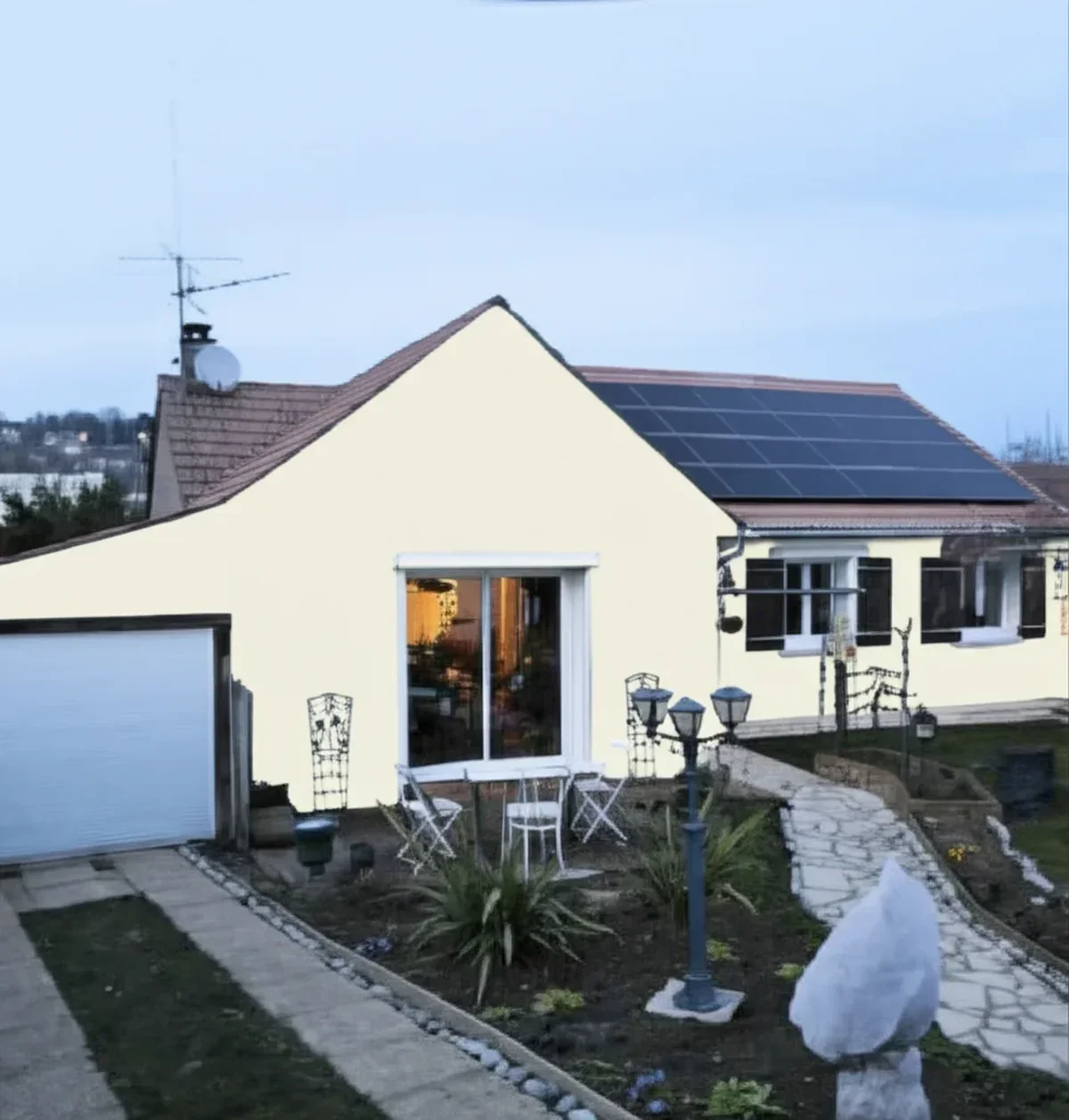
Upload one photo and see SW 7069 applied in 30 seconds. No signup.
Room by room, exposure by exposure
At LRV 6 both colors absorb almost all the light that hits them, so undertone, sheen, and daylight decide everything. Here is how the duel plays out in the situations homeowners actually ask about.
- North-facing rooms. This is where the two separate most clearly. Iron Ore in flat north light collapses toward true black, dramatic but heavy in a small room. Wrought Iron keeps its charcoal identity in the same light: the slate cast reads softer and holds a hint of gray depth. For a moody den with weak light, Wrought Iron is the gentler pick.
- South and west sun. Direct warm light wakes Iron Ore up: the warm lean surfaces and the wall reads like a rich, velvety black that flatters wood tones and brass. Wrought Iron in strong sun shows its cool side and can look faintly green-gray next to warm materials. Sunny room, warm palette: Iron Ore wins.
- Kitchen cabinets and islands. Iron Ore is the established cabinet near-black: in satin it reads crisp and black enough to anchor an island while staying friendlier than true black. Wrought Iron on cabinetry reads more "charcoal furniture piece" than "black island," a legitimate look but a different one.
- Exteriors. Both are proven full-siding near-blacks with the same practical caveats (heat load, deep-tint base, two coats). The undertone logic carries outside: Iron Ore leans warm against cedar and cream trim, Wrought Iron leans architectural against crisp white trim and black-frame windows. The Iron Ore exterior deep dive covers the SW side in full.
- Doors and shutters. Nearly a tie. Both look premium on a front door; pick whichever brand ecosystem the rest of the palette already lives in, since matching a competitor's chip always costs a little accuracy.
Same photo, BM 2124-10 applied. Free AI render in 30 seconds.
When to choose Iron Ore
- You want the blackest read without committing to true black. Iron Ore delivers the "is that black?" effect from across the room while keeping a soft edge up close.
- The palette is warm. Oak or walnut floors, brass or aged-bronze hardware, cream whites: Iron Ore's warm lean ties into all of it instead of fighting it.
- The project is a kitchen island or cabinet run. It is the safer, more predictable cabinet black of the two.
- The rest of the spec is already Sherwin-Williams. Staying inside one deck avoids cross-brand matching drift on a color this dark.
When to choose Wrought Iron
- You want charcoal, not black. Wrought Iron is the near-black that still reads as a color. If "softened" is the brief, it is the answer.
- The light is weak or northern. Its slate cast keeps a dim wall from collapsing into a light-swallowing void.
- The palette is cool. Marble, chrome or matte-black steel, crisp gallery whites: Wrought Iron's cool undertone belongs in that company.
- Traditional or historical architecture. On the shutters and doors of Colonials and Tudors, Wrought Iron reads inherited rather than trendy.
Frequently asked questions
Are Iron Ore and Wrought Iron the same color?
No. They share an LRV of 6 and both read near-black from a distance, but Iron Ore SW 7069 carries a warm, faintly brown lean while Wrought Iron 2124-10 carries a cool slate cast with a whisper of green-gray. Side by side on one wall, Iron Ore looks blacker and warmer, Wrought Iron looks grayer and softer.
Which is darker, Iron Ore or Wrought Iron?
On paper they are effectively tied at LRV 6, with Wrought Iron's datasheet printing a hair above. On the wall, Iron Ore usually reads a touch darker because its undertone pulls toward black, while Wrought Iron holds a visible charcoal-gray quality. In dim light the perceived gap widens in Iron Ore's favor.
Can I use Iron Ore or Wrought Iron on a full exterior?
Yes, both are proven full-siding colors. Expect the standard dark-color caveats for either: an ultra-deep tint base, two coats, higher surface temperatures in full sun, and a check of any HOA guidelines. Outside, Iron Ore flatters warm trim and cedar, Wrought Iron flatters crisp white trim and black-frame windows.
What is the Benjamin Moore equivalent of Iron Ore?
Wrought Iron 2124-10 is the closest Benjamin Moore cross-shop for Iron Ore SW 7069, which is exactly why this duel exists. It is not a formula match: Wrought Iron runs a breath softer and cooler. If you need Iron Ore exactly in a BM product, a store can spectrophotometer-match it, but test the result, because near-blacks expose small matching errors.
More near-black face-offs
This is one round in a bigger dark-neutral bracket. If Behr is on your shortlist too, the Behr Cracked Pepper vs Iron Ore exterior face-off settles that different pairing. Still deciding whether a near-black body is right for your house at all? The dark exterior paint pros, cons, and heat data roundup is the step-back read.
Apply Iron Ore and Wrought Iron to the same photo of your home. 1 HD render plus 3 free color variations, no signup.
Bottom line. There is no wrong answer here, only a wrong match for your light and materials. Iron Ore SW 7069 is the warmer, blacker-reading soft black for warm palettes, sunny exposures, and cabinetry. Wrought Iron 2124-10 is the softer, cooler charcoal for weak light, cool palettes, and traditional architecture. Test both on one photo before you buy a single gallon. Authoritative references: the official Sherwin-Williams Iron Ore SW 7069 page and the official Benjamin Moore Wrought Iron 2124-10 page.
Trademark notice. Sherwin-Williams® and Iron Ore® are trademarks of The Sherwin-Williams Company. Benjamin Moore® and Wrought Iron® are trademarks of Benjamin Moore & Co. Behr® is a trademark of Behr Process Corporation. FacadeColorizer is not affiliated with, endorsed by, or sponsored by these companies; brand names are used for descriptive editorial purposes only (nominative fair use, 15 U.S.C. § 1125). Hex and RGB values are approximate digital renderings; the only authoritative reference is a physical color sample.
Trademarks mentioned (Sherwin-Williams, Benjamin Moore, Behr, Caparol, Brillux, Sto, Alpina, Valspar, PPG, Glidden, Dulux, Crown Trade, Sandtex, Farrow & Ball, Johnstone's, Leyland) are property of their respective owners. FacadeColorizer is independent and not affiliated with any of them. Nominative fair use under Lanham Act §1125.