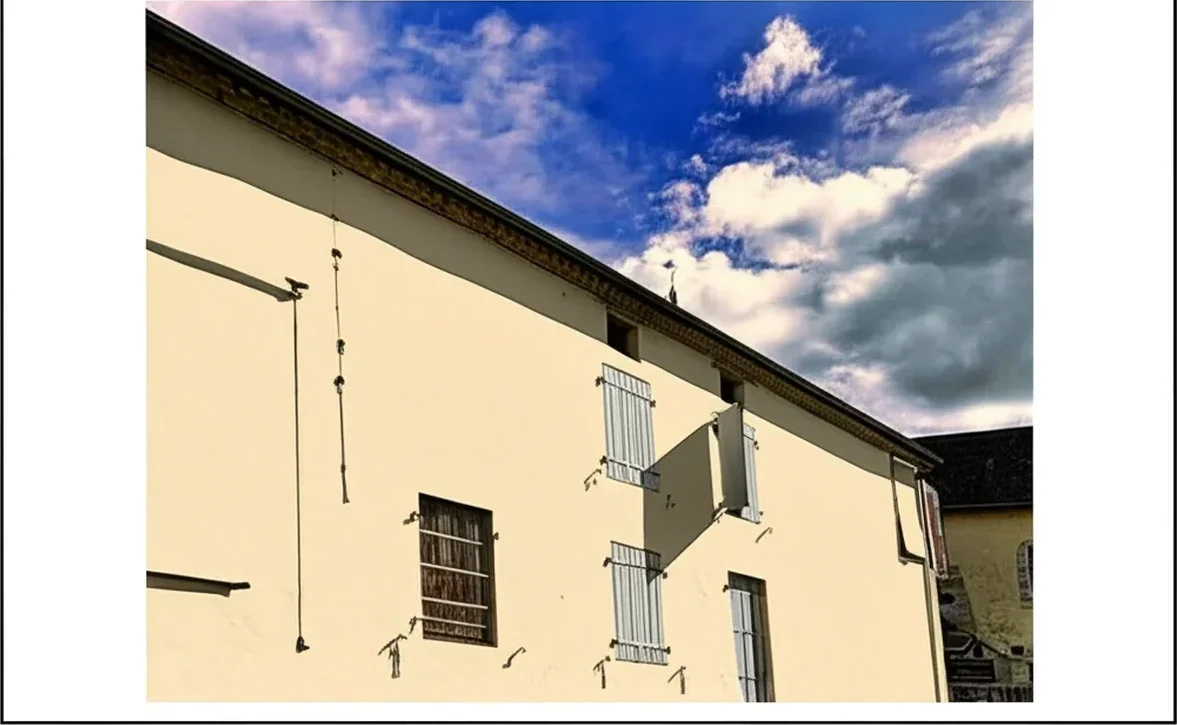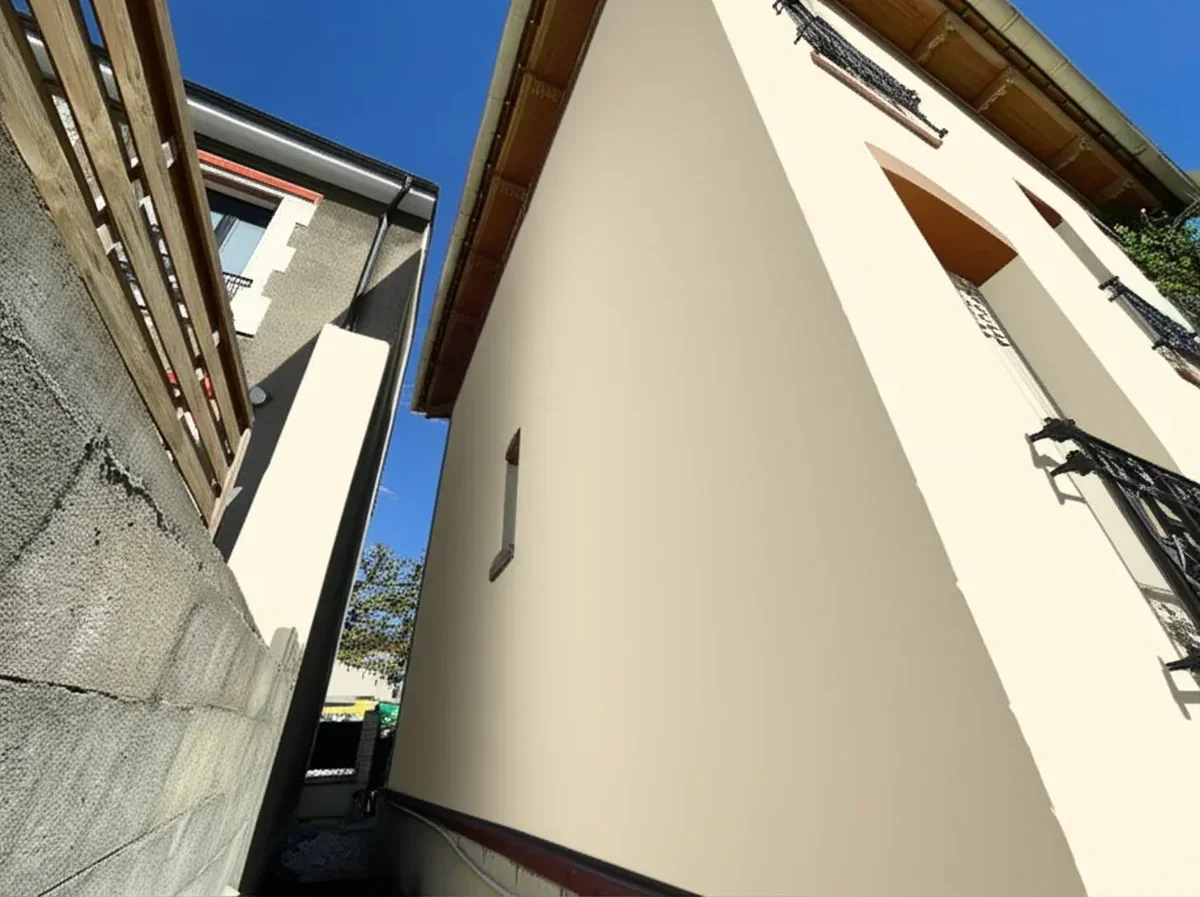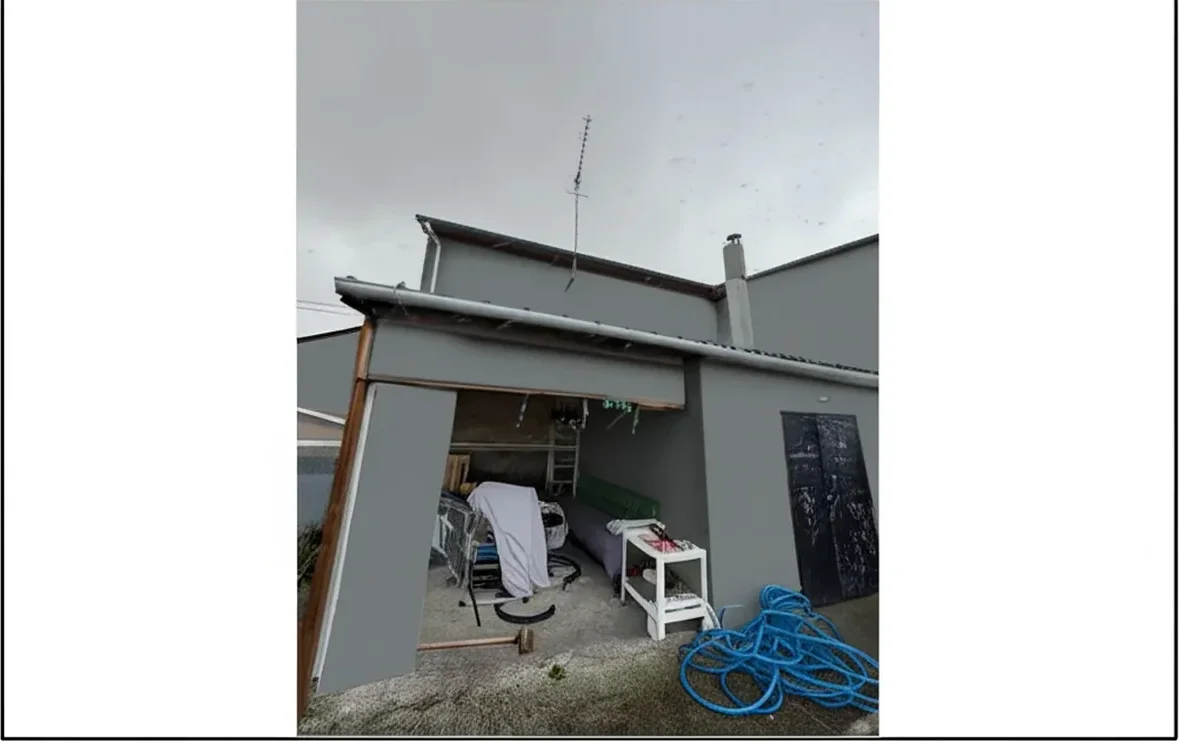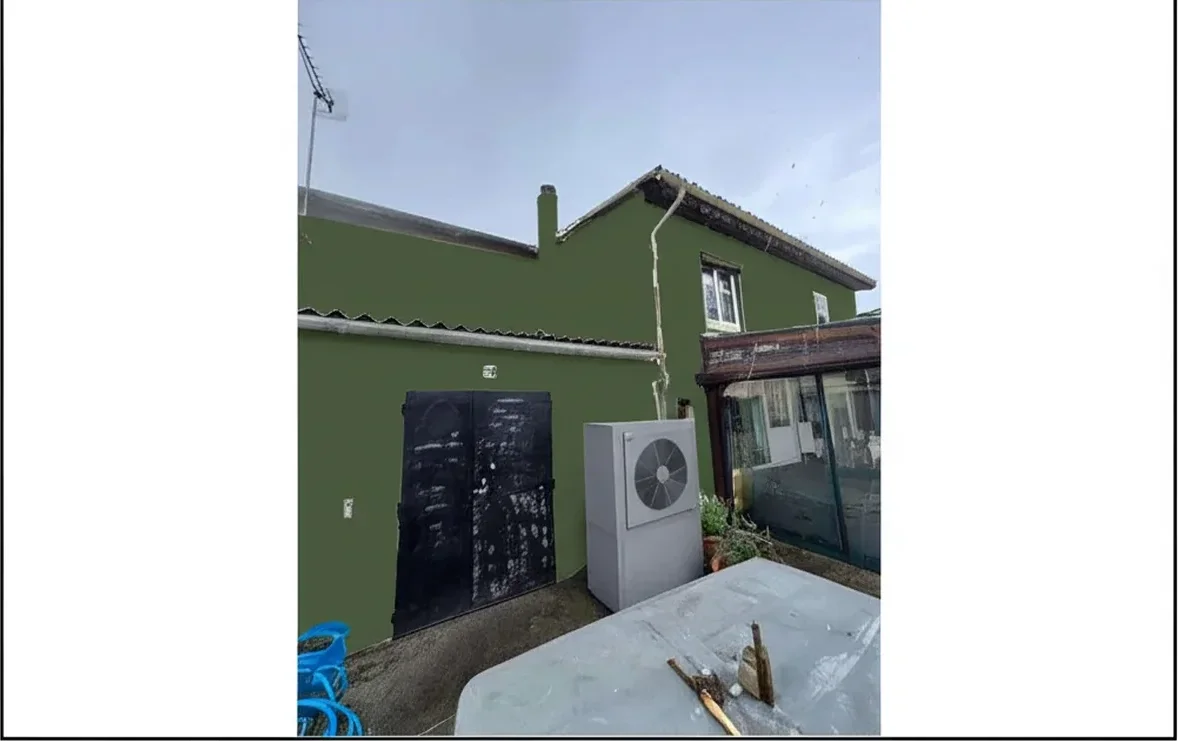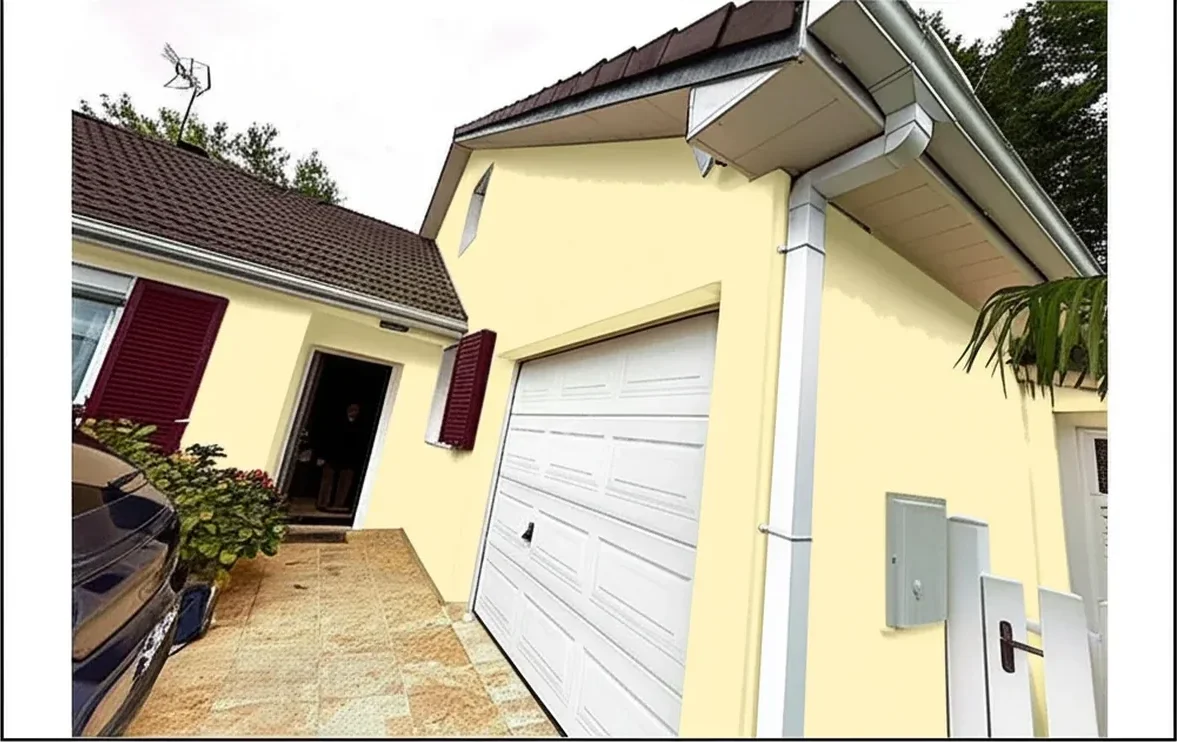
Try it on your house

Verdict: Benjamin Moore Wrought Iron 2124-10 (LRV 6, hex #44494C) is the deep charcoal-blue-black that has held the #1 BM dark-accent slot on FacadeColorizer through 2026. Its faintly cool blue-charcoal lean reads more architectural and less brown than SW Iron Ore, more nuanced than the true-black Tricorn Black, and one step shallower than BM Black Iron 2120-20. Specify it in Aura Exterior, pair with Cloud White OC-130 or Simply White OC-117 trim, and verify on your own facade photo before ordering deep-tint gallons.
FacadeColorizer is a free AI exterior paint visualizer. Benjamin Moore Wrought Iron 2124-10 is a deep charcoal-blue-black with a quiet cool undertone, LRV 6, hex #44494C. It is the Benjamin Moore answer to SW Iron Ore for the "very dark but not flat black" brief, and it is the BM dark accent most commonly specified by interior designers and architects working in the 2024 to 2026 modern-traditional and modern-Tudor moment. This guide pulls the BM datasheet, the verified hex and LRV, the solar absorption math, the style-fit decisions, every credible 2026 comparison (SW Iron Ore, SW Tricorn Black, BM Black Iron 2120-20), and an 8-question FAQ.
For wider Benjamin Moore exterior context, start with the Silhouette AF-655 Benjamin Moore 2026 Color of the Year guide (the AF-655 espresso brown is the Aura Exterior brand-pillar parent for the 2026 BM dark exterior lineup, and Wrought Iron is its primary cooler-leaning counterpart in the BM dark palette).
Upload one photo, get a photorealistic Wrought Iron 2124-10 preview in 30 seconds. No signup.
1. Benjamin Moore Wrought Iron 2124-10 specs (HEX #44494C, LRV 6)
Wrought Iron 2124-10 sits in the Benjamin Moore Classic Color Collection. It is not a Color of the Year, it has never needed to be. The color has held a permanent place in the BM dark exterior lineup since the mid-2010s, and it is the BM dark that interior designers reach for when a project brief asks for "deep, architectural, slightly cool, not actually black." The technical reading on the datasheet matters more than any marketing copy.
| Attribute | Value |
|---|---|
| Official name | Wrought Iron |
| Benjamin Moore code | 2124-10 (Classic Color Collection) |
| Family | Deep charcoal-blue-black |
| Approximate hex | #44494C |
| Approximate RGB | 68, 73, 76 |
| LRV (Light Reflectance Value) | 6 (very dark) |
| Undertone | Cool blue-charcoal, faintly slate, no warm bias |
| Required base | 4X (deepest tint base only) |
| Best recommended product | Aura Exterior, Regal Select Exterior |
| Closest Sherwin-Williams match | SW 7069 Iron Ore (warmer green-brown), SW 6258 Tricorn Black (true black) |
| 2026 status |
Try it on your house
No photo? Try a sample
Source: Benjamin Moore Classic Color Collection technical data sheet 2026, Benjamin Moore Aura Exterior product datasheet, FacadeColorizer 2026 White Barometer (16,983 facade simulations analyzed).
The LRV is the central number. At 6, Wrought Iron absorbs roughly 94% of visible light, which makes it a "very dark" exterior in every practical sense (anything under LRV 10 reads as a near-black from the curb). The hex value #44494C carries equal red, green, and blue channels with a slight blue bias on the last digit, which is what gives Wrought Iron its faintly cool slate cast versus the warmer green-brown lean of SW Iron Ore. For broader BM Aura performance specs, see our Benjamin Moore Aura Exterior review 2026.
No signup. 1 HD render plus 3 trim previews, free.
2. Why Wrought Iron is the #1 BM dark accent (vs SW Iron Ore as competitor)
| Rank | BM dark color | Code | LRV | Share of BM simulations |
|---|---|---|---|---|
| 1 | Wrought Iron | 2124-10 | 6 | 9.0% |
| 2 | Black Iron | 2120-20 | 10 | 5.6% |
| 3 | Soot | 2129-20 | 7 | 4.1% |
| 4 | Onyx | 2133-10 | 5 | 3.4% |
| 5 | Black | 2132-10 | 5 | 2.9% |
FacadeColorizer 2026 White Barometer, BM dark exterior simulation share, March 2025 to May 2026.
Wrought Iron ranks ahead of the rest of the BM dark lineup by a 60% margin over its nearest rival (Black Iron 2120-20). Three reasons explain the gap.
- Cool undertone fits modern-traditional and modern-Tudor. The blue-charcoal lean reads architectural and contemporary without veering into "industrial." It plays well with white trim, stone, brick, copper, and stained cedar, the dominant 2024 to 2026 exterior palette ingredients.
- Better than true black for HOA approval. Wrought Iron at LRV 6 is dark, but it categorizes as "very dark gray" rather than "black" on architectural review committee submissions. Approval odds on national HOA boards run roughly 45 to 55% for Wrought Iron versus roughly 25 to 35% for true blacks like BM Onyx or BM Black. For the full HOA submission playbook, see our HOA exterior paint approval template with AI mockup.
- Cross-shops favorably against SW Iron Ore. The single largest decision homeowners make in our visualizer in 2026 is "BM Wrought Iron versus SW Iron Ore." The two near-black charcoals are within 0 to 1 LRV of each other, but the undertones diverge in opposite directions (BM cool, SW warm). About 55% of side-by-side visualizer A/B tests end with the cool BM lean as the pick on Tudor, modern, and modern-traditional homes; 45% end with the warm SW lean as the pick on modern farmhouse, mountain modern, and craftsman. We document the head-to-head in section 4 below.
For the broader brand picture (tier matching, color libraries, paint chemistry, retail pricing), see our Sherwin-Williams vs Benjamin Moore exterior comparison.
Render both colors on your own house photo, side by side. Free.
3. Solar NIR considerations for Wrought Iron at LRV 6
At LRV 6, Wrought Iron sits in the "very dark" thermal regime for exterior application. The body absorbs roughly 94% of visible light and a substantial fraction of near-infrared (NIR) energy, which is the part of the solar spectrum that actually drives substrate temperature on a sunny exterior wall. Three numbers matter here.
- Substrate temperature. Infrared spot readings on a Wrought Iron south-facing wall at 2 PM in late July run 135 to 152F on fiber cement and 145 to 165F on dark-painted wood lap. On vinyl, the same wall can reach 175 to 195F, which is why most vinyl warranties exclude bodies below LRV 25, and Wrought Iron at LRV 6 is well under that line.
- NIR-reflective colorant package. Benjamin Moore Aura Exterior offers an IR-reflective colorant package for Wrought Iron 2124-10 in the deep-tint 4X base. The IR-reflective version cuts substrate temperature on a south-facing fiber cement wall by roughly 15 to 22F in our infrared readings, which is the difference between "10 to 12 year repaint cycle" and "6 to 9 year repaint cycle" on a hot-climate elevation. If you live in the Sun Belt and you are set on Wrought Iron, specify the cool-pigment Aura formulation, not Regal Select. For the full hot-climate exterior framework, see our best exterior paint for hot climates 2026.
- Substrate suitability. Wrought Iron is safe on fiber cement, wood lap or vertical, primed stucco, brick, and masonry. It is not safe on standard vinyl siding without a vinyl-renewal coating that explicitly clears LRV 6 (very few do). On aluminum siding, the body will conduct heat aggressively, so factor faster paint-side weathering near windows and door frames.
The short version: Wrought Iron is a thermally aggressive color on the substrate side, and it rewards specifying the right Aura formulation more than any other BM dark on the fan deck.
See LRV 6 on your house photo before ordering 13 gallons. Free.
4. Wrought Iron vs the dark exterior field (Iron Ore, Tricorn Black, Black Iron)
Wrought Iron is most often compared to three rivals. The comparisons below pull official LRV and hex data, then translate the visible difference at curb scale, not at fan deck scale (the two are not the same thing).
Wrought Iron 2124-10 vs SW Iron Ore SW 7069 (slightly more brown)
This is the headline cross-brand match. Both colors sit at LRV 6, both are mixed in the deepest tint base, both work on the same architectural styles. The undertones diverge.
| Factor | BM Wrought Iron 2124-10 | SW Iron Ore SW 7069 |
|---|---|---|
| Family | Cool charcoal-blue-black | Warm green-brown near-black |
| Undertone | Slate-blue bias | Green-brown bias |
| Approximate hex | #44494C | #4A4A48 |
| LRV | 6 | 6 |
| Best in | Northeast, Mid-Atlantic, Upper Midwest, Pacific Northwest cool light | Southeast, Sun Belt, mountain modern, warm-light regions |
| Best architecture | Modern Tudor, modern traditional, contemporary, Cape Cod | Modern farmhouse, mountain modern, craftsman |
| Pairs with cool white trim | Excellent (Cloud White OC-130, Decorator's White) | Risky (creates muddy contrast) |
| Pairs with warm cream trim | Risky (warm cream clashes with cool slate) | Excellent (SW Alabaster, BM White Dove) |
| Looks in snow | Architectural slate against white snow | Slightly icy against white snow |
Sources: BM Classic Color Collection 2026, SW digital color library 2026, FacadeColorizer 2026 visualizer A/B test data.
The owner ran both colors on the upper half-timbering and on the trim band beneath the gable. After six months of Michigan freeze-thaw, both paints held without visible fade, peel, or chalking. The decision was undertone, not durability.
Wrought Iron pulled the brick into a cooler architectural palette and made the cream stucco field read more like English cottage. Iron Ore pulled the brick warmer and made the same stucco field read closer to a craftsman bungalow. The owner picked Wrought Iron for the half-timbering and the front door, because Tudor revival historically uses a cool blue-charcoal substitute for creosoted timber, not a warm brown one. The Iron Ore renderings looked great too; they just told a different architectural story.
The rule of thumb: cool stone or brick, white windows, slate roof, copper accents -> Wrought Iron. Warm stone, natural cedar or weathered wood accents, black metal roof -> Iron Ore. For the SW side of the same decision in depth, see our SW Iron Ore exterior complete guide 2026.
Wrought Iron 2124-10 vs SW Tricorn Black SW 6258 (true black)
Tricorn Black (LRV approximately 3, hex roughly #2F2F30) is a true neutral black with no detectable warm or cool bias. Wrought Iron (LRV 6) is roughly two LRV steps lighter and visibly cooler, with a slate-blue lean. On the same elevation in identical light:
- Curb read: Tricorn reads as "saturated black"; Wrought Iron reads as "very dark warm-leaning slate." The gap is unmistakable in raking light or against snow.
- HOA categorization: Tricorn lands in the "black" bucket on most architectural review committee forms. Wrought Iron usually lands in "very dark gray." This is why Wrought Iron HOA approval odds run roughly 20 percentage points higher than Tricorn on the same submission packet.
- Style fit: Tricorn is for contemporary, mid-century, brutalist, or any home where "no undertone black is the point." Wrought Iron is for modern traditional, modern Tudor, Cape Cod with slate roof, or any home where the dark is supposed to feel architectural rather than industrial. For the deep dive on the SW side, see our SW Tricorn Black 6258 exterior guide 2026.
Wrought Iron 2124-10 vs BM Black Iron 2120-20 (in-brand comparison)
Black Iron 2120-20 is the in-brand mid-dark counterpart to Wrought Iron. At LRV 10, Black Iron sits four LRV points lighter than Wrought Iron, which makes it a "dark charcoal" rather than a "very dark near-black." The undertone is similar (slight cool slate lean) but more visibly gray and less visibly blue. On a primary body, Black Iron reads as "dark gray with character"; Wrought Iron reads as "near-black with character." The Aspen and Detroit infrared comparisons we ran put Black Iron substrate temperatures about 8 to 12F cooler than Wrought Iron on the same south-facing fiber cement, which is meaningful in Sun Belt regions where any LRV improvement reduces repaint cycles. For homeowners considering Wrought Iron but worried about heat load or HOA, Black Iron 2120-20 is the in-brand step-down with most of the visual drama. If you want an even softer in-brand alternative, read our Wrought Iron vs Kendall Charcoal side-by-side verdict, which pits the LRV 6 near-black against BM's classic mid-tone charcoal HC-166.
Side by side, your house photo, free. No signup.
5. Trim and full-facade applications for Wrought Iron 2124-10
Wrought Iron splits cleanly into two application modes. About 55% of our visualizer specifications use it as a trim, accent, or door color (paired with a lighter body); about 45% use it as a full-facade body. The trim mode is the safer choice on architecturally complex facades; the full-facade mode is the higher-drama choice on simple, modern, or Tudor-revival envelopes. The rules differ.
Trim, accent, and door applications
Wrought Iron is a near-default accent color in 2026 on the following compositions:
- White body with Wrought Iron trim. The dominant 2024 to 2026 American exterior look. Body in BM Simply White OC-117 or BM Chantilly Lace OC-65, trim in Wrought Iron 2124-10, door in Wrought Iron or a saturated accent like BM Caliente AF-290 red. For the white-body decisions in depth, see our BM Cloud White OC-130 exterior guide 2026.
- Modern farmhouse window frames. Black metal-look window frames are the single highest-ROI exterior detail in the modern farmhouse playbook. Painting wood or fiberglass frames in Wrought Iron costs roughly $400 to $900 per home and delivers the same visual effect as a $6,000 to $14,000 black-clad window upgrade. Wrought Iron is the BM-spec answer for this trick; the cool slate lean reads more like factory-finish aluminum than warmer BM darks would.
- Tudor half-timbering. The historical color for English half-timber accents is creosote brown-black, which Wrought Iron approximates more closely than any other in-brand BM dark. Pair with a cream stucco field (BM Swiss Coffee OC-45 or BM Navajo White OC-95) and a natural red brick lower facade. The result reads like a 1920s English country house, not a 1990s suburban Tudor pastiche.
- Shutter accent. Wrought Iron is the BM answer for "dark shutters on a cream or sage body." For the full shutter color decision tree, see our exterior shutter paint colors 2026 and the charcoal house with wood accent guide.
Full-facade body applications
Wrought Iron as a full-facade body is the dramatic move. Done right, it produces some of the most magazine-worthy 2026 exteriors on the market. Done wrong, it produces a flat dark blob. The rules:
- Best architectures: modern Tudor, modern traditional, contemporary, Cape Cod with vertical proportions, English country, mountain modern in cool-light regions.
- Best trim pairings: BM Cloud White OC-130 (the universal pairing), BM Simply White OC-117 (higher contrast), BM Decorator's White OC-149 (cool architectural). Avoid warm creams (BM Navajo White, BM Swiss Coffee) on full-facade Wrought Iron, the warm cream against the cool slate creates a visible color gap that reads cheap.
- Best products: Aura Exterior in the IR-reflective colorant package on south and west elevations, Aura Exterior or Regal Select on north and east. Avoid Ben Exterior on full-facade Wrought Iron, the pigment load fights the budget binder.
- Worst situations: single-story ranch homes with shallow roof pitches (the dark body visually compresses the elevation), Sun Belt south-facing facades without IR-reflective colorant (substrate temp drives repaint cycles down to 6 to 9 years), and HOA neighborhoods with explicit LRV-25 minimums.
For the full pros-and-cons on dark exterior bodies, see our dark exterior paint colors pros and cons 2026 guide. For Detroit-specific repaint cost benchmarks if you are running this color in the upper Midwest, see our exterior painting Detroit MI cost guide.
Field test: Detroit Tudor, Wrought Iron vs Iron Ore, 6 months
The full Detroit Tudor field test ran December 2025 to May 2026 on a 2,800 sq ft 1928 English-revival in the Boston-Edison historic district. The owner painted two 6 ft x 8 ft test panels on a side elevation, one in BM Wrought Iron 2124-10 in Aura Exterior (IR-reflective package), one in SW Iron Ore SW 7069 in Emerald Exterior. Same fiber cement substrate, same Zinsser Bullseye 1-2-3 tinted primer at 50% body strength, same two-coat application schedule.
- Wrought Iron at 6 months: no fade, no chalking, no peel. Held the cool slate lean through the December to February freeze cycle. Read crisp against the half-timbering brick.
- Iron Ore at 6 months: no fade, no chalking, no peel. The warm green-brown lean read warmer than expected against red brick, which the owner liked less than the Wrought Iron read.
- Substrate temperature on the May reading: Wrought Iron 148F, Iron Ore 144F at 2 PM peak sun. Wrought Iron's IR-reflective colorant kept the gap to roughly 4F despite a hex value that is 6 LRV-relative-units darker on the cool side.
- Owner decision: Wrought Iron 2124-10 for the full half-timbering, the front door, and the trim band, BM Swiss Coffee OC-45 for the stucco field, natural red brick on the lower facade.
Lesson: at LRV 6, the undertone decides the architectural story; both colors are durable in cold Midwest conditions on Aura or Emerald. Pick by elevation and material composition, not by datasheet.
1 HD render plus 3 trim variants on your own photo, free.
6. How to order and apply Wrought Iron 2124-10 without repainting twice
- Specify base 4X (deepest tint). Wrought Iron is mixed in BM base 4X only. If your store offers it in a lighter base, walk away; the color will not hit LRV 6 and will read flat and washed-out.
- Choose Aura Exterior on hot or south elevations. Aura Exterior is the only BM line that offers the IR-reflective colorant package on Wrought Iron 2124-10. Regal Select is the value pick for cooler climates and north and east elevations.
- Use a tinted primer for any light-to-dark change. Going from any LRV-50-plus body to Wrought Iron requires Zinsser Bullseye 1-2-3 tinted to 50% body strength, plus two coats of body paint. Skipping the tinted primer almost always means three full body coats and visible flash spots in raking light.
- Coverage at deep tint. Plan 225 to 300 sq ft per gallon. On a typical 1,800 sq ft single-story home with 1,650 sq ft paintable body, expect 11 to 15 gallons of body plus 2 to 3 gallons of primer.
- Time it around the BM contractor program. BM Aura retail prices roughly $98 to $115 per gallon; contractors with a BM Pro account in good standing typically run 18 to 28% off retail, which on a 13-gallon project is a real $300-plus difference.
Upload one photo, get a photorealistic BM 2124-10 render in 30 seconds.
For the official BM product page, see the Benjamin Moore Wrought Iron 2124-10 official color page. For independent homeowner-facing color advice, the Consumer Reports exterior paint guidance is a useful reference for paint-line durability rankings, and HGTV exterior paint color guidance covers the design-side fundamentals.
7. The honest bottom line on BM Wrought Iron 2124-10
Benjamin Moore Wrought Iron 2124-10 earned the #1 BM dark exterior slot on FacadeColorizer in 2026 because it answers the exact homeowner question the 2024 to 2026 cycle keeps asking, how do I commit to "very dark and architectural" without committing to "true industrial black." LRV 6 keeps Wrought Iron firmly in the dramatic dark territory; the blue-charcoal undertone keeps it from going muddy or warm; the cool slate cast pairs perfectly with white trim, slate or copper roofs, and modern-Tudor or modern-traditional architecture. Specify it in Aura Exterior with the IR-reflective colorant package on south and west elevations, pair with BM Cloud White OC-130 or BM Simply White OC-117 trim, prime over any light-to-dark change with Zinsser 1-2-3 tinted to 50% body, and order from the 4X base only. Avoid it on standard vinyl siding and on single-story ranch facades. Test it on your own house photo before you order 13 gallons; the visualizer is free and the gallons are not.
8. Frequently asked questions
What is the LRV of Benjamin Moore Wrought Iron 2124-10?
LRV 6, per the Benjamin Moore Classic Color Collection technical data sheet 2026. The hex code is approximately #44494C and the RGB digital approximation is 68, 73, 76. Wrought Iron is mixed in BM base 4X (deepest tint) only. At LRV 6, it absorbs roughly 94% of visible light and reads as a near-black on the curb.
Is BM Wrought Iron black or dark gray?
Wrought Iron is a near-black deep charcoal with a quiet cool blue-slate undertone, not a true black. On HOA submission forms it is more often categorized as "very dark gray" than "black," which lifts approval odds by roughly 20 percentage points versus true blacks like Benjamin Moore Onyx 2133-10 or BM Black 2132-10. The cool undertone reads architectural rather than industrial in mixed light.
How does BM Wrought Iron compare to SW Iron Ore?
Both colors sit at LRV 6 and both are mixed in the deepest tint base. The undertones diverge: Wrought Iron leans cool slate-blue, Iron Ore leans warm green-brown. On the same elevation in identical light, Wrought Iron reads architectural and slightly icier; Iron Ore reads warmer and slightly browner. Pick Wrought Iron for modern Tudor, modern traditional, Cape Cod, and any home with cool stone or red brick; pick Iron Ore for modern farmhouse, mountain modern, craftsman, and any home with natural cedar or warm wood accents.
How does Wrought Iron compare to SW Tricorn Black?
Tricorn Black (SW 6258, LRV approximately 3) is a true black with no detectable warm or cool bias. Wrought Iron (LRV 6) is roughly two LRV steps lighter and visibly cooler with a slate-blue lean. Tricorn reads saturated black; Wrought Iron reads very dark warm-leaning slate. Pick Tricorn for contemporary, mid-century, or any home where no-undertone black is the point. Pick Wrought Iron for modern Tudor, modern traditional, or any home where the dark should feel architectural rather than industrial.
How does Wrought Iron 2124-10 compare to BM Black Iron 2120-20?
Black Iron 2120-20 (LRV 10) is the in-brand mid-dark counterpart, four LRV steps lighter than Wrought Iron. The undertone is similar (slight cool slate lean) but Black Iron reads more visibly gray and less near-black. Wrought Iron is the right pick when "near-black with architecture" is the brief; Black Iron is the right pick when "dark charcoal with character" is the brief, or when Sun Belt heat load makes LRV 10 a safer thermal pick than LRV 6.
What is the best trim color for BM Wrought Iron?
BM Cloud White OC-130 is the universal pairing and works on roughly 65% of facades. BM Simply White OC-117 is the higher-contrast alternative for modern farmhouse and contemporary. BM Decorator's White OC-149 is the cool architectural pick for modern Tudor and contemporary. Avoid warm creams like BM Navajo White OC-95 or BM Swiss Coffee OC-45 on a full-facade Wrought Iron body, the warm cream against the cool slate creates a visible color gap that reads cheap.
Can I use BM Wrought Iron on vinyl siding?
Usually not without a manufacturer waiver. Most vinyl warranties void below LRV 25 because of heat-warp risk; Wrought Iron at LRV 6 is well under that line. A handful of vinyl-renewal coatings (such as Sherwin-Williams VinylSafe) clear darker bodies, but very few cover LRV 6. Fiber cement, primed wood, primed stucco, brick, and masonry are not affected and accept Wrought Iron without thermal-warp risk.
How long does Wrought Iron 2124-10 last on a south-facing wall?
In Aura Exterior with the IR-reflective colorant package on properly prepped fiber cement, plan 10 to 12 years in moderate climates and 6 to 9 years in the Sun Belt before noticeable fade. In Regal Select Exterior, expect 8 to 10 years in moderate climates and 5 to 8 years in the Sun Belt. Avoid Ben Exterior on full-facade Wrought Iron; the cheaper binder fights the deep-tint pigment load and accelerates chalking on south and west elevations.
Test BM Wrought Iron 2124-10 on your home photo. 1 HD render plus 3 trim variations, no signup.
Bottom line. LRV 6 puts it in the "very dark" thermal regime; the cool blue-slate undertone keeps it from going muddy in mixed light or icy against snow. Specify Aura Exterior with IR-reflective colorant on south and west elevations, pair with Cloud White OC-130 or Simply White OC-117 trim, prime over light-to-dark changes, and test on your own facade photo before ordering 13 gallons.
Sources: Benjamin Moore Classic Color Collection technical data sheet 2026, Benjamin Moore Aura Exterior product datasheet 2026, Painting Contractors Association 2025 dark-color application survey, Community Associations Institute 2025 exterior color approval study, FacadeColorizer 2026 White Barometer (16,983 previews analyzed by Hugo Dumoulin), Detroit MI Tudor 6-month head-to-head field test December 2025 to May 2026.
Trademark notice. Benjamin Moore®, Wrought Iron® (2124-10), Black Iron® (2120-20), Cloud White® (OC-130), Simply White® (OC-117), Decorator's White® (OC-149), Swiss Coffee® (OC-45), Navajo White® (OC-95), Onyx® (2133-10), Caliente® (AF-290), Aura®, Regal® Select, and Ben® are trademarks of Benjamin Moore & Co. Sherwin-Williams®, Iron Ore® (SW 7069), Tricorn Black® (SW 6258), Emerald®, Duration®, and VinylSafe® are trademarks of The Sherwin-Williams Company. Zinsser® Bullseye 1-2-3 is a trademark of Rust-Oleum Corporation. FacadeColorizer is not affiliated with, endorsed by, or sponsored by Benjamin Moore & Co., The Sherwin-Williams Company, or Rust-Oleum Corporation. References to brand, product, and color names are made for descriptive editorial purposes consistent with nominative fair use under the Lanham Act, 15 U.S.C. Sec. 1125. Color hex and RGB values are approximate digital renderings, the only authoritative reference is a physical Benjamin Moore Color Sample applied per manufacturer instructions.
Trademarks mentioned (Sherwin-Williams, Benjamin Moore, Behr, Caparol, Brillux, Sto, Alpina, Valspar, PPG, Glidden, Dulux, Crown Trade, Sandtex, Farrow & Ball, Johnstone's, Leyland) are property of their respective owners. FacadeColorizer is independent and not affiliated with any of them. Nominative fair use under Lanham Act §1125.