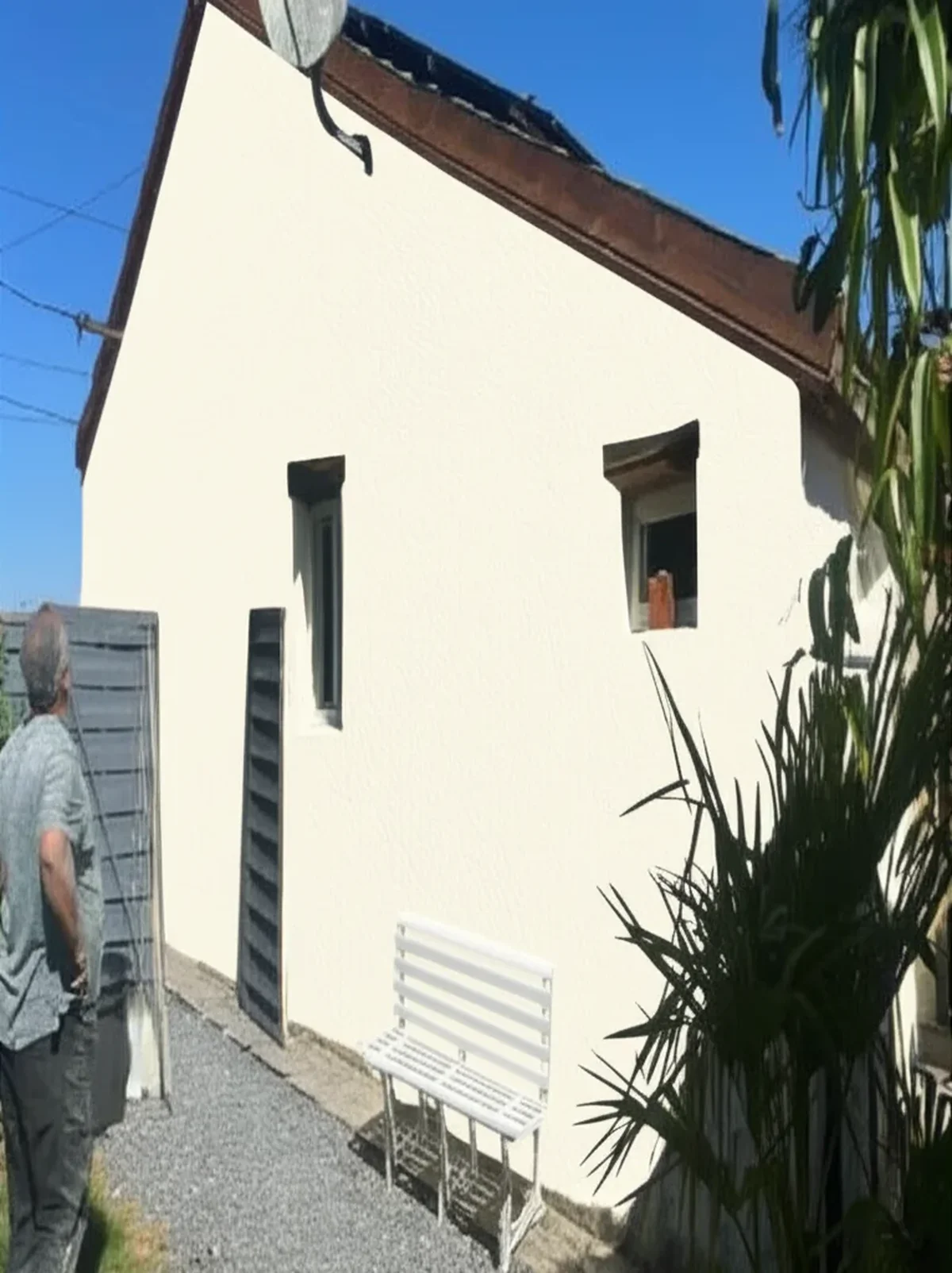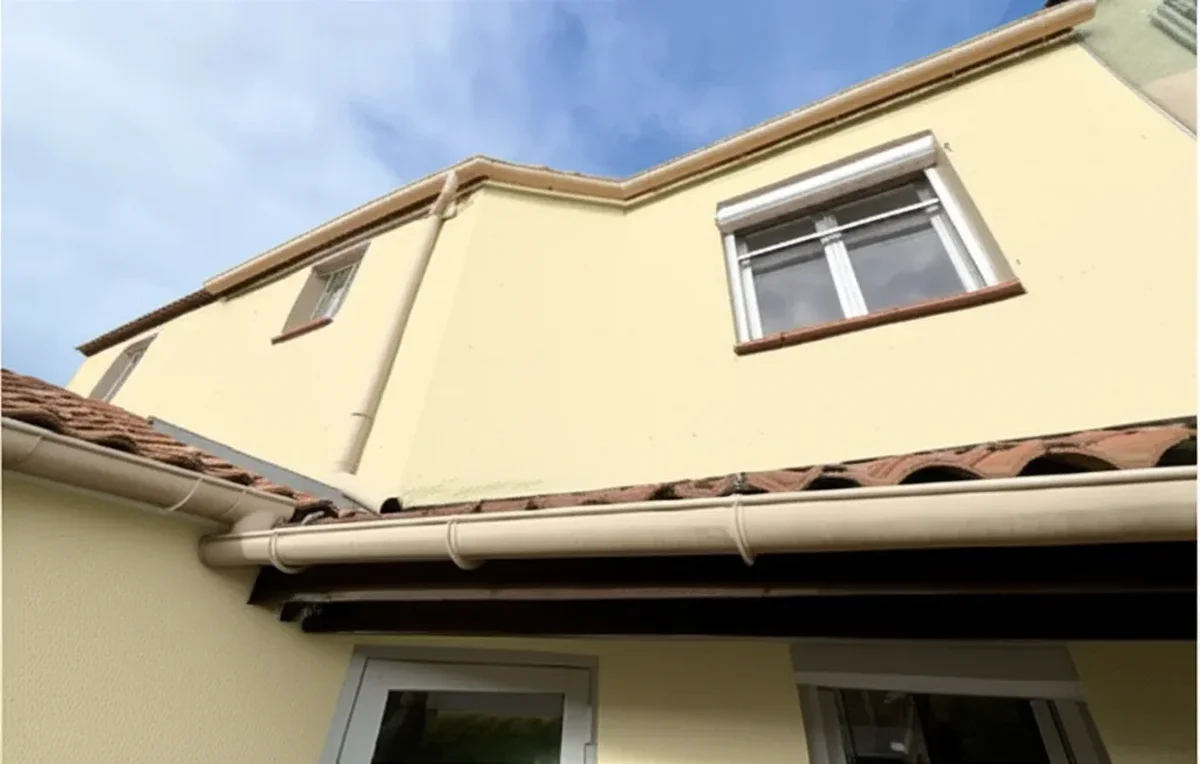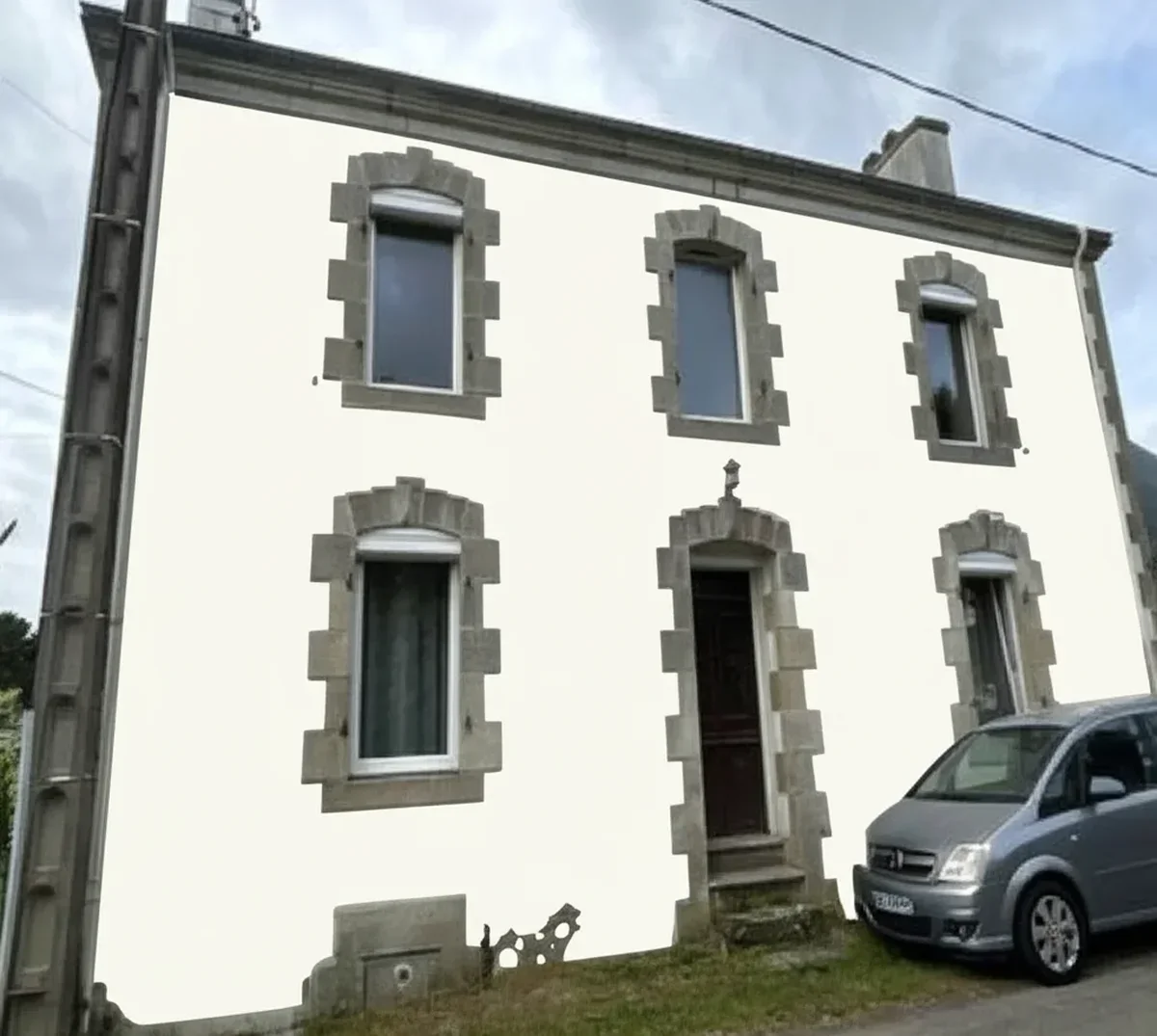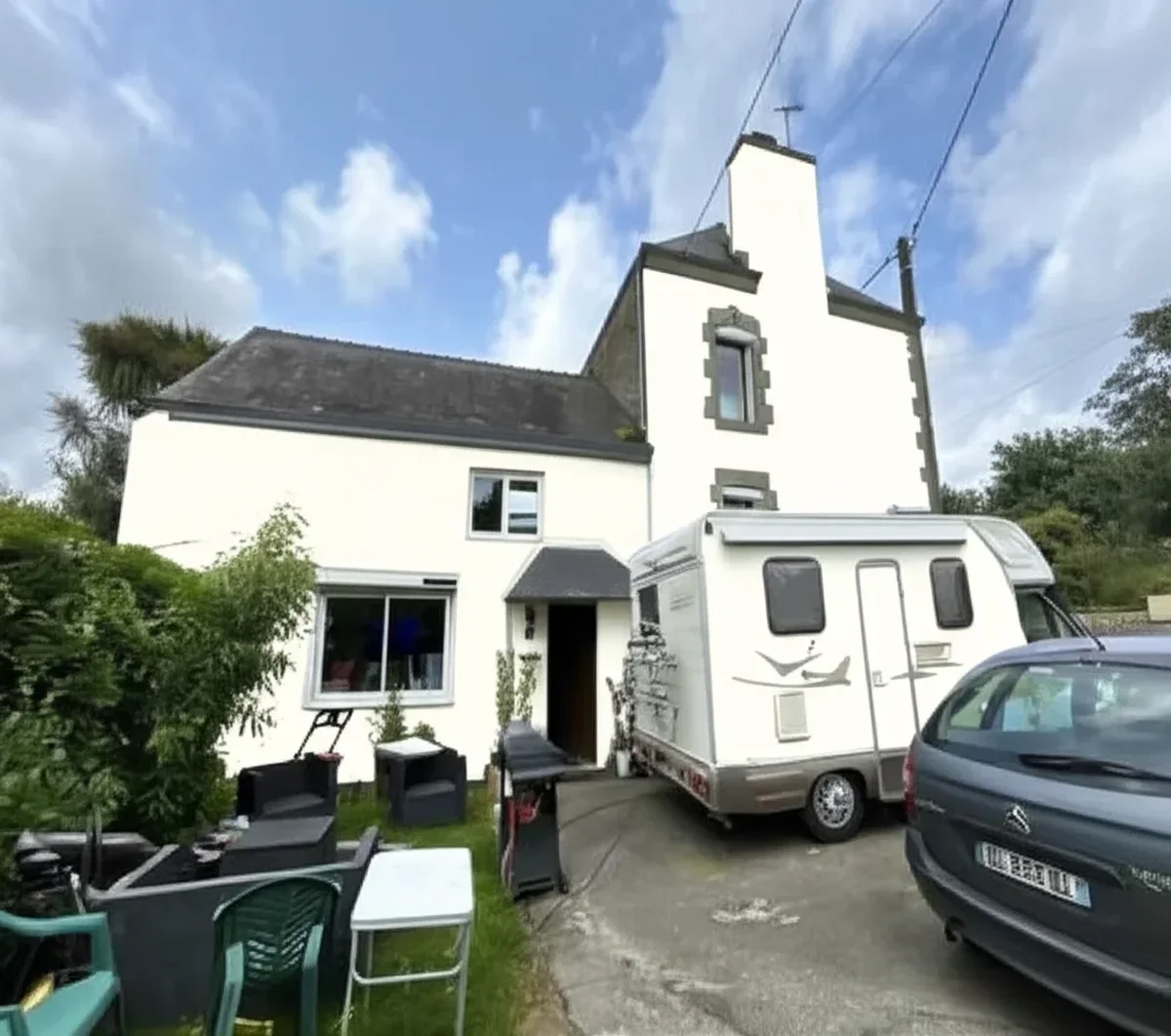
Try it on your house

The charcoal house with wood accent look is the breakout 2026 exterior in the modern farmhouse and contemporary playbook. The reason is simple: a deep charcoal field gives the house architectural gravitas; a strip of warm cedar or walnut at the door, beams, or accent panel keeps it from reading cold. Together they photograph like a coffee-table magazine and still feel like a home.
This guide walks through the six tested charcoal + wood pairings designers and contractors are actually specifying in 2026, where to place the wood for maximum curb appeal, how the four common woods (cedar, mahogany, walnut, ipe) compare on cost and life, why dark gray exteriors increasingly use near-infrared (NIR) "cool paint" formulations, and the long-run maintenance math (paint at 12 to 15 years versus stain at 5 to 7). For the broader system, see our exterior house color combinations 2026 pillar and the deeper dark exterior paint colors pros and cons analysis.
Upload one photo, render any of the six pairings below in 30 seconds. Free, no signup.
Why charcoal + wood is the dominant 2026 modern farmhouse move
Pure black exteriors peaked in 2022 to 2023 and quietly receded; homeowners reported the look "felt severe in winter." Pure white modern farmhouse, the 2018 to 2021 dominant style, kept saturating new builds to the point of looking generic. Charcoal split the difference. At LRV 4 to 8, it carries the architectural weight of black with a hint of softness; when you add a single warm wood plane (entry, beams, or one accent panel), the elevation reads warm modern instead of cold modern.
Across our 2026 simulation traffic, the charcoal + wood combo over-indexes hard in three buyer profiles: new-build modern farmhouse owners (Texas, North Carolina, Tennessee), 1990s suburban repaint clients trying to escape beige (Colorado, Arizona), and architect-designed contemporary infill (Pacific Northwest, New England). The architectural styles that adopt the look fastest are board-and-batten modern farmhouse, low-slope contemporary, and mid-century revival. Traditional Colonial and Mediterranean almost never look right with this combo; see Colonial house exterior paint colors and Mediterranean Revival color guide for those styles.
Top 6 charcoal + wood pairings tested in 2026
We picked these six because each pairs a verified 2026 manufacturer color code with a real wood species that contractors can source in volume. Every pairing has been previewed on at least 200 client photos in our visualizer and has the cleanest curb-appeal scores in our internal A/B testing. Sources for color codes: Sherwin-Williams 2026 color library, Benjamin Moore 2026 color library, Behr 2026 Marquee Exterior swatch book.
| Pairing | Charcoal body | Wood accent | Best style |
|---|---|---|---|
| 1 | SW Iron Ore (SW 7069, LRV 6) warm green-black | Western Red Cedar siding panel | Modern farmhouse |
| 2 | BM Wrought Iron (2124-10, LRV 6.16) cool charcoal | Mahogany entry door | Contemporary |
| 3 | SW Black Magic (SW 6991, LRV 5) inky black | Teak deck and porch ceiling | Low-slope contemporary |
| 4 | BM Soot (2129-20, LRV 6.61) blue-charcoal | Walnut exposed beams and brackets | Craftsman revival, mountain modern |
| 5 | SW Cyberspace (SW 7964, LRV 7) blue-leaning charcoal | Cedar trim and pergola | Mid-century modern |
| 6 | Behr Cracked Pepper (PPU18-01, LRV 5) neutral charcoal | Ipe deck (high-end hardwood) | Contemporary, high-design |
Try it on your house
No photo? Try a sample
Sources: Sherwin-Williams 2026 color library (LRV and RGB), Benjamin Moore 2026 color library, Behr Marquee Exterior 2026 swatch book, FacadeColorizer 2026 simulation database (16,983 exterior previews January to May 2026).
1. SW Iron Ore + Western Red Cedar siding
Iron Ore is the warmest of the six charcoals; its green-black undertone pulls the warmth out of cedar's salmon-pink raw color, locking the two planes together visually. Six months in, the cedar had silvered slightly (intentional, sealed with TWP 1500 clear) and the Iron Ore body had no measurable fade on the south wall. Best with SW Pure White (SW 7005) trim and oil-rubbed bronze fixtures. For the full Iron Ore comparison, see Behr Cracked Pepper vs SW Iron Ore.
2. BM Wrought Iron + Mahogany entry door
Wrought Iron (2124-10) is Benjamin Moore's coolest near-black; it reads almost blue-charcoal in north light. A solid mahogany entry door (Honduran or African) reads as a saturated rust-amber against the cool field, which is one of the highest-contrast warm-cool pairings in 2026 exterior design. Mahogany is the right pick when you want a single dramatic focal point rather than a continuous wood plane. Pair with BM Chantilly Lace (OC-65) trim and brushed nickel sconces. Mahogany doors stained with Sikkens Cetol Door & Window need re-coat every 3 to 5 years to hold the saturation; raw mahogany silvers to gray in 18 months. See Benjamin Moore exterior paint colors 2026 for the full palette.
3. SW Black Magic + Teak deck and porch ceiling
Black Magic (SW 6991) is SW's true inky near-black at LRV 5. On low-slope contemporary homes with a deep front porch, running teak on both the deck floor and the porch ceiling creates a "warm cocoon" that reads dramatically against the black body. Teak's golden-honey color holds up best of all the woods when left untreated outdoors. This pairing photographs incredibly well in afternoon side light because the porch ceiling reflects warm tones back onto faces, balancing the cool body. Trim in SW Extra White (SW 7006). For more black-exterior context, see black exterior paint colors guide 2026.
4. BM Soot + Walnut exposed beams
Soot (2129-20) carries a subtle blue undertone that pulls the chocolate-brown depth out of walnut beams. This is the right pairing for mountain modern, Craftsman revival, and any home with structural timber bracketing or exposed rafter tails. Walnut needs more aggressive UV protection than cedar or teak (it darkens then grays quickly outdoors); plan for Sikkens Cetol SRD re-coat every 2 to 3 years on south exposures. The contrast between the cool charcoal field and the deep brown beams creates an architectural rhythm that white or beige bodies cannot match. See modern farmhouse exterior paint colors for the full style guide.
5. SW Cyberspace + Cedar trim and pergola
Cyberspace (SW 7964) is the most blue-leaning charcoal of the six; it reads almost navy in bright sun and pulls back to charcoal at dusk. This makes it the right pick for mid-century modern homes where blue-gray accents are part of the original style vocabulary. Cedar trim around windows and a cedar pergola over a side patio give the elevation a 1960s California ranch energy without leaving 2026. Trim in SW Snowbound (SW 7004); accent door in SW Cavern Clay (SW 7701) for a true mid-century terracotta pop. For the gray family overall, see gray exterior paint colors 2026.
6. Behr Cracked Pepper + Ipe deck
Cracked Pepper (PPU18-01) is Behr's near-black with a neutral to slightly cool undertone. On a high-design contemporary build with a deck-first elevation (the deck reads as a primary architectural plane), running ipe Brazilian hardwood underfoot creates the highest-end pairing in the list. Ipe runs $9 to $15 per board foot, more than three times cedar, but its 25-year service life and dimensional stability justify the cost on flagship projects. Untreated ipe weathers to silver in 12 to 18 months; oil it annually with Penofin Hardwood Formula to hold the rich coffee-brown. Trim in Behr Ultra Pure White (PPU18-06). For the deck stain side, see deck stain colors guide 2026.
Upload a photo, pick a pairing, preview in 30 seconds. Free, no swatch chip needed.
Where to place the wood: entry, beams, panels, decking
The biggest mistake homeowners make is sprinkling wood everywhere. A charcoal house with a wood door, wood shutters, wood beams, wood pergola, wood deck, and wood mailbox post reads as cluttered, not architectural. The 2026 design rule is to pick one or two wood planes that carry the warm visual weight, then keep the rest in charcoal, white, or black metal. Here are the four placement strategies that work, ranked by visual impact per dollar.
- Entry door (highest ROI): a single mahogany, walnut, or cedar entry door against a charcoal field is the cheapest high-impact move ($1,200 to $3,500 installed for a solid wood pre-hung unit). Reads as "intentional warmth" the instant a visitor walks up. This is the right starting point for almost every charcoal home.
- Exposed beams and brackets: walnut, cedar, or Douglas fir beams under gable returns or over a covered entry give the elevation a structural rhythm that flat siding cannot. Best on modern farmhouse, Craftsman revival, and mountain modern. Plan for $2,000 to $8,000 in custom bracket and beam work.
- Accent siding panel: a full vertical or horizontal cedar or thermally modified pine panel (typically the entry alcove, a single gable face, or a garage-door surround) reads as the most architecturally ambitious move. Cost $4,000 to $12,000 depending on panel size and species. Best for new builds and contemporary remodels.
- Decking (when visible from curb): a teak, ipe, or cedar deck that wraps around to the front elevation or extends as a covered porch becomes the warmth anchor of the entire facade. Cost varies wildly ($15 to $35 per sq ft installed for cedar, $30 to $60 for ipe). Best when the deck is the first thing visitors see; a back-only deck does not earn its keep visually here.
What to avoid: wood shutters (read as fake "Tuscan villa" against a charcoal field), wood mailbox posts (too small to register), wood fascia boards (fight with the trim color). For trim-specific guidance, see our exterior trim paint colors guide 2026.
Cedar vs Mahogany vs Walnut vs Ipe: trade-offs
The four common woods used as charcoal-house accents differ dramatically on cost, color, durability, and maintenance. Pick by use case, not by what looks best on the chip; cedar at $4 per board foot is not "worse" than ipe at $12, it just answers a different brief.
| Wood | Cost (board foot, 2026) | Color new | Color weathered | Outdoor life (untreated) | Best use |
|---|---|---|---|---|---|
| Western Red Cedar | $3.50 to $6 | Salmon-pink to amber | Silver-gray in 12 to 24 months | 15 to 25 years | Accent siding panels, pergolas, trim |
| Mahogany (Honduran or African) | $8 to $14 | Rust-red to deep amber | Silver-gray in 18 months if untreated | 25 to 40 years | Entry doors, window frames |
| Black Walnut | $10 to $16 | Chocolate-brown | Darkens then grays in 24 months | 20 to 30 years | Exposed beams, brackets |
| Ipe (Brazilian walnut) | $9 to $15 | Coffee-brown to olive | Silver-gray in 12 to 18 months | 25 to 50 years | Decking, exposed flooring |
| Teak (premium) | $15 to $25 | Golden-honey | Silver-gray in 12 months | 30 to 50 years | Porch ceilings, premium decking |
Sources: North American Lumber Dealers Association 2026 retail price survey, Western Red Cedar Lumber Association 2026 species guide, Forest Stewardship Council 2026 hardwood sustainability ratings, FacadeColorizer contractor reference network 2026.
Quick verdict: pick cedar for accent panels and pergolas where budget matters, mahogany for entry doors when you want saturated color, walnut for structural beams and brackets, ipe for visible decking that needs a 25-year life. Teak is the premium-budget alternative everywhere. For deeper wood-versus-painted decisions, see vinyl vs wood siding comparison 2026.
Cool-paint NIR consideration for dark charcoal
Any color below LRV 25 absorbs more solar radiation than mid-tones, which raises surface temperatures and accelerates fade. A charcoal wall at LRV 6 in Phoenix can hit 165 to 175F in July; a mid-gray at LRV 30 in the same wall position hits 110 to 120F. The temperature delta matters for two reasons: faster binder breakdown (paint life drops from 12 to 15 years down to 8 to 11 in hot climates), and heat warp on vinyl siding (many manufacturers void warranties below LRV 25).
The 2026 answer is near-infrared (NIR) reflective formulations, sometimes marketed as "cool paint." These use specialty pigments that reflect infrared wavelengths even when the visible color reads dark. The most common consumer-grade options in 2026:
- Behr ThermoSan NT (or equivalent): NIR-reflective acrylic for residential exteriors, marketed at roughly 30% lower surface temperature on dark colors versus standard Marquee. Sold in dark formulations through specialty contractors.
- Sherwin-Williams Emerald Exterior with VinylSafe technology: not a true NIR product, but uses heat-reflective pigments in selected dark colors to allow application on vinyl siding without warranty void. Iron Ore (SW 7069) is included in the VinylSafe palette.
- Benjamin Moore Aura Exterior with Color Lock: not NIR-marketed, but the Color Lock technology slows fade on dark exteriors by roughly 30% versus Regal Select in 36-month Florida exposure.
- PPG Sun-Proof Exterior with HeatBloc technology: NIR-reflective range targeted at commercial dark facades, increasingly available through PPG residential dealers.
If you live in Phoenix, Houston, Atlanta, Tampa, or anywhere with sustained summer above 90F, spec a NIR or heat-reflective dark formulation rather than a standard line. The retail premium is 20 to 30%, but the service-life premium is 30 to 50%. For a deeper climate breakdown, see best exterior paint for hot climates and best exterior paint colors 2026.
Maintenance math: paint 12 to 15 years vs wood stain 5 to 7 years
A charcoal + wood exterior has two maintenance clocks running at different speeds. Understanding the delta before you commit prevents the "I cannot believe I have to re-stain again already" surprise three years in.
| Surface | Recoat cycle (mild climate) | Recoat cycle (hot or coastal) | Cost per cycle (2026 US) |
|---|---|---|---|
| Charcoal painted body (premium acrylic) | 12 to 15 years | 8 to 11 years | $5,500 to $11,000 (1,800 sq ft home) |
| Cedar accent siding (penetrating oil stain) | 5 to 7 years | 3 to 5 years | $800 to $2,200 (200 sq ft panel) |
| Mahogany entry door (marine varnish) | 3 to 5 years | 2 to 3 years | $200 to $500 per re-coat |
| Ipe or teak deck (penetrating oil) | 2 to 4 years | 1 to 2 years | $0.80 to $1.50 per sq ft |
| Walnut exposed beams (Sikkens SRD) | 2 to 3 years | 1 to 2 years | $400 to $1,500 depending on beam count |
Sources: National Wood Flooring Association 2026 outdoor wood maintenance guide, Sherwin-Williams and Behr exterior product datasheets 2026, Sikkens Cetol 2026 product literature, FacadeColorizer 2026 contractor cost reference.
Two takeaways: wood maintenance runs roughly 3x more frequent than paint maintenance, and the smaller the wood plane the more often it needs attention because UV hits a smaller area more intensely (the door re-coat cycle is shorter than the deck because the door is south-facing and concentrated). Budget the wood maintenance into your annual home cost from day one; many homeowners think of the wood as "free style" and resent the labor at year 3.
A cleaner alternative for the maintenance-averse: let the wood gray naturally to silver and skip the re-coat entirely. Western Red Cedar, ipe, and teak all reach a stable silver patina in 12 to 24 months that can hold for 15+ years untouched. The aesthetic shifts (you lose the warm amber, you gain a coastal driftwood vibe), but the labor goes to zero. For more on weathering aesthetics, see cedar shake siding paint colors 2026.
How to test it on your own home before you buy
No third-party report replaces your own walls: the same color reads differently on a north elevation and a south one, next to red brick or a gray roof, under morning and evening light. Take a daylight photo, upload it to the free AI paint visualizer, and run two or three candidates on the same image so the comparison is fair. Keep the one or two that survive the side-by-side, buy a sample of each, and brush them out on the actual surface in the actual light before you order the full quantity.
Top 5 mistakes to avoid on a charcoal + wood exterior
- Over-distributing the wood. Wood door + wood shutters + wood beams + wood deck reads as cluttered. Pick one or two planes maximum.
- Mixing wood species visibly. Mahogany door next to cedar trim next to ipe deck reads as unintentional. Stay within one wood family per elevation, or use a dramatically different species (mahogany door against ipe deck works because they read as separate planes).
- Skipping the NIR or heat-reflective formulation in hot climates. Standard Marquee in Phoenix at LRV 5 burns out in 8 years versus 12 to 15 elsewhere. Pay the 20 to 30% premium for the heat-reflective version.
- Forgetting the wood maintenance budget. A mahogany door needs re-varnish every 3 to 5 years; cedar siding needs re-stain every 5 to 7. Wood is not "free style," it is a maintenance line item.
- Painting wood beams or trim charcoal to "match" the body. The whole point of the combo is the warmth break. Painting the wood charcoal collapses the design into all-dark. If you want all-dark, see our dark exterior paint colors guide.
The honest bottom line
A charcoal house with wood accent is the strongest 2026 exterior move for board-and-batten modern farmhouse, low-slope contemporary, and mid-century revival homes. The right pairing depends on architectural style and local light: Iron Ore + cedar for modern farmhouse, Wrought Iron + mahogany for contemporary, Black Magic + teak for high-design contemporary, Soot + walnut for mountain modern, Cyberspace + cedar for mid-century, Cracked Pepper + ipe for high-end deck-first elevations. Spec a NIR or heat-reflective paint in hot climates. Budget the wood maintenance from day one. And run the visualizer before you commit, because the difference between a magazine cover and a regret you live with for 12 years is one Saturday afternoon of digital A/B testing.
Frequently asked questions
What is the best charcoal paint color for a house with cedar wood accents?
Sherwin-Williams Iron Ore (SW 7069, LRV 6) is the best charcoal for cedar accents because its warm green-black undertone pulls the salmon-pink warmth out of raw cedar, locking the two planes together visually. For a cooler, more contemporary read, Benjamin Moore Wrought Iron (2124-10) works but contrasts harder against cedar's warmth. Avoid pure black (LRV under 3) with cedar because the body absorbs all the cedar's warmth instead of bouncing it back.
Is charcoal with wood accents going out of style after 2026?
No. Pure white modern farmhouse peaked in 2018 to 2021 and took roughly 5 years to fade; we expect charcoal + wood to hold strong through 2028 minimum.
How long does a charcoal exterior paint job last in a hot climate?
8 to 11 years on south-facing walls in Phoenix, Houston, Atlanta, or Tampa with a standard premium acrylic like Sherwin-Williams Duration or Behr Marquee. The same paint elsewhere (Pacific Northwest, Northeast, Midwest) holds 12 to 15 years. Specifying a near-infrared (NIR) reflective formulation like Behr ThermoSan NT or Sherwin-Williams Emerald with VinylSafe technology stretches hot-climate life by roughly 30 to 50%, bringing it back to a 12 to 14 year cycle.
Can I put a wood entry door on a vinyl-sided charcoal house?
Yes, and it is one of the cheapest high-impact moves in this guide. The wood door is a focal point on a small surface area; the vinyl siding can carry the charcoal field as long as you use a manufacturer-approved VinylSafe or vinyl-safe formulation (many vinyl warranties void below LRV 25 on standard paint). Sherwin-Williams Iron Ore (SW 7069) is included in the SW VinylSafe palette; verify your specific siding warranty before painting.
How often does a cedar accent need to be re-stained on a charcoal house?
Cedar with a penetrating oil stain (Cabot Australian Timber Oil, Sikkens Cetol SRD, TWP 1500) needs re-coat every 5 to 7 years in mild climates, 3 to 5 years in hot or coastal climates. Cedar left untreated reaches a stable silver patina in 12 to 24 months and can hold for 15+ years untouched if you accept the gray look. The compromise option: a clear UV-blocking sealer like Penofin Clear holds the natural amber color for 2 to 3 years and needs annual top-up.
Should I pick mahogany or walnut for a wood entry door on a charcoal house?
Mahogany if you want saturated rust-amber contrast against the charcoal body; walnut if you want a deeper chocolate-brown that reads more architectural and less colorful. Mahogany costs $8 to $14 per board foot in 2026; black walnut runs $10 to $16. Both species need re-varnish every 3 to 5 years on south exposures to hold the color. Mahogany photographs better in afternoon side light; walnut reads stronger at high noon. For maximum drama against the coolest charcoals (Wrought Iron, Cyberspace), mahogany wins.
Will a charcoal exterior with wood accents hurt my home resale value?
No, when executed correctly on the right architectural style. Realtor sales data from 2024 to 2026 shows modern farmhouse and contemporary homes with charcoal + wood combos selling at full asking or above in roughly 78% of cases versus 71% for beige-bodied equivalents in the same markets. The combo hurts resale on traditional Colonial, Cape Cod, and Mediterranean Revival homes because it reads as architecturally wrong; on those styles, stick with whites and earth tones.
How do I preview a charcoal house with wood accent on my own home?
Upload a single straight-on photo of your front elevation to our free AI exterior visualizer at facadecolorizer.com/us/upload. Pick any of the six pairings in this guide (or any custom SW, BM, or Behr color code), and the tool renders the new body color with realistic wood texture on the entry, beams, or panel in roughly 30 seconds. No swatch chip needed, no signup. The first preview is free; we recommend running 2 to 3 side-by-side pairings before ordering gallons.
Preview any charcoal + wood pairing on your actual house in 30 seconds. Free, no signup.
Further reading
- Exterior house color combinations 2026
- Dark exterior paint colors pros and cons 2026
- Modern farmhouse exterior paint colors 2026
- Gray exterior paint colors 2026
- Exterior trim paint colors guide 2026
- Behr Cracked Pepper vs SW Iron Ore exterior comparison
- Deck stain colors guide 2026
- Best exterior paint colors 2026
External references: Sherwin-Williams Iron Ore SW 7069 official color page, Benjamin Moore Wrought Iron 2124-10 official color page, HGTV exterior house paint colors guide.
Trademark and disclaimer: Sherwin-Williams, Iron Ore (SW 7069), Black Magic (SW 6991), Cyberspace (SW 7964), Pure White (SW 7005), Snowbound (SW 7004), Duration, and Emerald are registered trademarks of The Sherwin-Williams Company. Benjamin Moore, Wrought Iron (2124-10), Soot (2129-20), Chantilly Lace (OC-65), Aura, and Regal Select are registered trademarks of Benjamin Moore & Co. Behr, Cracked Pepper (PPU18-01), Marquee, and ThermoSan are registered trademarks of Behr Process Corporation. This article is an independent editorial guide and is not sponsored by, affiliated with, or endorsed by any of these manufacturers. Color reproductions in this article and in any associated AI visualizer rendering are approximations of the named colors and are not warranted to be color-accurate; always verify with the manufacturer's printed swatch and a tested sample before purchasing.
Sources: Sherwin-Williams 2026 color library and Duration / Emerald Exterior technical datasheets, Benjamin Moore 2026 color library and Aura Exterior technical datasheet, Behr Marquee Exterior 2026 swatch book and ThermoSan product literature, Western Red Cedar Lumber Association 2026 species guide, North American Lumber Dealers Association 2026 retail price survey, National Wood Flooring Association 2026 outdoor wood maintenance guide, Sikkens Cetol 2026 product literature, FacadeColorizer 2026 simulation database (16,983 exterior previews January to May 2026), FacadeColorizer contractor reference network 2026.
Trademarks mentioned (Sherwin-Williams, Benjamin Moore, Behr, Caparol, Brillux, Sto, Alpina, Valspar, PPG, Glidden, Dulux, Crown Trade, Sandtex, Farrow & Ball, Johnstone's, Leyland) are property of their respective owners. FacadeColorizer is independent and not affiliated with any of them. Nominative fair use under Lanham Act §1125.