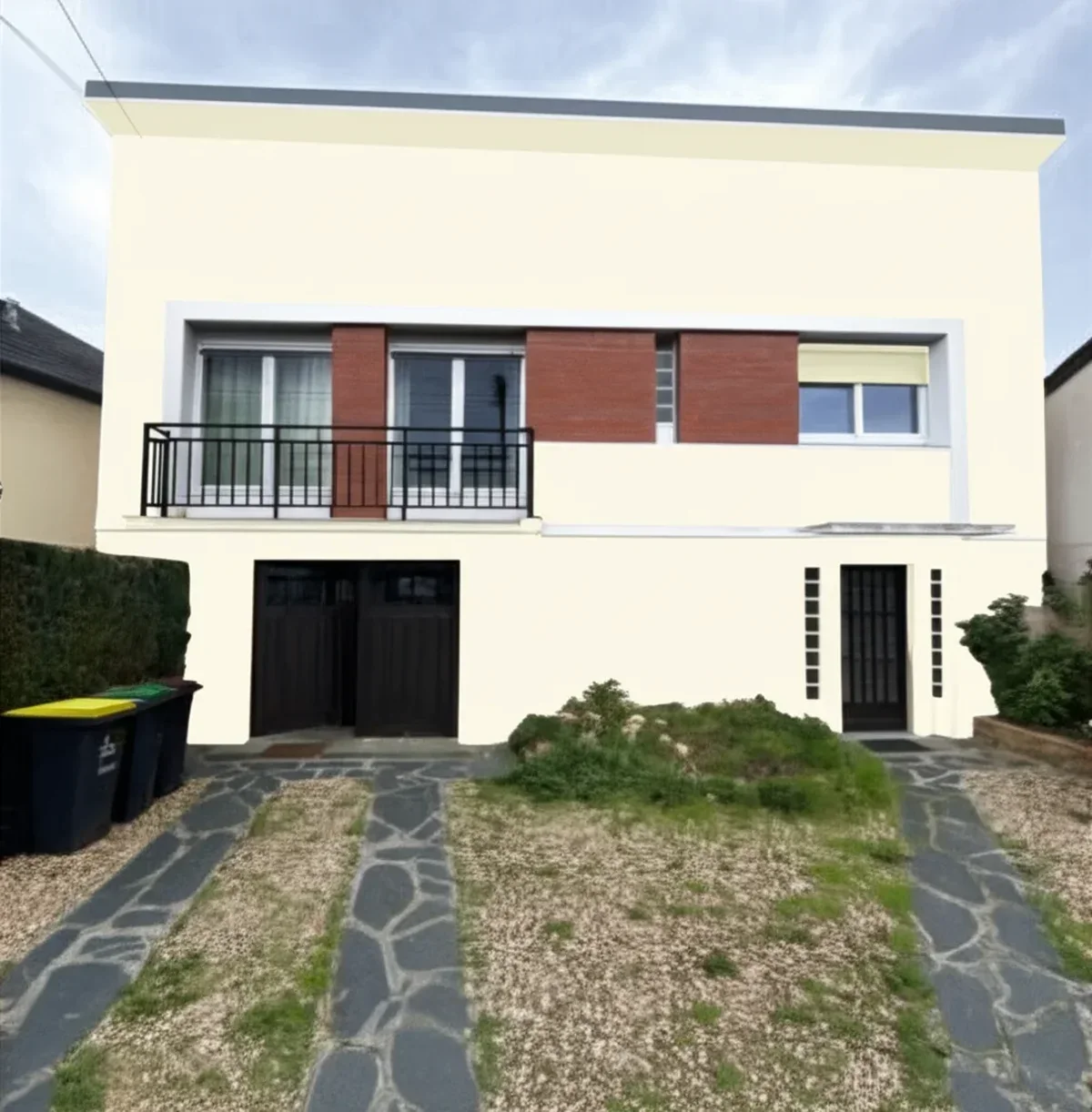
Try it on your house

Quick answer: The 8 best Prairie Style exterior paint colors for 2026 across Midwest Prairie School districts: (1) BM Bracken Brown HC-78 deep earth-brown body for stucco upper bands, (2) SW Sequoia 6313 russet body for lower brick or stucco panels, (3) BM Hampshire Taupe AC-3 warm taupe field color, (4) BM Iron Mountain 2134-30 deep charcoal horizontal-line trim, (5) BM Hale Navy HC-154 leaded glass mullion accent, (6) SW Roycroft Bronze Green 2846 olive accent for soffit bands, (7) BM Linen White stained-glass surround trim, (8) SW Restrained Gold 6129 mortar-line warm accent. The Prairie Style was the first uniquely American architecture, codified by Frank Lloyd Wright in Oak Park between 1900 and 1909 and built across the Midwest until 1920. Its low-pitched hipped roofs, deep eaves, and horizontal banding demand an earth-tone palette layered to emphasize the horizontal datum rather than vertical mass.
The Prairie Style is the only architectural movement that began in the American Midwest and shaped global modernism. Frank Lloyd Wright drafted his first Prairie houses from his Oak Park studio between 1900 and 1909, and the Prairie School (Walter Burley Griffin, Marion Mahony Griffin, William Drummond, George Washington Maher, Purcell and Elmslie) carried the vocabulary across Illinois, Iowa, Wisconsin, and Minnesota until 1920. Real estate agents in Oak Park, River Forest, Mason City, and Buffalo still mislabel surviving Prairie homes as "Craftsman" or "transitional," and homeowners trying to repaint a 1908 Oak Park Prairie or a 1912 Mason City Stockman House end up with palettes designed for one-story bungalows that violate the Prairie horizontal datum. The truth is more useful: the Prairie Style is its own vocabulary, and its earth-tone palette must layer in horizontal bands rather than vertical contrast.
This guide covers the Prairie Style specifically: the low-pitched hipped roof, deep overhanging eaves, ribbon windows in horizontal bands, two-story stucco or brick masses divided by trim datum lines, and the integration of art-glass leaded windows into the elevation. Built across Oak Park IL, River Forest IL, Mason City IA, Buffalo NY, and Minneapolis MN between 1900 and 1920. Below are the eight authentic Prairie earth tones that consistently work in 2026, the horizontal-line trim emphasis logic that drives Prairie color decisions, the integration of stained glass with body colors, the surviving heritage districts that pre-approve these palettes, and a Prairie-specific FAQ. For the broader Craftsman context, see our parent guide on Craftsman house exterior paint colors 2026 top 15. You can also test any of these eight colors on your own Prairie home photo before buying sample pots.
Try it on your house
No photo? Try a sample
Prairie Style 1900-1920: Frank Lloyd Wright and the Prairie School
Frank Lloyd Wright launched the Prairie Style from his Oak Park studio in 1900 with the publication of "A Home in a Prairie Town" in Ladies' Home Journal. The Robie House (Chicago, 1909), the Frederick C. Robie residence, the Ward Willits House (Highland Park IL, 1901), the Dana-Thomas House (Springfield IL, 1902), and the Frank Lloyd Wright Home and Studio (Oak Park, expanded 1898-1909) anchored the movement geographically. Wright trained or influenced a generation of collaborators called the Prairie School: Walter Burley Griffin, Marion Mahony Griffin, William Drummond, Barry Byrne, George Washington Maher, William Gray Purcell, and George Grant Elmslie, who carried the vocabulary across the Midwest until roughly 1920.
The Prairie Style spread fastest where Wright or his collaborators built reference houses that local builders could study and adapt. The surviving Prairie stock today concentrates in five heritage districts: Oak Park IL and adjacent River Forest IL (the densest Wright cluster, with the Frank Lloyd Wright Historic District protecting roughly 25 Wright-designed houses), Mason City IA (Walter Burley Griffin Stockman House 1908 and the Rock Crest-Rock Glen district with eight Prairie School homes), Buffalo NY (Wright's Darwin Martin House complex 1903-1905), Minneapolis-Saint Paul (Purcell and Elmslie work), and Springfield IL (Dana-Thomas House). Outside these clusters Prairie homes are rare: roughly 1.2 percent of pre-1940 Midwestern housing stock wears authentic Prairie vocabulary, the smallest cohort of any Midwest heritage style. For the broader Midwest cost context, see our exterior painting Chicago IL cost guide.
Upload a photo of your Prairie home and test every Frank Lloyd Wright earth tone below in under a minute.
The 8 best Prairie Style exterior paint colors in 2026
1. Benjamin Moore Bracken Brown HC-78 - #5B4A3A
A deep, slightly warm earth-brown that reads as oxidized walnut in overcast Oak Park light and warm cocoa in late-afternoon sun. Role: upper-story stucco band, second-story field color between deep eave and second-floor datum line. Trim pairing: BM Iron Mountain 2134-30 horizontal trim with Linen White art-glass surround. Best for: Oak Park Frank Lloyd Wright Historic District homes, Mason City Rock Crest-Rock Glen district, and Buffalo Darwin Martin House neighborhood adjacent restorations. Psychology: grounded, horizontal, prairie-honest. Aligns with the original Wright specification of "warm earth tones, never white walls" documented in his 1908 essay "In the Cause of Architecture" in Architectural Record.
2. Sherwin-Williams Sequoia SW 6313 - #6F3A2E
A deep russet brown drawn from the giant redwoods of the Pacific Coast that reads as cinnamon bark in direct sun and oxidized copper in shadow. Role: lower-story brick or stucco panel between water table and first-story datum. Trim pairing: BM Iron Mountain horizontal trim with BM Linen White art-glass surrounds and BM Hale Navy mullion accent. Best for: Prairie homes with masonry lower-story bases (Wright's Robie House precedent), Buffalo Darwin Martin complex restorations, and Springfield Dana-Thomas neighborhood homes. Psychology: grounded, woodsy, regionally honest. Reads as the chromatic equivalent of Wright's preferred Roman brick at twilight.
3. Benjamin Moore Hampshire Taupe AC-3 - #B9A78F
A warm mid-taupe with green-gray undertones that reads as weathered prairie grass in sun and shaded limestone in cloud cover. The most flexible Prairie field body color when the stucco needs to read lighter than Bracken Brown without slipping into builder beige. Role: body, full-height stucco field on smaller Prairie School homes or porch and pavilion masses. Trim pairing: BM Iron Mountain or SW Roycroft Bronze Green horizontal trim with Linen White art-glass surrounds. Best for: Mason City Stockman House style smaller Prairie homes, Minneapolis Purcell and Elmslie work, and Twin Cities Prairie revival restorations where neighbor blocks lean lighter. Psychology: restrained, horizontal, weather-honest.
4. Benjamin Moore Iron Mountain 2134-30 - #6C6C68
A deep, slightly warm charcoal gray with green undertones that reads as wet basalt in shadow and weathered slate in direct sun. The single most popular Prairie trim color in 2026 historic-district packets. Role: horizontal-line trim, datum bands, window casings, soffit fascia. Body pairing: Bracken Brown, Sequoia, or Hampshire Taupe bodies. Best for: articulating the horizontal datum lines that separate Prairie stucco upper bands from lower brick or stucco lower bands, ribbon-window mullion separators, and the deep eave fascia that defines the Prairie sheltering roof. Psychology: grounding, horizontal, confidently Prairie. Without Iron Mountain or an equivalent deep horizontal trim, the Prairie horizontal datum collapses and the elevation reads as generic two-story stucco.
5. Benjamin Moore Hale Navy HC-154 - #444E5C
A deep, slightly green-gray navy that reads as wet slate in shadow and weathered indigo in direct sun. The Prairie leaded-glass mullion accent color of choice when the art-glass windows carry geometric tracery in deep blues, greens, and golds. Role: leaded-glass mullion paint, deep-set window sash, accent porch pier wrap. Body pairing: Bracken Brown, Sequoia, or Hampshire Taupe bodies with Iron Mountain horizontal trim. Best for: Prairie homes with surviving original art-glass windows (Wright designed roughly 4,300 art-glass panels across his Prairie career), Oak Park Wright Historic District restorations, and Mason City Rock Crest-Rock Glen homes. Psychology: contemplative, horizontal, art-glass integrated.
6. Sherwin-Williams Roycroft Bronze Green SW 2846 - #5F634E
A deep olive green with bronze undertones drawn from the Roycroft Arts and Crafts colony palette that Frank Lloyd Wright endorsed in The Craftsman correspondence with Gustav Stickley. Reads as oxidized bronze in sun and forest moss in shadow. Role: soffit fascia, eave underside, porch pier cap, secondary horizontal accent. Body pairing: Hampshire Taupe, Bracken Brown, or Sequoia bodies with Iron Mountain primary trim. Best for: Prairie homes in mature wooded lots where neighbor maples and oaks shade the soffit underside, Wright-influenced Prairie School homes in Minneapolis-Saint Paul, and Mason City Stockman House neighborhood. Psychology: contemplative, integrated with landscape, Arts and Crafts heritage.
7. Benjamin Moore Linen White - #F0EAD6
A warm off-white with a hint of yellow-green that reads as aged linen rather than cold builder white. The Prairie art-glass surround trim color of choice when the body is brown, russet, taupe, or olive and the leaded windows need a warm halo. Role: art-glass window surround, deep-set sash inside the casing, porch ceiling. Body pairing: Bracken Brown, Sequoia, or Hampshire Taupe bodies. Best for: any Prairie home where the ribbon windows and art-glass panels deserve a warm visual halo rather than a cold white contrast, Wright Historic District homes in Oak Park, and Mason City Rock Crest-Rock Glen restorations. Psychology: warm, classical, art-glass respectful. Wright's surviving 1908 specification letters reference "warm off-white sash, never cold white" for Robie House and Coonley House interiors.
8. Sherwin-Williams Restrained Gold SW 6129 - #C7A772
A warm muted gold with green-yellow undertones that reads as aged brass in sun and weathered sandstone in shadow. The Prairie mortar-line warm accent color that connects masonry lower-story walls to stucco upper-story bands. Role: mortar-line wash, accent stucco band between brick lower story and stucco upper story, porch pier cap detail. Body pairing: Sequoia or Bracken Brown lower-story bodies with Hampshire Taupe upper-story bodies. Best for: two-tone Prairie homes where the lower-story brick or stucco runs darker than the upper-story stucco, Wright Robie House precedent restorations, and Buffalo Darwin Martin complex adjacent homes. Psychology: warm, integrated, horizontal datum reinforcing.
Test all 8 Prairie earth tones on your Oak Park, Mason City, or Buffalo home photo in under a minute.
Horizontal-line trim emphasis: the Prairie color rule
The Prairie Style's defining feature is the horizontal datum: long unbroken horizontal trim lines that emphasize the prairie horizon rather than the vertical building mass. Wright drove this principle into every Prairie elevation by aligning eave overhangs, second-floor datum bands, ribbon-window head trim, water-table caps, and porch parapet caps along strict horizontal lines that run the full width of the facade. The exterior color palette must respect that horizontal datum, which is the single biggest difference between a Prairie repaint and a Craftsman or American Foursquare repaint.
The correct 2026 Prairie trim approach is horizontal-line trim emphasis: a single deep trim color (typically Iron Mountain 2134-30 or Roycroft Bronze Green SW 2846) carried unbroken along every horizontal element of the elevation. The horizontal trim color must read deeper than both the upper-story body color and the lower-story body color so the horizontal datum lines remain visually dominant. Window trim, soffit underside, and porch ceiling can wear a warmer secondary trim (Linen White) inside the deep horizontal frame, but the frame itself must hold one color. By contrast, an American Foursquare requires symmetric trim emphasis (see our American Foursquare paint colors Midwest 2026 guide) and a Craftsman bungalow allows asymmetric trim emphasis around gable brackets. Apply Foursquare symmetric logic or bungalow asymmetric logic to a Prairie home and the horizontal datum collapses into generic two-story stucco. The style Prairie was reacting against runs the opposite way: a Queen Anne facade from the two decades before Wright distributes a five-color hierarchy across body, trim, accent bracket, sash highlight and door, deliberately breaking the mass into articulated parts. Our guide to Queen Anne exterior paint colors sets out that hierarchy, which is worth knowing on a Midwest block where one Prairie house sits among Victorians and the two logics are easy to borrow from each other by mistake. For trim color logic across architectural styles, see our brown house with cream trim warm 2026 guide. Render Prairie horizontal-line trim emphasis on your photo before committing.
Stained glass and earth-tone body color integration
Frank Lloyd Wright designed roughly 4,300 art-glass leaded panels for his Prairie commissions between 1900 and 1920, more than any other architect of the era. The art-glass tracery typically uses deep greens, golds, ambers, blues, and clear textured glass arranged in geometric patterns drawn from prairie flora (stylized hollyhocks, sumac branches, cattails) or pure rectilinear grids. When a Prairie home retains its original art-glass windows, the body palette must integrate with the glass palette rather than fight it.
The 2026 best practice is to pull two earth tones from the dominant art-glass palette and use them as body and trim. A Prairie home with deep-green and amber art-glass tracery reads best with Hampshire Taupe AC-3 body, Roycroft Bronze Green soffit, Iron Mountain horizontal trim, and Linen White art-glass surrounds. A Prairie home with cobalt-blue and clear-textured art-glass reads best with Bracken Brown body, Iron Mountain horizontal trim, Hale Navy mullion accent inside the leaded panels, and Linen White surrounds. The leaded-glass mullions themselves can be painted (when the original lead came has been replaced) with either Iron Mountain to match the horizontal datum or Hale Navy to deepen the integrated blue cast. Never use a cold builder white around an original art-glass panel: the cool white will read as a hard frame and visually disconnect the glass from the body. For trim and accent layering across heritage styles, see our bungalow Craftsman revival paint colors 2026 guide and our Chicago bungalow paint colors 2026 guide.
Prairie heritage districts: Oak Park, Mason City, Buffalo
The Prairie Style survives in concentrated heritage clusters rather than scattered tract neighborhoods. The five 2026 heritage districts that pre-approve the eight Prairie earth tones above are: (1) the Frank Lloyd Wright Historic District in Oak Park IL, protecting roughly 25 Wright-designed homes within a six-block radius of the Frank Lloyd Wright Home and Studio; (2) the Rock Crest-Rock Glen Historic District in Mason City IA, the densest Prairie School cluster outside Oak Park with eight homes designed by Walter Burley Griffin, Marion Mahony Griffin, Barry Byrne, and Einar Broaten between 1912 and 1916; (3) the Darwin Martin House Complex in Buffalo NY, restored 2004-2017 with adjacent restoration guidelines applied to neighboring Parkside neighborhood homes; (4) the Lake of the Isles and Prospect Park districts in Minneapolis-Saint Paul, protecting Purcell and Elmslie work including the Edna Purcell House (Minneapolis, 1913); and (5) the Aurora Avenue Historic District in Springfield IL, anchored by the Dana-Thomas House (1902).
Outside these five primary districts, individual Prairie homes appear in River Forest IL, Riverside IL (the Avery Coonley House 1908 and the Babson House district), Highland Park IL (Ward Willits House 1901), Decatur IL, Rockford IL, Dwight IL (Frank L. Smith Bank 1905), and scattered communities across Iowa, Wisconsin, Indiana, and Michigan. Owners of Prairie homes outside the five primary heritage districts still benefit from the same eight earth tones above because the surviving Prairie vocabulary is so consistent: upper-story stucco band, lower-story brick or stucco band, horizontal datum trim, ribbon-window mullion accent, soffit fascia, art-glass surround. The palette logic does not change with geography. For Pacific Northwest Craftsman context that Prairie owners sometimes confuse with their own style, see our Craftsman paint colors Pacific Northwest 2026 guide. For the related Midwest cubic form, see our American Foursquare paint colors Midwest 2026 guide. For Illinois HOA-approved palettes that often overlap with Prairie restoration packets, see our HOA approved exterior colors Illinois 2026 guide. Compare two Prairie heritage palettes side by side on the same photo before committing.
The Prairie Style also intersects with adjacent regional movements that share earth-tone vocabularies. Wright's Mid-Century later work (Usonian houses 1936-1959) carries forward Prairie horizontal datum logic in a single-story format, and 2026 owners restoring Prairie revival homes sometimes pull from desert mid-century palettes for accent decisions: see our mid-century modern paint colors Arizona 2026 guide. For broader 2026 exterior decisions, see our best exterior paint colors 2026 guide.
Test Wright earth-tone palettes side by side on your Prairie home photo.
Frequently asked questions about Prairie Style paint colors
What is the Prairie Style of architecture?
The Prairie Style is the first uniquely American architectural movement, codified by Frank Lloyd Wright in Oak Park IL between 1900 and 1909 and carried across the Midwest by the Prairie School (Walter Burley Griffin, Marion Mahony Griffin, William Drummond, George Washington Maher, Purcell and Elmslie) until 1920. Defining features include low-pitched hipped roofs, deep overhanging eaves, ribbon windows in horizontal bands, two-story stucco or brick masses divided by horizontal trim datum lines, integrated leaded art-glass windows, and an emphasis on horizontal datum over vertical mass.
What are the most authentic Frank Lloyd Wright Prairie paint colors?
The four most authentic 1900-1920 Prairie palettes are Bracken Brown HC-78 upper-story stucco with Iron Mountain 2134-30 horizontal trim and Linen White art-glass surrounds (Oak Park style), Sequoia SW 6313 lower-story brick with Hampshire Taupe AC-3 upper-story stucco and Iron Mountain trim (Robie House two-tone precedent), Hampshire Taupe field body with Roycroft Bronze Green SW 2846 soffit fascia and Iron Mountain trim (Mason City Stockman House style), and Bracken Brown body with Hale Navy HC-154 art-glass mullion accent and Linen White surrounds (Buffalo Darwin Martin style). All four are pre-approved in Oak Park Frank Lloyd Wright Historic District guidelines.
What is the Prairie horizontal-line trim emphasis rule?
The Prairie Style's defining color rule is horizontal-line trim emphasis: a single deep trim color (typically Iron Mountain 2134-30 or Roycroft Bronze Green SW 2846) carried unbroken along every horizontal element of the elevation including eave fascia, second-floor datum band, ribbon-window head trim, water-table cap, and porch parapet cap. The horizontal trim must read deeper than both the upper-story body and lower-story body so the horizontal datum lines remain visually dominant. Without this rule the Prairie horizontal datum collapses and the elevation reads as generic two-story stucco.
How is a Prairie color scheme different from a Craftsman bungalow scheme?
The Prairie Style is a two-story horizontal-datum form with low hipped roof and ribbon windows in horizontal bands, while the Craftsman bungalow is a one to one-and-a-half story asymmetric form with gabled porch and exposed rafter tails. The Prairie therefore requires horizontal-line trim emphasis with one unbroken deep trim color along every horizontal element. The bungalow allows asymmetric trim emphasis with deeper accents on gable brackets and lighter accents on knee braces. Apply bungalow asymmetric logic to a Prairie home and the horizontal datum collapses.
What color works best for an Oak Park Prairie home?
The most historically correct Oak Park Frank Lloyd Wright Historic District palette is Benjamin Moore Bracken Brown HC-78 upper-story stucco body with Iron Mountain 2134-30 horizontal trim, Linen White art-glass surrounds, and Hale Navy HC-154 leaded-glass mullion accent. This palette aligns with Wright's surviving 1908 specification letters for Robie House and Coonley House and is pre-approved in Oak Park historic district guidelines. Alternatives include Sequoia SW 6313 russet lower-story body paired with Hampshire Taupe upper-story body and Iron Mountain trim.
How should I integrate my Prairie home with its original art-glass windows?
Pull two earth tones from the dominant art-glass palette and use them as body and trim. A Prairie home with deep-green and amber art-glass reads best with Hampshire Taupe body, Roycroft Bronze Green soffit, Iron Mountain horizontal trim, and Linen White art-glass surrounds. A Prairie home with cobalt-blue and clear-textured art-glass reads best with Bracken Brown body, Iron Mountain trim, Hale Navy mullion accent, and Linen White surrounds. Never use cold builder white around an original art-glass panel because the cool white reads as a hard frame and visually disconnects the glass from the body.
Where do most surviving Prairie Style homes live?
The five 2026 Prairie heritage districts are the Frank Lloyd Wright Historic District in Oak Park IL (roughly 25 Wright-designed homes), the Rock Crest-Rock Glen Historic District in Mason City IA (eight Prairie School homes by Griffin, Mahony, Byrne, and Broaten), the Darwin Martin House Complex in Buffalo NY, the Lake of the Isles and Prospect Park districts in Minneapolis-Saint Paul (Purcell and Elmslie work), and the Aurora Avenue Historic District in Springfield IL (Dana-Thomas House). Outside these clusters individual Prairie homes appear in River Forest IL, Riverside IL, Highland Park IL, Decatur IL, and scattered Iowa, Wisconsin, and Indiana communities.
Which Prairie paint color holds best in Midwest winters?
Deep earth tones with iron-oxide pigment load hold UV and freeze-thaw cycles best on Midwest Prairie south and southwest exposures: Bracken Brown HC-78, Sequoia SW 6313, and Iron Mountain 2134-30 all carry deep iron-oxide pigments that resist fading through 8 to 10 Illinois, Iowa, and Wisconsin summer-winter cycles. Stucco substrates require an elastomeric or 100 percent acrylic exterior such as Benjamin Moore Aura Exterior or Sherwin-Williams Emerald Exterior to bridge stucco hairline cracks during freeze-thaw. The deep eave fascia and soffit underside are the highest-risk surfaces for premature failure because moisture infiltration concentrates at the eave-to-wall joint.
A successful Prairie Style repaint starts with correct identification of the regional variant (Oak Park Wright cluster, Mason City Prairie School, Buffalo Darwin Martin, Twin Cities Purcell and Elmslie, or Springfield Dana-Thomas), respects the horizontal-line trim emphasis demanded by the Prairie horizontal datum, integrates surviving art-glass windows into the body palette rather than fighting them, and ends with a full-scale rendering on your actual home before you commit. Test any of these 8 earth tones on a photo of your Prairie home in under a minute with our free AI paint visualizer before buying sample pots or submitting a historic-district packet. Sources: Frank Lloyd Wright Foundation Home and Studio archive, Old House Online Prairie Style archive, HGTV Prairie Style exterior gallery, Oak Park Frank Lloyd Wright Historic District guidelines, Mason City Rock Crest-Rock Glen Historic District restoration packets, and Buffalo Darwin Martin House Complex restoration records 2004-2017.
Trademarks mentioned (Sherwin-Williams, Benjamin Moore, Behr, Caparol, Brillux, Sto, Alpina, Valspar, PPG, Glidden, Dulux, Crown Trade, Sandtex, Farrow & Ball, Johnstone's, Leyland) are property of their respective owners. FacadeColorizer is independent and not affiliated with any of them. Nominative fair use under Lanham Act §1125.