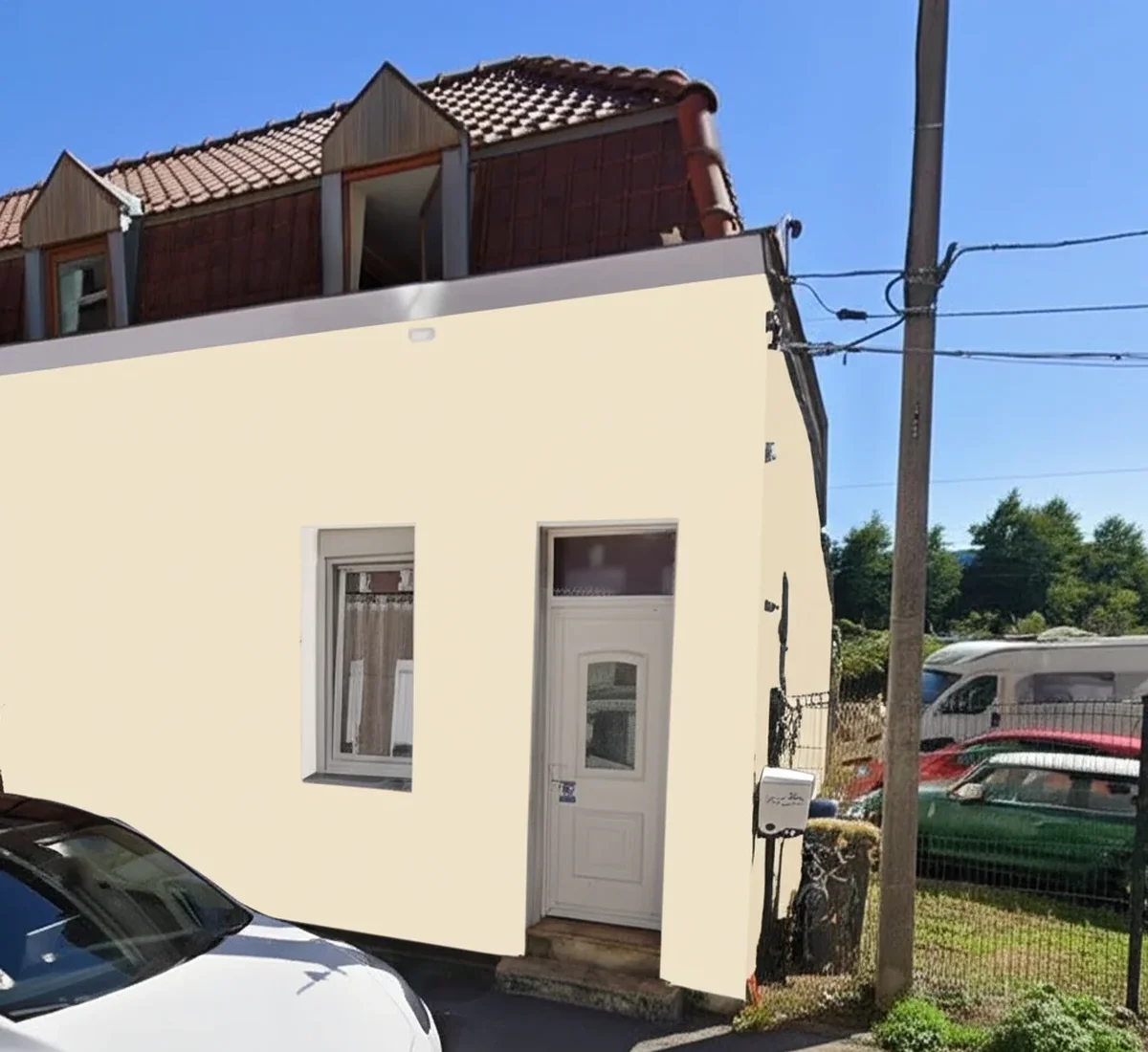
Try it on your house

Two dark neutrals dominate the 2026 US exterior request list at design centers and HOA review boards: Behr Cracked Pepper (PPU18-01, LRV 5) and Sherwin-Williams Iron Ore (SW 7069, LRV 6). Both read "dramatic black" from the curb. Both are sold as "near-black charcoal" on the swatch card. But pulled side by side on the same wall, they are not the same color, and the choice between them changes how a house photographs on a cloudy April morning versus a 95F July afternoon.
This guide pulls the 2026 datasheets, the Behr and Sherwin-Williams color libraries, and verified contractor application notes to settle the comparison: undertone, LRV, fade resistance, coordinating trims, application logic by architectural style, HOA approval odds, and a real side-by-side test on a single Atlanta photo using our free AI exterior visualizer. For the full pricing picture, see our complete exterior house painting cost guide and the broader dark exterior paint colors pros and cons analysis.
The two colors at a glance: LRV, undertone, base
| Spec | Behr Cracked Pepper (PPU18-01) | Sherwin-Williams Iron Ore (SW 7069) |
|---|---|---|
| LRV (Light Reflectance Value) | 5 | 6 |
| Reads as | Very dark cool charcoal, almost black | Very dark warm charcoal, near-black with brown lean |
| Undertone | Neutral to slightly cool gray (blue-green shift on north-facing walls) | Warm with a brown / green-black bias (reads softer in shade) |
| RGB (approximate, Behr / SW digital chips) | 52, 53, 55 | 61, 60, 56 |
| Exterior product recommended | Behr Marquee Exterior or Behr Ultra Exterior | Sherwin-Williams Duration Exterior or Emerald Exterior |
| Retail price per gallon (US 2026) | $50 to $58 (Marquee Exterior) | $85 to $99 (Duration), $99 to $115 (Emerald) |
| Tint base required | Ultra Pure White base (deep tint) | Ultradeep base |
| Coverage per gallon (deep tint reality) | 200 to 275 sq ft | 225 to 300 sq ft |
| Color of the Year status | Behr 2023 Color of the Year | Featured in SW Pottery Barn 2021 collection, top-10 dark seller every year since |
Try it on your house
No photo? Try a sample
Sources: Behr Marquee Exterior and Ultra Exterior technical datasheets 2026, Sherwin-Williams Duration and Emerald Exterior technical datasheets 2026, Behr and SW digital color libraries (RGB / LRV values pulled from each manufacturer's published swatch data), Painting Contractors Association 2025 dark-color application survey, Home Depot and SW retail pricing Q1 2026.
Side-by-side test: same Atlanta modern farmhouse, two simulations
A picture decides this comparison faster than a paragraph. We pulled a single Atlanta modern farmhouse photo (1,820 sq ft, board-and-batten fiber cement, white trim, black metal roof, west-facing front elevation, 11am October light) and ran both colors through our AI exterior visualizer. Both simulations used the same trim (Sherwin-Williams Pure White SW 7005 alternate trim test in Behr Ultra Pure White PPU18-06) and the same Naval-toned front door so the only variable was the body color.
- Behr Cracked Pepper (LRV 5) simulation: the body read sharp, contemporary, almost photographic black. The board-and-batten shadow lines vanished into the field. The white trim popped at maximum contrast. Verdict: high-drama, very modern, perfect for board-and-batten modern farmhouse and any house where "looks like a coffee-table magazine" is the goal.
- Sherwin-Williams Iron Ore (LRV 6) simulation: the body read warmer, softer, slightly more "lived-in." The board-and-batten texture stayed visible. The same white trim looked friendlier, less stark. Verdict: still dramatic, but with a craftsman / classic American warmth that pairs better with wood-tone elements (cedar accents, copper gutters, oil-rubbed bronze fixtures).
- Same house, side-by-side: Cracked Pepper photographs darker by roughly 1 to 2 LRV points in the same light. Iron Ore wins under tree shade and on overcast days because the warm undertone keeps it from looking flat-gray.
Upload a photo of your home and preview both colors side by side in 30 seconds. Free, no signup.
Undertone and how each color behaves in real US light
At LRV 5 versus LRV 6, both colors are squarely in the "very dark" exterior range (anything under LRV 25 reads dark from the curb; under LRV 10 reads as a black-substitute). The 1-point delta is small, but the undertone difference is what most homeowners actually see.
Behr Cracked Pepper: neutral to cool
Cracked Pepper is a near-black with a thin neutral-cool bias. In bright direct sun (Phoenix, Las Vegas, San Diego at noon) it photographs cleanly as a true black. In low north-facing light (Seattle, Portland in February) and on shaded elevations it can pick up a subtle blue-green cast that some homeowners read as "industrial" and others read as "modern." It is the safer pick when the design intent is contemporary, monochrome, or high-contrast against crisp white trim. Preview it on your own facade with the Behr color visualizer before ordering gallons.
Sherwin-Williams Iron Ore: warm with brown lean
Iron Ore is a near-black with a warm brown-green lean (some color analysts call it "green-black"). In southern light (Atlanta, Charlotte, Dallas, Nashville) the warmth blooms and the color reads softer and more inviting. Under heavy tree canopy in the Northeast, the brown undertone reads as "almost charcoal" rather than full black. This makes Iron Ore the friendlier choice for classic craftsman, traditional, and modern farmhouse homes where you want the gravitas of a dark exterior without the icy edge. The Sherwin-Williams color visualizer lets you confirm the warm undertone on your own elevation; if you would rather avoid the official ColorSnap app, our ColorSnap alternative renders SW 7069 directly on your photo.
For more on how cool versus warm undertones behave on real elevations, see warm exterior paint colors 2026. And if you want a softer 2026 alternative to either charcoal, Behr's 2026 Color of the Year is a muted sage-green at the opposite end of the LRV scale: see our Behr Hidden Gem 2026 visualizer guide.
Coordinating trims, doors, and accents
Dark bodies live or die on trim contrast. Here are the trim, door, and accent pairings that the SW design library and Behr's own swatch books recommend, plus what works on real US elevations:
Behr Cracked Pepper body
- Trim: Behr Ultra Pure White (PPU18-06) for crispest contrast on board-and-batten modern farmhouse. For a slightly warmer trim that softens the black, Behr Polar Bear (75) or Cameo White (W-D-200).
- Front door (pop): Behr Cellini Gold (M280-7), Behr Hidden Sea Glass (T18-04), or natural-stained cedar.
- Front door (mono): same Cracked Pepper for a monochrome statement; pair with a brass or aged-bronze house number plate.
- Window sashes: Cracked Pepper or Behr Carbon (N520-7) for a continuous dark-frame look.
- Garage door: match body for cohesion, or step down to Behr Dark Granite (PPU18-19) for subtle definition.
Sherwin-Williams Iron Ore body
- Trim: Sherwin-Williams Pure White (SW 7005) is the SW design-team default. For a warmer pairing, Alabaster (SW 7008) or Snowbound (SW 7004).
- Front door: Sherwin-Williams Naval (SW 6244) for navy contrast, Cavern Clay (SW 7701) for terracotta warmth, or natural cedar / mahogany for craftsman authenticity.
- Window sashes: match Iron Ore, or step lighter with Peppercorn (SW 7674, LRV 11) for a softer dark-on-dark.
- Shutters or board-and-batten accent: SW Tricorn Black (SW 6258, true black) for maximum body-trim drama on accent gables.
- Coordinating natural materials: Iron Ore is the warmer pick when the house has copper gutters, cedar shake, oil-rubbed bronze lighting, or natural stone columns.
See exactly how Cracked Pepper or Iron Ore looks with white trim, navy door, or natural cedar on your actual house. Free.
Application by architectural style: modern farmhouse vs craftsman
Modern farmhouse: Cracked Pepper wins
The modern farmhouse playbook (board-and-batten body, gable returns, white trim, black-framed windows, metal roof) is built for maximum body-trim contrast and a slightly cooler, contemporary edge. Cracked Pepper hits that brief at LRV 5 with a neutral-cool undertone that reads "Joanna Gaines but updated for 2026." It also photographs best on the social-media platforms where modern farmhouses live (Instagram, Pinterest, Houzz), because the cool undertone holds its black in mixed lighting without going warm-muddy. See the full palette in our modern farmhouse exterior paint colors guide.
Craftsman: Iron Ore wins
Classic American craftsman bungalows (1905 to 1930) were originally painted in earthy stains and warm body colors paired with cream trim and natural wood porches. Cracked Pepper is too cool and too contemporary for the style; the cool bias fights the warm wood porch ceiling and the earth-toned stone foundation. Iron Ore, with its warm green-black undertone, reads as a respectful modernization of an authentic craftsman color story. SW Pure White trim, a natural stained door, and copper-finish lighting complete the picture. See craftsman house exterior paint colors for the full historical context.
Other styles, fast verdict
- Cape Cod / Coastal: Iron Ore on shingle siding, white trim, Naval door. Cracked Pepper reads too urban here.
- Colonial / Federal: Iron Ore on shutters and front door over a white body. Cracked Pepper for shutters only feels too cool against the historical white.
- Tudor / Storybook: Cracked Pepper for the half-timber stripes (the cool undertone reads as "fresh blacks"); Iron Ore is too brown against the stucco infill.
- Mid-century modern: Cracked Pepper, hands down. The cool neutral works with anodized aluminum, terrazzo, and saturated 1960s accent doors.
- Mediterranean / Spanish Revival: neither is correct; warm earth tones rule. See our Mediterranean Revival color guide.
Upload one photo, preview both colors with white trim and a Naval door, free. No swatch chip needed.
HOA considerations and approval odds
Dark exteriors are the single most-rejected category at HOA architectural review committees, per the 2025 Community Associations Institute exterior color study. Approval odds for "near-black" body colors hover around 41% nationally, versus 89% for off-whites and 76% for mid-tone grays. That said, both Cracked Pepper and Iron Ore have track records on approved boards.
- Approval odds (Cracked Pepper, body): roughly 35 to 45% nationally. Higher in modern-farmhouse-heavy HOAs (Texas, North Carolina, suburban Atlanta), lower in traditional Colonial / Cape Cod neighborhoods.
- Approval odds (Iron Ore, body): roughly 45 to 55% nationally. The warmer undertone reads as "dark gray" rather than "black" on many board submission forms, which broadens approval.
- Trim-only or accent-only use: both colors clear HOA review at 80%+ when used on shutters, doors, or trim instead of body.
- Submission tip: provide a printed photo simulation (the AI visualizer output works) and a same-elevation neighborhood reference. Approval rates jump roughly 20 points when the board sees a contextual visual instead of just the swatch chip. See our HOA exterior paint approval template with AI mockup for the exact submission package, plus the broader best HOA-approved exterior paint colors 2026 shortlist.
For the full process, including which states limit HOA color restrictions, see HOA exterior paint color rules and the step-by-step HOA color change approval process.
Durability, fade, and heat absorption on dark exteriors
Any color at LRV under 25 absorbs more solar radiation than mid-tones, which raises surface temperatures (a Cracked Pepper or Iron Ore wall in Phoenix can hit 165 to 175F in July versus 110 to 120F for a mid-gray). Higher temperatures accelerate binder degradation, expansion-contraction cycling, and fade. Both manufacturers address this in different ways:
- Behr Marquee Exterior (the recommended Cracked Pepper carrier): 100% acrylic with cross-linking technology, written 10-year limited warranty on a properly prepped surface. Realistic fade onset on south-facing walls at LRV 5: noticeable at year 6 to 8 in southern states, year 9 to 11 in Pacific Northwest and Northeast. We break down the line's coverage, sheen options, and warranty fine print in our full Behr Marquee exterior paint review for 2026.
- Sherwin-Williams Duration Exterior (the recommended Iron Ore carrier): advanced acrylic with PermaLast technology, written 25-year transferable warranty on substrates the manufacturer lists. Realistic fade onset on south-facing walls at LRV 6: year 8 to 10 in southern states, year 11 to 14 elsewhere.
- SW Emerald Exterior (premium tier): adds anti-fade pigment binder system. The Emerald data sheet shows roughly 30 to 40% less fade in 36-month Florida exposure versus Duration at the same LRV.
- Heat-driven failure on vinyl siding: both colors at LRV under 25 can void some vinyl siding manufacturer warranties due to heat warp. Always verify with the siding manufacturer before applying either color to vinyl. Fiber cement, wood, and stucco are not affected.
For a deeper comparison of dark-exterior longevity by climate, see best exterior paint for hot climates.
Cost per gallon, coverage, and total project math
On a 1,800 sq ft single-story home with roughly 1,650 sq ft of paintable body (subtracting windows and doors), two coats at deep-tint coverage, here is the rough 2026 material math:
- Cracked Pepper in Behr Marquee Exterior: coverage 200 to 275 sq ft per gallon at deep tint, two coats = roughly 12 to 17 gallons. At $52 to $58 per gallon retail at Home Depot, material total is $624 to $986.
- Iron Ore in SW Duration Exterior: coverage 225 to 300 sq ft per gallon at deep tint, two coats = roughly 11 to 15 gallons. At $89 to $99 per gallon retail (or $58 to $68 with PaintPerks pricing), material total is $979 to $1,485 retail or $638 to $1,020 with trade pricing.
- Iron Ore in SW Emerald Exterior: 11 to 15 gallons at $99 to $115 = $1,089 to $1,725 retail.
- Per-elevation primer cost: a dark-color exterior almost always benefits from a tinted primer (50% strength of body color). Add 2 to 3 gallons of Zinsser Bullseye 1-2-3 at $35 to $45 per gallon, or roughly $90 to $135.
Material verdict: at full retail Cracked Pepper is roughly $350 to $700 cheaper per project than Iron Ore. With a PaintPerks contractor account or a timed SW 40%-off sale, the price gap narrows to within $100. Labor cost is identical because both colors need the same number of coats at the same prep level.
For full national pricing, see the complete exterior painting cost guide linked at the top of this page, plus the city-by-city cost guide.
Free AI exterior visualizer. Upload a photo, get both renderings in 30 seconds, before you order a single gallon.
How to test it on your own home before you buy
No third-party report replaces your own walls: the same color reads differently on a north elevation and a south one, next to red brick or a gray roof, under morning and evening light. Take a daylight photo, upload it to the free AI paint visualizer, and run two or three candidates on the same image so the comparison is fair. Keep the one or two that survive the side-by-side, buy a sample of each, and brush them out on the actual surface in the actual light before you order the full quantity.
Top 5 mistakes to avoid with either color
- Buying without a 12-inch peel-and-stick or a digital photo simulation. A 3-inch swatch chip understates LRV by roughly 30%. On a 1,650 sq ft body the difference between "dramatic" and "oppressive" is visible only at scale. Walk through the workflow in our test 5 paint brands on the same house photo case study, or jump straight to applying 2026 trend palettes with try the 2026 Colors of the Year on your house.
- Skipping tinted primer on a light-to-dark change. Going from a beige or cream body to LRV 5 or 6 without a tinted primer eats three full coats and still shows flash spots. Use Zinsser 1-2-3 tinted to 50% body color strength.
- Applying either color on vinyl siding without manufacturer approval. Many vinyl warranties void below LRV 25. Verify in writing before painting.
- Mismatching trim white. Behr Ultra Pure White against SW Iron Ore reads slightly cool-gray, not crisp. Stay in-brand: Behr Cracked Pepper with Behr trim, SW Iron Ore with SW trim, unless you have done a digital test.
- Ignoring HOA submission timing. Most boards review monthly; dark-color approvals take 2 to 3 submission cycles when context visuals are missing. Submit with a printed AI visualizer rendering on the first round.
The honest bottom line
Pick Behr Cracked Pepper if you want a contemporary, neutral-cool near-black at a Home Depot price point, you are painting a modern farmhouse, mid-century, or Tudor, and you want maximum contrast against crisp white trim. Pick Sherwin-Williams Iron Ore if you want a warmer, friendlier near-black with brown-green depth, you are painting a craftsman, Cape Cod, Colonial, or any home with natural wood and copper accents, and you can access PaintPerks or a timed sale to close the price gap. Both colors are 2026 winners; the right pick comes down to undertone, architectural style, and HOA fit, not which brand has the bigger marketing budget. If Iron Ore is the one you land on, the next step is the dedicated Sherwin-Williams Iron Ore SW 7069 exterior guide, which carries the LRV 6 body color through cedar and stone pairings and a 12-month cold-climate field test.
Frequently asked questions
Is Behr Cracked Pepper the same color as Sherwin-Williams Iron Ore?
No. They look nearly identical on a small chip but read differently on a full elevation. Cracked Pepper (PPU18-01, LRV 5) is a near-black with a neutral to slightly cool undertone. Iron Ore (SW 7069, LRV 6) is a near-black with a warm brown-green undertone. On the same house in identical light, Iron Ore appears roughly 1 to 2 LRV points lighter and softer; Cracked Pepper photographs sharper and more contemporary.
Can Home Depot color-match Sherwin-Williams Iron Ore in Behr paint?
Yes. Any Home Depot paint desk will match SW 7069 Iron Ore in Behr Marquee Exterior or Ultra Exterior using a spectrophotometer for free, in under 10 minutes. The match accuracy on deep dark colors (LRV under 10) is typically 92 to 96%, slightly less than mid-tones because of pigment-load differences. For maximum color fidelity on SW signature darks, buy from a Sherwin-Williams store.
Which dark exterior color holds up longer in southern sun, Cracked Pepper or Iron Ore?
Both fade on south-facing walls because dark exteriors absorb more solar radiation, but the paint carrier matters more than the color name. SW Iron Ore in Emerald Exterior shows roughly 30 to 40% less fade at 36 months in Florida exposure testing than Behr Cracked Pepper in Marquee. If you live in Phoenix, Houston, Atlanta, or Tampa and want maximum longevity, Iron Ore in Emerald is the durability winner. If budget is tighter, Cracked Pepper in Marquee with a quality tinted primer still delivers 8 to 11 years before noticeable fade outside the Sun Belt.
Will my HOA approve a Cracked Pepper or Iron Ore exterior?
Approval odds nationally are roughly 35 to 45% for Cracked Pepper body and 45 to 55% for Iron Ore body, per the 2025 Community Associations Institute exterior color study. Iron Ore approves more often because its warm undertone reads as "dark gray" rather than "black" on many submission forms. Both colors clear HOA review at over 80% when used on shutters, doors, or trim. Always submit with a printed AI photo simulation and a same-elevation neighborhood reference; approval rates jump roughly 20 points with a contextual visual.
What is the best trim color for Cracked Pepper versus Iron Ore?
For Cracked Pepper, the in-brand crispest trim is Behr Ultra Pure White (PPU18-06), with Polar Bear (75) as a slightly warmer alternative. For Iron Ore, the SW design-team default is Pure White (SW 7005), with Alabaster (SW 7008) or Snowbound (SW 7004) as warmer options. Stay in-brand when possible, because the white you choose tints how the body color reads at the edges; cool-leaning whites can flatten Iron Ore, and warm-leaning whites can soften Cracked Pepper's contemporary edge.
Can I paint vinyl siding Cracked Pepper or Iron Ore?
Usually not without a manufacturer waiver. Many vinyl siding warranties void on any paint with an LRV below 25 because of heat-warp risk, and Cracked Pepper (LRV 5) and Iron Ore (LRV 6) both fall well under that threshold. Behr and Sherwin-Williams have vinyl-safe formulations for selected darker colors (Behr Vinyl-Safe and SW VinylSafe), but neither covers Cracked Pepper or Iron Ore at full strength. Fiber cement, wood, stucco, and brick are not affected. Always verify your specific siding warranty in writing before applying either color.
How many coats of Cracked Pepper or Iron Ore do I need on a previously light-colored exterior?
Going from a light body (LRV above 50) to either Cracked Pepper or Iron Ore typically requires one coat of tinted primer (Zinsser Bullseye 1-2-3 tinted to roughly 50% body color strength) plus two coats of body paint. Skipping the tinted primer almost always means three full body coats plus visible flash spots in raking light. Total system: 1 primer + 2 body. Coverage at deep tint runs 200 to 300 sq ft per gallon, so expect 11 to 17 body gallons on an 1,800 sq ft home plus 2 to 3 gallons of primer.
Related comparisons
If you are still weighing brands before you settle on a dark neutral, three more head-to-heads are worth a read. Start with our Sherwin-Williams vs Benjamin Moore exterior test, which settles the two biggest premium lines on real siding. Once you have committed to Sherwin-Williams, the product line matters as much as the color, so see where we put SuperPaint against Emerald for exterior. And if a warm greige keeps sneaking back onto your shortlist, we set Revere Pewter next to Edgecomb Gray to show how two near-identical neutrals split apart on a full wall.
See how a near-black reads on your own siding before you commit a single gallon.
Preview Behr Cracked Pepper and Sherwin-Williams Iron Ore on a photo of your actual house before committing to gallons.
Expertise: ASTM Heat-Build and EPA ENERGY STAR Reflectance Standards
Dark near-black exteriors below LRV 10 absorb significantly more solar radiation than mid-tone or light colors. ASTM E1980 defines the Solar Reflectance Index (SRI) used to quantify the heat-build risk; both Cracked Pepper and Iron Ore measure SRI under 6, well below the EPA ENERGY STAR Reflective Coatings threshold (SRI 29 for steep-slope roofs). This is why vinyl siding warranties typically void below LRV 25 (heat-warp risk per the Vinyl Siding Institute test protocol). ASTM E1980 SRI standard, EPA ENERGY STAR reflective products, and Vinyl Siding Institute (VSI) are the references your contractor should reference before recommending a near-black exterior.
Trust and methodology: Comparison last updated June 3, 2026. LRV and RGB values verified against the manufacturer color libraries; 36-month fade data referenced from Sherwin-Williams Emerald Exterior and Behr Marquee Exterior public Florida exposure tests.
Trademark and disclaimer: Behr and Cracked Pepper (PPU18-01) are registered trademarks of Behr Process Corporation. This article is an independent editorial comparison and is not sponsored by, affiliated with, or endorsed by Behr Process Corporation. All references to Behr products are for descriptive comparison purposes only.
Trademark and disclaimer: Sherwin-Williams, Iron Ore (SW 7069), Duration, and Emerald are registered trademarks of The Sherwin-Williams Company. This article is an independent editorial comparison and is not sponsored by, affiliated with, or endorsed by The Sherwin-Williams Company. All references to Sherwin-Williams products are for descriptive comparison purposes only. Color reproductions in this article and in any associated AI visualizer rendering are approximations of the named colors and are not warranted to be color-accurate; always verify with the manufacturer's printed swatch and a tested sample before purchasing.
Sources: Behr Marquee Exterior and Ultra Exterior technical datasheets 2026, Sherwin-Williams Duration Exterior and Emerald Exterior technical datasheets 2026, Behr and Sherwin-Williams digital color libraries (LRV and RGB values), Painting Contractors Association 2025 dark-color application survey, Community Associations Institute 2025 exterior color approval study, Home Depot and Sherwin-Williams Q1 2026 retail pricing.
Trademarks mentioned (Sherwin-Williams, Benjamin Moore, Behr, Caparol, Brillux, Sto, Alpina, Valspar, PPG, Glidden, Dulux, Crown Trade, Sandtex, Farrow & Ball, Johnstone's, Leyland) are property of their respective owners. FacadeColorizer is independent and not affiliated with any of them. Nominative fair use under Lanham Act §1125.