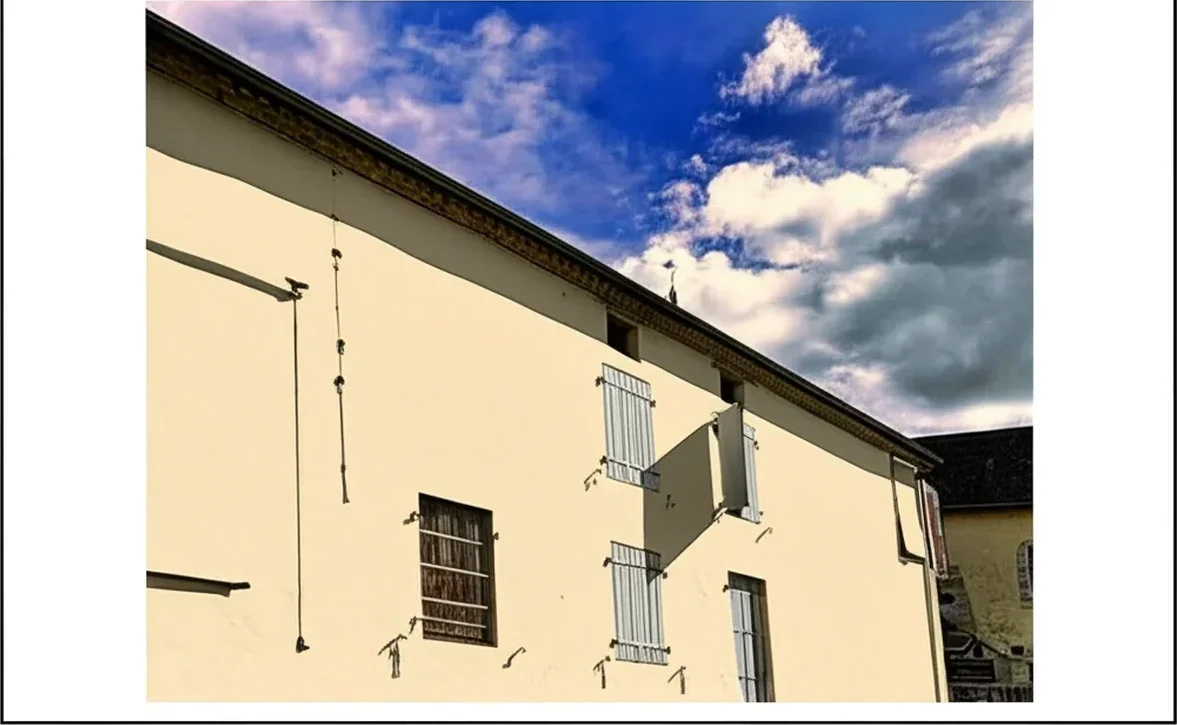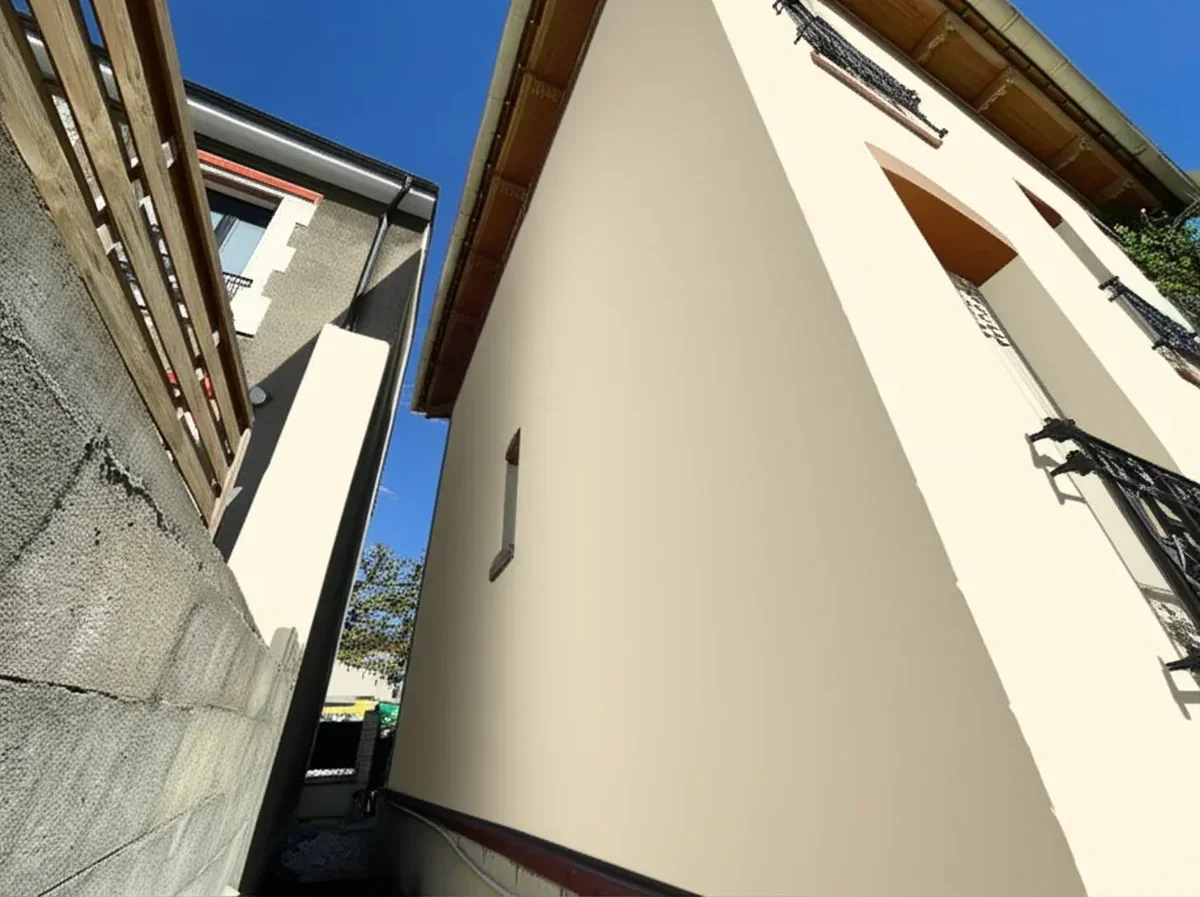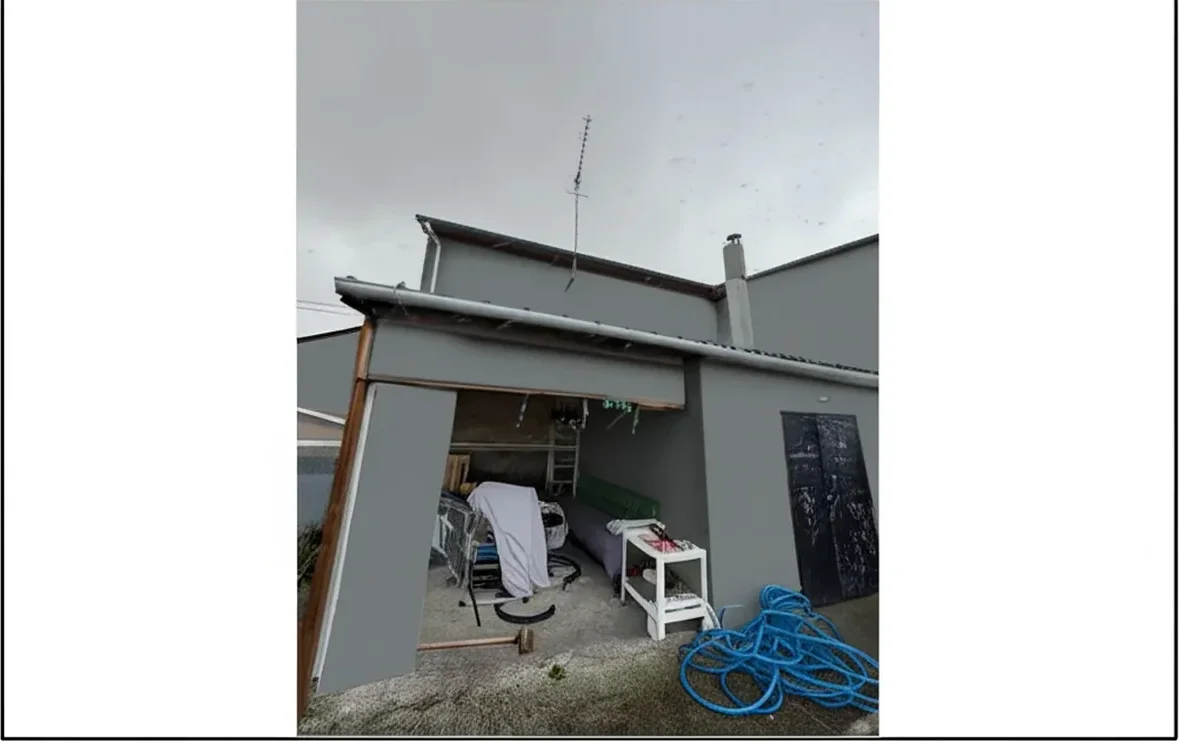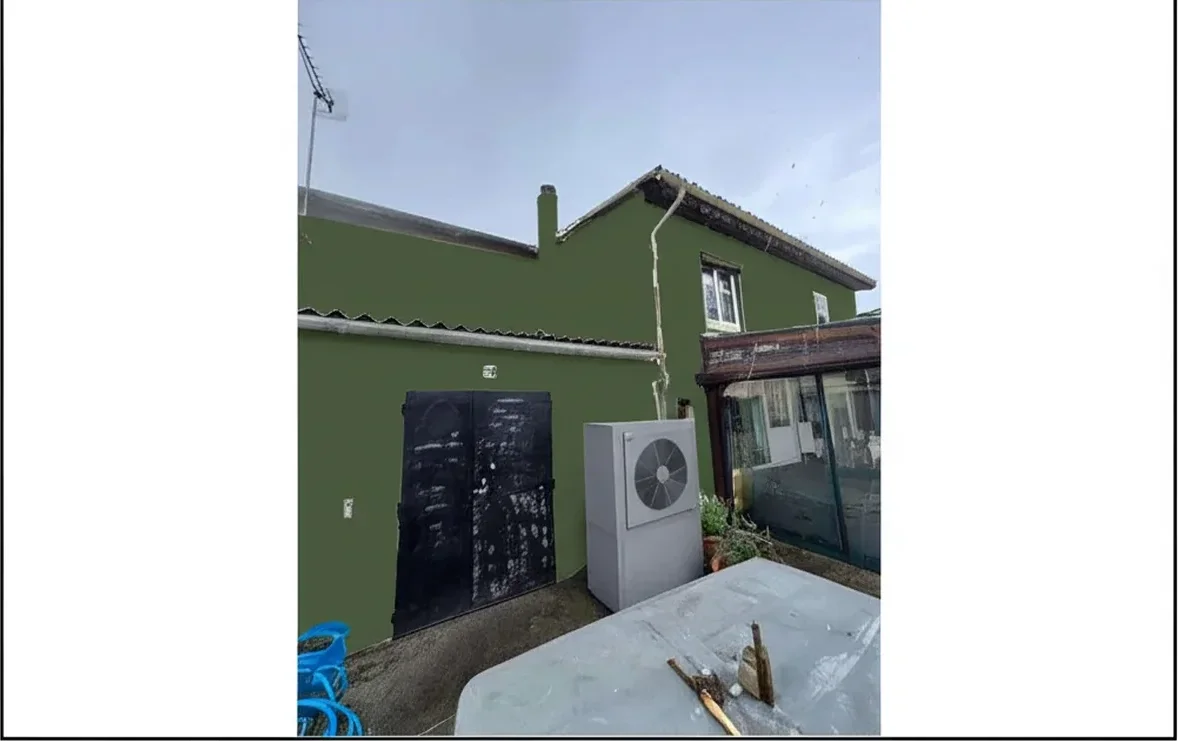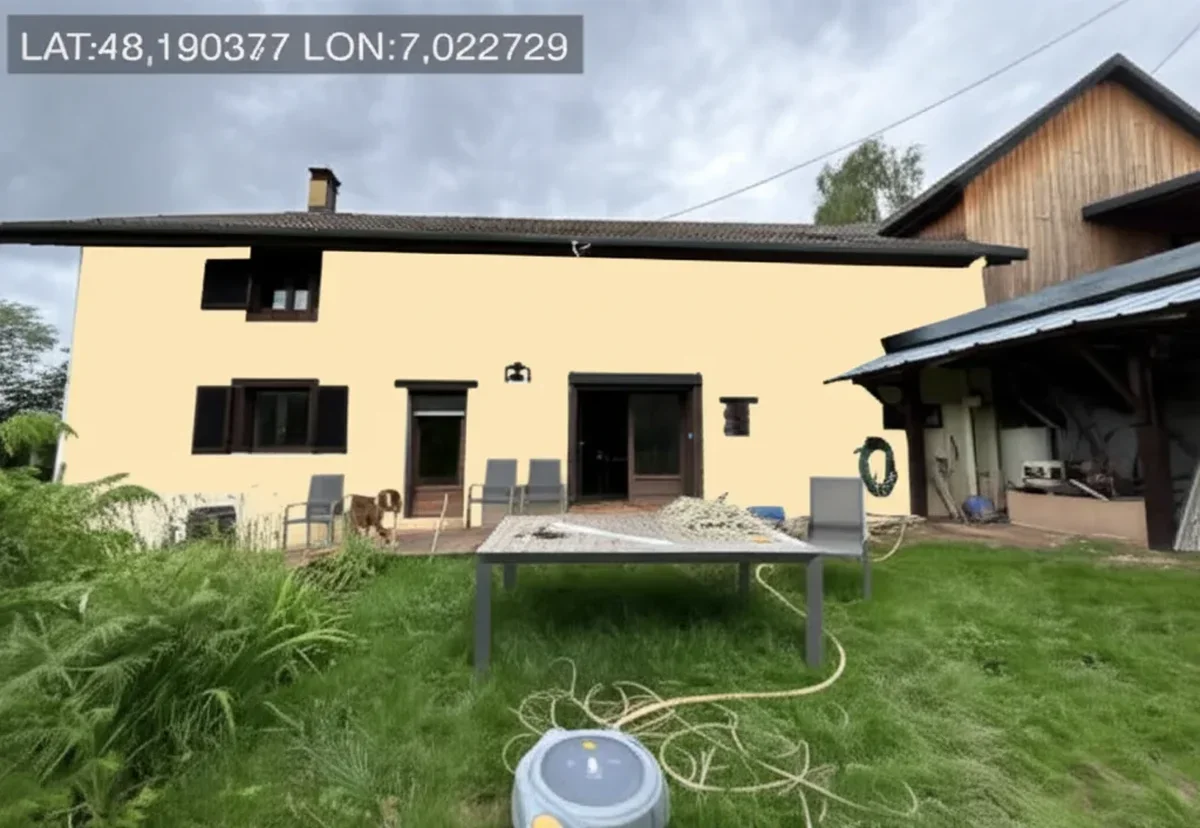
Try it on your house

Benjamin Moore® Pale Oak OC-20 is the #1 ultra-light warm greige Benjamin Moore exterior pick of 2026. Sitting on the Off-White (OC) Collection at approximate hex #DDD9CE and an official LRV of 68.64, it occupies the narrow band between a true off-white (LRV 80 and up) and a conventional mid-tone greige (LRV 50 to 60). Pale Oak is the color homeowners reach for when White Dove OC-17 reads "too white" and Edgecomb Gray HC-173 reads "too greige," and our facade data confirms that intuition.
This 2026 guide answers one practical question, "Is Pale Oak the right ultra-light greige for my exterior?" Below you will find the full technical spec, the four-orientation light behavior (north, south, east, west), an honest comparison against Edgecomb Gray HC-173 (the half-step-deeper sibling), Manchester Tan HC-81 (the warm tan-beige alternative), and Sherwin-Williams Accessible Beige 7036 (the closest cross-shop), trim pairings, shutter coordination, and a step-by-step protocol to preview Pale Oak on a photo of your own facade with our exterior paint visualizer. For the 2026 Color of the Year pillar, see our guide on Benjamin Moore Silhouette AF-655.
Upload one photo, get a photorealistic OC-20 preview in 30 seconds. No signup.
1. What is Benjamin Moore Pale Oak OC-20?
Pale Oak OC-20 is an ultra-light warm greige in the Benjamin Moore Off-White (OC) Collection. The "Pale" reference signals the unusually high LRV for a greige (approaching 69, which is closer to off-white territory), and the "Oak" reference points to the soft warm tan-gray cast that gives the color its character. The technical reading is what matters on a facade.
| Attribute | Value |
|---|---|
| Official name | Pale Oak |
| Benjamin Moore code | OC-20 (Off-White Collection) |
| Family | Ultra-light warm greige |
| Approximate hex | #DDD9CE |
| Approximate RGB | 221, 217, 206 |
| LRV (Light Reflectance Value) | 68.64 |
| Undertone | Warm greige, soft tan-gray cast, minimal pink or yellow pull |
| Munsell coordinates (approx) | 10YR 8/2 |
| Best recommended product | Aura® Exterior, Regal® Select Exterior |
| Closest Sherwin-Williams match | SW Natural Linen 9109 (slightly warmer), SW Accessible Beige 7036 (deeper) |
| Collection | Off-White (OC) Collection |
| 2026 status |
Try it on your house
No photo? Try a sample
Source: Benjamin Moore Off-White Collection technical data sheet, Painting Contractors Association exterior color tracker 2025-2026, FacadeColorizer internal facade simulation dataset (16,983 renders, 2025-2026).
The official LRV of 68.64 is the single most important number on the spec sheet. At that reflectance value Pale Oak sits roughly five and a half points brighter than Edgecomb Gray HC-173 (LRV 63.09) and about thirteen points brighter than Revere Pewter HC-172 (LRV 55.51), which puts it right at the upper edge of the "greige" band before crossing into off-white territory. The practical consequence is that Pale Oak looks "almost white" in full sun and "soft greige" in shade, which is exactly the read homeowners want when they want a light-colored exterior without the harsh institutional feel of a pure white.
2. Why Pale Oak is the #1 BM ultra-light greige for exteriors
All three share a common requirement, a body color that reads as a light warm neutral, contrasts cleanly with darker trim and accents, and avoids the institutional feel of a sterile pure white. OC-20 solves all three with a single chip.
- Modern farmhouse (2015-present). The modern farmhouse is the dominant new-construction style of the past decade, with horizontal lap siding, board-and-batten accents, and dark accent windows. Pale Oak reads as a "soft white" on these facades and pairs naturally with black-framed windows, Cottage Red doors, and a Wrought Iron 2124-10 trim accent. For the broader category roundup, see our modern farmhouse exterior paint colors 2026 top 15 guide.
- Transitional traditional (1980-present). The transitional category covers updated Colonials, suburban traditionals, and 1980s-1990s tract-built homes refreshed for the 2020s. Pale Oak modernizes these facades without forcing a complete style change, and works particularly well on homes with mature landscaping that benefits from a lighter facade backdrop.
- Coastal cottage and Cape (1900-present). On the coast, ultra-light greiges read as "weathered shell" rather than "pure white," and Pale Oak holds that read better than most off-whites because of the soft tan-gray cast. Used widely on Charleston single houses, Cape Cods, and Pacific Northwest beach cottages.
"warm greige with no pink pull" sub-segment. For deeper neutrals on the brand pillar, see our BM Revere Pewter HC-172 exterior guide and the BM Manchester Tan HC-81 exterior guide.
See Pale Oak on your facade. Free, 30 seconds.
3. Four-orientation light behavior
At LRV 68.64, Pale Oak is brighter than most exterior greiges, and that high reflectance means the color shifts more visibly across orientations than a mid-tone like Revere Pewter. There is no significant pink pull on north walls (a common worry with off-whites in this band) but the color does brighten noticeably in direct sun, which is something to test on the actual elevation before committing.
| Orientation | Light condition | Apparent reading | Apparent LRV |
|---|---|---|---|
| North | Flat, cool, no direct sun | Soft warm greige, slight gray pull | ~65 |
| South | Direct full sun, midday | Reads almost off-white, very bright | ~72 |
| East | Warm morning sun | Warm cream-greige, soft caramel lift | ~68 |
| West | Warm late-afternoon sun | Warm greige, slight tan saturation | ~70 |
Apparent LRV readings are visual estimates from FacadeColorizer render comparisons, not photometer values. Variation depends on substrate, paint product, and sky conditions.
The seven-point spread (apparent LRV 65 to 72) is wider than Manchester Tan or Edgecomb Gray, and that is the single most important fact about Pale Oak. On a wraparound facade, the north elevation will read as a soft greige while the south elevation reads as a near-white. Most homeowners find this a feature rather than a bug (it adds dimension to the envelope), but it does mean the trim choice matters more than it would on a mid-tone body. A bright white like Chantilly Lace OC-65 can disappear into the south wall in direct sun, while a warm white like White Dove OC-17 holds the contrast on every elevation.
4. Pale Oak vs Edgecomb Gray, Manchester Tan, and Accessible Beige
Pale Oak is most often considered alongside three sibling colors, BM Edgecomb Gray HC-173 (the half-step-deeper greige), BM Manchester Tan HC-81 (the warm tan-beige alternative), and SW Accessible Beige 7036 (the closest Sherwin-Williams cross-shop). Side by side, the four colors look distinct, and picking the wrong one for the orientation and architecture is the most common error seen most often in this family.
| Attribute | Pale Oak OC-20 | Edgecomb Gray HC-173 | Manchester Tan HC-81 | SW Accessible Beige 7036 |
|---|---|---|---|---|
| Color family | Ultra-light warm greige | Light warm greige | Warm tan-beige | Warm soft beige |
| Approx hex | #DDD9CE | #D4CCBC | #D2BFA4 | #CFC1A8 |
| LRV | 68.64 | 63.09 | 60 | 58 |
| Undertone | Warm greige, tan-gray cast | Warm greige, soft beige cast | Warm tan, soft caramel | Cool beige, slight gray |
| Best architecture | Modern farmhouse, transitional, coastal cottage | Cape Cod, Colonial, Craftsman | Italianate, ranch, Plaza Mediterranean | Suburban traditional, transitional |
| Best trim | White Dove OC-17, Simply White OC-117 | Simply White OC-117, Chantilly Lace OC-65 | White Dove OC-17 | SW Alabaster SW 7008 |
| Shutter coordination | Wrought Iron, Hale Navy, charcoal | Wrought Iron, Hale Navy, dark green | Brown, dark green, black | Black, dark green |
The headline distinction is brightness. Pale Oak (LRV 68.64) reads "almost off-white with warmth," Edgecomb Gray (LRV 63.09) reads "soft greige with body," Manchester Tan (LRV 60) reads "warm tan with caramel," and Accessible Beige (LRV 58) reads "cool beige with gray." A homeowner who tested Edgecomb Gray and found it "too dark for a farmhouse" almost always lands on Pale Oak. A homeowner who tested Pale Oak and found it "too white in midday sun" usually steps down to Edgecomb Gray. For the deeper greige and tan comparisons, see our forward BM Edgecomb Gray HC-173 exterior guide and the cross-shop SW Accessible Beige 7036 exterior guide, plus the brand-level Sherwin-Williams vs Benjamin Moore exterior comparison.
See Pale Oak and Edgecomb Gray side by side on your own home. Free, 30 seconds.
5. Trim pairings, the twelve that work
Pale Oak's high LRV means trim contrast matters more than on a mid-tone body. A trim color that disappears into the south wall in direct sun looks fine on the north wall, and vice versa.
| # | Trim / accent color | BM code | LRV | Use |
|---|---|---|---|---|
| 1 | White Dove | OC-17 | 85 | Trim, warm white preserves contrast on every elevation |
| 2 | Simply White | OC-117 | 91 | Trim, brighter contrast for transitional facades |
| 3 | Wrought Iron | 2124-10 | 6 | Windows and accent, modern farmhouse signature |
| 4 | Hale Navy | HC-154 | 7 | Door, classic anchor for traditional and Cape |
| 5 | Cottage Red | CC-86 | 9 | Door, farmhouse and coastal cottage |
| 6 | Black Forest Green | 2047-10 | 5 | Door or shutters, Colonial and traditional |
| 7 | Iron Mountain | 2134-30 | 10 | Door, charcoal anchor |
| 8 | Chantilly Lace | OC-65 | 92 | Trim, crisp cool-white (use selectively, can disappear in sun) |
| 9 | Stone Hearth | CSP-185 | 66 | Soffit, tone-on-tone mushroom layer |
| 10 | Tudor Brown | 2111-10 | 7 | Door or shutters, deeper warm anchor |
| 11 | Kendall Charcoal | HC-166 | 12 | Shutters, modern farmhouse and transitional |
| 12 | Soft Chamois | OC-13 | 76 | Soffit, tone-on-tone layer |
All BM trim and accent codes verified against the Benjamin Moore 2026 fan deck. LRVs are official Benjamin Moore datasheet values.
The signature recipe on Pale Oak is White Dove OC-17 trim with Wrought Iron 2124-10 windows and a Hale Navy HC-154 or Cottage Red CC-86 door. White Dove trim holds the contrast on every elevation (which Chantilly Lace does not, in our experience), the wrought iron windows provide the dark frame that the modern farmhouse style demands, and the navy or red door supplies the anchor that prevents the whole facade from feeling washed out in midday sun.
6. Shutter coordination, dark anchors for an ultra-light body
With a body LRV near 69, shutters and door work best as deep anchors. The contrast ratio is what gives the facade visual weight, and on Pale Oak we typically see homeowners reach for Wrought Iron 2124-10, Hale Navy HC-154, or Kendall Charcoal HC-166 first. The traditional brown shutter that pairs so well with Manchester Tan is less common on Pale Oak because the body is too light to anchor a warm-brown shutter, and the result usually reads as "1990s suburban" rather than "modern traditional."
| Shutter color | BM code | Best use | Architectural fit |
|---|---|---|---|
| Wrought Iron | 2124-10 | Soft black, less harsh than pure black | Modern farmhouse, transitional |
| Hale Navy | HC-154 | Navy anchor, classic traditional | Cape Cod, Colonial, coastal cottage |
| Kendall Charcoal | HC-166 | Mid-deep charcoal, softer than wrought iron | Transitional, modern farmhouse |
| Black Forest Green | 2047-10 | Dark green alternative | Colonial, Cape Cod, Craftsman |
| Tudor Brown | 2111-10 | Deep brown anchor | Craftsman, transitional with warm trim |
For the broader greige-with-charcoal category, see our mushroom greige house with charcoal 2026 guide, which walks through the deeper greige-plus-dark-shutter combinations and explains the contrast math more rigorously. For the Aura paint product details that hold this kind of high-LRV color on south-facing walls, see our Benjamin Moore Aura Exterior review 2026.
Same body, three shutter colors compared. Free AI render, 30 seconds.
7. Real installs, Charleston single house vs Portland farmhouse
To pressure-test Pale Oak's claim as the #1 BM ultra-light greige, we ran OC-20 against two real architectural styles in the FacadeColorizer photo dataset, a Charleston single house (Lowcountry coastal traditional) and a Portland modern farmhouse (Pacific Northwest new construction). Both styles benefit from an ultra-light warm body, both demonstrate the trim choice difference between coastal traditional and modern farmhouse, and both validate the LRV behavior in two very different sky conditions.
| Factor | Charleston single house | Portland modern farmhouse |
|---|---|---|
| Substrate | Cypress lap siding + brick foundation | Fiber-cement lap + board-and-batten accents |
| Climate | Humid subtropical, salt air | Marine West Coast, frequent rain |
| OC-20 application | Full body lap siding (porches in trim white) | Full body, both lap and batten zones |
| Best trim recipe | Simply White OC-117 trim + Black Forest Green shutters + Hale Navy door | White Dove OC-17 trim + Wrought Iron 2124-10 windows + Cottage Red door |
| Recommended product | Aura Exterior (salt air, UV) | Aura Exterior (moisture resistance) |
| Expected service life | 10-12 years on Aura | 11-13 years on Aura |
The same color, OC-20, works on both facades because both styles share the ultra-light warm-neutral body language. The trim recipe shifts because the Charleston single house uses the crisper Simply White trim to reinforce the historical coastal traditional read, while the Portland modern farmhouse uses the warmer White Dove trim to preserve contrast against the wrought iron windows. The Aura Exterior product is the same in both cases because both climates load the south and west elevations with significant UV or moisture.
See OC-20 on either siding profile. Free render.
8. How to test Pale Oak on your house (step-by-step)
Two methods, the AI photo render and the physical sample board. For a high-LRV color like Pale Oak that shifts visibly across orientations, combining both methods is the right approach before committing to 8-12 gallons of premium exterior paint.
Method A, the AI photo render (15 minutes, free)
- Take one front-elevation photo on an overcast day around 10 AM or 2 PM. Pale Oak distorts more in harsh sun than mid-tones, so an overcast photo gives the most reliable render baseline.
- Upload to FacadeColorizer's free AI exterior visualizer. No signup required for the first render.
- Enter Pale Oak OC-20 as a custom hex value (~#DDD9CE) or pick from the Benjamin Moore palette.
- Generate three trim variants, White Dove OC-17, Simply White OC-117, Chantilly Lace OC-65. The free tier includes one HD render plus three free previews.
- Pull a second photo at a different time of day and re-render to see the orientation effect described in section 3, which is more pronounced on OC-20 than on most exterior colors.
Method B, the physical sample board (3 days, ~$30)
- Buy a Benjamin Moore Color Sample pint of Pale Oak OC-20 (~$10) and a 24" x 36" primed white foamboard (~$10).
- Roll two coats of OC-20 on the foamboard, 24 hours between coats.
- Tape the foamboard to the actual elevation at roughly 5 feet up.
- Observe at 9 AM, 1 PM, and 6 PM. Photograph each.
- If the color reads too white in midday sun, sister-test Edgecomb Gray HC-173 (deeper) or Ballet White OC-9 (warmer alternative at similar LRV). If it reads too gray on the north wall, sister-test Soft Chamois OC-13 (warmer at LRV 76) or Manchester Tan HC-81 (warmer tan at LRV 60).
9. Frequently asked questions
What is the LRV of Benjamin Moore Pale Oak OC-20?
Officially LRV 68.64 per the Benjamin Moore Off-White Collection technical data sheet. That puts Pale Oak at the upper edge of the greige band, roughly five and a half points brighter than Edgecomb Gray HC-173 (LRV 63.09) and about thirteen points brighter than Revere Pewter HC-172 (LRV 55.51). Reflects roughly 69% of visible light, almost off-white territory.
Pale Oak vs Edgecomb Gray, which one should I pick?
Pale Oak is lighter and slightly warmer, Edgecomb Gray is deeper with more visible greige body. On a modern farmhouse, coastal cottage, or shaded north-facing facade, Pale Oak is usually the right call. On a Cape Cod, Colonial, or sun-loaded south-facing facade where you want more body, Edgecomb Gray HC-173 is usually the better pick. Our forward BM Edgecomb Gray HC-173 exterior guide walks through the full comparison.
Does Pale Oak look pink in any light?
Rarely, but possible. The official Munsell coordinates put OC-20 squarely in the 10YR (warm yellow) family with no significant red pull, so a pink read usually traces to either a pink-toned substrate showing through (older stucco, raw cedar) or a neighboring brick that reflects warm light onto the wall. If your house sits next to a red-brick driveway or a pink-toned stone foundation, sister-test Classic Gray OC-23 (cooler) or Edgecomb Gray HC-173 (more body) as alternatives.
What is the closest Sherwin-Williams® color to Pale Oak OC-20?
Sherwin-Williams Natural Linen 9109 is the closest direct cross-shop at the same LRV band, slightly warmer than Pale Oak with a touch more cream pull. SW Accessible Beige 7036 is the deeper cross-shop alternative (LRV 58, more body). Any Sherwin-Williams store will spectrophotometer-match Pale Oak to SW Duration or Emerald at 94-97% accuracy. For full comparison see our Sherwin-Williams vs Benjamin Moore exterior comparison.
Does Pale Oak work on a modern farmhouse?
Yes, and it is one of the most popular modern farmhouse body colors in our 2025-2026 dataset. The high LRV reads as a "soft white" on lap and board-and-batten siding, the warm tan-gray cast prevents the sterile institutional feel of pure white, and the contrast against wrought iron windows and a Hale Navy or Cottage Red door is exactly the modern farmhouse signature. See our modern farmhouse exterior paint colors 2026 top 15 for the broader palette.
What trim color is best with Pale Oak exterior?
The warm white preserves contrast on every elevation, where the cooler Chantilly Lace OC-65 can disappear into the south wall in direct sun. Simply White OC-117 is the brighter alternative for transitional facades that want a crisper read, and Stone Hearth CSP-185 is the tone-on-tone option for soffits and porch ceilings.
Which Benjamin Moore paint product is best for Pale Oak exterior?
Benjamin Moore Aura® Exterior is the top pick for Pale Oak on south and west elevations because the high LRV means UV fade is the dominant failure mode. Aura's Color Lock® technology extends color stability on sun-loaded walls by roughly 40% versus Regal® Select Exterior. Regal Select works on north and east elevations or in cooler climates. Expected service life 11-13 years on Aura, 8-10 years on Regal Select, 5-7 years on Ben® Exterior.
Will Pale Oak look dated in five years?
Unlikely. Pale Oak has been a consistent top-frequency BM Off-White Collection pick for more than fifteen years, in the same evergreen tier as White Dove OC-17 and Classic Gray OC-23. The 2025-2026 trend cycle (warm browns like Silhouette AF-655, soft sage greens) reinforces the warm-neutral palette around OC-20 rather than displacing it. Stone House 1083 is a related warm neutral worth comparing for deeper-body homes, see our BM Stone House 1083 exterior guide.
Test Pale Oak OC-20 on your home photo. 1 HD render + 3 trim variations, no signup.
Bottom line. Pale Oak OC-20 is the #1 ultra-light warm greige Benjamin Moore exterior pick of 2026 because it solves a real architectural need, a high-LRV body color that reads as soft warm white in full sun and soft greige in shade, without the sterile feel of a pure white or the body weight of a true mid-tone greige. Pair it with White Dove OC-17 trim, Wrought Iron 2124-10 windows, and a Hale Navy HC-154 or Cottage Red CC-86 door for the textbook modern farmhouse composition. Because OC-20 shifts more across orientations than mid-tones (apparent LRV 65 on north walls to 72 on south walls), test on a photo of your own facade in your own light, with at least three trim variants, before committing to 8-12 gallons of Aura Exterior at $90 a gallon. Authoritative outbound references: the official Benjamin Moore Pale Oak OC-20 page, Consumer Reports annual exterior paint testing, and HGTV reveal-episode palette archives.
Trademark notice. Benjamin Moore®, Pale Oak®, Edgecomb Gray®, Manchester Tan®, Revere Pewter®, Classic Gray®, Ballet White®, White Dove®, Simply White®, Chantilly Lace®, Hale Navy®, Wrought Iron®, Stone House®, Aura®, Regal® Select, Ben®, Color Lock®, Historical Color®, Off-White Collection® and Gennex® are trademarks of Benjamin Moore & Co. Sherwin-Williams®, Accessible Beige®, Natural Linen®, Duration® and Emerald® are trademarks of The Sherwin-Williams Company. HGTV® is a trademark of Scripps Networks LLC. Consumer Reports® is a trademark of Consumer Reports, Inc. FacadeColorizer is not affiliated with, endorsed by, or sponsored by Benjamin Moore & Co., Sherwin-Williams, HGTV, or Consumer Reports. References to brand and product names are made for descriptive and editorial purposes only, consistent with nominative fair use under the Lanham Act (15 U.S.C. § 1125). Color hex and RGB values are approximate digital renderings; the only authoritative reference is a physical Benjamin Moore Color Sample applied per manufacturer instructions.
Trademarks mentioned (Sherwin-Williams, Benjamin Moore, Behr, Caparol, Brillux, Sto, Alpina, Valspar, PPG, Glidden, Dulux, Crown Trade, Sandtex, Farrow & Ball, Johnstone's, Leyland) are property of their respective owners. FacadeColorizer is independent and not affiliated with any of them. Nominative fair use under Lanham Act §1125.