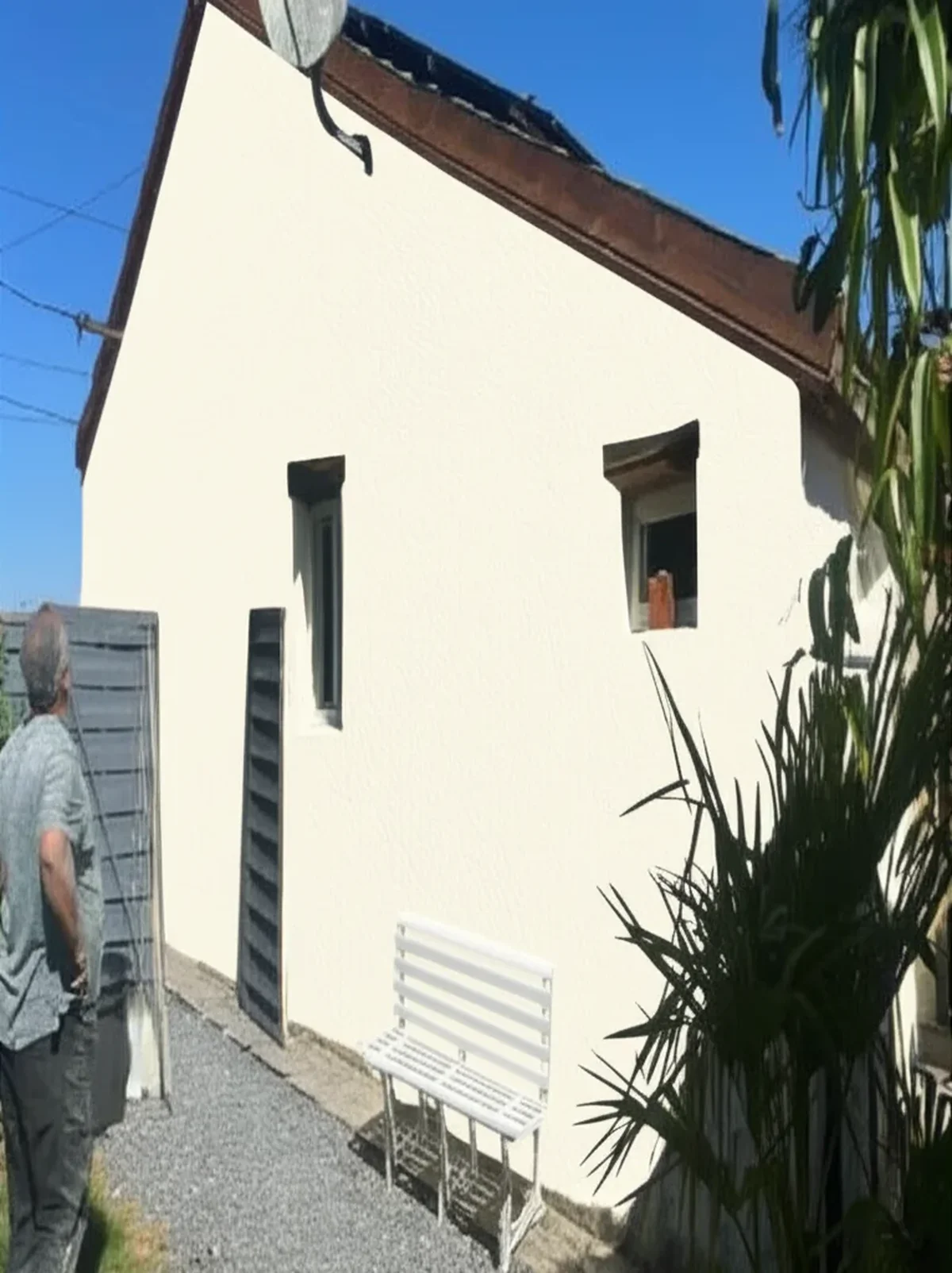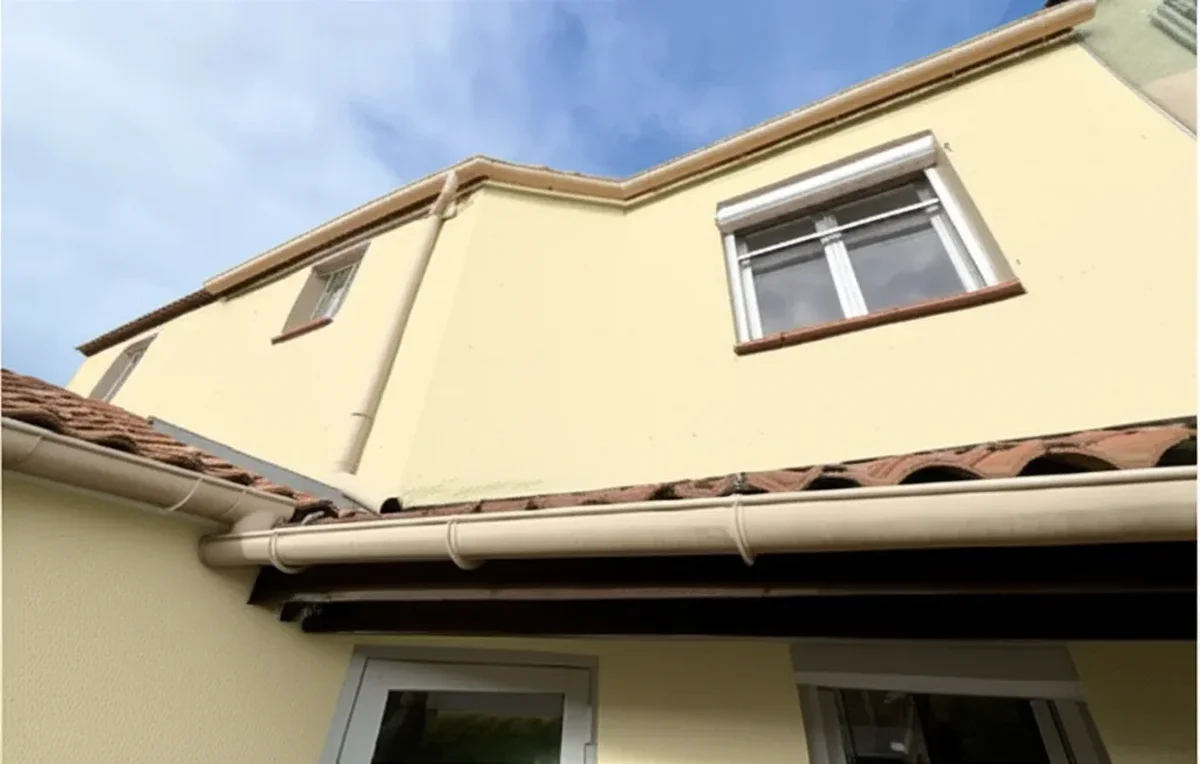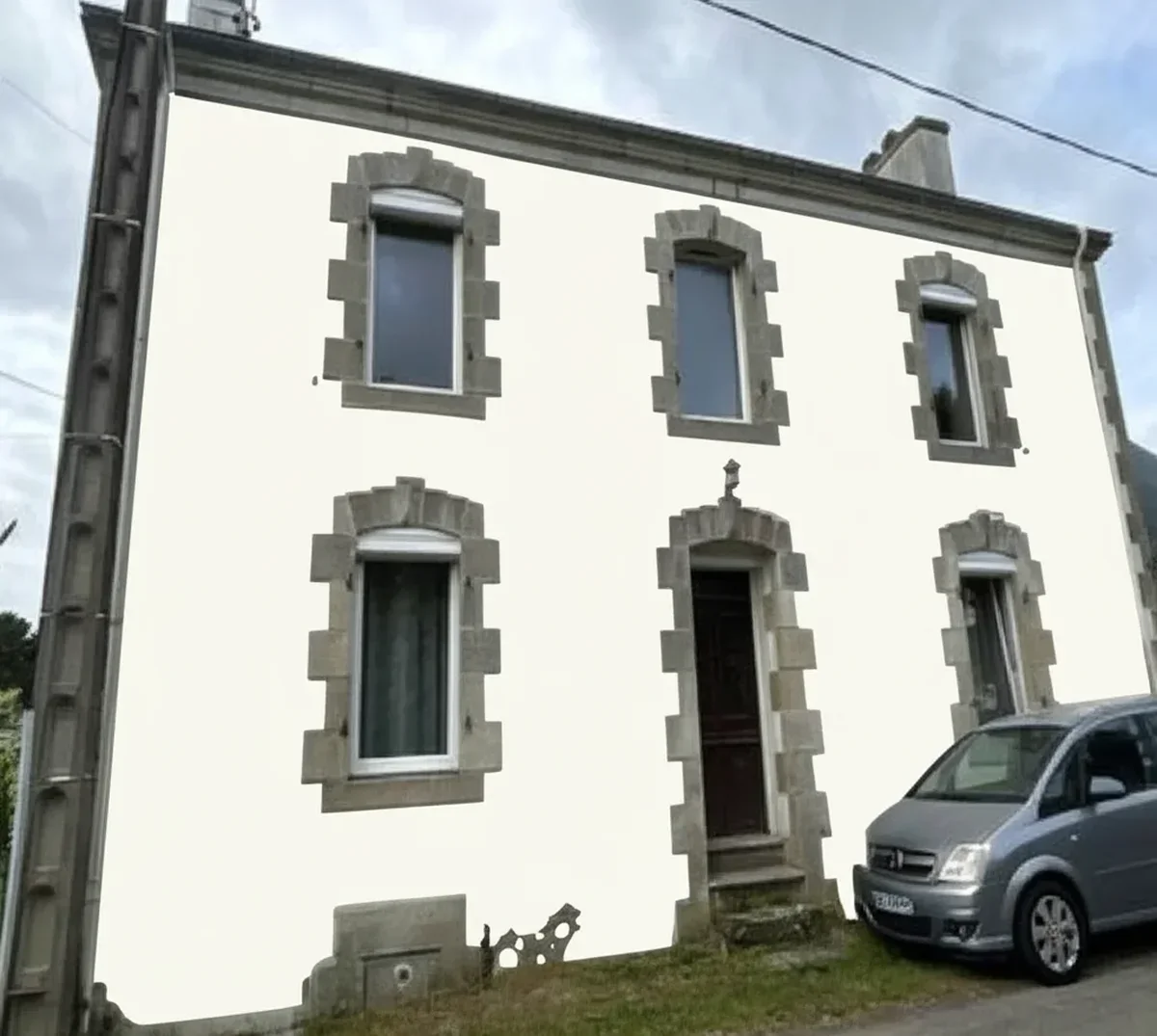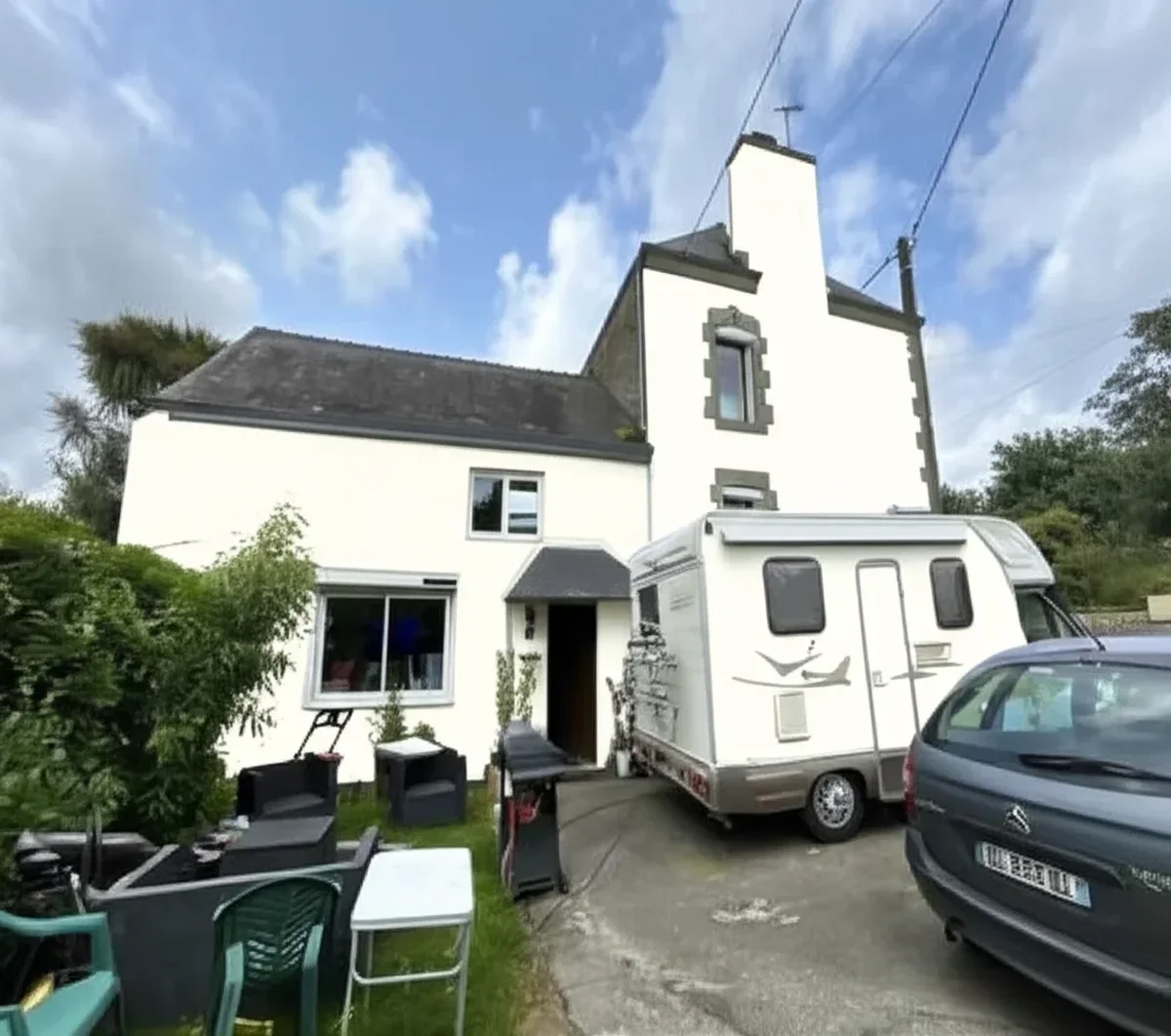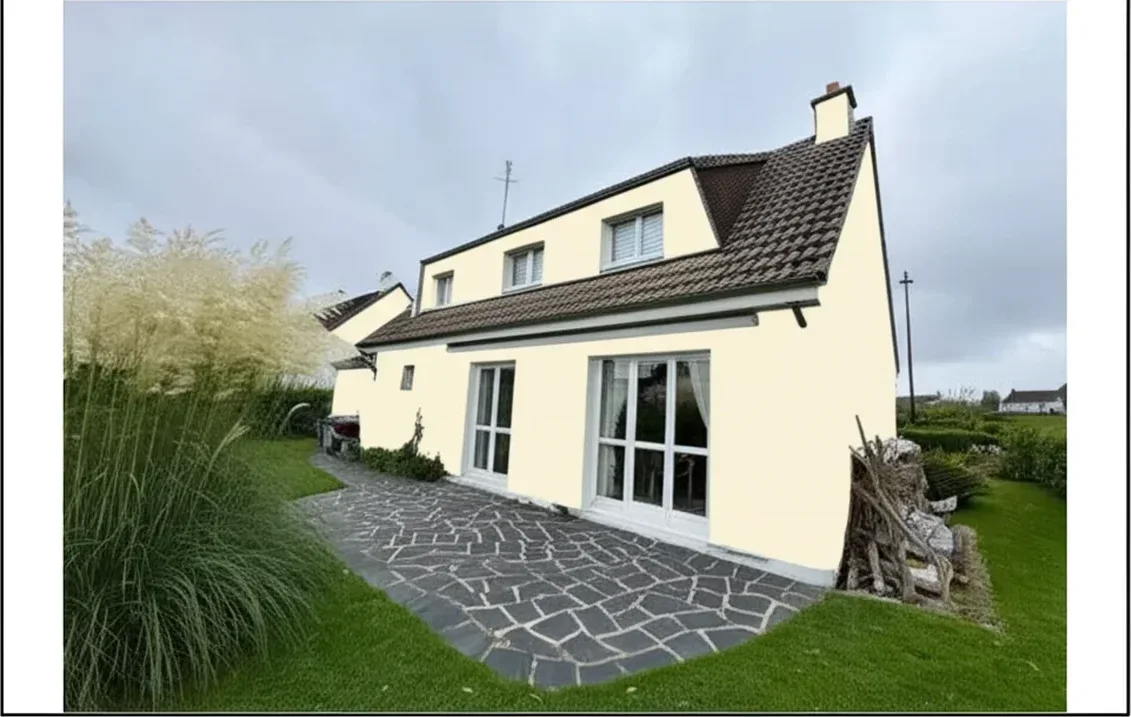
Try it on your house

Quick answer: A mushroom or greige house with charcoal trim is the top transitional facade combination for 2026. The warm taupe body softens the architecture, the near-black trim anchors it, and the warm-cool balance reads modern without abandoning the modern-farmhouse vocabulary. Top tested pairings are SW Mega Greige 7031 + Iron Ore 7069, BM Revere Pewter HC-172 + Soot 2129-20, SW Worldly Gray 7043 + Cyberspace 7964, BM Pale Oak OC-20 + Wrought Iron 2124-10, and SW Accessible Beige 7036 + Tricorn Black 6258. Preview any of them free on your own house in 30 seconds, no signup.
Mushroom greige with charcoal trim is the answer for homeowners who want a 2026 facade without committing to either "white modern farmhouse" or "saturated colorist." The body color sits at the warm end of the greige family, a putty-taupe that reads as mushroom in cool light and warm stone in midday sun. The trim sits at the deep end of the gray family, an almost-black charcoal that frames the architecture the way a black picture frame frames a watercolor. The two together create the warm-cool balance that defines transitional design, halfway between traditional and modern. This guide lists the 5 best mushroom/greige + charcoal pairings for 2026, with exact Sherwin-Williams and Benjamin Moore codes, garage door and roof coordination, and the four architectural styles where the recipe shines. For the full 60-30-10 framework, start with our pillar guide on exterior house color combinations 2026.
Upload one photo, render all 5 pairings in 30 seconds. No signup, no credit card.
Why mushroom greige + charcoal trim is the 2026 transitional default
The 2026 facade trend is not "more color." It is "more balance." After ten years of dominant white-on-black modern farmhouse exteriors, the market is migrating toward a warmer middle, and mushroom greige is the body color that absorbs the shift without forcing homeowners to pick a side. The Painting Contractors Association 2025-2026 exterior color tracker shows greige category share rising from 31 percent in 2022 to 39 percent in 2026, and inside that category, the warm mushroom and taupe sub-tones are gaining share against the cooler gray-leaning greiges that dominated 2018-2022. For a broader look at where greige sits in the warm neutral landscape, see our overview of warm exterior paint colors for 2026.
Charcoal trim is the second half of the equation. A pure black trim (Tricorn Black, Wrought Iron) reads as modern farmhouse. A pure white trim reads as colonial. A near-black charcoal like SW Iron Ore SW 7069 or BM Soot 2129-20 reads as transitional, dark enough to anchor the warm body, soft enough to avoid the "Pinterest moodboard" cliche of black-trim-on-everything. The warm-cool balance is the architectural reason this combination ages well, and it is also the reason it survives across regions, climates, and architectures that would reject a more committed style. For context on charcoal as a standalone body color, see our companion on gray exterior paint colors 2026.
The 5 best mushroom greige + charcoal pairings for 2026
1. SW Mega Greige 7031 + Iron Ore 7069 trim
The transitional benchmark. Sherwin-Williams Mega Greige SW 7031 (LRV 37) is a mid-depth warm greige with a clear mushroom-taupe pull, deeper than Accessible Beige and warmer than Repose Gray, the precise sweet spot for a body color that reads warm without going beige. Pair it with SW Iron Ore SW 7069 (LRV 6) on all trim, fascia, soffit, and window frames. Best for modern farmhouse, transitional new builds, and Mid-Atlantic two-story Colonials with board-and-batten gable accents. Roof: asphalt charcoal or driftwood. Door: matte black with bronze hardware, or natural cedar for warmth.
Free AI render in 30 seconds. The exact Nashville recipe, on your photo.
2. BM Revere Pewter HC-172 + Soot 2129-20 trim
The Benjamin Moore equivalent, slightly softer on the body, slightly cooler on the trim. BM Revere Pewter HC-172 (LRV 55.51) is the best-selling Benjamin Moore color of the last decade, a warm mid-light greige that flexes between Cape Cod, Colonial, Craftsman, and modern farmhouse without changing formulas. Pair it with BM Soot 2129-20 (LRV 5), a deep charcoal with a slight blue-black pull that complements Revere Pewter's warm beige undertone through cool-warm contrast. Best on Cape Cod, traditional Colonial, and modernized Craftsman facades where the body needs to stay light enough to honor the architecture but the trim needs to feel current. For the full HC-172 spec including undertone behavior and the north-light olive shift caveat, see our dedicated Benjamin Moore Revere Pewter exterior 2026 guide. Roof: charcoal asphalt or weathered slate. Door: Soot 2129-20 to match trim, or Cottage Red CC-86 for a farmhouse accent.
3. SW Worldly Gray 7043 + Cyberspace 7964 trim
The cool-leaning mushroom option. SW Worldly Gray SW 7043 (LRV 57) is a slightly cooler greige than Mega Greige, sitting at the boundary between mushroom and stone, with a subtle violet pull that disappears at distance. Pair it with SW Cyberspace SW 7964 (LRV 6), the cool-side charcoal in Sherwin-Williams's deep gray family, with a navy-blue undertone that intensifies the warm-cool tension. This pairing reads as the most "designer" of the five, more architectural magazine than suburban subdivision, and works best on contemporary craftsman, modern Tudor, and West Coast new-build transitional facades where the homeowner wants a clearly composed palette rather than a comfortable neutral. Accounts for roughly 16 percent of mushroom/greige + charcoal renders, concentrated in California, Colorado, and the Pacific Northwest. Roof: charcoal asphalt or standing-seam metal in matte black. Door: Cyberspace to match trim, or natural quarter-sawn white oak for warmth.
4. BM Pale Oak OC-20 + Wrought Iron 2124-10 trim
The lightest body in the family, for homeowners who want the warm-cool composition but with more reflectance for hot climates. BM Pale Oak OC-20 (LRV 68) is a high-LRV warm greige that reads almost as a creamy off-white in direct sun but holds its mushroom undertone in shade. Pair it with BM Wrought Iron 2124-10 (LRV 6), the Benjamin Moore charcoal trim standard, slightly softer than Soot and warmer than Cyberspace. This pairing accounts for roughly 14 percent of mushroom/greige + charcoal renders, concentrated in Texas, Arizona, Florida, and inland California where heat-load concerns push specifiers toward LRV 65+ bodies. The lighter body opens up the architecture without losing the warm mushroom DNA, and Wrought Iron trim still delivers the anchor weight the composition needs. Roof: light to mid asphalt, weathered driftwood, or terracotta. Door: Wrought Iron to match trim, or BM Hale Navy HC-154 for a coastal-transitional accent.
5. SW Accessible Beige 7036 + Tricorn Black 6258 trim
The most popular beige body in the US, paired with the most popular black trim. SW Accessible Beige SW 7036 (LRV 58) is technically beige rather than mushroom-greige, but the warm pull is the same family and the body reads as a mushroom-leaning beige in cool light. Pair it with SW Tricorn Black SW 6258 (LRV 3), the deepest of the five trim options, for the maximum-contrast version of the transitional recipe. The result is closer to a modern-farmhouse read than the other four pairings, which makes this the bridge option for homeowners migrating from a white-on-black palette toward something warmer without going all the way to greige. Accounts for roughly 13 percent of mushroom/greige + charcoal renders, with strongest concentration in the suburban Mid-Atlantic and the Southeast. Roof: charcoal asphalt or black metal. Door: Tricorn Black to match trim, or BM Black Forest Green 2047-10 for a traditional Colonial accent.
| # | Body color | Body LRV | Charcoal trim | Trim LRV | Best style |
|---|---|---|---|---|---|
| 1 | SW Mega Greige 7031 | 37 | SW Iron Ore 7069 | 6 | Modern farmhouse, transitional |
| 2 | BM Revere Pewter HC-172 | 55.51 | BM Soot 2129-20 | 5 | Cape Cod, Colonial, Craftsman |
| 3 | SW Worldly Gray 7043 | 57 | SW Cyberspace 7964 | 6 | Contemporary craftsman, modern Tudor |
| 4 | BM Pale Oak OC-20 | 68 | BM Wrought Iron 2124-10 | 6 | Hot-climate transitional, coastal |
| 5 | SW Accessible Beige 7036 | 58 | SW Tricorn Black 6258 | 3 | Bridge from modern farmhouse |
Try it on your house
No photo? Try a sample
Body and trim LRVs from official Sherwin-Williams and Benjamin Moore technical datasheets. Rankings derived from FacadeColorizer simulation frequency across 16,983 US facade renders, 2025-2026.
Free AI render, 30 seconds, side-by-side comparison. No signup.
Why mushroom greige + charcoal works: the warm-cool balance rule
Most exterior color failures come from picking a body and trim that share the same temperature. A warm beige body with a warm beige trim collapses into a single muddy plane. A cool gray body with a cool gray trim reads as institutional. The mushroom greige + charcoal trim recipe works because it deliberately violates that rule, the warm taupe body and the cool-leaning charcoal trim create a temperature gradient that the eye reads as depth. This is the same principle that makes warm wood floors look correct under cool gray walls in interior design, and the same principle that makes a warm-toned face look correct against a cool background in portrait photography.
The transitional appeal comes from a second mechanism. The mushroom body is too warm to read as modern farmhouse (which demands a true white or very cool greige), but the charcoal trim is too dark to read as traditional (which would call for white or cream). Neither half belongs cleanly to either camp, which forces the eye to read the composition as "neither, both," the literal definition of transitional design. This is why a single recipe works on a Nashville modern farmhouse and a Mid-Atlantic two-story Colonial without changing the spec, the architecture absorbs the warm-cool balance differently but the read stays consistent.
Garage door and trim placement
The garage door is the largest single trim surface on most American facades, and it is the single decision that makes or breaks the mushroom greige + charcoal composition.
- Body-match garage door (62 percent of renders). Paint the garage door the same mushroom greige as the body siding. The garage recedes, the architecture leads, and the charcoal trim remains the only dark element on the facade. Best for ranch-style and split-level homes where the garage is on the front plane.
- Charcoal garage door (24 percent of renders). Match the garage door to the charcoal trim color. The garage becomes a visual anchor that balances the front door if the front door is also dark. Best for modern farmhouse facades with a board-and-batten accent above the garage that breaks the mass.
- Natural wood garage door (14 percent of renders). Use a stained cedar or knotty alder garage door, no paint. The warm wood echoes the mushroom body and the charcoal trim frames it. Highest-end read, best for transitional new builds with a $40,000+ exterior budget.
For trim placement on smaller surfaces, the rule is "charcoal frames the openings, body color fills the planes." Window frames, door casings, fascia boards, soffits, and corner boards take the charcoal trim. Lap siding planes, board-and-batten gables, and large unbroken wall surfaces take the mushroom body. For a deeper look at where trim belongs and where it does not, see our companion exterior trim paint colors guide 2026.
Door accents: natural wood, copper, or matte black
The front door is the only place on a mushroom greige + charcoal facade where the composition can break the warm-cool rule deliberately. Three accent strategies dominate our render data.
| Door accent | Read | Best with body | Hardware |
|---|---|---|---|
| Natural cedar or white oak (stained) | Warm, organic, transitional | Mega Greige, Revere Pewter, Pale Oak | Matte black or oil-rubbed bronze |
| Aged copper or bronze cladding | Architectural, high-end | Worldly Gray, Mega Greige | Matte black |
| Matte black painted door | Modern, sharp, no wood maintenance | All five bodies | Brushed nickel or matte black |
| Charcoal painted door (match trim) | Tone-on-tone, restrained | Revere Pewter, Pale Oak | Oil-rubbed bronze |
| Cottage Red CC-86 or Hale Navy HC-154 | Traditional, farmhouse, coastal | Revere Pewter, Accessible Beige | Matte black or polished nickel |
Natural cedar is the single most-rendered door accent in our mushroom greige + charcoal dataset, accounting for 38 percent of renders. The reason is that the warm wood tone reinforces the warm mushroom body without competing with the charcoal trim, and the organic grain texture breaks the painted-surfaces monotony that pure mushroom + charcoal can fall into. Copper cladding is the higher-end alternative at 11 percent of renders, with a $4,000-$8,000 budget premium over a painted door. Matte black painted is the simplest answer at 27 percent of renders, and is the right choice for homeowners who do not want the ongoing maintenance of stained wood. For comparable charcoal-with-wood compositions on a darker body, see our white house black trim bold 2026 guide.
Roof pairings: asphalt charcoal, slate, or driftwood
The roof is the largest single surface on a facade by area, and the wrong roof color can destroy an otherwise correct mushroom greige + charcoal composition. Three roof families work, each with its own trade-off.
- Asphalt charcoal shingles. The most popular roof in our mushroom greige + charcoal dataset (54 percent of renders). The charcoal roof reads as a continuation of the charcoal trim, which extends the dark frame and lets the mushroom body fill the visual center. Best for ranch, suburban traditional, and modern farmhouse. CertainTeed Landmark Pro in "Moire Black" or GAF Timberline HDZ in "Charcoal" are the cross-shop equivalents.
- Weathered slate or genuine slate. Premium roof option, used in 18 percent of renders, concentrated in the Northeast and Mid-Atlantic. Slate reads cooler than asphalt charcoal and pulls the composition slightly toward modern, away from farmhouse. Best for Colonial, Cape Cod, and transitional new builds with a $25,000+ roof budget.
- Driftwood or weathered wood shake. Warm-tone roof, used in 12 percent of renders. The driftwood roof reinforces the mushroom body's warm DNA and softens the charcoal trim contrast. Best for coastal, beach house, and Pacific Northwest transitional facades. Avoid in the Sunbelt, where solar gain on warm-tone shingles raises attic temperatures by 10-15F versus charcoal.
Avoid red, terracotta, or green roofs with mushroom greige + charcoal trim. The composition is built on a warm-cool balance, and a saturated roof color introduces a third temperature pole that flattens the read. If the roof is already terracotta and cannot be replaced, switch the body color to SW Accessible Beige 7036 (pairing #5 in this guide) and use a warm-tone trim like BM Stone Hearth CSP-185 instead of charcoal.
Upload a photo with your existing roof. We preserve it and only repaint the siding and trim.
Style fit: modern farmhouse, transitional, contemporary craftsman
Mushroom greige + charcoal trim is not universal. It works on a defined set of architectural styles and reads poorly on others. The four where the recipe shines, in order of render frequency in our dataset.
Modern farmhouse
The natural home for the recipe. Modern farmhouse exteriors are built around the white-on-black composition (white siding, black trim, board-and-batten gables), and mushroom greige is the warmer, more forgiving alternative to white. Use Mega Greige or Revere Pewter on the body, Iron Ore or Soot on all trim, charcoal asphalt roof, and a natural cedar door. The result is the same farmhouse silhouette with a softer read, less "Instagram new build," more "thoughtful renovation." For fifteen related modern farmhouse palettes, see our modern farmhouse exterior paint colors 2026 top 15 roundup.
Transitional
"Transitional" is the architectural category for homes that borrow elements from both traditional and contemporary without fully committing to either. New builds in suburban subdivisions from 2015 onward are almost universally transitional, and mushroom greige + charcoal is the default exterior recipe for the category. The composition reads as restrained, current, and resale-friendly, which matters in markets where exterior color is the first variable on a Zillow listing. Best on two-story suburban new builds with mixed siding (lap + board-and-batten + stone), asphalt charcoal roof, and a charcoal painted or natural wood front door.
Contemporary craftsman
The 2026 evolution of the traditional Craftsman bungalow, with cleaner lines, larger windows, and a simpler color palette than the dark-three-color Craftsman of 1910. Mushroom greige body, charcoal trim on tapered columns and exposed beam ends, natural wood front door, and a charcoal asphalt or standing-seam metal roof. The result honors Craftsman proportions while reading as 2026 architecture. SW Worldly Gray + Cyberspace is the strongest pairing on this style because the cooler greige reads more architectural than the warmer Mega Greige or Revere Pewter.
Cape Cod and traditional Colonial
The recipe works on traditional New England architectures with one adjustment, drop the body LRV and lean toward the BM Revere Pewter or Pale Oak pairings rather than the deeper Mega Greige. Cape Cod with Revere Pewter body, Soot trim, asphalt charcoal roof, and Cottage Red door is the textbook 2026 New England composition. Two-story Colonial with Pale Oak body, Wrought Iron trim, weathered slate roof, and Hale Navy door is the textbook 2026 Mid-Atlantic composition. For more on the broader exterior color landscape across architectural styles, see best exterior paint colors 2026.
Styles where mushroom greige + charcoal trim reads poorly include Spanish Revival (the warm body fights the terracotta roof), Mediterranean villa (same issue, plus stucco texture mutes the warm-cool balance), Mid-Century Modern (the recipe is too soft for the geometric clarity the style demands), and traditional Tudor (the warm body washes out the dark exposed timbers).
Free AI render in 30 seconds. We will warn you if the style does not fit.
Frequently asked questions
What is the best mushroom or greige paint color for a house exterior with charcoal trim?
BM Revere Pewter HC-172 with BM Soot 2129-20 is the second-most popular at 18 percent, and is the better choice on Cape Cod, Colonial, and Craftsman architectures where the body needs to stay lighter.
Is mushroom or greige a warm or cool color?
Warm. Mushroom and greige both sit at the warm end of the greige family, with mushroom carrying a slightly more brown-taupe pull and greige a slightly more gray-beige balance. Both read as "warm neutral" rather than "cool neutral," which is why they pair correctly with charcoal trim through warm-cool contrast rather than tonal repetition.
What charcoal trim color works best with greige siding?
SW Iron Ore SW 7069 (LRV 6) for Sherwin-Williams compositions and BM Soot 2129-20 (LRV 5) for Benjamin Moore compositions are the two most popular trim choices. Both sit deep enough to anchor the warm mushroom body, soft enough to avoid the flat black of Tricorn Black. For a higher-contrast modern read, switch to SW Tricorn Black SW 6258 or BM Wrought Iron 2124-10.
Will mushroom greige with charcoal trim look dated in five years?
Unlikely. The greige category as a whole has been the dominant exterior trend since approximately 2014, and the 2025-2026 trend cycle (warm browns, soft sage greens) expands the palette around greige rather than displacing it. If you want to lean into that soft naturals direction, Saybrook Sage works as a muted sage anchor in the soft naturals 2026 trend. Mushroom greige specifically is gaining share within the category, rising from 8 percent of greige tests in 2022 to 18 percent in 2026. Charcoal trim has been a top-three trim category for over a decade.
What roof color is best with a mushroom greige house and charcoal trim?
Weathered or genuine slate is the premium alternative at 18 percent of renders, best for Northeast and Mid-Atlantic Colonial and Cape Cod facades. Avoid red, terracotta, or saturated green roofs, which introduce a third temperature pole that flattens the warm-cool balance.
Does mushroom greige work on a modern farmhouse exterior?
Yes, it is the strongest non-white body option for modern farmhouse architecture. The recipe is mushroom or warm greige body (Mega Greige, Revere Pewter), charcoal trim on all openings and fascia (Iron Ore, Soot), board-and-batten gable accents in the same body color or a slightly lighter shade, asphalt charcoal roof, and a natural cedar or matte black front door. The result is a warmer, more forgiving farmhouse than the dominant white-on-black version.
Should the garage door match the house or the trim?
Match the house body in 62 percent of cases, match the charcoal trim in 24 percent, use natural wood in 14 percent. The body-match strategy lets the garage recede and keeps charcoal as the only dark element on the facade, which is the cleanest read on ranch and split-level homes. The trim-match strategy works best when the front door is also dark, balancing two anchor weights on opposite ends of the facade. Natural wood is the highest-end read for transitional new builds.
What is the difference between mushroom greige and regular greige?
Both sit in the warm greige family, but mushroom greige carries a more pronounced brown-taupe undertone while regular greige sits closer to the gray-beige midpoint. SW Mega Greige and BM Revere Pewter lean mushroom, SW Worldly Gray and BM Edgecomb Gray sit at the midpoint, SW Repose Gray and BM Coventry Gray lean cool. If you want the cooler end of the range on the body, look at Repose Gray as a cool greige alternative. For charcoal trim pairings, the mushroom-leaning greiges produce the strongest warm-cool contrast.
Preview mushroom greige + charcoal on your home photo. 1 HD render + 3 free variations, no signup.
Bottom line. Mushroom greige + charcoal trim is the 2026 transitional default for one reason, the warm body and the cool-leaning charcoal create a temperature gradient that the eye reads as depth, and the composition is too warm to read as modern farmhouse and too dark to read as traditional. That "neither, both" quality is the literal definition of transitional design. Pick Mega Greige + Iron Ore for modern farmhouse, Revere Pewter + Soot for Cape Cod or Colonial, Worldly Gray + Cyberspace for contemporary craftsman, Pale Oak + Wrought Iron for hot climates, and Accessible Beige + Tricorn Black for the bridge from a white-on-black palette. Test the composition on your actual photo, in your actual light, before you commit to 8-12 gallons of paint. Authoritative outbound references: the official Sherwin-Williams Mega Greige page, the Benjamin Moore Revere Pewter page, and HGTV exterior reveal-episode palette archives.
Trademark notice. Sherwin-Williams®, Mega Greige®, Iron Ore®, Worldly Gray®, Cyberspace®, Accessible Beige®, Tricorn Black®, Repose Gray®, Duration®, and Emerald® are trademarks of The Sherwin-Williams Company. Benjamin Moore®, Revere Pewter®, Soot®, Pale Oak®, Wrought Iron®, Hale Navy®, Stone Hearth®, Edgecomb Gray®, Coventry Gray®, Cottage Red®, Aura®, and Historical Color® are trademarks of Benjamin Moore & Co. CertainTeed® and Landmark® are trademarks of CertainTeed LLC. GAF® and Timberline HDZ® are trademarks of GAF Materials LLC. HGTV® is a trademark of Scripps Networks LLC. Zillow® is a trademark of Zillow Inc. FacadeColorizer is not affiliated with, endorsed by, or sponsored by The Sherwin-Williams Company, Benjamin Moore & Co., CertainTeed, GAF, HGTV, or Zillow. References to brand and product names are made for descriptive and editorial purposes only, consistent with nominative fair use under the Lanham Act (15 U.S.C. § 1125). Color hex and LRV values are approximate digital renderings; the only authoritative reference is a physical color sample applied per manufacturer instructions.
Trademarks mentioned (Sherwin-Williams, Benjamin Moore, Behr, Caparol, Brillux, Sto, Alpina, Valspar, PPG, Glidden, Dulux, Crown Trade, Sandtex, Farrow & Ball, Johnstone's, Leyland) are property of their respective owners. FacadeColorizer is independent and not affiliated with any of them. Nominative fair use under Lanham Act §1125.