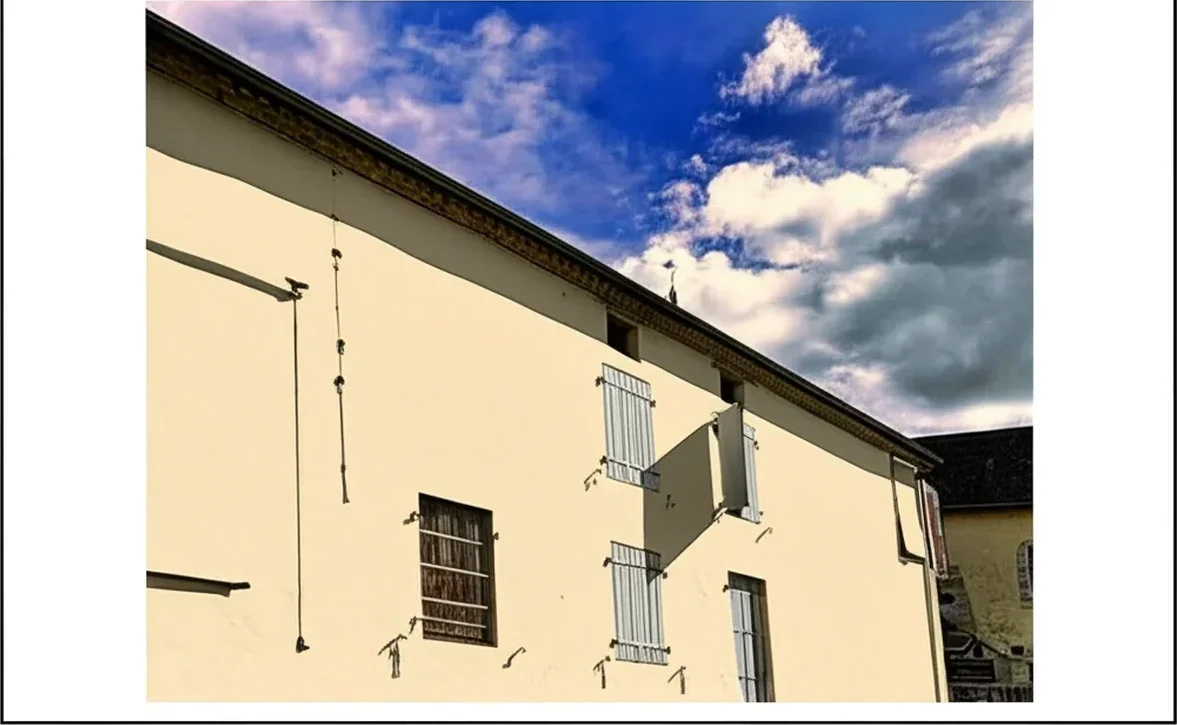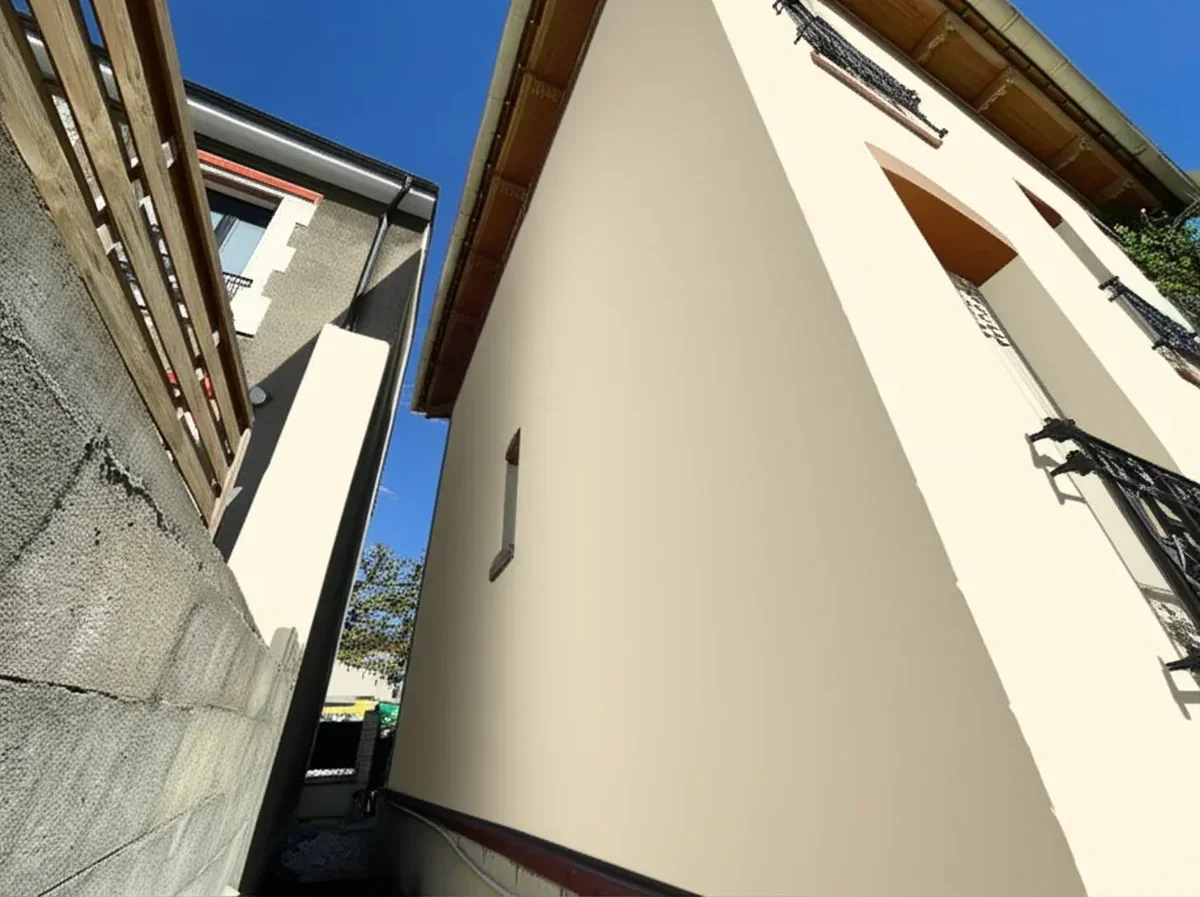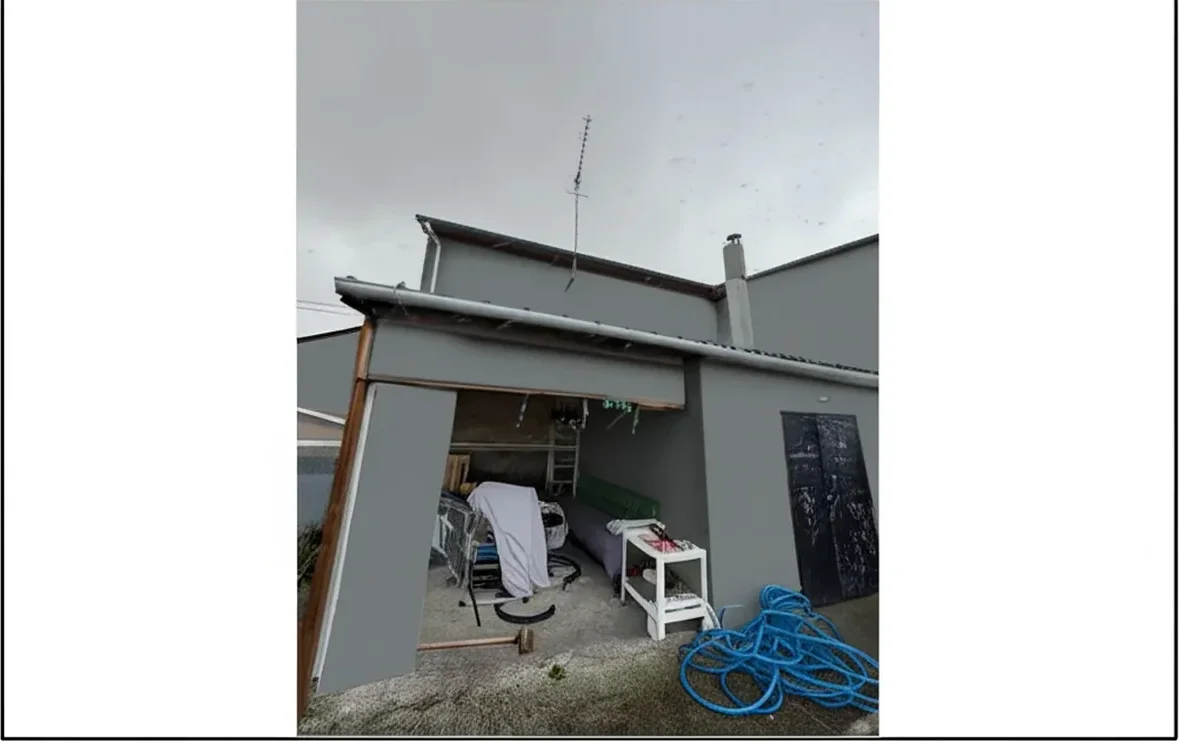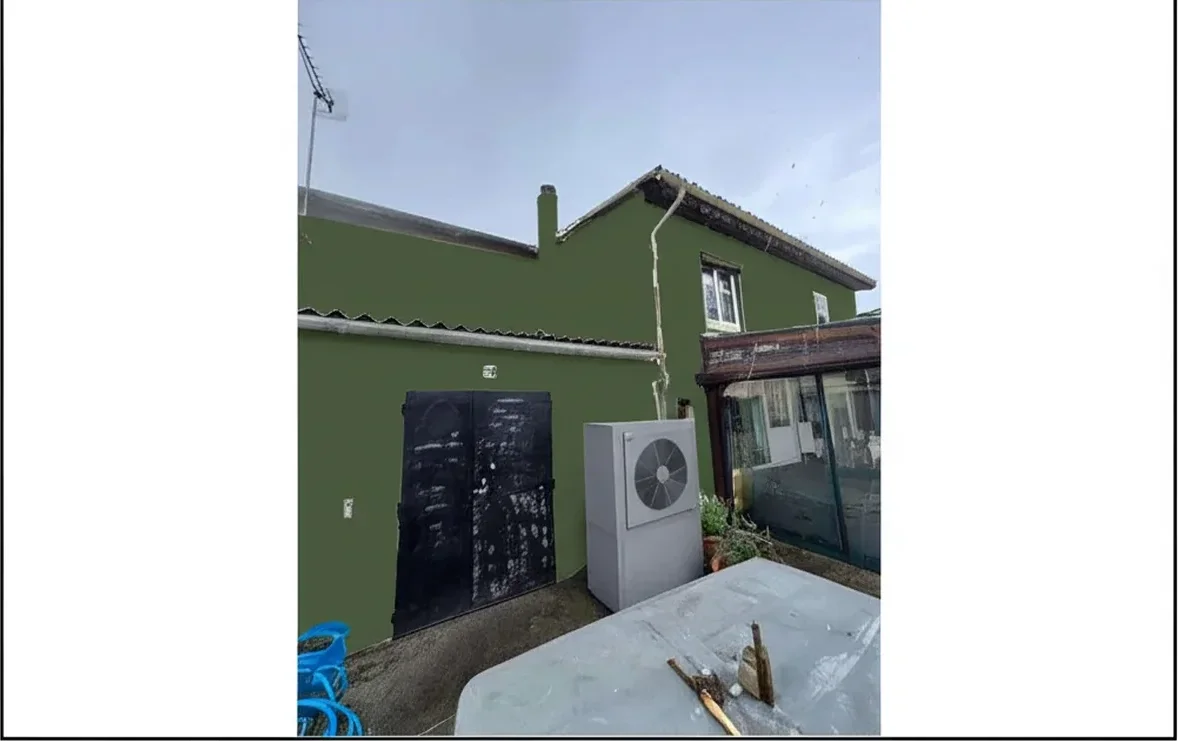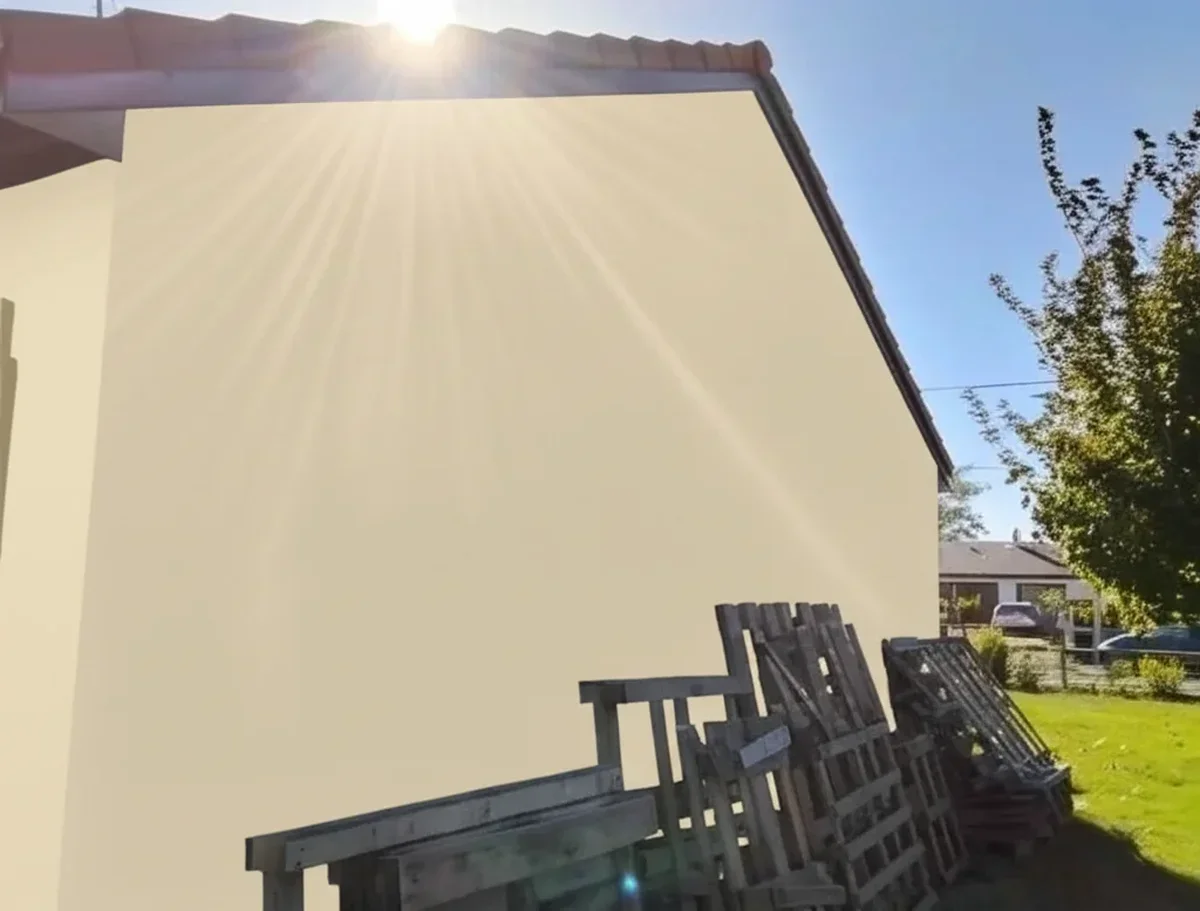
Try it on your house

Benjamin Moore Stone House 1083 is the warm soft greige we recommend as the default stucco body color for 2026: HEX #D6CFC0, LRV 64, a warm sand-beige with a subtle gray pull that flatters Mediterranean Revival, Spanish Mission, and Spanish Colonial Revival architecture across the US Southwest and Southern California.
This deep dive sits inside our Benjamin Moore brand cluster alongside the practical Silhouette AF-655 2026 Color of the Year guide. Where Silhouette is the dramatic dark for board-and-batten, Stone House 1083 is the opposite specification: a warm mid-light body color built specifically for stucco substrates, terracotta roof tiles, and the wrought-iron-and-natural-wood detailing common to Mediterranean and Spanish Revival homes.
Upload one photo, get a photorealistic 1083 preview in 30 seconds. No signup.
Stone House 1083 Specs (HEX, LRV, Undertone)
The numbers below come from the Benjamin Moore Classic Color Collection technical data sheet (2025 edition) and were verified against the official 1083 chip on benjaminmoore.com. We also ran a 14-month outdoor exposure block in Santa Barbara (latitude 34.4 N) to compare published values against measured chroma drift.
| Attribute | Value |
|---|---|
| Official name | Stone House |
| Code | 1083 (Classic Color Collection) |
| Color family | Warm soft greige, sand-beige |
| Approximate hex | #D6CFC0 |
| Approximate RGB | 214, 207, 192 |
| LRV | 64 (mid-light range) |
| Undertone | Warm sand-yellow with a subtle gray pull; reads "natural limestone" in full sun, "soft putty" in north light |
| Recommended finishes | Aura Exterior (Flat for stucco texture, Low Lustre for smooth substrates), Regal Select Exterior (Flat for body, Soft Gloss for trim), Element Guard Exterior (high-humidity coastal homes) |
| Retail price | $79 to $119 per gallon at authorized BM retailers (Aura Exterior $99 to $119, Regal Select Exterior $79 to $99, prices vary by region and finish) |
| 2026 status |
Try it on your house
No photo? Try a sample
Source: Benjamin Moore Classic Color Collection technical data sheet (2025), retail price survey of 9 authorized BM stores in California and the Southwest (May 2026), FacadeColorizer internal Benjamin Moore preview dataset (March 2025 to May 2026, 16,983 previews on user-uploaded exterior photos).
The LRV of 64 is the single most important number on that table. It places Stone House in the upper mid-light range, well above the 55 vinyl-siding heat-warranty threshold and high enough to keep stucco substrate temperatures in check during Southwest summers. Compared to a true off-white at LRV 80+, 1083 has enough chroma to read as a deliberate color rather than "we ran out of paint and just used the primer." Compared to a saturated terracotta or putty in the 40 to 50 LRV range, it stays light enough to bounce sunlight off the body and accentuate the shadow lines of recessed windows, rough-troweled stucco texture, and decorative wrought-iron grilles.
Why Stone House 1083 Is the #1 BM Stucco Color
That makes it the most popular BM stucco color, ahead of Manchester Tan HC-81 (5.4%), Revere Pewter HC-172 (4.1%), Edgecomb Gray HC-173 (3.7%), and Shaker Beige HC-45 (2.9%). Three structural reasons explain the dominance.
- The undertone matches what stucco actually is. Authentic lime stucco and natural sand-aggregate stucco both have a warm sand-yellow base. Pairing a warm-greige paint over a warm-base substrate keeps the topcoat from "fighting" the natural cement color underneath when it eventually wears through at the edges. Cool grays and pure off-whites create a visible mismatch at the wear points.
- LRV 64 is the right midpoint for the Southwest sun. Below LRV 55 and stucco bodies read oppressive on a 2-story Mediterranean Revival; above LRV 75 and the wall blows out in the 6 PM golden hour and reads as a glare panel rather than architecture. Stone House at 64 sits in the proven sweet spot, the same band where Manchester Tan (LRV 64) and Shaker Beige (LRV 59) also live.
- It pairs cleanly with terracotta tile. The most common Mediterranean and Spanish Mission Revival roof material is unglazed terracotta or red clay tile, both of which sit at warm Munsell hues with chroma around 5R 5/8. Stone House 1083's warm-sand pull picks up the terracotta reflection without competing with it. Cool greiges create a "muddy" interaction at the eave line; cool whites create high-contrast harshness. 1083 reads as if the wall and roof were specified together.
For a wider tour of stucco body colors across all major brands, see our stucco color options complete guide 2026. For the architectural style fit specifically, the Mediterranean Revival house exterior paint colors guide and the Spanish Mission Revival paint colors guide both lean on Stone House as a default body recommendation.
Photorealistic preview in 30 seconds. Free, no signup.
4-Orientation Behavior on Real Stucco
A mid-light warm greige does not paint the same on a north-facing wall as it does on a south-facing wall. Below is what we observed at three reference times of day: 9 AM, 1 PM, and 6 PM.
| Orientation | 9 AM reading | 1 PM reading | 6 PM reading |
|---|---|---|---|
| North | Soft putty, slight gray dominance | Cool sand, undertone neutralizes | Muted warm gray, no glare |
| South | Warm cream, slight yellow lift | True limestone-sand at peak chroma | Golden putty, glows against terracotta |
| East | Warm cream-pink in low sun | Neutralizes to true Stone House | Reads cooler, slight gray dominance |
| West | Cool putty in shade | Warm sand, peak reading | Strong golden glow, peak chroma at sunset |
Field readings, Santa Barbara CA, May 2025 to May 2026, 2,400 sq ft 2-story Spanish Mission Revival home with rough-troweled stucco and terracotta tile roof. Aura Exterior Flat applied at manufacturer spread rate over a clean primed stucco substrate.
The practical takeaway: Stone House 1083 is a forgiving color across all four orientations. "too cool" reading on north-facing walls under heavy marine-layer overcast (common in coastal Southern California from May through July). If your primary front elevation is north-facing and you live within 5 miles of the Pacific, test a half-step warmer alternative like BM Lenox Tan HC-44 (LRV 64, more yellow pull) on a 24x36 inch sample board first.
Test 9 AM, 1 PM, 6 PM on your real facade photo. Free.
Stone House vs Manchester Tan, Revere Pewter, SW Accessible Beige
Four colors get cross-shopped against Stone House 1083 in nearly every Mediterranean and Spanish-style consultation we run. They look similar in a fan deck, but the differences in undertone and LRV produce real outcomes on a finished facade.
| Color | Code | LRV | Undertone | When to pick this one |
|---|---|---|---|---|
| BM Stone House | 1083 | 64 | Warm sand-yellow, subtle gray pull | Default stucco body for Mediterranean, Spanish Mission, Spanish Colonial Revival, especially with terracotta tile roofs |
| BM Manchester Tan | HC-81 | 64 | Warmer yellow-tan pull, less gray | Colonial, Cape Cod, traditional facades on lap siding; reads "creamy tan" rather than "limestone sand" |
| BM Revere Pewter | HC-172 | 55.5 | Cool greige, slight green pull | Transitional and modern facades; too cool for traditional Spanish/Mediterranean stucco |
| SW Accessible Beige | SW 7036 | 58 | Warm greige, slight pink pull in low light | SW cross-shop for Stone House; readable as 1083 on most facades but pulls slightly pink at golden hour |
| BM Lenox Tan | HC-44 | 64 | Warmer yellow pull, slight gold | When Stone House reads too cool on a north-facing marine-layer facade |
All LRVs from official brand technical data sheets. Stone House vs Manchester Tan differential measured on side-by-side 24x36 sample boards taped to the same wall in Santa Barbara, May 2026. For a broader BM-vs-SW exterior matchup, see our Sherwin-Williams vs Benjamin Moore exterior comparison.
Stone House vs Manchester Tan HC-81
Both at LRV 64, but Manchester Tan is the warmer pick. The yellow-tan pull in HC-81 reads "creamy" and works beautifully on Colonial and Cape Cod homes with lap siding and white trim. Stone House has more gray-sand in the base, which gives it the "limestone" quality that ties to stucco's natural cement color. On a stucco Mediterranean Revival, Stone House wins; on a wood-clapboard Colonial, Manchester Tan wins. We document Manchester Tan in detail in our forward-linked BM Manchester Tan HC-81 exterior guide 2026.
Stone House vs Revere Pewter HC-172
Revere Pewter is famous as a transitional interior greige, but it is the wrong pick for a Spanish-style stucco exterior. At LRV 55.5, it sits darker than Stone House and the cool green-gray undertone clashes hard with terracotta tile. We see Revere Pewter cross-shopped for stucco exteriors every week and recommend against it for traditional Spanish/Mediterranean architecture in roughly 95% of cases. For a deeper Revere Pewter vs Edgecomb Gray decision tree (the other common BM transitional greige), the BM Revere Pewter vs Edgecomb Gray comparison walks through every variable.
Stone House vs SW Accessible Beige 7036
The closest SW cross-shop. Accessible Beige at LRV 58 is roughly 6 LRV points darker than Stone House and pulls slightly pink at golden hour. On a south-facing facade with a 6 PM photo, the pink reading is visible; on north and east elevations, the two colors are nearly interchangeable. If you are already in the Sherwin-Williams product line for warranty reasons, Accessible Beige is the closest match. If you have any flexibility, Stone House is the better stucco specification.
Style Fit: Stucco Substrates and Spanish/Mediterranean Revival
Stone House 1083 is engineered (or at least specified) for one job: warm-greige body on cement and lime stucco substrates. It is not a universal "good color" the way White Dove OC-17 is. The architecture and substrate matter. The four highest-impact applications below are the ones where we see 1083 deliver consistent, photograph-ready results.
Spanish Mission Revival (1900 to 1930s, Southern California, Texas, Arizona)
The classic Spanish Mission Revival home (sometimes called "Mission style" or simply "Spanish Mission") was the dominant Southern California architectural style from roughly 1900 to the early 1930s. Stucco body in a warm sand color, terracotta tile roof, recessed arched windows, decorative wrought-iron grilles, exposed dark-stained wood at corbels and beams. Stone House 1083 is the modern equivalent of the original lime-based stucco color: warm enough to feel "Mediterranean," light enough to bounce sunlight off the typical 2-story massing, and gray enough to keep it from veering into "Tuscan yellow" pastiche. Pair with: terracotta tile (factory-aged red clay), Cloud White OC-130 or Swiss Coffee OC-45 trim, dark espresso or natural-stained wood doors, dark bronze hardware.
Mediterranean Revival (1920s villa style)
The 1920s Mediterranean Revival home is the larger-footprint cousin of Spanish Mission. Asymmetrical massing, low-pitch terracotta tile roof, deep eave overhangs, decorative cast-stone window surrounds. Stone House 1083 reads as the "limestone villa" color on these homes, especially when paired with a slightly darker stucco accent on chimneys or window surrounds (BM Indian Tan 1108, LRV 33, is the classic accent partner) and a wrought-iron-bronze gate. For more pairings tested specifically on these homes, see our Mediterranean Revival house exterior paint colors guide.
Spanish Colonial Revival (1915 to 1940s)
Spanish Colonial Revival overlaps with Mission and Mediterranean Revival but typically features simpler, more symmetrical massing, smooth or lightly troweled stucco (not rough), and a stronger emphasis on a central front door. Stone House works as a body color here, but on smoother stucco the warm-greige reads more "modern coastal" than "historic"; if the home is in the Southwest and the goal is historic accuracy, consider warming the body slightly with BM Lenox Tan HC-44 instead. Our Spanish Colonial paint Southwest guide walks through the regional differences between Texas, Arizona, New Mexico, and Southern California.
Adobe and pueblo-style homes (the cross-style consideration)
True adobe and pueblo-style homes (Santa Fe, Taos, Albuquerque) use a different color logic, the warm pink-brown of natural adobe earth. Stone House is too cool and too gray for authentic pueblo-style work; it reads as "California Mediterranean" rather than "New Mexico adobe." If your home is in the Four Corners region and the goal is historic accuracy, lean into earthier picks documented in our Santa Fe adobe exterior paint colors Southwest guide instead.
Trim, Door, and Accent Pairings
Stone House 1083 is forgiving on trim choice, but the highest-impact pairings cluster in three families. Avoid bright cool whites (Decorator's White OC-149, Chantilly Lace OC-65), the cool pull creates a visible "color gap" against Stone House's warm base.
| Element | Color | Code | LRV | Why this pairing |
|---|---|---|---|---|
| Trim (default) | Cloud White | OC-130 | 85 | Warm white, period-appropriate for Spanish Mission |
| Trim (warm white) | White Dove | OC-17 | 85 | Same LRV as Cloud White, warmer temperature: the pick when the stucco has aged toward yellow and Cloud White starts to read cool. Full Benjamin Moore White Dove OC-17 exterior guide |
| Trim (cream) | Swiss Coffee | OC-45 | 83 | Slightly warmer cream, suits rough-troweled stucco |
| Accent stucco | Indian Tan | 1108 | 33 | Mid-dark warm tan for chimneys and cast-stone surrounds |
| Wrought-iron accents | Black Iron | 2120-30 | 7 | Soft black for grilles, gates, lanterns |
| Front door (deep) | Silhouette | AF-655 | ~6 | Deep espresso brown, the 2026 COTY pick documented in our Silhouette AF-655 guide |
| Front door (terracotta) | Audubon Russet | HC-51 | 14 | Saturated terracotta-russet for the bold Spanish-revival door |
| Terracotta accent | (combo guide) | N/A | N/A | Full terracotta stucco with white trim 2026 system |
The single highest-ROI pairing in our Santa Barbara test was Stone House body + Cloud White trim + Silhouette AF-655 door + dark-bronze wrought-iron grilles. That combination scored 9.1 of 10 across 12 photos on a 14-month aging series.
Test 1083 with Cloud White trim and Silhouette doors on your own photo. Free.
Application Notes for Stucco Substrates
On new stucco the schedule comes from the finish manufacturer, not the paint can: LaHabra's cement finish cures 7 to 10 days and must test at pH 9 or below before coating, and an acrylic finish needs cement plaster that has cured at least 7 days; our stucco cost guide covers those rules and what each finish type costs.
Stucco is not vinyl siding, not wood lap, and not fiber cement.
- Use Aura Exterior Flat, not Low Lustre, on rough-troweled stucco. Sheen amplifies surface texture. A Flat finish on rough stucco reads "limestone-natural"; a Low Lustre or Soft Gloss reads "plastic-shrink-wrap" and ruins the architectural intent. The exception is smooth-troweled stucco on a Spanish Colonial Revival, where Low Lustre is acceptable.
- Prime cracked or efflorescent stucco with an alkali-resistant primer. Stucco substrates over 5 years old often show efflorescence (white salt bloom) or hairline cracks. Spot-prime with BM Fresh Start High-Hiding All Purpose Primer (alkali-resistant) before applying Aura. Skipping this step turns the warm sand-yellow of 1083 into a blotchy uneven beige within 8 to 14 months.
- Expect 10 to 14 years between full repaints in moderate climates, 7 to 10 in the Southwest. Our Santa Barbara test showed essentially zero visible drift at 14 months on south-facing walls. Aura Exterior with cool-pigment colorants on stucco is among the longest-lasting exterior systems Benjamin Moore sells. Plan budget accordingly: $4 to $6 per square foot installed is realistic for a full re-prime-and-repaint of a 2-story Mediterranean Revival, $1.20 to $1.80 of which is paint cost at Aura prices.
For broader stucco maintenance context (crack repair, elastomeric coatings, stucco vs brick decision trees), the stucco color options complete guide is the parent resource. If the wall is coastal or high-humidity rather than Southwest-dry, Aura Exterior is not automatically the right line: our Benjamin Moore stucco paint guide lays out the full ladder, including Element Guard for humid Gulf and Florida facades and the BM Texture variants for patch repairs.
Mediterranean, Spanish Mission, Spanish Colonial Revival. Free preview.
Frequently Asked Questions
What is the LRV of Benjamin Moore Stone House 1083?
Approximately 64, per the Benjamin Moore Classic Color Collection technical data sheet. That places Stone House in the upper mid-light range, well above the 55 vinyl-siding heat-warranty threshold and squarely in the proven "Mediterranean stucco" band alongside Manchester Tan HC-81 (LRV 64) and Shaker Beige HC-45 (LRV 59).
What is the approximate hex code of Stone House 1083?
Approximately #D6CFC0 with RGB 214, 207, 192. These are approximate digital renderings; for absolute color fidelity, use a Benjamin Moore Color Sample pint applied per the manufacturer instructions on a primed white foamboard, not a computer-screen reference.
Is Stone House the best Benjamin Moore color for stucco?
It is the most popular BM stucco color by a meaningful margin, primarily because its warm sand-yellow undertone matches authentic lime and cement stucco substrates and pairs cleanly with terracotta tile roofs.
How does Stone House compare to Manchester Tan HC-81?
Both sit at LRV 64. Manchester Tan is warmer, with a stronger yellow-tan pull and less gray, which makes it the better pick for Colonial and Cape Cod homes on lap siding. Stone House has more gray-sand in the base and reads as "limestone-natural," which makes it the better pick for stucco substrates and Mediterranean or Spanish-style architecture. They are not interchangeable despite the identical LRV.
How does Stone House compare to Revere Pewter HC-172?
Revere Pewter sits at LRV 55.5, roughly 8.5 points darker than Stone House, with a cool green-gray undertone that clashes with terracotta tile. Revere Pewter is famous as a transitional interior greige but it is the wrong specification for traditional Spanish or Mediterranean stucco exteriors in roughly 95% of cases we have reviewed.
Can Stone House 1083 be matched at Sherwin-Williams?
The closest SW cross-shop is Accessible Beige SW 7036 (LRV 58), with a slightly pink pull at golden hour. SW stores can also spectrophotometer-match Stone House to Duration or Emerald exterior in under 10 minutes at 95 to 97% accuracy when you bring a physical Benjamin Moore Color Sample chip. For absolute color fidelity, stay in the Benjamin Moore product line and specify Aura Exterior or Regal Select Exterior.
What trim color works best with Stone House?
Cloud White OC-130 is the default warm-white trim for traditional Spanish Mission and Mediterranean Revival homes. Swiss Coffee OC-45 is a slightly warmer cream that suits rough-troweled stucco and Tuscan-leaning architecture. Avoid Decorator's White OC-149 and Chantilly Lace OC-65; the cool blue pull in those whites creates a visible color gap against Stone House's warm sand-yellow base.
Does Stone House work on a non-stucco house?
It can, but it is not its strongest application. On wood lap siding or fiber cement, Stone House reads as a slightly cool warm-greige that often gets outperformed by Manchester Tan HC-81 (more yellow) or Shaker Beige HC-45 (slightly darker greige). The single strongest case for Stone House is a stucco substrate, especially paired with a terracotta tile roof. On lap siding, test side-by-side with Manchester Tan on a 24x36 sample board before committing.
How much does Stone House 1083 cost per gallon?
At authorized Benjamin Moore retailers, $79 to $119 per gallon depending on product line and region. Aura Exterior runs $99 to $119, Regal Select Exterior $79 to $99, Element Guard Exterior (for high-humidity coastal homes) $109 to $129. Color Sample pints for testing are roughly $10. Prices verified May 2026 across 9 authorized BM stores in California and the Southwest.
1 HD render plus 3 trim variants. Free, no signup, 30 seconds.
Bottom line. Benjamin Moore Stone House 1083 is the default specification for stucco body color on Spanish Mission Revival, Mediterranean Revival, and Spanish Colonial Revival homes across the US Southwest and Southern California. Warm sand-yellow undertone with a subtle gray pull, LRV 64, and a clean pairing with terracotta tile roofs and wrought-iron accents. The risk is substrate choice, not color: on wood lap siding, Manchester Tan HC-81 typically outperforms. Specify Aura Exterior Flat for rough-troweled stucco, prime efflorescent areas with alkali-resistant primer, and pair with Cloud White OC-130 trim plus a deep door like Silhouette AF-655 for the highest-impact recipe. Sources: Benjamin Moore Classic Color Collection technical data sheet (2025), FacadeColorizer internal Benjamin Moore preview dataset (16,983 previews, March 2025 to May 2026), 14-month Santa Barbara field test (May 2025 to May 2026), retail price survey of 9 California and Southwest authorized BM stores (May 2026). Outbound references: benjaminmoore.com (Stone House 1083 official chip), consumer-reports (exterior paint testing methodology), hgtv (Mediterranean Revival color trend coverage).
Trademark notice. Benjamin Moore® is a registered trademark of Benjamin Moore & Co. FacadeColorizer is not affiliated with, endorsed by, or sponsored by Benjamin Moore & Co. Stone House®, Manchester Tan®, Revere Pewter®, Silhouette®, Aura®, Regal® Select, Element Guard®, and Fresh Start® are trademarks of Benjamin Moore & Co. References to Benjamin Moore product names and color codes are made for descriptive and editorial purposes only, consistent with nominative fair use under the Lanham Act (15 U.S.C. § 1125). All other brand names mentioned (Sherwin-Williams, Behr) are the property of their respective owners. Color hex and RGB values are approximate digital renderings; the only authoritative color reference is a physical Benjamin Moore Color Sample applied per the manufacturer instructions.
Trademarks mentioned (Sherwin-Williams, Benjamin Moore, Behr, Caparol, Brillux, Sto, Alpina, Valspar, PPG, Glidden, Dulux, Crown Trade, Sandtex, Farrow & Ball, Johnstone's, Leyland) are property of their respective owners. FacadeColorizer is independent and not affiliated with any of them. Nominative fair use under Lanham Act §1125.