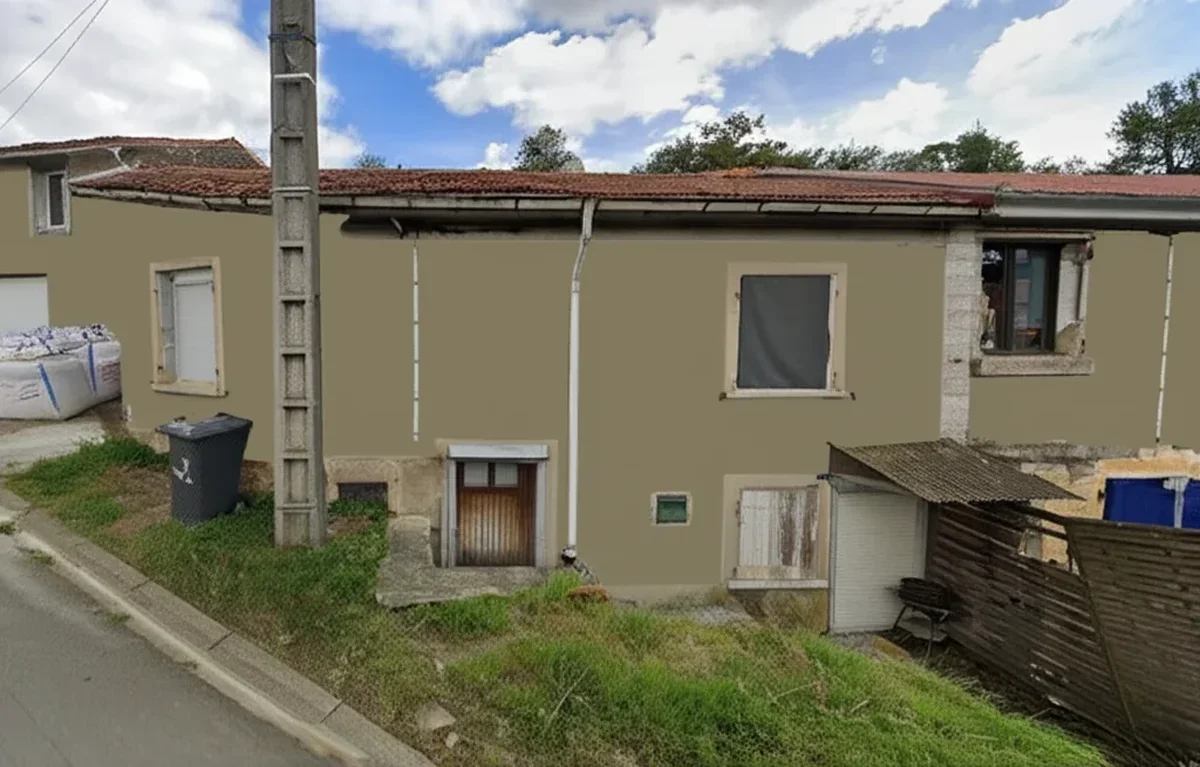
Try it on your house

Quick answer: The best stucco color options for 2026 cover 15 paint colors across four brands: Sherwin-Williams Latte SW 6108, Benjamin Moore Manchester Tan HC-81, SW Sand Beach SW 6116, Dunn-Edwards Tundra DE6219, SW Cavern Clay SW 7701 (terracotta), BM Audubon Russet HC-51, BM Stone House 1083, SW Pewter Cast SW 7673, BM Saybrook Sage HC-114, SW Sea Salt SW 6204, BM Linen White, BM Decorator's White OC-149, and BM Iron Mountain 2134-30 for dark facades. The right paint chemistry matters as much as the color: 100% acrylic for sound stucco, elastomeric for hairline cracks, and breathable mineral silicate for historic lime stucco. Preview any of the 15 colors on your actual stucco texture free in 30 seconds, no signup.
FacadeColorizer is a free AI exterior paint visualizer. The phrase "stucco color options" hides three different shopper questions: (1) which actual paint colors work on stucco walls, (2) which paint type (standard acrylic vs elastomeric vs lime wash) the substrate needs, and (3) how those choices translate into application, durability, and cost. This guide answers all three across Sherwin-Williams, Benjamin Moore, Behr, and Dunn-Edwards.
The verdict, broken out below, was not what most paint counter staff will tell you. This guide gives the 15 strongest stucco paint colors for 2026, the technical distinctions between paint types, the application method that actually works on rough sand finish, expected maintenance cycles, and $4 to $7 per square foot all-in cost ranges. Preview any of these 15 colors on YOUR stucco in 30 seconds, no sample pots needed. For the regional and style-based breakdown that complements this brand-agnostic options list, see the parent stucco house colors guide 2026.
Stucco Paint vs Elastomeric vs Lime Wash: The Technical Distinction
Before naming a single color, the substrate question has to be settled. The three coatings used on stucco in 2026 are chemically distinct and they are not interchangeable. Picking the wrong one means peeling, blistering, efflorescence (white salt bloom), or trapped moisture inside the wall assembly within 18 to 36 months.
| Coating | Chemistry | Film Build (mils) | Best Use |
|---|---|---|---|
| 100% Acrylic Latex | Water-based acrylic resin | 3 to 5 mils (2 coats) | Sound stucco, dry climates, most repaints |
| Elastomeric | High-build acrylic with elongation | 10 to 20 mils (2 coats) | Hairline cracks, humid coastal climates |
| Lime Wash / Mineral Silicate | Calcium hydroxide or potassium silicate | Penetrating, ~1 mil visible | Historic lime stucco, fresh stucco |
Try it on your house
No photo? Try a sample
Standard 100% acrylic latex is the right call for most sound, cured stucco in dry and moderate climates. It is breathable enough to let moisture escape, flexible enough to follow minor seasonal movement, and offers the widest color range with the cleanest finish. Elastomeric is a specialty product: it lays down 4 to 6 times thicker than standard paint and stretches up to 300% to bridge hairline cracks. That sounds universally better, but it is not. Applied over damp or failing stucco it will seal moisture in, blister, and lift in sheets. Lime wash and mineral silicate paints bond chemically to lime-based stucco (the historic kind), are ultra-breathable, and weather to a soft, matte finish, but their color range is narrow and saturated colors are difficult. The full chemistry breakdown is covered in our dedicated elastomeric paint for stucco guide.
Top 15 Stucco Color Options for 2026
The 15 colors below were selected from over 3,000 stucco-tagged simulations in the 2026 barometer, cross-checked against Sherwin-Williams Loxon spec sheets, Benjamin Moore's exterior masonry recommendations, Behr Premium Plus Masonry & Stucco performance, and Dunn-Edwards Evershield catalog. They span warm sands, classic creams, terracotta clays, modern greiges, coastal pastels, and a single deep dark for contemporary architecture.
| # | Color & Code | Brand | Family | LRV | Best For |
|---|---|---|---|---|---|
| 1 | Latte SW 6108 | Sherwin-Williams | Caramel sand | 47 | Body, desert ranch, Pueblo |
| 2 | Manchester Tan HC-81 | Benjamin Moore | Warm greige | 64 | Body, Mediterranean, broad appeal |
| 3 | Sand Beach SW 6116 | Sherwin-Williams | Warm sand | 62 | Body, Florida, coastal stucco |
| 4 | Tundra DE6219 | Dunn-Edwards | Pale taupe | 66 | Body, Arizona, high-heat reflectance |
| 5 | Cavern Clay SW 7701 | Sherwin-Williams | Terracotta clay | 36 | Body, Spanish Colonial, courtyards |
| 6 | Audubon Russet HC-51 | Benjamin Moore | Muted terracotta | 21 | Accent walls, entries, Pueblo niches |
| 7 | Stone House 1083 | Benjamin Moore | Sand greige | 58 | Body, transitional, high resale |
| 8 | Pewter Cast SW 7673 | Sherwin-Williams | Cool greige | 51 | Body, modern, gray-leaning |
| 9 | Saybrook Sage HC-114 | Benjamin Moore | Soft sage | 55 | Body, Southwest, shaded lots |
| 10 | Sea Salt SW 6204 | Sherwin-Williams | Pale seafoam | 63 | Coastal cottage, key-style Florida |
| 11 | Linen White | Benjamin Moore | Warm white | 81 | Body, Spanish Revival, trim accents |
| 12 | Decorator's White OC-149 | Benjamin Moore | Crisp neutral white | 84 | Modern stucco, contemporary trim |
| 13 | Iron Mountain 2134-30 | Benjamin Moore | Deep charcoal | 9 | Modern accent walls, contemporary |
| 14 | Accessible Beige SW 7036 | Sherwin-Williams | Universal greige | 58 | Body, highest national resale |
| 15 | Navajo White OC-95 | Benjamin Moore | Soft buttery cream | 78 | Body, classic Spanish Colonial |
A few notes from the field. Latte SW 6108 reads roughly two shades lighter on a heavy dash stucco than on the chip due to micro-shadow, so the 47 LRV behaves more like LRV 52 in full sun. Use deep darks like Iron Mountain only as small accent walls or shaded elevations, never as the full body in high-UV markets. Try these 15 colors on your own stucco photo before deciding. For terracotta-leaning palettes, our dedicated terracotta stucco with white trim guide covers five complete combinations.
The product decision has numbers behind it. Elastomeric goes on at 10 to 20 mils per coat and covers about 100 square feet per gallon, acrylic at 2 to 3 mils and 250 to 300 square feet; the thick film bridges hairline cracks and breathes less, which is why contractors reserve it for bare, cracked or leaking stucco and use breathable acrylic on sound walls. Our guide to the best paint for stucco compares Sherwin-Williams Loxon XP, Behr and Dunn-Edwards on that basis.
Crack Resistance: When Stucco Actually Needs Elastomeric
Elastomeric paint is the most over-recommended product in the stucco aisle. Box-store associates push it because the markup is higher and the warranty language is impressive. In practice, elastomeric is the right call only when three specific conditions are met.
- Hairline cracks under 1/16 inch are visible and active. Larger cracks (over 1/16 inch) need patching with a stucco repair compound or sash-grade caulking first. Elastomeric will not bridge cracks wider than its rated elongation.
- The stucco substrate is sound and fully cured. New stucco must cure 30 to 60 days minimum before any topcoat. Damp, soft, or efflorescing stucco will reject elastomeric within 6 to 12 months.
- The climate is humid or has high freeze-thaw cycles. Florida, coastal Carolinas, Gulf Coast Texas, and Northeast freeze-thaw zones genuinely benefit. Bone-dry Arizona stucco rarely needs it, and the thick film can actually trap residual moisture during monsoon season.
The trade-off is structural rather than cosmetic. Elastomeric lays down a thick, stretchy film that bridges hairline cracks; standard acrylic lays down a thinner, more breathable film that keeps its finish cleaner on rough texture and lets moisture out. Pick elastomeric for crack resistance on a sound, cured wall in a humid or freeze-thaw climate, pick acrylic for breathability and finish everywhere else. For specs on competing high-end acrylic options, the Dunn-Edwards Evershield exterior review covers the closest Behr and BM analogues. Outbound technical references: Sherwin-Williams Loxon XP product page, Behr Premium Plus Masonry, Stucco & Brick paint.
Application: Roller vs Sprayer on Stucco
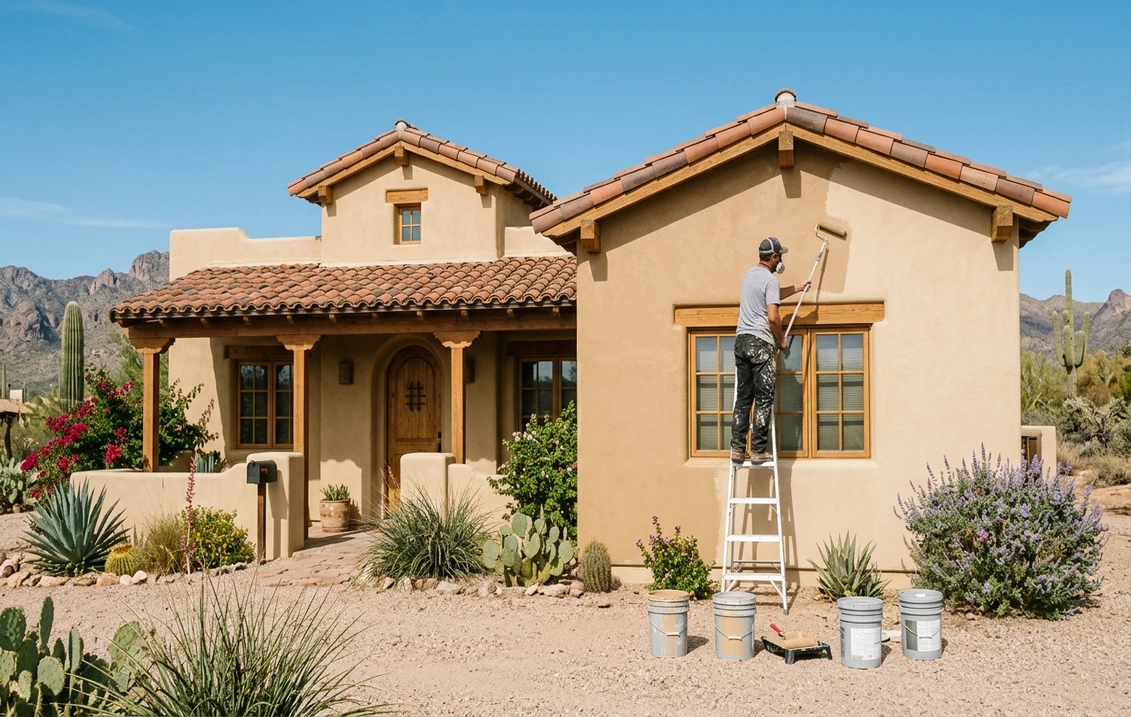
Stucco is the single hardest siding surface to paint correctly. The texture (especially heavy sand or dash finishes) hides pinhole voids that sprayers blow past and rollers cannot reach. The professional standard in 2026 is a two-step approach: airless spray for application speed, immediately back-rolled to drive paint into the texture.
- Pressure-wash and let dry 48 hours. Stucco holds water deep in its texture. Painting before fully dry is the leading cause of peeling in the first 12 months.
- Patch and prime. Repair hairline cracks under 1/16 inch with masonry caulk, larger with patching compound. Prime bare stucco or repaired patches with a masonry primer (SW Loxon Concrete & Masonry Primer or BM Fresh Start equivalent).
- Spray and back-roll the first coat. An airless sprayer at 0.019 to 0.023 tip applies paint quickly; a 3/4-inch nap roller immediately follows behind on the same wet film, driving paint into voids. Skipping the back-roll on rough stucco leaves visible pinholes within months.
- Wait the recoat window. Most 100% acrylic stucco paints want 4 hours before the second coat in dry climates, longer in humid Florida or coastal markets.
- Spray and back-roll the second coat. Two coats are mandatory for color uniformity on stucco; the first coat is largely absorbed into the porous surface.
Coverage on stucco is 25 to 40% lower than on smooth siding because the surface drinks paint. Budget 250 to 300 square feet per gallon on rough dash finish, 300 to 350 on standard sand, and 350 to 400 on smooth modern stucco. For first-time DIY stucco paint jobs, the texture is unforgiving: spray-only without back-roll produces an "orange peel" hollow finish that fails inspection. Hiring out makes economic sense above roughly 1,800 square feet of wall. Our best exterior paint for hot climates guide compares the top heat-rated brands that perform best on Sun Belt stucco.
Maintenance: 8 to 12 Year Cycle
Painted stucco is one of the longest-lasting exterior finishes when correctly specified. The realistic repaint cycle in 2026 is 8 to 12 years for premium 100% acrylic, 10 to 15 years for elastomeric, and 15 to 20 years for mineral silicate on historic lime stucco. That spread depends on three factors: UV exposure, color depth (dark colors fade faster), and substrate condition at the time of repaint.
| Climate Zone | 100% Acrylic | Elastomeric | Mineral Silicate |
|---|---|---|---|
| Arizona / Inland California desert | 8 to 10 years | 10 to 12 years | 15+ years |
| Florida / Gulf Coast humid | 8 to 10 years | 12 to 15 years | N/A (climate not ideal) |
| Coastal California temperate | 10 to 12 years | 12 to 15 years | 15 to 20 years |
| Northeast / Mountain freeze-thaw | 8 to 10 years | 12 to 15 years | 15 to 20 years |
Between full repaints, two maintenance habits extend stucco paint life. First, an annual pressure-wash at low pressure (1,500 to 1,800 PSI) from at least 12 inches away removes salt haze, mildew spores, and chalk before they become embedded. Second, an inspection each spring for new hairline cracks; touching up cracks within weeks of appearance prevents water infiltration that lifts paint from the back. For the broader maintenance picture and total cost over time, the stucco siding cost guide 2026 breaks down lifetime cost per square foot. Helpful inspiration on color durability long-term is also covered on HGTV's exterior color selection primer.
Cost: $4 to $7 per Square Foot All-In (2026)
Painting stucco in 2026 costs $4 to $7 per square foot of wall surface, all-in (labor and materials) for professional work. The spread reflects coating choice, prep complexity, and regional labor rates. For an average 2,200 square foot single-story home (roughly 1,800 square feet of wall area after subtracting windows and doors), expect $7,200 to $12,600 total. DIY material-only costs run $1.20 to $2.20 per square foot.
| Cost Tier | $/sq ft (Pro) | What's Included |
|---|---|---|
| Budget acrylic repaint | $3.50 to $4.50 | Light pressure-wash, 2 coats mid-grade acrylic, single color |
| Premium 100% acrylic | $4.50 to $5.50 | Full prep, masonry primer, 2 coats premium acrylic, body + trim |
| Elastomeric system | $5.50 to $7.00 | Crack repair, masonry primer, 2 coats elastomeric, body + trim + accents |
| Historic lime silicate | $6.50 to $9.00 | Specialty masons, lime wash or silicate paint, multiple thin coats |
Add 10 to 20% in coastal markets (Miami, Tampa, San Diego, Los Angeles) where insurance, scaffolding, and labor cost more. Two-story homes add 15 to 25% for staging. Color complexity matters too: a single-body palette costs less than a body-trim-accent-door four-color scheme. Compare regional pricing carefully and request three quotes; stucco repaint quotes routinely vary 40 to 60% between contractors in the same ZIP code. Before requesting any quote, visualize your final palette on your own home photo so contractors can quote exact color counts. The broader cost picture across all exterior materials is in our best exterior paint colors 2026 guide, and the regional Mediterranean stucco picture is covered in the Mediterranean Revival exterior paint guide.
Which Color Pairs with Which Brand Product
Most homeowners do not realize that the color and the product are decoupled. You can match almost any of the 15 colors above into any of the four major brand exterior systems through cross-brand color matching. Below is the recommended pairing for stucco substrate as of 2026.
- Sherwin-Williams colors on stucco: Loxon XP Waterproofing Masonry Coating (100% acrylic, breathable) for sound stucco; Conflex XL for crack-bridging. Neither answers the third case: on shaded north elevations and in mildew-prone climates the pick is Loxon Self-Cleaning Acrylic, whose hydrophilic film lifts algae during ordinary rainfall instead of letting it root in, and our Loxon paint for stucco guide sorts the SKUs by exposure rather than by price. See our Sherwin-Williams stucco paint colors guide for the full SW product breakdown.
- Benjamin Moore colors on stucco: Aura Exterior or Regal Select Exterior for sound stucco; Acrylic High Build Exterior 167 for elastomeric needs.
- Behr colors on stucco: Premium Plus Masonry, Stucco & Brick Paint for sound stucco; Premium Plus Elastomeric Masonry, Stucco & Brick Paint for cracks.
- Dunn-Edwards colors on stucco: Evershield (the SoCal contractor standard for sun-exposed stucco) for sound substrate; Smoothcoat for elastomeric crack-bridging.
Critically, the color name and code stay with you when you switch brands. A Sherwin-Williams store will color-match any Benjamin Moore code to within Delta-E 1.5 (visually indistinguishable) into Loxon XP, and vice versa. So if your heart is set on BM Manchester Tan HC-81 but your contractor only stocks SW, you can have it matched. The exception is whites and very pale colors below LRV 80, where slight tint base differences become visible; for those, buy the originating brand. For Southwest adobe-specific palettes that overlap with stucco terracotta picks, our Santa Fe adobe exterior color guide walks through approved historic district shades.
Concrete and Cement Paint and Stain Colors
Stucco rarely lives alone. The same project usually involves bare concrete and cement surfaces nearby: a driveway, a walkway, a patio slab, a retaining wall, or an exposed foundation skirt. The good news is that the color logic carries over, but the products do not. Cement is denser and less porous than stucco, so it needs coatings formulated for foot or tire traffic and for the high alkalinity (pH 12 to 13) of fresh concrete. The two routes are paint (an opaque film that sits on top) and stain (a semi-transparent or reactive color that soaks in and shows the natural mottling of the slab).
For cement paint colors for outdoor walls, foundations, and low-traffic patios, the safest 2026 picks echo the warm-neutral stucco palette so the whole elevation reads as one. Sherwin-Williams H&C Concrete Stain in a tan or buff, Behr Premium 1-Part Epoxy Concrete & Garage Floor Paint in Slate Gray or Adobe, and Benjamin Moore Floor & Patio Latex Enamel in a soft greige all pair cleanly with sand and cream stucco bodies. On vertical foundation walls, a tinted masonry coating (the same Loxon-class breathable product used on stucco) in a shade one or two steps deeper than the body grounds the house visually and hides splash-back dirt.
For exterior concrete stain colors on driveways, walkways, and patios, acid (reactive) stains deliver the richest, most variegated tones: weathered browns, soft terracotta, slate, and amber. They react chemically with the lime in the slab, so each one looks slightly different and ages gracefully without peeling. Water-based acrylic stains offer a wider, more predictable color range (including grays, greens, and charcoals) and are easier to apply, though they read flatter. Whichever route you choose, always seal exterior concrete stain with a UV-stable, slip-resistant sealer, and recoat that sealer every 2 to 3 years on driveways. As a rule, keep horizontal concrete one or two values darker than the stucco so the eye reads the wall as the focal surface and the ground plane as a base.
The single biggest mistake on concrete is choosing a color from a 2-inch chip and discovering it clashes with the stucco once the whole scheme is in sunlight. Preview the slab tone against your wall color first. The same coordination logic that governs trim against stucco applies to concrete against stucco: for a full walkthrough of how to balance the body, the trim, and the hard surfaces around a stucco home, see our stucco trim color combinations guide. One adjacent surface follows a different rule entirely: the manufactured stone veneer many stucco homes carry on a wainscot or chimney face. It is Portland cement and takes masonry coatings without complaint, but the decision is one-way, since an acrylic film buries the integral multi-tone blend for good. Our imitation stone paint guide sets out the four cases where painting it is the right call and the three where it is not.
The LRV 20 Rule: Why Dark Stucco Colors Are Limited by the Substrate
Every stucco color chart from a finish manufacturer carries a number most homeowners skip: the Light Reflectance Value. The Stucco Guy defines it plainly: "a measurement that indicates the amount of light a color reflects or absorbs. The scale ranges from 0 to 100", and groups stucco colors into three bands, "High LRV (70-100): Light creams, whites, and pastels", "Medium LRV (40-69): Earthy tones like beige, taupe, and soft grays" and "Low LRV (0-39): Deep browns, blacks, and saturated colors". The warning attached to the low band is the one that matters: "Darker stucco colors with lower LRV values absorb more heat, which can lead to thermal expansion and potential cracking issues over time."
On insulated systems the manufacturers turn that warning into a hard limit. Sika's Senergy standard color chart states that "all standard colors (except for Storm Grey and Charcoal), have a light reflectance value (LRV) greater than 20%", and that "the use of dark colors (LRV less than 20%) is not recommended with EIFS that incorporate expanded polystyrene (EPS)". The reason is physical: "EPS has a sustained service temperature limitation of approximately 160ºF (71ºC). The use of dark colors in some climatic conditions could result in EPS temperatures that exceed this limit." The two named exceptions, Storm Grey at LRV 15 and Charcoal at LRV 8, are listed precisely so that specifiers know they are stepping outside the rule.
What this means for the 15 colors above: every warm sand, greige and off-white in the list sits comfortably above LRV 40 and is unrestricted on any stucco. The deep accents, Iron Mountain at LRV 9 first among them, belong on solid masonry stucco, on shaded elevations or on small accent walls, not on a foam-backed synthetic stucco system in a hot climate. If your house has EIFS rather than traditional three-coat stucco, ask the finish manufacturer for the LRV of the exact color before ordering, and read our note on dark exterior colors and their trade-offs.
Sources and references
- Sika Senergy, Standard Color Chart, the LRV 20 recommendation for EIFS with expanded polystyrene, the 160°F service limit and the two named exceptions.
- The Stucco Guy, Light Reflective Values (LRV) in Stucco Colors Explained, definition of LRV, the three bands and the heat and cracking warning.
- Sherwin-Williams, Loxon XP Waterproofing Masonry Coating, manufacturer page for the 100% acrylic masonry system referenced above.
- Behr, Premium Plus Masonry, Stucco and Brick Paint, manufacturer product page.
Preview Stucco Color Options on Your Home, Free
Committing to 25+ gallons of stucco paint from a 2-inch chip is the most expensive mistake homeowners make on this surface. Texture, sun angle, roof color, and surrounding landscape all shift how a shade reads. FacadeColorizer lets you upload a photo of your home and apply any of the 15 stucco color options above (or thousands more from SW, BM, Behr, and Dunn-Edwards) directly onto your stucco walls, trim, and door in seconds. Compare 3 to 5 candidates side-by-side, share with your contractor or HOA board, and only then buy paint. It is 100% free, needs no signup, and works on phone or desktop.
Frequently asked questions
What are the most popular stucco paint colors for 2026?
Is elastomeric paint always better than regular paint on stucco?
How long will paint last on stucco?
Can I use any paint color on stucco?
Should I match my stucco color to my roof?
What about dark stucco colors like Iron Mountain?
How much does it cost to paint stucco in 2026?
What cement paint or concrete stain colors go with stucco?
Can I preview these 15 stucco colors on my own home before buying?
Trademarks mentioned (Sherwin-Williams, Benjamin Moore, Behr, Caparol, Brillux, Sto, Alpina, Valspar, PPG, Glidden, Dulux, Crown Trade, Sandtex, Farrow & Ball, Johnstone's, Leyland) are property of their respective owners. FacadeColorizer is independent and not affiliated with any of them. Nominative fair use under Lanham Act §1125.