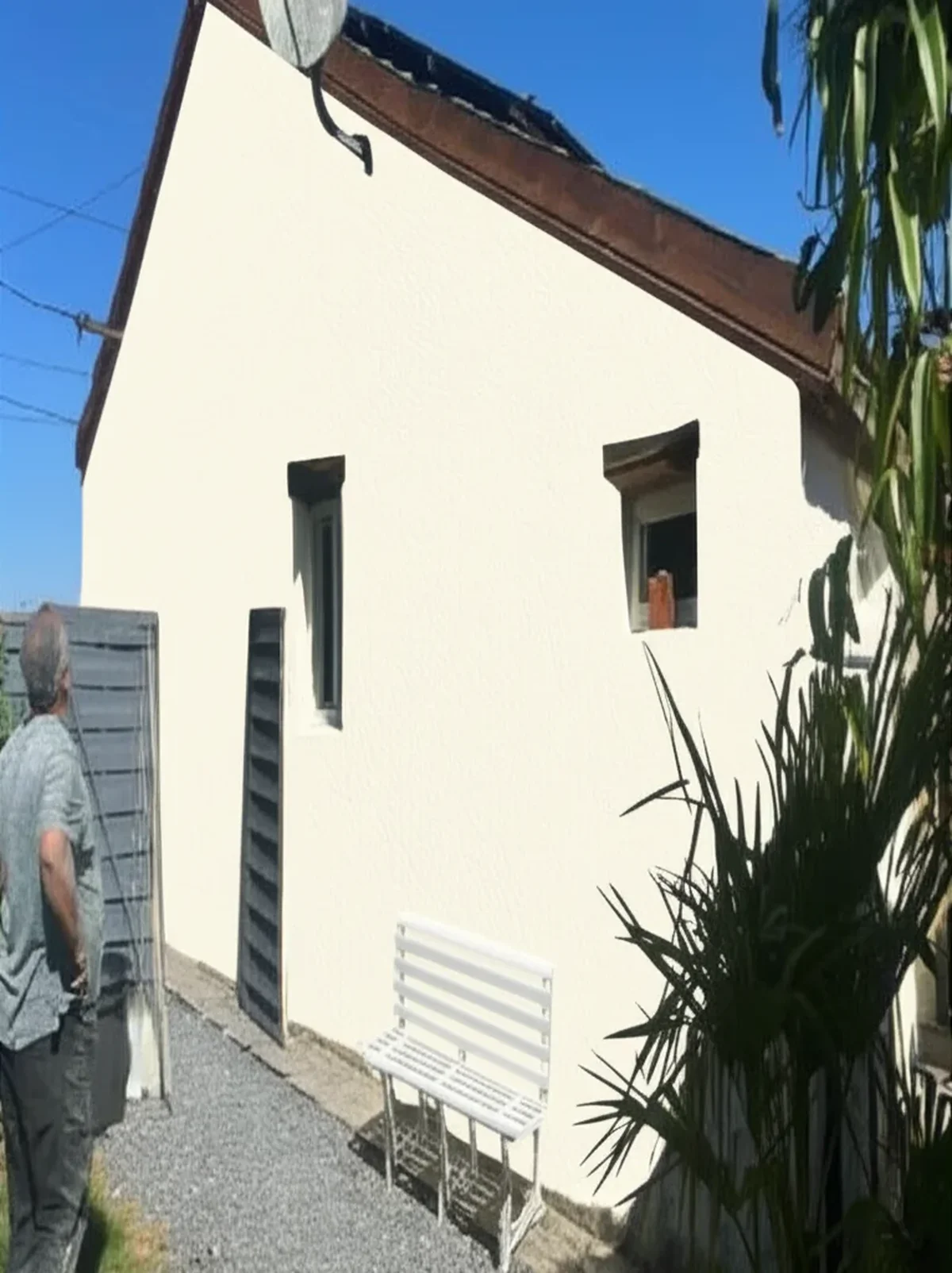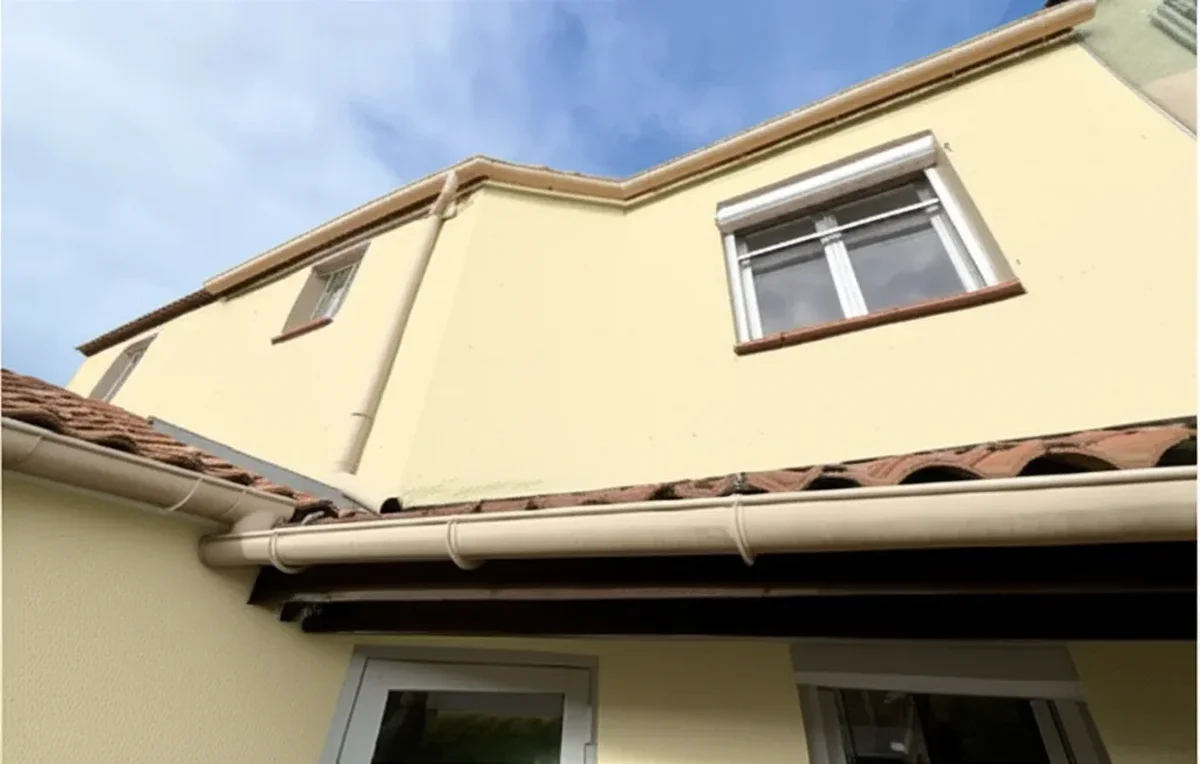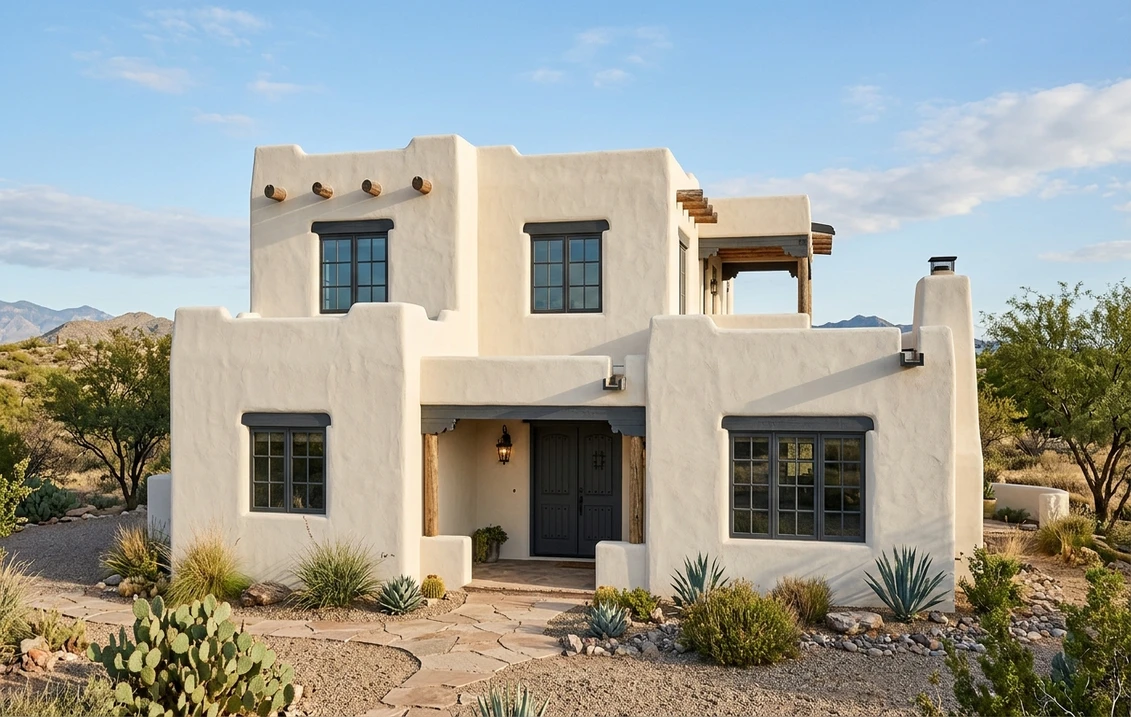
Try it on your house

Quick answer: The best stucco and trim color combinations in 2026 keep the stucco body and the trim in the same undertone temperature, then add contrast through value. Top pairings include warm white stucco with charcoal trim, greige stucco with crisp white trim, terracotta stucco with creamy white trim, and sand stucco with deep olive trim. Because stucco is textured and reflects more light than flat siding, colors read one to two shades lighter on a real wall. Preview any stucco-and-trim pairing free on your own house photo with AI in about 30 seconds, no signup.
FacadeColorizer is a free AI exterior paint visualizer. Stucco is its own surface: the rough texture scatters light, softens edges, and makes every color read brighter and slightly chalkier than the same paint on smooth lap siding. That is why a stucco and trim color combination has to be chosen as a pair, with the trim doing the heavy lifting on contrast since the stucco body tends to wash out in full sun. This roundup gives you 10 tested stucco body + trim pairings with exact Sherwin-Williams and Benjamin Moore codes, the undertone behind each, and the best use for it.
These are stucco-specific schemes, not generic siding trios. If you want broader inspiration across all surfaces, see our pillar guide to outside house color ideas for 2026, and for full body-trim-door trios across every cladding type, our exterior house color combinations roundup. To put any pairing on your actual stucco facade, jump straight to the free visualizer.
10 Stucco & Trim Color Combinations (2026)
Each row pairs a stucco body color with a trim color for window casings, fascia, soffit, and corner accents, using real SW (Sherwin-Williams) and BM (Benjamin Moore) codes. The undertone column tells you which temperature family the body leans, so you can keep the whole facade consistent. Remember that stucco lightens in sunlight, so for a true-to-sample result, choose a stucco body one half-step deeper than you think you want.
| Stucco Body | Trim | Undertone | Best Use |
|---|---|---|---|
| SW Alabaster 7008 (warm white) | SW Iron Ore 7069 (charcoal) | Warm | Modern farmhouse, high contrast |
| SW Agreeable Gray 7029 (greige) | SW Pure White 7005 | Warm-neutral | Transitional, broad resale appeal |
| SW Cavern Clay 7701 (terracotta) | SW Creamy 7012 (creamy white) | Warm | Spanish, Mediterranean, Southwest |
| SW Universal Khaki 6150 (sand) | SW Pewter Green 6208 (deep olive) | Warm earth | Tuscan, hacienda, hillside homes |
| BM Swiss Coffee OC-45 (soft white) | BM Black Beauty 2128-10 | Warm | White stucco, crisp modern lines |
| BM Revere Pewter HC-172 (greige) | BM Simply White OC-117 | Warm-neutral | Traditional, timeless curb appeal |
| SW Shoji White 7042 (warm off-white) | SW Pewter Green 6208 | Warm | Soft, organic, garden-forward |
| SW Repose Gray 7015 (cool gray) | SW Extra White 7006 | Cool-neutral | Contemporary, clean and bright |
| BM Pale Oak OC-20 (warm light greige) | BM Kendall Charcoal HC-166 | Warm | Soft body, dramatic trim contrast |
| SW Accessible Beige 7036 (warm tan) | SW Black Fox 7020 (warm black) | Warm | Tudor, ranch, warm-toned roofs |
Try it on your house
No photo? Try a sample
Codes are starting points, not guarantees. Stucco texture, sun exposure, roof color, and adjacent stone shift how each pairing reads on your specific wall. Before you buy a single gallon, preview these pairings on YOUR stucco, free.
Why Stucco Changes the Color Rules
A color sampled on a flat fan deck behaves differently on stucco for three reasons, and ignoring them is the most common reason a stucco repaint disappoints:
- Texture scatters light. The peaks and valleys of a stucco finish (smooth, sand, lace, or dash) catch the sun unevenly. The high points read lighter and the recesses read darker, so the average color looks brighter and a touch chalkier than the flat sample. Go one half-step deeper on the body to land where you intended.
- Stucco is usually the whole wall. Unlike lap siding broken up by shadow lines, stucco is one continuous plane. A color that feels right on a 2-inch chip can overwhelm a 30-foot wall. Mid-tone neutrals (greige, sand, warm white) are the safest large-field choices.
- The trim carries the contrast. Because the body softens in sun, the trim has to work harder to define windows, eaves, and corners. On stucco, trim that contrasts the body by at least two value steps keeps the architecture legible from the curb.
This is also why true white stucco bodies are rarer than they look in listings. A "white" stucco almost always reads as a soft warm white (Alabaster, Swiss Coffee, Shoji White) once it is on a textured wall in daylight, which is exactly why those shades anchor rows 1, 5, and 7 above.
Match the Stucco and Trim Undertone First
The single biggest mistake on stucco is pairing a warm body with a cool trim white, or the reverse. At stucco scale the clash is impossible to hide. Three rules keep the pairing clean:
- Warm body, warm trim white. A warm stucco (Accessible Beige, Universal Khaki, Cavern Clay) wants a warm white trim (Creamy, Swiss Coffee, Alabaster). A cool stucco (Repose Gray) wants a cooler white (Extra White, Pure White).
- Contrast through value, not temperature. Keep the body and trim in the same family but separate them by lightness. Pale greige body with charcoal trim (row 9) is high contrast yet harmonious because both are warm.
- Let the door, not the trim, be the temperature break. If you want a cool teal or a warm wood door against a warm stucco, that is the right place for an opposite note. Keep body and trim agreeing. If you prefer to start from a finished scheme rather than build one, the Sherwin-Williams body, trim and door trios are already sorted by undertone family.
Terracotta and clay stucco bodies deserve special mention: they are warm and saturated, so they pair best with a soft, creamy white trim that lets the body stay the star. For a deeper look at that exact scheme, see our guide to terracotta stucco with white trim.
Best Stucco Pairings by Region and Style
Stucco dominates the Southwest, California, Florida, and Mediterranean-revival homes everywhere, and the climate shapes which pairings hold up:
- Southwest and desert (AZ, NM, NV): Warm earth bodies (Universal Khaki, Cavern Clay) with deep olive or warm-black trim (rows 3, 4, 10). These tones absorb glare and tie into terracotta-tile roofs.
- California and coastal: Warm white or pale greige stucco with charcoal or soft-black trim (rows 1, 5, 9) reads clean and modern, and bright sun keeps the body from feeling heavy.
- Florida and the Southeast: Light, reflective bodies (Swiss Coffee, Shoji White) with white or soft green trim (rows 5, 7) stay cooler in heat and resist the chalky look humidity exaggerates.
- Spanish and Mediterranean revival: Terracotta or sand stucco with creamy white trim and a dark wood or wrought-iron accent (rows 3, 4) is the signature pairing.
- Modern and contemporary: Cool or warm white stucco with near-black trim and minimal detailing (rows 1, 8) for crisp, gallery-like lines.
Whatever the region, coordinate with the roof: a clay-tile roof pushes the body warm, while a charcoal or standing-seam metal roof opens the door to cooler greiges and grays.
Stucco Body and Trim Pairing Cheat Sheet
A quick reference for matching a trim direction to whatever stucco body you already have or are leaning toward:
| If your stucco is... | Safest trim direction | Avoid |
|---|---|---|
| Warm white | Charcoal or warm black (Iron Ore, Black Fox) | Cool blue-gray trim |
| Greige | Crisp white or charcoal (Pure White, Kendall Charcoal) | A second greige one shade off |
| Terracotta / clay | Creamy white (Creamy, Swiss Coffee) | Bright stark white, cool gray |
| Sand / khaki | Deep olive or espresso (Pewter Green) | Pink-leaning whites |
| Cool gray | Cool white (Extra White, Chantilly Lace) | Warm cream trim |
5 Stucco Color Mistakes to Avoid
Stucco repaints are expensive and slow to redo, so these errors cost the most:
- Choosing the body from a tiny chip. Texture and scale make stucco read lighter and brighter. Always preview the color at full-wall scale before committing.
- Body and trim too close in value. On a continuous stucco plane, low contrast erases the windows and eaves. Keep at least two value steps between body and trim.
- Mixing undertones. A warm sand stucco under a cool blue-white trim looks wrong from across the street and there is nowhere for it to hide on a stucco facade.
- Ignoring the roof. A clay-tile roof over a cool gray stucco is the most frequent clash in our simulation data. Pull the body toward the roof temperature.
- Going too dark on the body. Deep colors absorb heat and can stress some stucco and EIFS systems in hot climates. Keep saturation in the trim and accents, not the full wall.
How to Test a Stucco Pairing Before You Commit
A pairing that looks perfect on a screen can read differently on hundreds of square feet of textured wall in your own light. Use the process color consultants follow:
- Start with the fixed elements. Roof tile, stone veneer, and pavers do not change. Pull your stucco body from their temperature first.
- Preview the pairing digitally. Upload a photo of your home and apply body and trim together so you see the contrast at real scale before buying anything.
- Paint a 4x4 stucco sample. Brush both body and trim onto an actual textured wall section, not a smooth board, so the texture effect shows.
- Watch it for 48 hours. Stucco shifts dramatically between dawn, harsh noon, and dusk. Check all three.
- Step across the street. If the body washes out or the trim disappears, deepen the body a half-step or increase trim contrast.
Preview Any Stucco & Trim Combination on Your Home - Free
Why gamble with a costly stucco repaint? FacadeColorizer lets you upload a photo of your home and apply any stucco body and trim pairing from Sherwin-Williams, Benjamin Moore, Behr, PPG, and Valspar to your stucco, trim, fascia, soffit, and front door in seconds. Compare several complete pairings side by side, then share the winner with your painting contractor, HOA board, or partner before committing. The free tier includes 1 full HD simulation plus 3 variations, requires no signup, and works on phone or desktop. For broader inspiration, start with our outside house color ideas pillar or the full exterior house color combinations roundup. Preview these stucco pairings on YOUR house, free.
Related deep-dives in this hub
Frequently asked questions
What trim color goes best with stucco?
Why does stucco look lighter than the paint sample?
What are the best stucco and trim color combinations for 2026?
What color trim goes with terracotta stucco?
Should stucco be lighter or darker than the trim?
Can I preview a stucco and trim combination on my house before painting?
Trademarks mentioned (Sherwin-Williams, Benjamin Moore, Behr, Caparol, Brillux, Sto, Alpina, Valspar, PPG, Glidden, Dulux, Crown Trade, Sandtex, Farrow & Ball, Johnstone's, Leyland) are property of their respective owners. FacadeColorizer is independent and not affiliated with any of them. Nominative fair use under Lanham Act §1125.