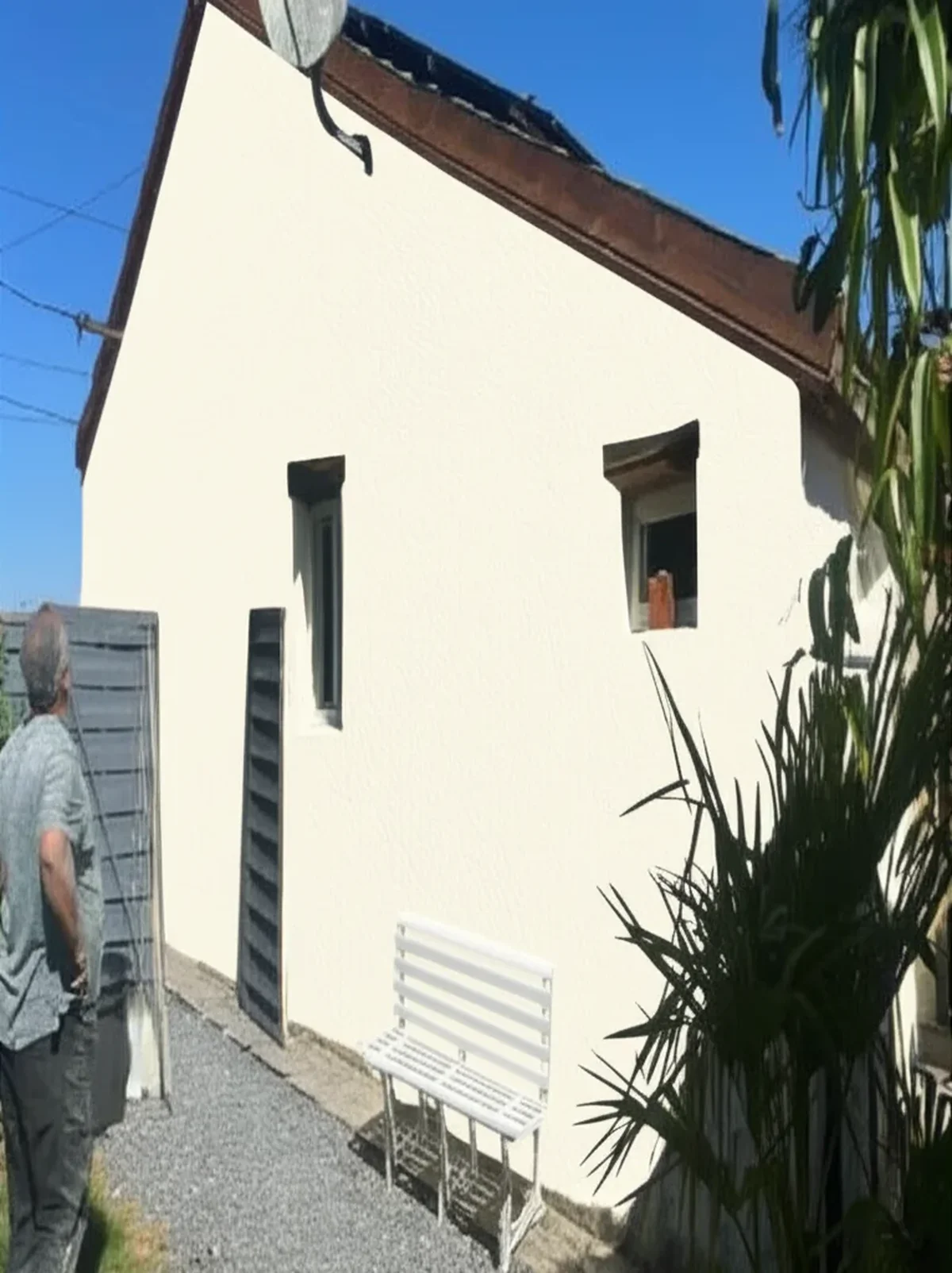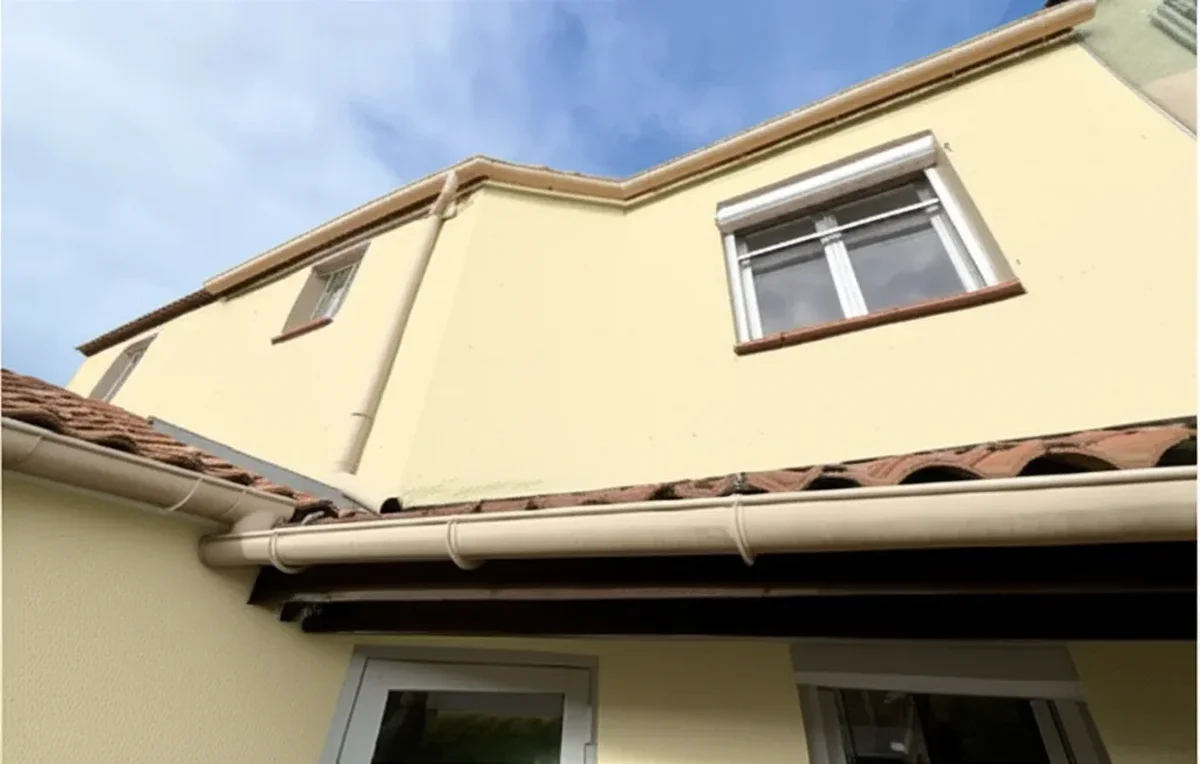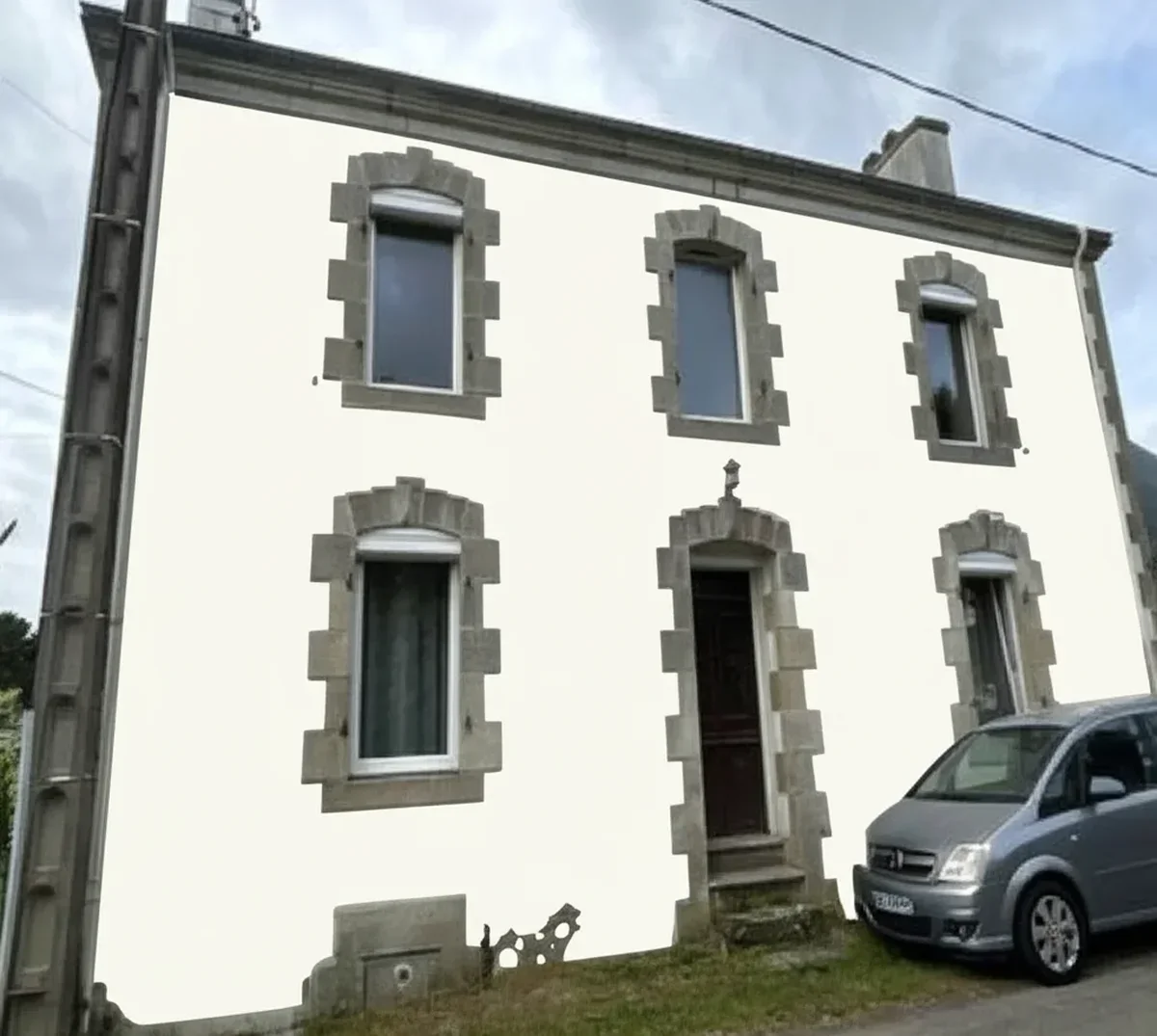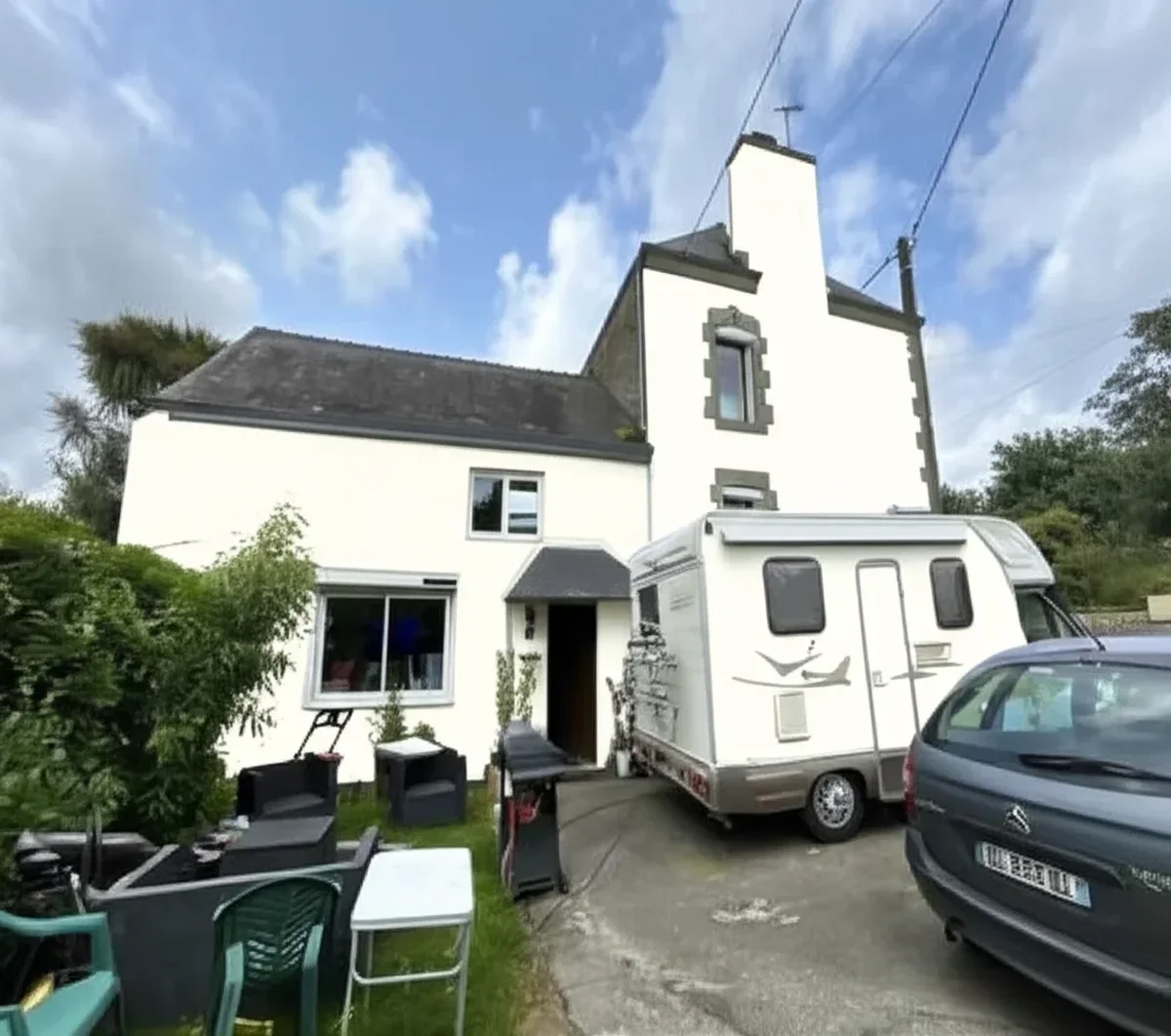
Try it on your house

Quick answer: The best terracotta stucco house with white trim combinations for 2026 are (1) Sherwin-Williams Cavern Clay SW 7701 body + Pure White SW 7005 trim, (2) Benjamin Moore Audubon Russet HC-51 + Simply White OC-117, (3) Sherwin-Williams Reddened Earth SW 6053 + Snowbound SW 7004, (4) Benjamin Moore Caliente Adobe 1325 + Cloud White OC-130, (5) Sherwin-Williams Adobe SW 6358 + Alabaster SW 7008. The formula is clay-warm body, crisp slightly warm white trim, red barrel-tile roof, and a single bold accent on the door (turquoise, dark wood, or wrought iron black). Preview any pairing free on your own home photo in 30 seconds, no signup.
A terracotta stucco house with white trim is the defining American Mediterranean and Spanish Colonial Revival palette, the look that earned the postcard reputation of Santa Barbara, Coral Gables, Pasadena, Scottsdale, and the Texas Hill Country. After previewing Sherwin-Williams Cavern Clay paired with Pure White trim and a turquoise Pueblo door in Santa Fe, New Mexico, then walking the same recipe onto a 1928 Spanish Colonial in Pasadena, the conclusion is clear: terracotta survives the daylight test only when the white trim is warm enough to feel like sun-bleached linen, not hospital-grade snow.
This guide breaks down the 5 terracotta-and-white pairings that consistently work across Spanish Colonial, Tuscan, Pueblo Revival, and Mediterranean Revival homes, with exact Sherwin-Williams and Benjamin Moore codes you can order today. We also cover where this palette wins regionally, which door, roof, and ironwork choices lock the look in, and the cool-paint NIR specification that keeps a clay-pigmented stucco from baking under desert sun. If you want to compare terracotta against other warm exterior trios, browse our 20 tested exterior house color combinations. For the full Mediterranean palette beyond a single trim color, see our Mediterranean Revival house exterior paint colors guide.
Upload a photo of your stucco home and preview all 5 terracotta + white combos in 30 seconds, no signup.
Why terracotta stucco with white trim is the Mediterranean classic
Terracotta literally means "baked earth" in Italian, and the color of fired clay has been the surface of Mediterranean architecture for two millennia, from Pompeii frescoes to Florentine palazzi to the mission churches of Alta California. When American architects George Washington Smith, Wallace Neff, and Bertram Goodhue codified the Spanish Colonial Revival style between 1915 and 1930, they paired warm clay stucco walls with crisp white trim and red barrel-tile roofs as a deliberate visual quotation of Andalusia and the missions of the El Camino Real. The combination is not a designer trend, it is a 100-year-old American architectural vernacular.
The reason the pairing reads as timeless instead of dated comes down to color theory. Terracotta sits in the red-orange family on the Munsell wheel (typically 5YR to 10R hue, chroma 4 to 8). White trim, when chosen correctly, provides a high-LRV neutral counterweight that lets the eye rest between expanses of saturated clay. A slightly warm white (LRV 84 to 92 with a peach or yellow undertone) reads as sun-bleached limestone or weathered plaster against terracotta walls. A cool blue-white reads as fluorescent, fights the warm body, and collapses the Mediterranean illusion. Get the white temperature wrong and the entire facade looks suburban-builder, not Carmel.
For the broader picture of warm earth tones nationwide, our warm exterior paint colors 2026 guide covers the trend. For homes whose stucco is already in place and needs a fresh coat, the stucco house colors guide 2026 walks through substrate-specific picks.
5 tested terracotta stucco + white trim pairings with SW and BM codes
1. Sherwin-Williams Cavern Clay SW 7701 + Pure White SW 7005
The 2026 default and the most popular terracotta-and-white pairing in our Southwest visualizer tests. Cavern Clay SW 7701 (LRV 36) was Sherwin-Williams' 2019 Color of the Year and remains the gold standard for warm clay stucco bodies, with a measurable iron-oxide red undertone that reads as sun-baked adobe at golden hour. Pure White SW 7005 (LRV 84) is the cleanest moderately warm white in the SW line, with a near-neutral mass tone that does not pull yellow or pink against the clay body. Pair with a red barrel-tile roof and either a Pueblo turquoise or hand-forged iron door. Works on Spanish Colonial Revival, Tuscan, and Pueblo Revival homes from Phoenix to Pasadena. For a city-specific cost breakdown, see our house painting Phoenix AZ cost guide.
2. Benjamin Moore Audubon Russet HC-51 + Simply White OC-117
The Historical Collection terracotta. Audubon Russet HC-51 (LRV 19) is a deeper, brick-leaning clay with more red than orange, ideal on larger Mediterranean villas where a mid-LRV body grounds the elevations without going dark. Simply White OC-117 (LRV 91.7), Benjamin Moore's 2016 Color of the Year, is a softly warm white with a faint yellow whisper that reads as Tuscan plaster trim against the deeper russet. Pair with weathered terracotta tile, dark walnut shutters, and a satin-black wrought-iron front door. Best on stucco villas in Coral Gables FL, Highland Park TX, and Montecito CA.
3. Sherwin-Williams Reddened Earth SW 6053 + Snowbound SW 7004
The desert Pueblo recipe. Reddened Earth SW 6053 (LRV 24) is the warmest, most red-shifted terracotta in the SW exterior fan, capturing the iron-rich clay of northern New Mexico. Snowbound SW 7004 (LRV 83) is a soft warm white with a faint gray undertone that prevents the trim from glowing under high-altitude sun. The combination is the closest paint-on-paint match to a traditional adobe mud plaster with sun-bleached lime trim. Pair with a turquoise door (SW 9135 Drizzle or BM 776 Santa Monica Blue) and exposed cedar vigas. Works on Pueblo Revival, Territorial, and Santa Fe-style homes in NM, AZ, and West TX. For an authentic Santa Fe palette, see our Santa Fe adobe exterior paint colors Southwest guide.
4. Benjamin Moore Caliente Adobe 1325 + Cloud White OC-130
The Coral Gables and South Florida Mediterranean Revival pairing. Caliente Adobe BM 1325 (LRV 27) is a softer, pinker terracotta that leans coral, ideal on subtropical stucco where the body color must compete with bougainvillea pink, hibiscus red, and saturated tropical foliage. Cloud White OC-130 (LRV 85.4) is one of BM's three most popular whites for exterior trim, with a creamy undertone that reads as old plaster against the coral body. Pair with a barrel-tile roof, mahogany doors, and copper gutters with green patina. Works in Coral Gables FL, Naples FL, and Mediterranean Revival neighborhoods of Tampa, Sarasota, and Charleston. For broader hot-climate paint chemistry, see our best exterior paint for hot climates 2026 guide.
5. Sherwin-Williams Adobe SW 6358 + Alabaster SW 7008
The Texas Hill Country and Scottsdale combination. Adobe SW 6358 (LRV 36) is the most peach-leaning of the SW terracotta family, with a softer chroma than Cavern Clay and a warmer pink undertone that reads as a Tucson sunset. Alabaster SW 7008 (LRV 82) was SW's 2016 Color of the Year and remains the most popular warm white in the line, with a creamy off-white tone that pairs naturally with limestone surrounds and Texas-quarried sandstone. Use it on lighter-massing ranch and hacienda layouts where the Adobe body needs to feel sun-faded and lived-in. Pair with dark walnut beams, weathered copper, and an oxblood or cobalt door.
| # | Body (Terracotta) | Trim (White) | Body LRV | Best For |
|---|---|---|---|---|
| 1 | SW 7701 Cavern Clay | SW 7005 Pure White | 36 | Spanish Colonial / Pueblo |
| 2 | BM HC-51 Audubon Russet | BM OC-117 Simply White | 19 | Mediterranean Villa |
| 3 | SW 6053 Reddened Earth | SW 7004 Snowbound | 24 | Pueblo Revival / Territorial |
| 4 | BM 1325 Caliente Adobe | BM OC-130 Cloud White | 27 | South FL Mediterranean Revival |
| 5 | SW 6358 Adobe | SW 7008 Alabaster | 36 | Tuscan / Hacienda / Hill Country |
Try it on your house
No photo? Try a sample
Free AI preview, all 5 terracotta + white combos in 30 seconds, no signup.
Architectural styles that wear terracotta and white best
Terracotta stucco with white trim is not a universal palette. It speaks four specific architectural dialects, and pushing it onto a mismatched style usually backfires.
- Spanish Colonial Revival (1915 to 1940, dominant in CA, FL, AZ, TX). Smooth troweled stucco walls, low-pitched red-tile roof, arched openings, wrought-iron details. This is the original American showcase for the palette, with one regional caveat worth knowing before you order: inside California's review districts the clay usually moves off the main body and onto a wing, a tower mass, or a chimney face, the body stays a cream, and the trim drops to a soft Linen White rather than a bright one, which reads blue against terracotta tile. Our guide to Spanish Colonial paint colors in California sets out what the Santa Barbara and Los Angeles boards actually approve.
- Mediterranean Revival (1920 to 1940, dominant in FL, coastal CA). More ornate than Spanish Colonial, with formal symmetry, balustrades, and decorative tile risers. Caliente Adobe pairing #4 is the canonical recipe.
- Tuscan / Italianate (1920s and 2000s revival). Heavier stucco texture, hipped roofs, exposed eave brackets. Adobe + Alabaster pairing #5 is the closest paint match to Sienese palazzo walls.
- Pueblo Revival / Territorial (1900 to present, NM, AZ). Rounded parapets, exposed vigas, flat roofs. Reddened Earth + Snowbound pairing #3 is the authentic adobe-mud match.
That California caveat travels further than the state line. A full Spanish Colonial Revival scheme is four roles rather than two: stucco body, trim, wrought iron, and tile-roof harmonization. In the role table of our Spanish Colonial exterior paint colors guide, Cavern Clay SW 7701 is the accent body or the single wing and the main body goes to a cream, Antique White SW 6119 or White Dove OC-17, with the Santa Barbara, Coral Gables, and Scottsdale variants set out one by one. Read this page for the terracotta-forward version of the palette and that one for the version a historic district is most likely to approve.
Where terracotta and white do not work: Cape Cod, Colonial Revival, Tudor Revival, Mid-Century Modern, and contemporary box modernism. These styles read as accidentally costumed when forced into a Mediterranean palette. For Colonial homes, our red house with white trim classic guide covers the appropriate Federal-era recipe instead.
Where terracotta and white wins regionally in the US
- Arizona (Phoenix, Scottsdale, Tucson). Pueblo Revival and Spanish Colonial inventory, plus 300+ sunny days that flatter clay tones. Cavern Clay and Adobe SW 6358 dominate.
- California (Santa Barbara, Pasadena, Los Angeles, San Diego). Mission Revival and Spanish Colonial Revival pre-war inventory; Mediterranean light flatters the red-orange chroma. Cavern Clay + Pure White is the local default.
- Florida (Coral Gables, Naples, Sarasota, Boca Raton). Mediterranean Revival pre-war villas and post-2000 "Med-Med" suburbs. Caliente Adobe + Cloud White is the Coral Gables recipe.
- Texas (Austin Hill Country, San Antonio, Highland Park). Hacienda, Tuscan revival, and Spanish Colonial. Adobe SW 6358 + Alabaster is the Hill Country recipe.
- New Mexico (Santa Fe, Albuquerque, Taos). Pueblo Revival and Territorial. Reddened Earth + Snowbound is the closest paint-on-paint match to traditional mud plaster.
The roof: red barrel tile is the structural anchor
A terracotta stucco facade with white trim is incomplete without the red barrel-tile roof. The S-shaped clay tile (variously called "Spanish tile," "mission tile," or "two-piece tile") in a warm red-orange (Munsell 7.5R 4/8 to 10R 5/8 range) is the third leg of the palette tripod, and substituting asphalt shingle, metal panel, or flat concrete tile breaks the architectural quotation. The two roof color choices that work:
- Natural-fired terracotta clay tile. Standard manufacturers: MCA, Ludowici, Boral, Eagle Roofing's "Capistrano" line. Color blends like "Mission Red," "Tuscan Sunset," or "Vintage Cathedral" are the most popular. Expect 50 to 100-year service life; replacement cost runs 15 to 28 dollars per square foot installed in 2026.
- Concrete tile in a clay-blend color. Eagle Roofing "Capistrano Mission," Boral "Saxony Slate-Style," or US Tile "Barcelona 900-2 Vintage Red." Cheaper at 8 to 14 dollars per square foot, but the color is surface-applied and fades faster under desert UV (delta-E 4 to 6 over 10 years vs. delta-E 1 for fired clay).
Avoid asphalt shingle in any color, standing-seam metal in red, and dark gray concrete tile on a terracotta-stuccoed Mediterranean home; all three read as suburban-builder retrofits.
Door accents: 3 authentic choices for a terracotta + white facade
The front door is where you spend your bold-color budget. Three traditional choices are historically defensible and visually high-contrast against terracotta walls and white trim:
Turquoise (Pueblo and Spanish folk authentic). New Mexican tradition holds that turquoise wards off evil at thresholds; the practice migrated up through Sonora and into the Spanish Colonial vernacular of the entire Southwest. Best paint matches: Sherwin-Williams SW 9135 Drizzle (LRV 32), Benjamin Moore 776 Santa Monica Blue (LRV 28), or Behr M460-4 Maya Blue (LRV 30). Pair with hand-forged iron pulls and an arched wood-plank frame. Most authentic on Pueblo Revival and northern New Mexico Spanish Colonial.
Dark walnut or hand-rubbed wood. Unpainted oiled wood (walnut, mesquite, reclaimed Douglas fir) shows the grain through a clear penetrating finish (TWP 1500 series, Sikkens Cetol Door & Window). This is the most popular door treatment for Mediterranean Revival and Tuscan homes, where the wood reads as warm-on-warm against the terracotta walls. Pair with hand-hammered bronze hardware and a Spanish-grille speakeasy.
Black wrought iron or near-black paint. A satin-black or charcoal-black painted door reads as wrought iron from the curb and is the historically defensible choice for formal Mediterranean Revival villas. Best matches: Sherwin-Williams Tricorn Black SW 6258 (LRV 3), Benjamin Moore Onyx 2133-10 (LRV 5), or Behr Black Suede N520-7 (LRV 4). Pair with iron rejas (window grilles) and a barrel-vault arched frame.
Avoid bright red, baby blue, sage green, primary yellow, and any pastel; they fight the warm body chroma and collapse the Mediterranean identity into suburban-eclectic.
Free AI visualizer, 30 seconds, no signup required.
Terracotta is a mid-to-dark body color, and on stucco that points to a breathable premium acrylic rather than an elastomeric: contractors report that darker elastomeric colors fade faster under strong sun, and the thick film is only worth its cost on cracked or bare stucco. Our guide to the best paint for stucco sets out the decision and what Sherwin-Williams, Behr and Dunn-Edwards claim for their stucco products.
Stucco prep and cool-paint NIR specification for terracotta bodies
A terracotta-pigmented stucco body absorbs significantly more near-infrared (NIR) radiation than a white or beige facade, because the iron oxide pigment that gives clay its warmth has a low solar reflectance index (SRI) in the visible band. In Phoenix and Tucson summer conditions (115 deg F ambient, 100 deg F dew-point dry), a standard-formulation terracotta paint can push wall surface temperatures to 170 to 185 deg F. That heat load accelerates pigment fade, drives chalking, and bleeds into interior cooling costs. The fix is to specify a cool-paint NIR-reflective formulation that uses heat-reflective pigment chemistries (cobalt-doped iron oxides, complex inorganic colored pigments) to bounce the infrared band while keeping the visible-band terracotta color.
Three product lines to specify on terracotta bodies in hot climates in 2026:
- Sherwin-Williams Emerald Rain Refresh with Cool Pigments. Independent testing shows surface-temperature reduction of 20 to 25 deg F on dark and saturated bodies vs. standard formulations. Specify color "tinted with cool pigment system" at the SW Pro Desk.
- Benjamin Moore Aura Exterior with Gennex colorant system. The Gennex inorganic-pigmented base holds delta-E 1.4 over 5 years on terracotta hues in Sonoran Desert field tests, vs. delta-E 4+ for organic-colorant bargain latex.
- Dunn-Edwards Cool Coat Exterior. Specifically formulated for Southwest hot-climate use, with SRI values 15 to 20 points higher than standard formulations on dark bodies. Available through DE-Color centers in CA, AZ, NV, and TX.
Substrate prep matters as much as paint chemistry. Existing stucco must be pressure-washed at 1,500 to 2,500 PSI, allowed to dry 48 to 72 hours, and primed with a high-quality alkali-resistant masonry primer (SW Loxon XP, BM Fresh Start 023). Cracks wider than 1/16 inch should be elastomeric-patched before primer. For a deeper walkthrough on stucco-specific repair and cost, see our stucco crack repair cost guide 2026.
The single mistake that ruins terracotta + white
The most common failure we see in our visualizer flow is homeowners picking a clean cool white (Chantilly Lace, Decorator's White, Extra White SW 7006) for the trim. Cool whites have a measurable blue or violet undertone (Munsell hue 5PB to 10B at extremely low chroma) that reads as fluorescent glare against the red-orange of terracotta walls. The result: the white trim looks newer than the body, the body looks dirty by comparison, and the entire facade reads as a poorly executed two-coat repaint instead of a hundred-year-old Mediterranean villa. The fix is simple: choose a moderately warm white (Pure White, Alabaster, Simply White, Cloud White, Snowbound) in the LRV 82 to 92 band with a yellow, peach, or cream undertone. The trim should look like sun-bleached limestone, not gym-shoe foam.
How to test a terracotta + white combo on YOUR home
Order peel-and-stick samples (Samplize, Color Lab) of your top two terracotta bodies and top two whites. Place 12 by 12 inch swatches on three elevations of the actual house (south for full sun, east for morning, north for shade). Photograph at 10 am, 2 pm, and 5 pm so you see how the clay shifts under different sun temperatures, then compare on the same screen.
Before ordering physical samples, use an AI exterior paint visualizer to narrow the field. Upload one straight-on daylight photo of your home to our house paint visualizer and preview all 5 terracotta-and-white combos in roughly 30 seconds. It will not replace a real swatch on the wall, but it cuts your physical-sample order from 8 colors to 4 and saves the 25 to 40 dollar swatch cost per eliminated candidate. Start your free terracotta + white preview now.
Free. 30 seconds. All 5 terracotta + white combos included.
For terracotta product references and to verify the exact codes above, see the manufacturer pages at Sherwin-Williams Cavern Clay SW 7701, Benjamin Moore Audubon Russet HC-51, and the curated HGTV terracotta paint feature. For a German-market view of terracotta facade paint brands and how the European Fassadenfarbe lineup compares, see our Fassadenfarbe Terrakotta Markenvergleich 2026.
No signup. No credit card. Get your top 2 candidates before ordering swatches.
Frequently asked questions
What is the best white trim color for a terracotta stucco house?
Pure White SW 7005 (LRV 84) and Alabaster SW 7008 (LRV 82) from Sherwin-Williams, or Simply White OC-117 (LRV 91.7) and Cloud White OC-130 (LRV 85.4) from Benjamin Moore. All four are moderately warm whites with peach or cream undertones that read as sun-bleached limestone against terracotta walls. Avoid cool blue-whites like Chantilly Lace or Extra White; they read as fluorescent and fight the warm clay body.
What color roof goes with terracotta stucco and white trim?
A red barrel-tile roof in the Munsell 7.5R 4/8 to 10R 5/8 range is the structural anchor of the Mediterranean palette. Specify natural fired-clay tile from MCA, Ludowici, Boral, or Eagle Roofing in a "Mission Red," "Tuscan Sunset," or "Vintage Cathedral" blend. Concrete tile in a clay-blend color is a cheaper alternative (8 to 14 dollars per square foot vs. 15 to 28), but fades faster under desert UV. Avoid asphalt shingle, dark gray concrete tile, and metal standing-seam.
Which front door color works best with terracotta and white?
Three historically defensible choices: (1) Turquoise (SW 9135 Drizzle, BM 776 Santa Monica Blue, Behr M460-4 Maya Blue) for Pueblo Revival and Spanish folk authentic homes; (2) Dark walnut or hand-rubbed wood for Mediterranean Revival and Tuscan villas; (3) Satin-black wrought iron (SW Tricorn Black 6258, BM Onyx 2133-10) for formal Mediterranean Revival. Avoid pastels, primary red, and sage green, which collapse the architectural identity.
Is terracotta stucco still in style in 2026?
Yes. Terracotta is a 100-year-old American architectural vernacular for Spanish Colonial Revival, Mediterranean Revival, Tuscan, and Pueblo Revival homes; it is not a trend cycle.
How do I keep terracotta paint from fading in desert sun?
Specify a cool-paint NIR-reflective formulation that uses inorganic colored pigments (cobalt-doped iron oxides) to bounce the infrared band while keeping the visible terracotta color. Three 2026 specifications: Sherwin-Williams Emerald Rain Refresh with Cool Pigments (20 to 25 deg F surface-temperature reduction), Benjamin Moore Aura Exterior with Gennex colorant (delta-E 1.4 over 5 years), and Dunn-Edwards Cool Coat Exterior (SRI 15 to 20 points higher than standard). Avoid organic-colorant bargain latex, which fades to dusty pink in 4 to 6 years in Phoenix.
What architectural styles work with terracotta stucco and white trim?
Four styles wear the palette naturally: Spanish Colonial Revival (1915 to 1940), Mediterranean Revival (1920 to 1940), Tuscan/Italianate, and Pueblo Revival/Territorial. Common features: smooth-troweled stucco, low-pitched red-tile roofs, arched openings, wrought-iron details. The palette does not work on Cape Cod, Federal Colonial, Tudor Revival, Mid-Century Modern, or contemporary box modernism, which read as accidentally costumed when forced into a Mediterranean color scheme.
Can I use elastomeric paint over terracotta stucco?
Yes on hard-coat synthetic stucco (EIFS, three-coat hardcoat) with appropriate prep, no on traditional adobe or lime-plaster substrates. Elastomeric forms a thick film that traps moisture inside breathable masonry, causing spalling and "popcorn" failure on adobe. For hard-coat stucco in good condition, pressure-wash at 1,500 to 2,500 PSI, allow 48 to 72 hours to dry, and prime with an alkali-resistant masonry primer (SW Loxon XP, BM Fresh Start 023) before topcoat. See our elastomeric paint for stucco guide for the full system spec.
How much does it cost to paint a terracotta stucco house?
In 2026, repainting an existing terracotta-color stucco facade runs 4.50 to 8.50 dollars per square foot of wall area in the Southwest (Phoenix, Tucson, Las Vegas), 5 to 9 dollars in California, and 4 to 7 dollars in Florida and Texas, including pressure wash, crack repair, alkali-resistant primer, and two coats of premium exterior paint. A 2,200-square-foot single-story Spanish Colonial typically lands at 9,500 to 17,000 dollars total. Cool-paint NIR formulations add roughly 8 to 12 percent to material cost but extend repaint cycles from 7 to 10 years out to 12 to 15.
Trademarks mentioned (Sherwin-Williams, Benjamin Moore, Behr, Caparol, Brillux, Sto, Alpina, Valspar, PPG, Glidden, Dulux, Crown Trade, Sandtex, Farrow & Ball, Johnstone's, Leyland) are property of their respective owners. FacadeColorizer is independent and not affiliated with any of them. Nominative fair use under Lanham Act §1125.