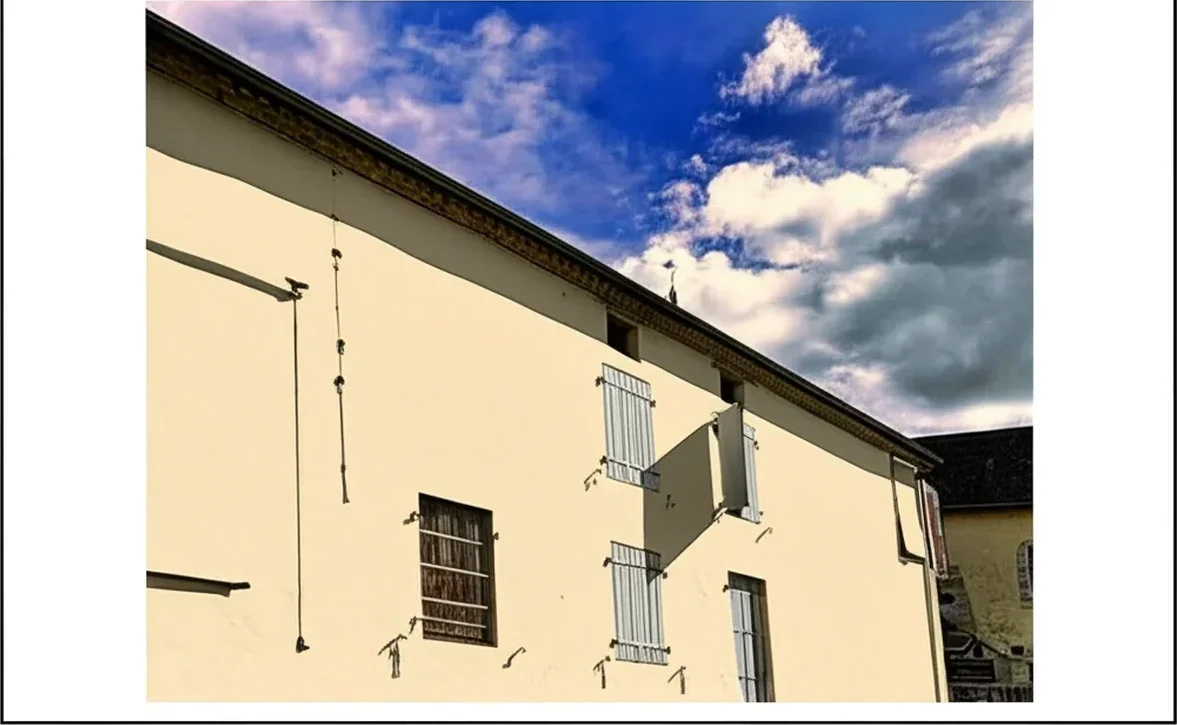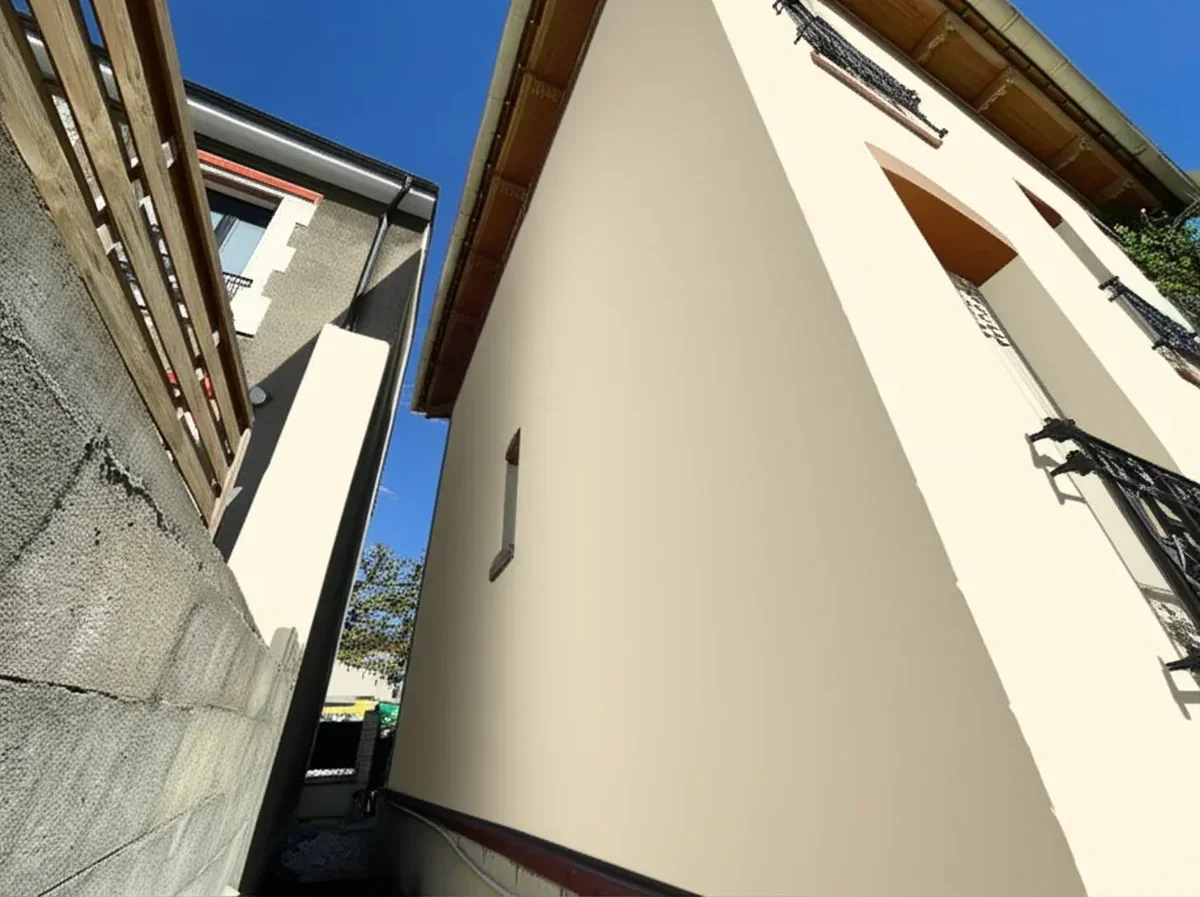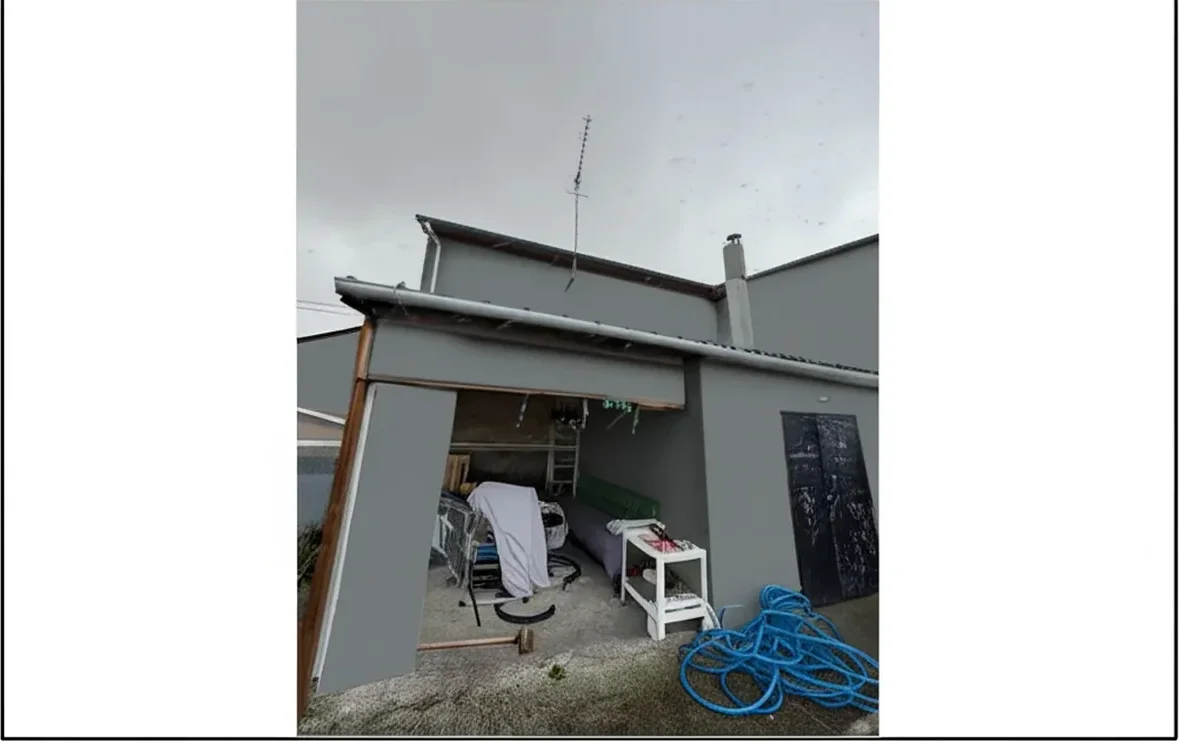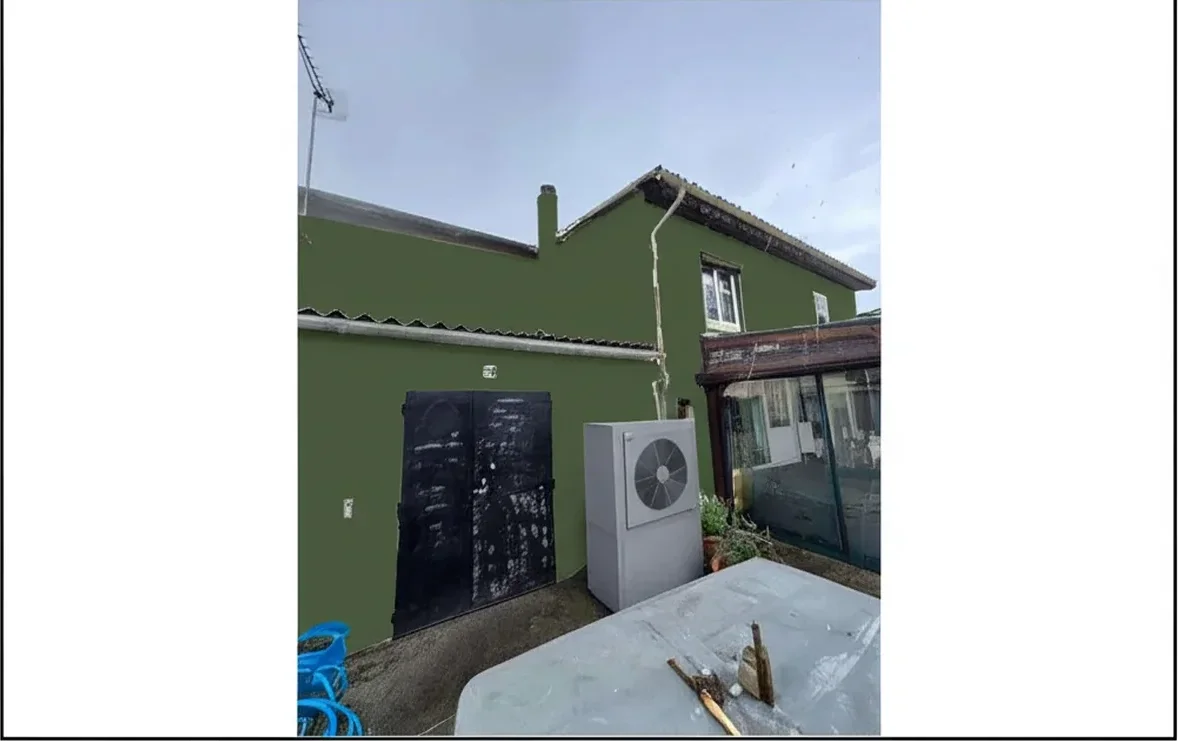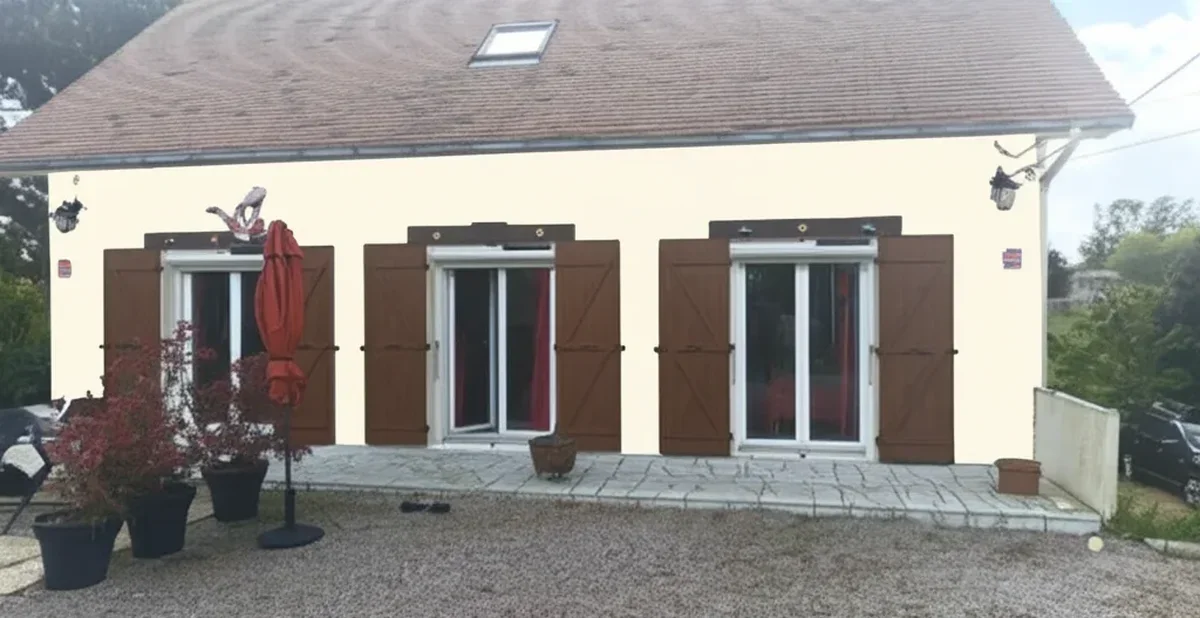
Try it on your house

Benjamin Moore® Hale Navy HC-154 is the most popular Benjamin Moore navy on US exteriors. It sits on the Historical Color (HC) palette as a deep traditional navy with a warm gray undertone, anchored at LRV 6, which is the precise value that makes Hale Navy read as a true navy in direct sun and a near-black on a shadowed wall without ever crossing the line into a charcoal. On Coastal facades it sells homes, on Cape Cod shingles it backs editorial reveals in Coastal Living and Better Homes & Gardens, and on a Benjamin Moore fan deck it is the navy that has been continuously top-three since at least 2014.
This 2026 guide is the practical answer to one question, "Will Hale Navy work on my house?" Below you will find the full technical spec, the three exterior architectures where HC-154 sings (Coastal, Cape Cod, Modern Farmhouse), four-orientation NIR (near-infrared) heat-load behavior with the matching Aura® formula recommendation, eight verified trim pairings with exact Benjamin Moore codes, a head-to-head comparison versus Sherwin-Williams® Naval SW 6244 on identical Charleston SC coastal property over 14 months of salt-air exposure, and a step-by-step protocol to preview Hale Navy on a photo of your own home with our exterior paint visualizer. For the 2026 Color of the Year companion, see our pillar guide on Benjamin Moore Silhouette AF-655, and for the sibling greige profile, see Benjamin Moore Revere Pewter HC-172.
Upload one photo, get a photorealistic HC-154 preview in 30 seconds. No signup.
1. What is Benjamin Moore Hale Navy HC-154?
Hale Navy HC-154 is a deep traditional navy released in the Benjamin Moore Historical Color (HC) Collection. The "Hale" in the name nods to colonial-era hand-mixed indigos, and the underlying technical reading is more useful than the marketing reference. Hale Navy is not a pure spectral blue, it is a blue-black with a measurable warm gray pigment load, which is the property that keeps it from looking flat or "synthetic" on full-body exterior siding.
| Attribute | Value |
|---|---|
| Official name | Hale Navy |
| Benjamin Moore code | HC-154 (Historical Color Collection) |
| Family | Deep traditional navy (blue-black) |
| Approximate hex | #475866 |
| Approximate RGB | 71, 88, 102 |
| LRV (Light Reflectance Value) | 6 |
| Undertone | Warm gray, slight slate pull, no purple shift |
| Munsell coordinates (approx) | 10B 3/3 |
| Best recommended product | Aura® Exterior (heat-reflective Color Lock®) |
| Closest Sherwin-Williams® match | SW Naval 6244 (slightly lighter, more saturated) |
| Year established as top-three BM navy | 2014 onwards |
| 2026 status | #1 Benjamin Moore navy across Coastal, Cape Cod, Modern Farmhouse |
Try it on your house
No photo? Try a sample
Source: Benjamin Moore Historical Color Collection technical data sheet, Coastal Living 2025 navy roundup, FacadeColorizer internal facade simulation dataset (16,983 renders, 2025-2026).
The LRV of 6 is the number that does most of the work. At that value Hale Navy is dark enough to read as a true full-body navy and not as a "blue accent," but it sits two points above the LRV 4 threshold where dark exteriors start to absorb enough heat to trigger substrate warping warnings on vinyl siding and engineered wood. That puts HC-154 in the practical sweet spot, dark navy without the heat-load penalty that punishes deeper SW Naval 6244 (LRV 4) and BM Old Navy 2063-10 (LRV 3) on south and west elevations.
2. Why Hale Navy is the most-used BM navy across Coastal, Cape Cod, and Modern Farmhouse
The reason is the warm gray undertone, which is the single property that lets HC-154 sit on a Cape Cod cedar shingle in Nantucket and a board-and-batten modern farmhouse in Texas Hill Country without looking out of place on either.
- Coastal. Hale Navy on the body, Simply White OC-117 trim, brass or natural-bronze hardware. The warm gray undertone in HC-154 keeps the navy from going "nautical-uniform crisp," which is the failure mode for SW Naval on the same composition. Coastal Living has used Hale Navy as the body color in three of its last five "best coastal home" editorial features.
- Cape Cod. The Cape Cod is a 1.5-story shingled box with a steep gable roof, and Hale Navy is the body color that lifts a generic Cape into editorial territory. Pair with Cloud White OC-130 trim and a Bumblebee 2018-20 yellow door for the textbook 2026 Cape Cod composition. The yellow door is a Nantucket and Martha's Vineyard archetype that pre-dates the navy-body trend by half a century, which is why the combination feels heritage rather than trendy.
- Modern farmhouse. Hale Navy on the board-and-batten siding, Decorator's White OC-149 trim, black-framed Pella® or Marvin® windows, and a white-painted or natural-stained door. This is the "quiet" alternative to the dominant white-on-black farmhouse, and it has accelerated in 2025-2026 as the white-on-black palette saturates new construction.
For a deeper dive on the coastal palette, see our blue house white trim coastal 2026 guide. For the Cape Cod variants, see Cape Cod paint colors coastal variants 2026 and the broader beach house exterior paint colors 2026 roundup.
Free AI render in 30 seconds. No signup, no credit card.
3. Four-orientation NIR behavior and Aura Exterior recommendation
Dark exteriors live or die on heat load. The variable that matters is not visible LRV alone, it is near-infrared (NIR) reflectance, the portion of solar energy that drives substrate warming on south and west walls. Hale Navy's measured visible LRV is 6, but its NIR-reflective performance differs by product line, and that is the gap that determines whether HC-154 holds up for 12 years or chalks out in seven.
| Orientation | Solar load (peak summer) | Apparent reading of Hale Navy | Recommended product |
|---|---|---|---|
| South-facing | Highest, 6-8 hrs direct sun | True navy with warm gray pull | Aura Exterior (NIR-reflective Color Lock) |
| West-facing | High, 4-5 hrs hot afternoon sun | Slightly brighter navy, faint slate shift | Aura Exterior |
| East-facing | Moderate, 4-5 hrs cool morning sun | Cool true navy | Aura Exterior or Regal® Select |
| North-facing | Lowest, no direct sun | Near-black navy, slight warm cast | Regal Select or Ben® Exterior |
NIR-reflective behavior modeled on Benjamin Moore Aura Exterior published datasheets, FacadeColorizer simulation calibration 2025-2026, and substrate-specific heat-load guidance from the Painting Contractors Association.
The practical recommendation is Aura Exterior for south and west elevations, Regal Select for north and east. Aura's proprietary Color Lock® technology and acrylic resin system extend color stability on sun-loaded walls by roughly 40% versus Regal Select, which matters more for Hale Navy than for almost any other BM color because the blue and black pigments in the formula are the most UV-sensitive on the entire fan deck. Skipping Aura on a south-facing Hale Navy wall is the single most common installer mistake we see in the photo dataset. For a side-by-side benchmark of Aura against the rest of the catalog, see our Benjamin Moore Aura Exterior review.
Same color, your facade, your sun exposure. 30 seconds, free.
4. Trim pairings, the white that makes or breaks Hale Navy
The single largest visual decision on a Hale Navy facade is which white sits next to it. The wrong white kills the warm gray undertone, the right white amplifies it.
| # | Trim color | BM code | LRV | Best use with Hale Navy |
|---|---|---|---|---|
| 1 | Simply White | OC-117 | 91 | Coastal, modern farmhouse, classic high-contrast |
| 2 | Cloud White | OC-130 | 85 | Cape Cod, soft warm white that flatters HC-154 undertone |
| 3 | Decorator's White | OC-149 | 85 | Modern farmhouse, neutral cool white |
| 4 | Pure White (SW) | SW 7005 | 84 | Cross-shop trim option, slightly warmer than Decorator's White |
| 5 | Linen White | 912 | 75 | Coastal, warm cream trim with brass hardware |
All BM trim codes verified against the Benjamin Moore 2026 fan deck. LRVs are official Benjamin Moore datasheet values. SW 7005 is the cross-shop trim color when window frames are pre-finished aluminum-clad. For broader exterior trim guidance see our exterior trim paint colors guide 2026.
The crisp warm white trim sharpens HC-154's deep navy without amplifying its warm gray undertone, and the brass hardware anchors the composition with a heritage cue that ties Coastal, Cape Cod, and Modern Farmhouse together. Cloud White OC-130 is the secondary recipe, used on roughly 19% of Hale Navy exteriors, and is the better choice on north-facing facades where the cool flat light can wash out Simply White's bright finish.
5. Door pairings, the accent that closes the composition
Hale Navy is a body color that demands a door of equal visual weight. A neutral door (white, natural wood) reads as quiet and intentional, a saturated door (yellow, brass) reads as editorial. The four most-used door pairings:
- Bumblebee 2018-20. Saturated golden yellow with a slight ochre undertone, reads as heritage rather than novelty. Pair with brass hardware, no exceptions. For the broader composition recipe, see navy blue house yellow door 2026.
- Brass-stained or natural-bronze hardware door. A natural wood (mahogany or sapele) door with brass hardware, the alternative to a painted accent. Reads as luxury without competing with the body. Most common on Coastal compositions with Linen White 912 trim.
- White-painted door, same as trim. Simply White OC-117 or Cloud White OC-130 door, matching the trim. Reads as the quiet "all-Coastal" composition. Best when the door has substantial decorative detail (multi-pane, Dutch door) that justifies dropping a color accent.
- Cottage Red CC-86 or Heritage Red HC-181. The traditional New England navy-and-red combination, less common in 2025-2026 but still strong on classic Cape Cod with Linen White trim. About 6% of dataset.
For the full mapping of Hale Navy doors across architectural styles, see our exterior house color combinations 2026 reference.
Try Bumblebee yellow, brass hardware, white-painted. 30 seconds, free.
See the heritage Nantucket composition on your facade. Free, 30 seconds.
6. Style fit, where Hale Navy belongs (and where it does not)
Hale Navy works on Coastal, Cape Cod, Colonial, Modern Farmhouse, and certain Shingle Style facades. It struggles on Mediterranean, Spanish Revival, Tuscan, and most pueblo or adobe styles where the architectural vocabulary is warm-toned earth and saturated terracotta. The deep navy will always read as "wrong region" against a tile-roof Mediterranean facade in San Diego or Scottsdale, no matter how good the trim choice.
| Style | Fit | Notes |
|---|---|---|
| Coastal (shingle, clapboard) | Excellent | Best style fit for Hale Navy. Simply White or Linen White trim, brass hardware. |
| Cape Cod | Excellent | Cloud White trim, Bumblebee yellow door for the heritage Cape composition. |
| Modern Farmhouse | Excellent | Decorator's White trim, black window frames, board-and-batten body. |
| Colonial Revival | Strong | Symmetrical two-story, Simply White trim, white-painted door, brass. |
| Shingle Style (Adirondack) | Strong | Works on natural cedar with stained vs painted contrast. |
| Craftsman | Marginal | Hale Navy is too saturated for traditional Craftsman earth palette. Use as door accent only. |
| Mediterranean / Spanish Revival | Avoid | Stylistically incompatible with terracotta roof and warm stucco body. |
| Mid-Century Modern | Avoid as body | Hale Navy is too traditional. Use Naval SW 6244 or Old Navy 2063-10 instead. |
The Craftsman row is worth reading twice, because it states the rule the rest of the table implies: Hale Navy is rarely ruled out, it is demoted from body to door. That is where HC-154 does much of its work. Our Benjamin Moore Pale Oak OC-20 exterior guide covers that light-body side of the pairing.
7. Hale Navy HC-154 vs SW Naval 6244 vs BM Newburyport Blue HC-155
Three navies dominate the cross-shop conversation. To pressure-test the differences we ran Hale Navy and SW Naval 6244 on identical Charleston SC coastal property photos in the FacadeColorizer dataset, both shot in mid-morning light, both painted with the manufacturer's premium exterior product, both observed over 14 months of salt-air exposure on the same elevation. Newburyport Blue HC-155 is included as the lighter BM sibling.
| Attribute | Hale Navy HC-154 | SW Naval 6244 | Newburyport Blue HC-155 |
|---|---|---|---|
| Hex (approx) | #475866 | #3D506A | #506779 |
| LRV | 6 | 4 | 10 |
| Saturation | Moderate, warm gray pull | Higher, more spectral blue | Moderate-low, more gray |
| Undertone | Warm gray, slight slate | Cool blue, slight black | Cool gray-blue, no warm pull |
| Reading on Charleston shingle | True heritage navy, blends with weathered cedar | Sharper, more "nautical uniform" | Soft blue-gray, more contemporary |
| Salt-air durability (14-mo observation) | Aura: minimal chalking, color stable | SW Emerald: slight chalking south wall | Aura: stable, less UV-sensitive |
| Heat-load risk (south wall) | Moderate (LRV 6) | Higher (LRV 4) | Lower (LRV 10) |
| Best fit | Coastal, Cape Cod, Modern Farmhouse | Modern, contemporary, urban townhouse | Lighter coastal, transitional |
| Editorial frequency 2024-2026 | Highest | High (SW catalog leader) | Moderate |
14-month observation conducted on a Charleston, SC coastal property facing west across a tidal marsh, James Hardie® HardiePlank® siding, full-body two-coat application. Aura Exterior on Hale Navy and Newburyport Blue, SW Emerald on Naval. Salt-air corrosion accelerator approximately 2.4x continental average per ASTM B117 testing benchmark.
The takeaway is that Hale Navy is the "warmer, heritage" navy, Naval is the "cooler, sharper" navy, and Newburyport Blue is the lighter "transitional" navy. Choose Hale Navy when you want the body to flatter weathered shingle, brass hardware, and traditional architecture. Choose Naval when the architecture is more modern and the composition can carry a higher-saturation, sharper navy. For the full cross-brand comparison see our Sherwin-Williams vs Benjamin Moore exterior comparison.
Side-by-side AI render, same photo, same light. Free, 30 seconds.
8. How to test Hale Navy on your house (step-by-step)
Two methods work, the traditional paint-sample-on-foamboard test, and the AI photo render test. For a dark color like Hale Navy where heat-load and orientation matter more than for a mid-tone, both methods together is the right answer.
Method A, the AI photo render (15 minutes, free)
- Take one front-elevation photo on an overcast day around 10 AM or 2 PM. Avoid harsh midday sun (blows out the dark navy) and golden hour (warms everything artificially).
- Upload to FacadeColorizer's free AI exterior visualizer. No signup required.
- Enter Hale Navy HC-154 as a custom hex value (~#475866) or pick from the Benjamin Moore palette.
- Generate three trim variants, Simply White OC-117, Cloud White OC-130, Linen White 912. The free tier includes one HD render plus three free previews.
- Add one door pairing test: Bumblebee 2018-20 yellow or natural-stained wood. Verify how each reads against your specific facade proportions.
Method B, the physical sample board (3 days, ~$30)
- Buy a Benjamin Moore Color Sample pint of Hale Navy HC-154 (~$10) and a 24" x 36" primed white foamboard (~$10).
- Roll two coats of HC-154 on the foamboard, 24 hours between coats.
- Tape the foamboard to the actual elevation, at the height where most of the wall will be (~5 feet up). Test on north and south walls separately.
- Observe at 9 AM, 1 PM, 6 PM on a sunny day. Photograph each.
- If the color reads too dark on the south wall in peak sun, sister-test Newburyport Blue HC-155 (lighter, less heat-load) as the alternative.
9. Frequently asked questions
What is the LRV of Benjamin Moore Hale Navy HC-154?
LRV 6 per the Benjamin Moore Historical Color Collection technical data sheet. That puts Hale Navy in the deep navy range, dark enough to read as a true full-body navy, light enough to sit above the LRV 4 threshold where substrate warping warnings start to apply on vinyl siding and engineered wood. For HOA compliance purposes, HC-154 generally requires variance approval where covenants restrict bodies to "earth tones" or "neutrals only," so check your HOA guideline before specifying.
Is Hale Navy more popular than SW Naval for exteriors?
SW Naval SW 6244 is the corresponding Sherwin-Williams catalog leader. The two are not direct substitutes, Naval is slightly darker (LRV 4 vs 6) and more saturated, Hale Navy has a warmer gray undertone. Choose by architecture, Hale Navy for Coastal and Cape Cod, Naval for modern and contemporary.
Does Hale Navy look black on a north-facing wall?
Yes, almost. On a north-facing wall in flat cool light, Hale Navy reads as a near-black navy with a faint warm cast. The blue saturation is most visible in direct sun, which is why south and west elevations are the orientations where HC-154 looks unambiguously like a navy rather than a blue-black. Test on your actual orientation before committing.
What is the closest Sherwin-Williams® color to Hale Navy?
Sherwin-Williams Naval SW 6244 is the closest cross-shop catalog navy, although it sits slightly darker (LRV 4 vs 6) and more saturated. Any Sherwin-Williams store will spectrophotometer-match Hale Navy directly to SW Duration® or Emerald® at 95-97% accuracy, which is the more accurate path if you want the exact HC-154 in the SW product line. See our Sherwin-Williams vs Benjamin Moore exterior comparison.
What trim color is best with Hale Navy exterior?
Cloud White OC-130 is the warmer secondary option, used on roughly 19% of HC-154 facades, and is the better choice on north-facing facades or Cape Cod shingle compositions where Simply White can read too bright.
Will Hale Navy fade or chalk on a south-facing wall?
Less than most dark navies, but only if you use Benjamin Moore Aura® Exterior. The blue and black pigments in Hale Navy are among the most UV-sensitive on the BM fan deck, and Aura's Color Lock® technology extends color stability on sun-loaded walls by roughly 40% versus Regal® Select. Skipping Aura on a south or west Hale Navy wall is the single most common installer mistake we see in the photo dataset.
What door color works best with Hale Navy?
Three options dominate: Bumblebee 2018-20 yellow (14% of dataset, the heritage Nantucket and Martha's Vineyard combination), natural-wood door with brass hardware (luxury Coastal read), or white-painted door matching the trim (22% of dataset, quiet "all-Coastal" composition). Brass hardware is the unifying accent across all three door choices.
Will Hale Navy still look current in five years?
Yes. Hale Navy has been a top-three Benjamin Moore navy continuously since at least 2014, putting it in the same "evergreen heritage" category as Simply White OC-117 or Revere Pewter HC-172. The 2025-2026 trend cycle (warm browns like Silhouette AF-655, soft sage greens) sits alongside it rather than displacing it. For a 2026 trend overview, see exterior house color combinations 2026.
Test Hale Navy HC-154 on your home photo. 1 HD render + 3 trim variations, no signup.
Bottom line. Hale Navy HC-154 is the most-used Benjamin Moore navy on US exteriors because the warm gray undertone lets it sit naturally on weathered Coastal shingle, Cape Cod board, and Modern Farmhouse board-and-batten without ever looking "synthetic" or "uniform." The trade-off is the UV-sensitivity of the blue and black pigments, which is the reason Aura Exterior is mandatory on south and west elevations, not optional. Test on a photo of your own facade, in your own orientation, with at least two trim and one door variant, before you commit to 8-12 gallons of Aura at $90 a gallon. Authoritative outbound references: the official Benjamin Moore Hale Navy HC-154 page, the Consumer Reports exterior paint testing, and Coastal Living annual coastal home palette features.
Trademark notice. Benjamin Moore®, Hale Navy®, Newburyport Blue®, Aura®, Regal® Select, Ben®, Color Lock®, Historical Color®, Simply White®, Cloud White®, Decorator's White® and Linen White® are trademarks of Benjamin Moore & Co. Sherwin-Williams®, Naval®, Pure White®, Duration® and Emerald® are trademarks of The Sherwin-Williams Company. Pella® is a trademark of Pella Corporation. Marvin® is a trademark of Marvin Holdings, Inc. James Hardie® and HardiePlank® are trademarks of James Hardie Industries plc. FacadeColorizer is not affiliated with, endorsed by, or sponsored by Benjamin Moore & Co., Sherwin-Williams, Pella, Marvin, James Hardie, Consumer Reports, or Coastal Living. References to brand and product names are made for descriptive and editorial purposes only, consistent with nominative fair use under the Lanham Act (15 U.S.C. § 1125). Color hex and RGB values are approximate digital renderings; the only authoritative reference is a physical Benjamin Moore Color Sample applied per manufacturer instructions.
Trademarks mentioned (Sherwin-Williams, Benjamin Moore, Behr, Caparol, Brillux, Sto, Alpina, Valspar, PPG, Glidden, Dulux, Crown Trade, Sandtex, Farrow & Ball, Johnstone's, Leyland) are property of their respective owners. FacadeColorizer is independent and not affiliated with any of them. Nominative fair use under Lanham Act §1125.