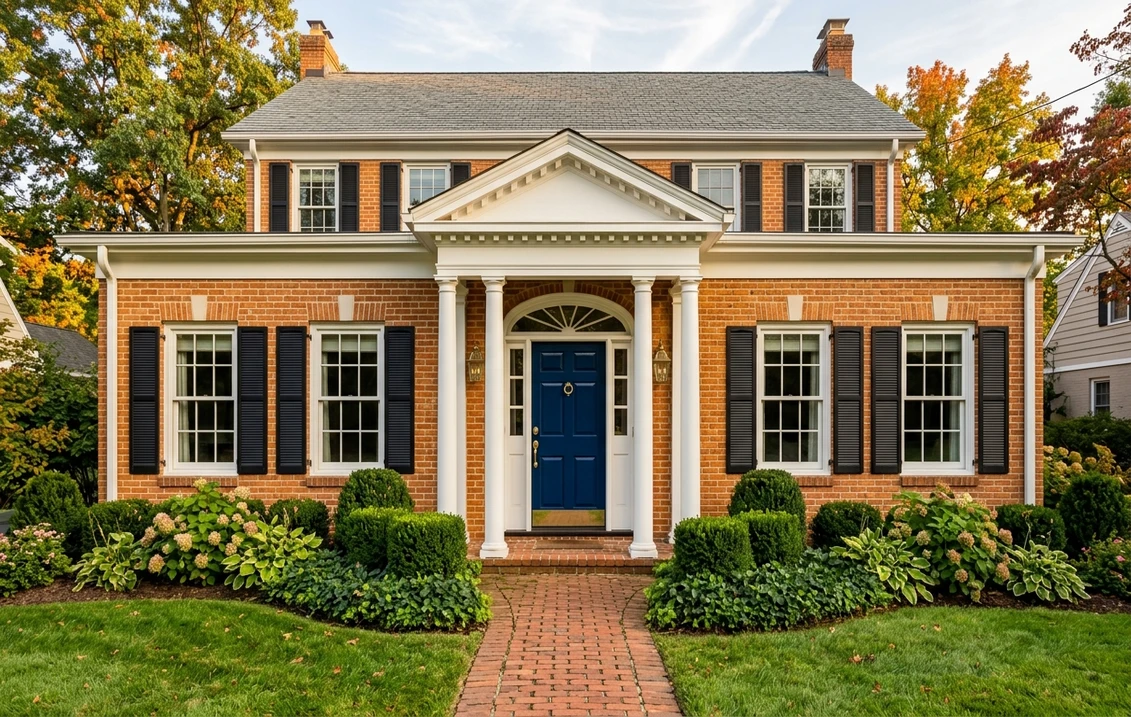
Try it on your house

A navy blue house with a yellow front door is the boldest curb appeal move of 2026, and when it lands, it lands like a magazine cover. Navy supplies the architectural gravity; yellow turns the entrance into a single high-energy focal point. The pairing only works when the yellow is tuned right: too bright and the facade reads gaudy; too pale and the door disappears. Here are the 5 best navy + yellow door pairings tested at full scale.
- Hale Navy HC-154 + Bumblebee 2018-20 door - the classic coastal pairing
- Naval SW 6244 + Yellow Highlighter SW 6906 - modern saturated combo
- Newburyport Blue HC-155 + Imperial Yellow 314 - heritage colonial pairing
- Indigo SW 6531 + Lemon Souffle SW 6376 - soft cottage style
- Stunning BM 826 + Ray of Light 2020-50 - airy modern coastal
Upload one photo and preview all 5 pairings on your actual home.
Navy + yellow door: bold, modern, coastal-classic at the same time
The reason this combination keeps trending is that it spans three styles at once. On a Cape Cod or shingle-style facade it reads coastal classic, echoing the lobster-buoy, slicker-yellow vocabulary of New England fishing villages. On a modern farmhouse or contemporary box it reads graphic and architectural, with the yellow door functioning as a single saturated punctuation mark against the dark wall. On a Victorian or colonial it reads heritage, recalling the 18th-century ochre and indigo palette of Federal-era doorways.
The pairing depends entirely on yellow temperature and saturation. A muted gold or mustard reads sophisticated; a primary highlighter yellow reads playful but risks looking like a school bus on a saturated navy body. The five pairings below cover the full range, from heritage gold to modern citron, with the navy partner that anchors each.
The 5 best navy blue + yellow door pairings for 2026
1. Benjamin Moore Hale Navy HC-154 + Bumblebee 2018-20 door
Bumblebee 2018-20 door
This is the most photographed combo of the five, and the safest place to start. Hale Navy (HC-154) is a slightly warm navy with subtle gray that keeps the facade from going purple at sunset. Bumblebee (2018-20) is a saturated golden yellow with brown depth, not a primary, so it photographs richer in golden hour. Best for: Cape Cod, shingle-style, coastal colonial in the Northeast and Pacific Northwest. Trim: Simply White OC-117 or Chantilly Lace OC-65. Roof: charcoal or weathered cedar shake. Hardware: oil-rubbed bronze or unlacquered brass. Field-tested on a Cape Cod in Newport, RI the Bumblebee read perceptibly warmer in afternoon light than on the fan deck; we recommend a single sample pot on the door itself before committing.
2. Sherwin-Williams Naval SW 6244 + Yellow Highlighter SW 6906 door
Yellow Highlighter SW 6906 door
The modern version of the pairing. Naval (SW 6244) is the most-spec'd 2026 navy, an inky deep blue with a faint green undertone that reads almost black at dusk. Yellow Highlighter (SW 6906) is brighter and more chromatic than Bumblebee, with a clean citrus pop that lands well on contemporary architecture. Best for: modern farmhouse, contemporary, board-and-batten with white trim. Trim: Pure White SW 7005 or Alabaster SW 7008. Roof: matte black standing seam or dark charcoal asphalt. Hardware: matte black, never brass. Risk note: Yellow Highlighter pushes toward gaudy if used on more than the door slab; keep sidelights, transom, and trim white.
Compare Hale Navy, Naval, and Newburyport Blue side by side in one upload.
3. Benjamin Moore Newburyport Blue HC-155 + Imperial Yellow 314 door
Imperial Yellow 314 door
The heritage colonial pairing. Newburyport Blue (HC-155) is a dusky deep navy from Benjamin Moore's Historical Color collection, a touch warmer and softer than Hale Navy, originally inspired by 18th-century New England merchant houses. Imperial Yellow (314) is a deep honey-gold with terra cotta warmth that pulls the navy into the warm-ochre Federal vocabulary. Best for: colonial revival, Federal, Georgian, and historic district homes (Charleston, Annapolis, Salem, Williamsburg). Trim: White Dove OC-17 or Linen White OC-146. Shutters: match Newburyport Blue or use a deep black such as BM 2132-10. Hardware: unlacquered brass, hand-forged iron. Avoid: chrome or polished nickel.
4. Sherwin-Williams Indigo SW 6531 + Lemon Souffle SW 6376 door
Lemon Souffle SW 6376 door
The softest, most cottage-friendly version. Indigo (SW 6531) is a slightly violet-leaning deep blue with cool undertones, less black than Naval, more textile-dye than ink. Lemon Souffle (SW 6376) is a pale buttery yellow with cream warmth, low-saturation, almost a pastel. Best for: cottages, beach bungalows, small lots where a saturated yellow would overpower the front elevation. Trim: Pure White SW 7005. Why it works: low-saturation yellow on a deep navy keeps the contrast strong without the visual shout; this is the pairing for buyers who want bold-but-not-aggressive curb appeal. Hardware: brushed brass or aged pewter.
5. Benjamin Moore Stunning 826 + Ray of Light 2020-50 door
Ray of Light 2020-50 door
The airy, modern coastal version. Stunning (BM 826) is a soft mid-navy with a touch of slate that reads lighter than Hale Navy in afternoon sun, so it photographs friendlier on small lots. Ray of Light (2020-50) is a clean cheerful yellow with a touch of green, lighter than Bumblebee but more saturated than Lemon Souffle. Best for: modern coastal builds in Florida, Carolinas, and Gulf Coast where extreme sun would scorch a Hale Navy facade. Trim: Decorator's White CC-20 or Simply White OC-117. Roof: charcoal or weathered gray. Hardware: brushed nickel, satin chrome.
Why yellow on navy works: complementary color theory
Yellow and blue sit at opposite ends of the color wheel, which is the definition of a complementary pair. When complementary colors meet, the eye registers maximum contrast and the focal point pops harder than any tonal palette can produce. That is the entire reason a yellow door on a navy house photographs so well: the door is unmissable from the curb, from the street, and from drone real-estate shots.
The theory has a catch. Pure complementary pairs are also the loudest possible combination, which is why interior designers usually mute one side. On exteriors, the navy stays saturated because the house is large enough to absorb the visual weight; the yellow door, which is small, must be tuned down or muted (mustard, honey, ochre) or the pair tips into circus territory. The yellow that works is always anchored by warmth or by reduced saturation, never neon, never primary.
Coastal vs modern fit: pick the right style match
The navy + yellow combo has two distinct style families. Coastal-classic uses warmer, deeper yellows (Bumblebee, Imperial Yellow) and warmer navies (Hale Navy, Newburyport), with white trim and black or charcoal roof. This reads like Nantucket, Cape May, or Kennebunkport - heritage architecture, low-pitched roofs, white trim everywhere. The older version of that same New England palette simply inverts the ratio: yellow goes on the body and the dark goes on the shutters, a Federal-era pairing traced to ochre and lampblack pigments used between 1790 and 1830, and our guide to the pale yellow house with black shutters carries the five combinations that still work on that plan. Modern uses brighter, cleaner yellows (Yellow Highlighter, Ray of Light) and inkier navies (Naval, Indigo), with crisp white trim and a flat or shed roof. This reads like a Hamptons new-build or a Pacific Northwest contemporary, with much less ornament.
For a deeper look at coastal builds, see our beach house exterior paint colors 2026 guide and the dedicated Cape Cod house exterior paint colors reference. For modern variations, our modern farmhouse exterior paint colors roundup shows how Naval pairs with crisp accents.
Free AI preview, 30 seconds, no signup required.
The biggest risk: an over-saturated yellow looks gaudy
The single failure mode of this pairing is picking a yellow that reads as a school-bus or taxi-cab tone on the finished facade. A 36 by 80-inch door is significantly larger than any sample chip, and saturated yellows amplify when scaled up. Rule of thumb: if the yellow looks bright on a fan deck, it will look 30 to 40 percent brighter on the actual door at noon. The fix is to step down one saturation level and step up one warmth level - mustard instead of primary, honey instead of lemon, ochre instead of canary.
The second risk is finish. High-gloss yellow magnifies the saturation problem; choose a satin or semi-gloss enamel rather than gloss. Premium options like Benjamin Moore Aura Grand Entrance or Sherwin-Williams Emerald Urethane Trim Enamel both hold the color through five-plus years of UV exposure, which matters on a south-facing front door where lesser yellows fade in 18 months.
Roof and trim pairings for a navy + yellow door house
The third color in the system matters as much as navy and yellow. Trim should be white or near-white in every pairing above - Simply White OC-117, Chantilly Lace OC-65, Pure White SW 7005, or Alabaster SW 7008 - because any cream or beige trim fights the cool blue body and dilutes the yellow door. Off-white tints with a faint warm bias work if they read warm-neutral, not yellow.
Roof selection follows the same logic: charcoal asphalt shingle (GAF Charcoal, Owens Corning Estate Gray) or matte black standing seam are the two roof families that work; weathered cedar shake is acceptable on heritage Cape Cod and shingle-style. Avoid: brown shingle, terra cotta tile, green metal. Shutters should match either the navy body or pure black; never paint shutters yellow on this scheme, because the door must remain the sole yellow element. If the shutters are the part you actually want colored, you are looking at a different system rather than a variation of this one: the body goes light and the shutters carry the hue, the way our cream house with burgundy shutters combinations are built. For a full trim breakdown, see our exterior trim paint colors guide, and for whole-house balance our exterior house color combinations 2026 roundup.
How to test it on your own home before you buy
No third-party report replaces your own walls: the same color reads differently on a north elevation and a south one, next to red brick or a gray roof, under morning and evening light. Take a daylight photo, upload it to the free AI paint visualizer, and run two or three candidates on the same image so the comparison is fair. Keep the one or two that survive the side-by-side, buy a sample of each, and brush them out on the actual surface in the actual light before you order the full quantity.
Frequently asked questions: navy blue house with yellow door
Does a yellow door really work on a navy blue house?
Yes, navy and yellow are complementary on the color wheel, which gives the front door maximum visual pop. The pairing works on Cape Cod, colonial, modern farmhouse, and contemporary facades. The key is choosing a warm or muted yellow (Bumblebee, Imperial Yellow, Lemon Souffle) rather than a primary highlighter yellow, which tips into gaudy at full scale.
What is the best yellow door color for Hale Navy HC-154?
Bumblebee 2018-20 is the most-photographed pairing - a saturated golden yellow with brown depth that complements Hale Navy's slightly warm undertone. For a heritage feel, Imperial Yellow 314 (deeper honey-gold) is the second-best Benjamin Moore option. Both come from BM's Historical and Classic collections, designed to read warm rather than primary.
Will a yellow front door fade on a south-facing exposure?
Yellow pigments fade faster than blue or red under UV, so a south-facing yellow door needs a premium UV-stable enamel. Benjamin Moore Aura Grand Entrance and Sherwin-Williams Emerald Urethane Trim Enamel both hold yellow saturation for five-plus years; cheaper exterior latex can fade noticeably in 18 months. Recoat every five to seven years.
What color trim works best on a navy house with a yellow door?
Crisp white or near-white trim is the only choice: Simply White OC-117, Chantilly Lace OC-65, Pure White SW 7005, or Alabaster SW 7008. Cream or beige trim fights the cool navy and dilutes the yellow accent. Black trim is too heavy and competes with the door for attention.
Is navy + yellow a good resale choice or too bold?
It is bold but resale-positive when executed with muted yellow. Real-estate broker surveys in 2026 rank navy + warm yellow door as a top-quartile curb appeal pairing on coastal markets (Cape Cod, Hamptons, Charleston, Annapolis) and a neutral-to-positive in inland markets. The risk is a primary or fluorescent yellow, which narrows the buyer pool.
What roof color works with a navy house and yellow door?
Charcoal asphalt shingle (GAF Charcoal, Owens Corning Estate Gray) or matte black standing seam are the two best roof matches. Weathered cedar shake is acceptable on heritage Cape Cod and shingle-style. Avoid brown shingle, terra cotta tile, and green metal - these compete with the yellow door for visual weight.
Can I paint just the door yellow without repainting the navy body?
Yes, this is the most common workflow. A standard 36 by 80-inch door takes one quart of premium exterior enamel and roughly three hours of labor; total DIY cost is 50 to 90 dollars. The yellow door alone makes a navy facade look intentional and curated, even if the navy is from a previous paint job. See coverage and prep tips in our trim and accent paint guide.
How can I test a yellow door on my navy house before I buy paint?
Upload one photo of your front elevation to our free AI exterior paint visualizer, select the door, and preview Bumblebee, Yellow Highlighter, Imperial Yellow, Lemon Souffle, and Ray of Light side by side. The render preserves your existing trim, siding, and roof. For full-house planning, the Sherwin-Williams color visualizer and Benjamin Moore color visualizer compare the navies too.
The right yellow on a navy house is the single highest-impact curb-appeal move of 2026 - and the easiest to get wrong without a full-scale preview. Test all 5 pairings on your own home in under a minute with our free AI exterior paint visualizer. Sources: BM 2026 Historical Color Collection, SW 2026 color forecast, FacadeColorizer internal data (Jan-May 2026), HGTV color trend reports.
Trademarks mentioned (Sherwin-Williams, Benjamin Moore, Behr, Caparol, Brillux, Sto, Alpina, Valspar, PPG, Glidden, Dulux, Crown Trade, Sandtex, Farrow & Ball, Johnstone's, Leyland) are property of their respective owners. FacadeColorizer is independent and not affiliated with any of them. Nominative fair use under Lanham Act §1125.