Try it on your house

A gray house is the most popular exterior color story in the United States, and the front door is where the entire palette is judged. The right door color turns a flat gray facade into a magazine-grade composition; the wrong one makes the same house look unfinished. In 2026, the seven proven front door colors for a gray house are black, navy blue, bold red, sage green, mustard yellow, warm wood stain, and white. Here is the short list, ranked by curb appeal performance.
- Black (Tricorn Black SW 6258 / Black BM 2132-10) - safe top pick, works on every gray
- Navy Blue (Naval SW 6244 / Hale Navy BM HC-154) - best modern coastal pairing
- Bold Red (Heritage Red BM HC-181) - high-contrast classic for cool grays
- Sage Green (Evergreen Fog SW 9130) - soft sophisticate for warm grays
- Mustard Yellow (Bee SW 6683) - bold accent for greige
- Warm Wood Stain (cedar or mahogany) - organic luxury
- White (Alabaster SW 7008) - only choice on very dark gray bodies
Upload one photo and preview all 7 colors on your actual home.
Rule #1: Match your door to the gray undertone (warm vs cool)
The single rule that explains every successful gray house door pairing is undertone matching. Gray is never neutral; it always leans warm (beige, taupe, greige, olive) or cool (blue, violet, true gray). Your door must echo or contrast the undertone, never fight it accidentally.
Cool grays (Repose Gray SW 7015, Stonington Gray BM HC-170) pair with black, navy, bold red, and crisp white. Warm grays and greiges (Agreeable Gray SW 7029, Revere Pewter BM HC-172, Edgecomb Gray BM HC-173) pair with sage green, mustard, warm wood stain, and warm blacks. To test the undertone in 30 seconds, hold pure white printer paper against your siding in midday sun: if the gray reads blue or violet, it is cool; if tan or olive, warm.
The 7 best front door colors for a gray house in 2026
1. Black (Tricorn Black SW 6258 / Black BM 2132-10)
AI render: black door, gray clapboard
Black is the most popular front door color of 2026 because it works on every gray. Tricorn Black (SW 6258) is a warm-leaning true black with a barely-detectable green undertone that keeps it from reading harsh on cool gray. Black BM 2132-10 is a slightly cooler counterpart preferred on greige. Best for: light-to-medium gray (LRV 40 to 65) with white trim. Why it works: black creates the strongest visual frame, turning a flat facade into a composed elevation. Hardware: brushed brass on warm gray; matte black or polished nickel on cool gray. Avoid on: very dark charcoal (LRV under 25), where the door disappears.
2. Navy Blue (Naval SW 6244 / Hale Navy BM HC-154)
AI render: navy door, charcoal roof
Navy is the most-loved upgrade from black in 2026. Naval (SW 6244) is a deep ink-navy with a slight green undertone that grounds the door without going purple; Hale Navy (BM HC-154) is more saturated and reads almost black at dusk. Best for: cool gray bodies (Repose Gray, Stonington Gray) with white trim and a charcoal or black roof. Why it works: navy carries the architectural weight of black but adds personality, which is why coastal New England and modern farmhouse builds default to it. Hardware: polished nickel, satin chrome, or polished brass. Avoid on: warm greige with yellow undertone, unless anchored by a navy planter.
Compare Naval, Hale Navy, and Tricorn Black side by side on one photo.
3. Bold Red (Heritage Red BM HC-181)
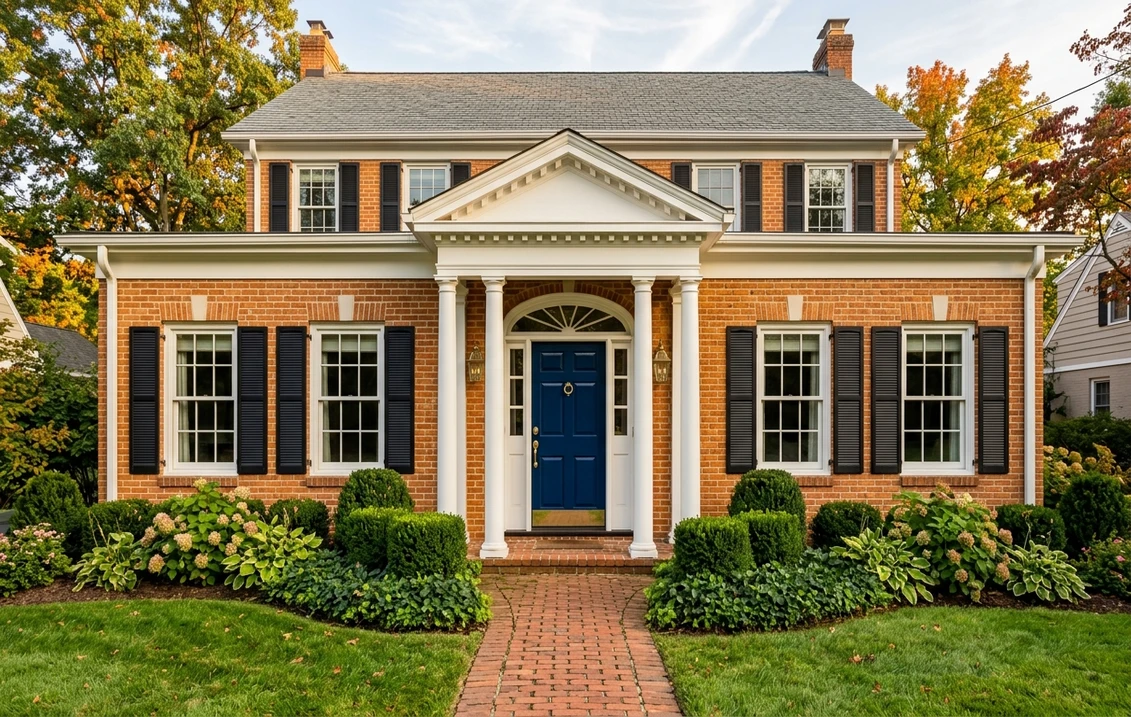
AI render: red door, gray colonial
Bold red is the original American front door color, and it still outperforms every brighter alternative on a gray house. Heritage Red (BM HC-181) is a deep, slightly muted red with a subtle blue undertone that prevents it from going tomato or orange. Best for: colonial, Cape Cod, and traditional gray bodies in medium-to-deep cool gray, with white trim and black shutters. Why it works: red is the chromatic opposite of gray on the color wheel, making it the strongest possible focal point against a cool gray facade. Hardware: polished brass or oil-rubbed bronze; avoid chrome. Avoid on: very warm taupe-grays where red can tip toward terracotta. Pair with a black storm door, never white.
4. Sage Green (Evergreen Fog SW 9130)
AI render: sage door, warm greige body
Sage green is the breakout 2026 alternative to navy for homeowners who want a softer, garden-friendly door. Evergreen Fog (SW 9130) is a muted sage with cool gray-olive undertones that ties beautifully to greige. Best for: warm gray and greige bodies (Agreeable Gray, Revere Pewter, Edgecomb Gray) with white or cream trim, especially on wooded lots where foliage reinforces the green. Why it works: sage is a tonal neighbor to warm gray, so it reads harmonious; it elevates the facade without screaming. Hardware: brushed brass, antique bronze, or matte black. Avoid on: very cool blue-grays, where sage can read muddy. Worth knowing before you commit the door: on wooded lots the sage often ends up looking better on the siding than on the door, and that inverted scheme has its own tested pairings in our guide to the sage green body with white trim and a black door.
5. Mustard Yellow (Bee SW 6683)
AI render: mustard door, greige craftsman
Mustard yellow is the most photographed door color of 2026 on Pinterest, and it works on warm gray and greige homes. Bee (SW 6683) is a saturated golden mustard with enough brown depth to read heritage rather than highlighter. Best for: craftsman, bungalow, and modern farmhouse facades in warm gray or greige with white trim. Why it works: mustard pulls the latent yellow out of greige and locks the palette into a warm story; it photographs beautifully at golden hour. Hardware: oil-rubbed bronze or aged brass. Avoid on: cool blue-gray bodies.
6. Warm Wood Stain (natural cedar or mahogany)
AI render: stained door, charcoal modern
A stained wood door is the highest-end pairing for a gray house, and the most under-used. Cedar, mahogany, and walnut stains add organic warmth no paint can match. Best for: modern, contemporary, and craftsman bodies in any gray tone, especially deeper charcoals where a stained door reads luxury rather than rustic. Why it works: wood grain breaks the monotony of painted siding; warm brown tones bridge cool gray to landscaping. Finish: marine-grade spar urethane; recoat every two to three years on south-facing doors. Hardware: matte black, oil-rubbed bronze, or unlacquered brass.
7. White (Alabaster SW 7008) - counterintuitive but works
AI render: white door, charcoal modern
A white door on a gray house sounds wrong until you see it on a very dark charcoal facade, where it is the only color that gives the entrance enough visual weight to function. Alabaster (SW 7008) is a soft warm white with just enough cream to avoid the glare of pure white. Best for: dark charcoal bodies (LRV under 30) like Iron Ore (SW 7069), Cracked Pepper (PPU18-01), or Kendall Charcoal (BM HC-166), where black would disappear. Why it works: on a dark gray facade, white is the highest possible contrast. Hardware: matte black or polished brass. Avoid on: light or medium gray bodies.
Avoid these mistakes when picking a door color for a gray house
Five mistakes cost homeowners thousands in repaints. First, too many colors on the front elevation: a gray house already has body, trim, roof, and often shutters; one saturated door color is plenty. Second, ignoring the trim color: a warm cream trim with a cool navy door clashes; match the door to the trim temperature, not just the body. Third, matching the door to the roof: shingles fade, so key the door to the siding instead. Fourth, picking from a fan deck indoors: north-facing indoor light reads colors 30 to 50 percent cooler than exterior light. Fifth, skipping the storm door: pick a black or color-matched frame, never white.
There is a sixth factor that is less a mistake than a blind spot: on most gray houses the door is never seen alone. It sits inside a porch, which adds three more painted surfaces (ceiling, floor, railings) competing for the same glance from the sidewalk. A pale blue ceiling or a mid-tone floor changes how a navy or black door reads far more than the shutters do, and the floor is not even the same product as the rest of the elevation. Our front porch paint color ideas guide covers those three surfaces and the order to decide them in.
How to test your front door color on your house in 30 seconds
The most expensive mistake in a door repaint is buying paint before you see the color at full scale on your home. A 16-square-foot door at eye level cannot be predicted by a credit-card hardware-store swatch. The 2026 fix is to photograph your front elevation and run an AI visualization before you buy a sample pot.
Upload one photo to our free AI exterior paint visualizer, select the door, and cycle through all seven colors. Your existing trim, siding, and roof stay preserved. For broader planning, our Sherwin-Williams color visualizer and Benjamin Moore color visualizer preview the whole facade.
No signup, no email, just a photo and 7 doors in under a minute.
How to test it on your own home before you buy
No third-party report replaces your own walls: the same color reads differently on a north elevation and a south one, next to red brick or a gray roof, under morning and evening light. Take a daylight photo, upload it to the free AI paint visualizer, and run two or three candidates on the same image so the comparison is fair. Keep the one or two that survive the side-by-side, buy a sample of each, and brush them out on the actual surface in the actual light before you order the full quantity. If the house is red brick rather than gray, the door palette changes with the brick's undertone, from orange-red to burgundy; the front door colors for a red brick house guide sorts the picks by brick.
The seven door colors by light reflectance value
Light reflectance value is the number that tells you how much a door will contrast with gray siding. The manufacturers publish it: Benjamin Moore lists Hale Navy HC-154 at LRV 8.36, Black 2132-10 at 4.56 and Heritage Red HC-181 at 10.26, describing the last as "a very classic shade of red that infuses a space with energy and personality". On the Sherwin-Williams side, Tricorn Black SW 6258 sits at LRV 3, Naval SW 6244 at 4, Evergreen Fog SW 9130 at 30, Bee SW 6683 at 55 and Alabaster SW 7008 at 82.
Read those numbers against your siding. A medium gray body around LRV 40 gives you a contrast of roughly 35 points against black or navy, which is why those two read so crisp; Evergreen Fog at 30 sits only ten points below the same siding and reads as a quiet, tonal door rather than an accent, which is the intended effect. Alabaster at 82 flips the logic entirely: on a dark charcoal house near LRV 10 it is the door with the biggest contrast on this list. If your gray is light, near LRV 60, the pale door loses its punch and the dark doors gain it. The visualizer applies your actual siding, which is faster than doing the arithmetic.
Sources and references
- Zillow, Slate blue, black front doors can sell homes for as much as $6,449 more (June 2022), the buyer study behind the resale figures quoted above.
- Benjamin Moore, Hale Navy HC-154, Black 2132-10 and Heritage Red HC-181, published LRV values.
- Sherwin-Williams, Tricorn Black SW 6258, manufacturer color page.
The right front door color is the single highest-ROI exterior paint decision on a gray house. Test all 7 colors on your home in under a minute with our free AI exterior paint visualizer. Sources: SW 2026 forecast, BM 2026 trend report, Zillow 2024 study, FacadeColorizer internal data.
Frequently asked questions
What is the most popular front door color for a gray house in 2026?
Does a navy door work on a warm gray or greige house?
Should the front door be lighter or darker than the gray siding?
What door color sells a gray house fastest?
Can I paint my gray house front door without repainting the trim?
What sheen should I use on a front door?
Trademarks mentioned (Sherwin-Williams, Benjamin Moore, Behr, Caparol, Brillux, Sto, Alpina, Valspar, PPG, Glidden, Dulux, Crown Trade, Sandtex, Farrow & Ball, Johnstone's, Leyland) are property of their respective owners. FacadeColorizer is independent and not affiliated with any of them. Nominative fair use under Lanham Act §1125.