Try it on your room

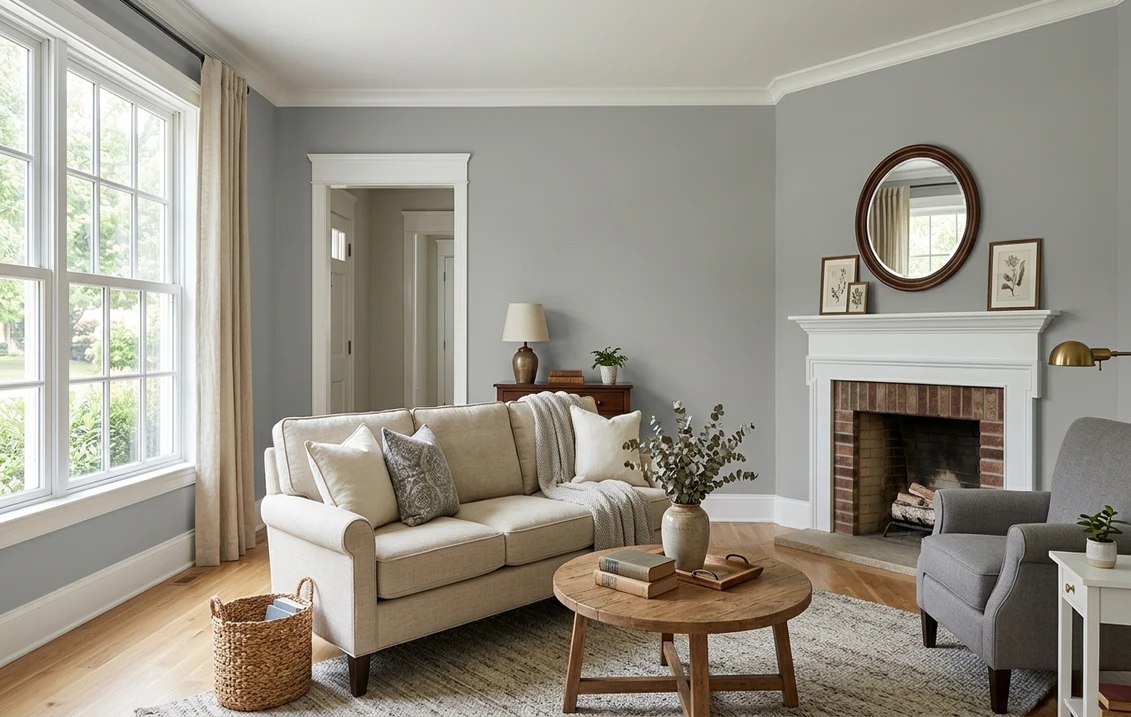
Benjamin Moore Coventry Gray (HC-169) is the gray I recommend when a homeowner says two sentences in a row: "I want real color on the wall" and "I do not want it to feel dark." Coventry sits in that middle band, deeper than the pale designer grays that read almost white by noon, yet light enough that a living room still feels open. The catch, and the reason people search it, is the undertone: Coventry leans blue, and how much blue you see depends on your windows and your bulbs. Here is how it actually behaves on interior walls.
Coventry Gray HC-169 belongs to Benjamin Moore's Historical Color collection and has a published LRV of about 48, with a hex approximation of #B8BAB6 (RGB 184, 186, 182). That is true mid-tone territory: it reflects roughly half the light that hits it, so it reads as a committed medium gray rather than a tinted white. On the fan deck it sits between the lighter Stonington Gray HC-170 above it and the much deeper Chelsea Gray HC-168 below it. This profile is one stop in our wider Benjamin Moore interior paint colors guide, which maps the whole family.
Upload a photo of your actual room and preview BM Coventry Gray under your own light in about 30 seconds, free.
Coventry Gray at a glance: the numbers that matter
Before opinions, the verifiable specs. These are the values you can take to a paint counter:
| Spec | Coventry Gray HC-169 |
|---|---|
| Color number | HC-169 (Historical Color collection) |
| LRV (Light Reflectance Value) | Approximately 48: a true mid-tone, reflects about half the light |
| Hex / RGB (approx.) | #B8BAB6 / 184, 186, 182 |
| Color family | Medium cool gray |
| Primary undertone | Light blue, calmer and grayer under warm light |
| Best base / finish | Eggshell or matte on walls, satin on doors and built-ins |
Try it on your house
No photo? Try a sample
The takeaway from those numbers: Coventry Gray is a decisive color choice, not a background neutral. An LRV near 48 means the wall visibly holds its tone through the day instead of washing out, but it also means Coventry asks more of your lighting than a light gray does. In a bright room it looks composed and tailored; in a dim one it settles noticeably deeper than the chip suggested. Plan for that and it rarely disappoints.
Is Coventry Gray blue or gray? The undertone, decoded
Both, honestly, and the ratio shifts with the light. Coventry Gray carries a light blue undertone, the same family trait that runs through its strip-mates. It is not a navy-adjacent blue-gray; it is a gray first, with a cool cast that surfaces most clearly in cool or indirect light.
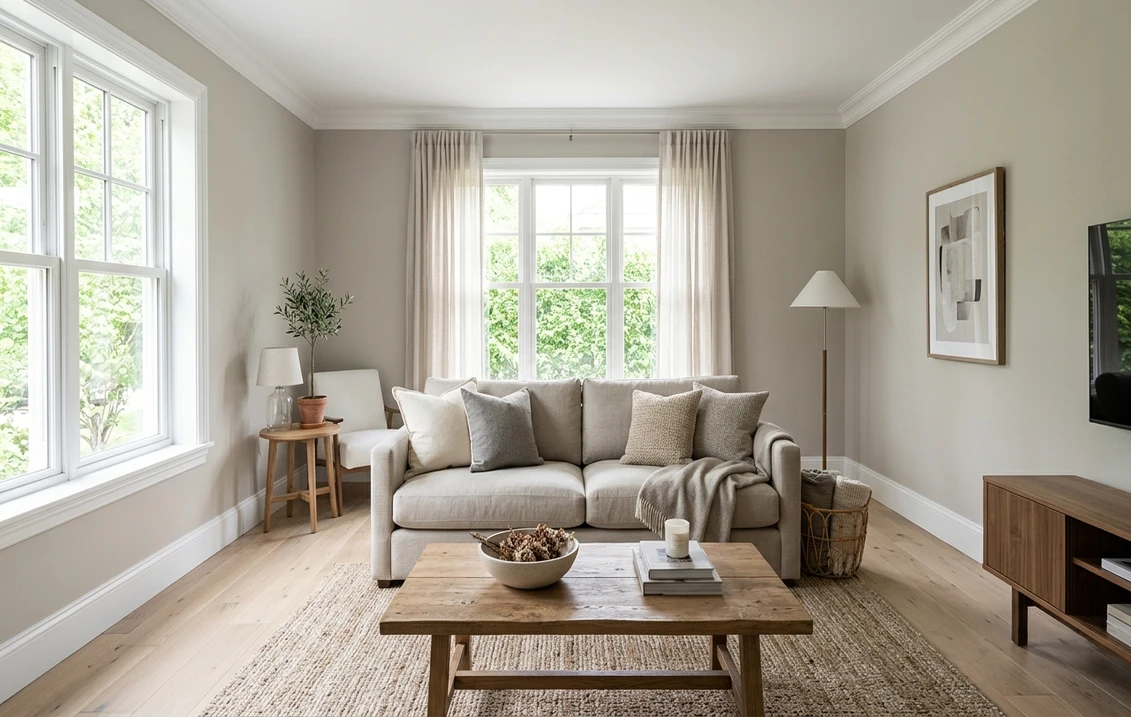
In warm afternoon sun the blue quiets down and Coventry reads as a classic medium gray, calm and slightly silvered. In a north-facing room, on an overcast day, or under cool 4000K bulbs, the blue steps forward and the wall reads distinctly blue-gray. The practical rule: if you want the gray read, feed it warm light. If you like the blue-gray read, a cooler room will give it to you all day.
| Indoor light | How Coventry Gray reads |
|---|---|
| South-facing (bright, warm) | Its grayest, calmest read; the blue softens into a silvery cast |
| West-facing (warm afternoon) | Balanced gray in the morning, warms and grays out by late day |
| East-facing (cool after noon) | Fresh in morning light, leans clearly blue-gray in the afternoon |
| North-facing (cool, indirect) | At its bluest and deepest; treat the blue-gray read as the design |
| Artificial light at night | Warm 2700K bulbs pull it toward neutral gray; cool bulbs push the blue forward |
Sources: Benjamin Moore HC-169 color data 2026; designer field reports compiled by FacadeColorizer.
Free AI visualizer. Test Coventry Gray on your real walls before buying a single sample pot.
Best rooms for Coventry Gray
A mid-tone gray with a cool lean is a workhorse in the right rooms and a liability in the wrong ones. Here is where Coventry consistently earns its keep:
Living rooms and dining rooms with good light
This is the classic Coventry assignment. At LRV 48 the walls have enough weight to frame art, white built-ins, and a fireplace surround, and against crisp white trim the contrast looks deliberate and architectural. It is why mid-tone grays like this one anchor so many traditional and transitional living spaces.
Bedrooms that want depth without darkness
In a bedroom Coventry reads restful and enveloping without tipping into moody. Cool colors are a natural fit for sleep spaces, and Coventry delivers that calm while staying firmly in livable-neutral territory. White bedding and pale wood keep the scheme fresh; brass and walnut warm it up.
Home offices, hallways, and cabinetry
Coventry is deep enough to work as a cabinetry or built-in color in a bright kitchen or mudroom, a gentler alternative when charcoal feels too heavy. Its darker strip-mate is covered in our Chelsea Gray HC-168 review: choose Chelsea when the island should read boldly dark, Coventry when it should read medium and calm.
Where to think twice
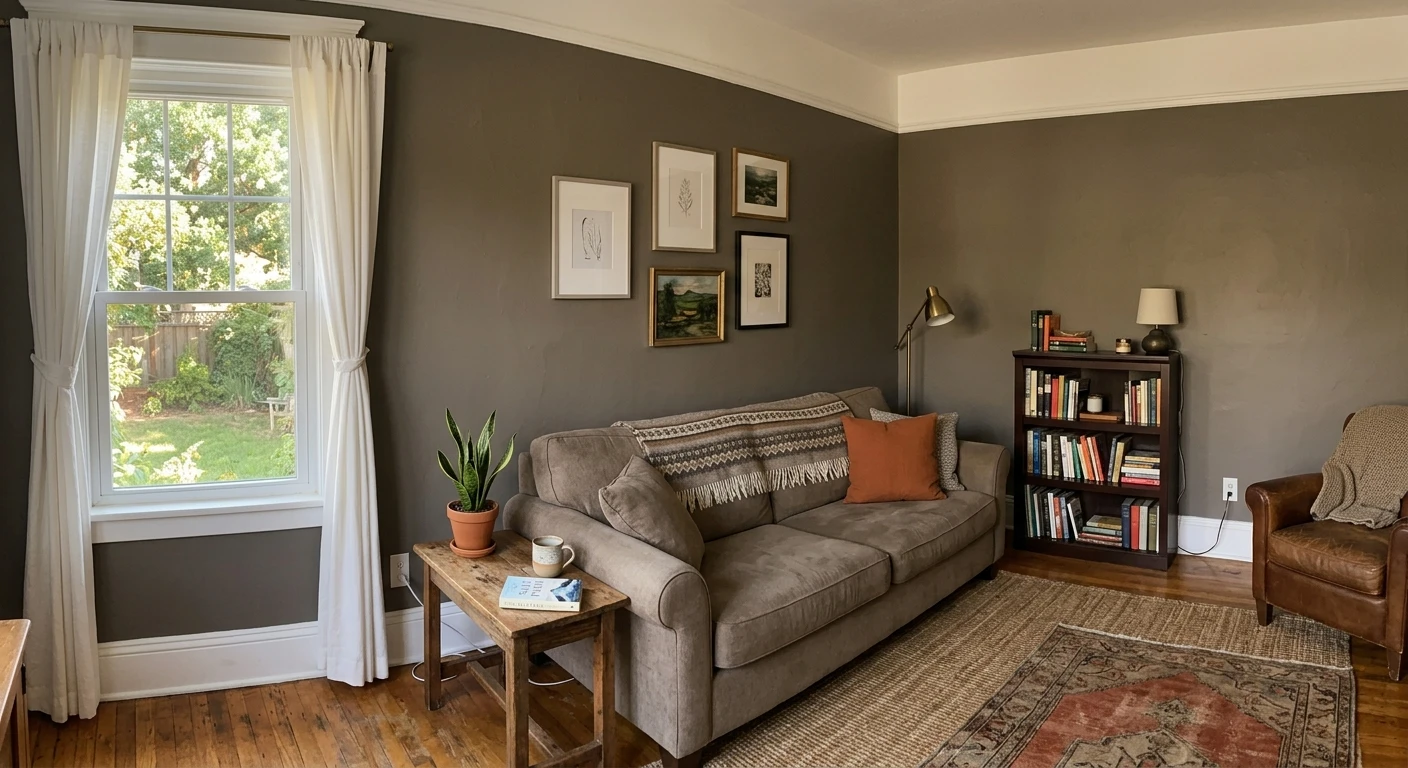
A small, dim, north-facing room is where Coventry Gray needs caution: the mid-tone LRV plus the cool cast can push a low-light space closer to dusk than to daylight. There, either commit to the moody blue-gray look on purpose, switch to warm 2700K bulbs, or step up one notch on the strip to a lighter gray.
Trim, ceiling, and decor pairings
Mid-tone cool grays live or die on their pairings. What works:
- Soft warm trim (most balanced): BM White Dove (OC-17) is the default answer. Its gentle warmth takes the chill off Coventry's blue cast while still reading clean, and the value gap between the two is wide enough that trim lines stay crisp.
- Crisp trim (cooler, more modern): BM Chantilly Lace (OC-65) sharpens the contrast and leans into the blue-gray read. Best with black window frames, marble, and contemporary furniture.
- Avoid: yellow-leaning cream trim. Next to a cool mid-tone gray, a heavy antique white looks dingy and makes the walls look bluer than they are.
- Ceilings: keep them a clean white to preserve the room's light budget; at LRV 48 the walls are already doing the darker work.
- Floors and decor: white oak, pale natural textiles, chrome, and brushed nickel flatter the cool side. Warm brass, walnut, and leather pull the scheme warmer and stop it from feeling stark.
Coventry Gray vs the colors people cross-shop
Nearly every Coventry Gray shortlist includes one of its own strip-mates:
- vs BM Stonington Gray (HC-170): the big one. Stonington (LRV about 59) is a full step lighter and reads airy and coastal; Coventry (LRV about 48) holds visibly more weight and keeps its color in bright light where Stonington starts to wash out. Small or dim rooms usually favor Stonington; bright rooms that want presence favor Coventry. Our Benjamin Moore Stonington Gray HC-170 profile covers the lighter sibling in depth, and Coventry Gray vs Stonington Gray: the full duel settles the head-to-head room by room.
- vs BM Chelsea Gray (HC-168): Chelsea (LRV about 23) is dramatically deeper, a true dark gray for islands, doors, and accent walls. Coventry is the whole-room version of the same cool attitude; the two layer beautifully together, and our Chelsea Gray vs Coventry Gray side-by-side duel settles which one your room actually needs.
- vs lighter designer grays generally: coming from high-LRV grays, expect Coventry to feel like a real commitment; judge it after the second coat, in daylight, on more than one wall.
Spelling note: coventry grey, BM Coventry Gray, and Coventry Gray Benjamin Moore all point to this same HC-169.
How to test Coventry Gray before you commit
Mid-tone grays are the most punishing colors to pick from a 2-inch chip, which cannot show how much light your room subtracts from an LRV 48 paint. Two better methods:
- Paint a large swatch: roll at least a 12-by-12-inch sample on two walls, one near the window and one in your darkest corner. Check it mid-morning, late afternoon, and at night under your normal bulbs. The dark-corner swatch is the honest one.
- Preview it digitally first: upload a photo of your room and run Coventry against its lighter and darker strip-mates before buying samples. Our guide on how to compare paint colors side by side walks through the exact shortlist-then-sample method that avoids the five-sample-pot spiral.
Preview the mid-tone and its lighter sibling side by side on your real walls, free.
Frequently asked questions
Is Coventry Gray blue or gray?
Coventry Gray (HC-169) is a medium gray with a light blue undertone, so it shows both faces depending on the light. In warm or bright light it reads as a classic silvery mid-tone gray. In north-facing rooms, on overcast days, or under cool bulbs the blue steps forward and it reads clearly blue-gray. Warm 2700K bulbs are the easiest way to keep it on the gray side at night.
What is the LRV of Coventry Gray?
Coventry Gray has a Light Reflectance Value of approximately 48, with a hex approximation of #B8BAB6 (RGB 184, 186, 182). That makes it a true mid-tone: it reflects about half the light that hits it, so it holds visible color through the day instead of washing out, but it also needs decent natural or warm artificial light to avoid settling deeper than expected.
What trim colors go with Coventry Gray?
BM White Dove (OC-17) is the most balanced trim: its soft warmth takes the chill off Coventry's blue cast while keeping crisp contrast against the mid-tone walls. BM Chantilly Lace (OC-65) is the cooler, sharper option for modern rooms and black window frames. Avoid yellow-leaning cream trim, which looks dingy next to a cool gray and exaggerates the blue in the walls.
Is Coventry Gray lighter or darker than Stonington Gray?
Coventry Gray is the darker of the two. Stonington Gray (HC-170) has an LRV of about 59 and reads light and airy, while Coventry Gray (HC-169) sits near 48 and reads as a committed medium gray. They share the same cool family on the Benjamin Moore strip, so the choice is mostly about depth: Stonington for small or dim rooms, Coventry for bright rooms that want more presence on the wall.
Preview BM Coventry Gray on your actual walls under your own light before buying a single sample.
Disclaimer: Benjamin Moore, Coventry Gray (HC-169), Stonington Gray (HC-170), Chelsea Gray (HC-168), White Dove (OC-17), and Chantilly Lace (OC-65) are trademarks of Benjamin Moore & Co. FacadeColorizer is an independent paint visualization service and is not affiliated with, endorsed by, or sponsored by Benjamin Moore. Color reproduction on screens approximates the manufacturer's chip; always confirm with a manufacturer sample under your own light before purchase. Sources: Benjamin Moore HC-169, HC-170 and HC-168 color data 2026, designer field reports compiled by FacadeColorizer.
Trademarks mentioned (Sherwin-Williams, Benjamin Moore, Behr, Caparol, Brillux, Sto, Alpina, Valspar, PPG, Glidden, Dulux, Crown Trade, Sandtex, Farrow & Ball, Johnstone's, Leyland) are property of their respective owners. FacadeColorizer is independent and not affiliated with any of them. Nominative fair use under Lanham Act §1125.