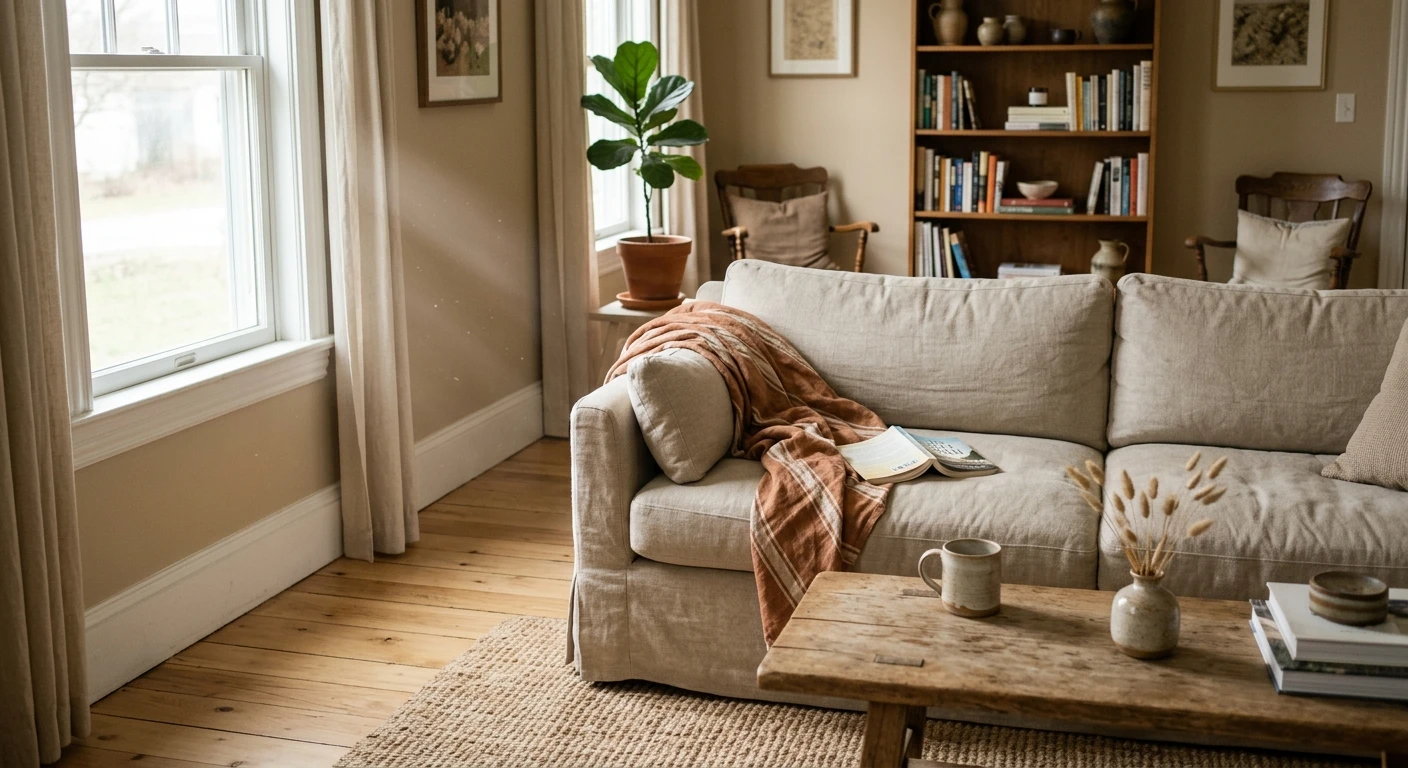
Try it on your room

A client handed me a fan deck last spring with one chip dog-eared and a sticky note that read "warm, but not yellow, please." The chip was Benjamin Moore Manchester Tan (HC-81), and after twenty-odd years of cutting in trim lines I knew exactly why she had landed there. This is the tan that refuses to go gold. It sits in the brand's Historical Color collection as a quiet, dependable neutral, the kind that flatters oak floors and cream cabinets without ever shouting. The recurring question, spelled a dozen ways, is whether Manchester Tan reads warm or cool, and which rooms it actually suits. The honest answer leans on your light. Here is how it behaves indoors.
Quick orientation before the deep dive. Manchester Tan HC-81 carries an approximate published LRV of 64 and a hex approximation of #D6CBB4 (RGB 214, 203, 180). That puts it in light, warm tan-greige territory (tan plus a touch of gray) with a soft cream-khaki lean. It is genuinely warm without being yellow, and that single trait is what keeps it from looking dated the way many builder tans do. This profile is one stop in our wider Benjamin Moore interior paint colors guide, and it is the indoor companion to our Manchester Tan HC-81 exterior guide: that one covers the color on siding and facades, while this one stays on interior walls, rooms, undertones, and pairings. They are complementary, not duplicates.
Upload a photo of your actual room and preview Manchester Tan under your own light in about 30 seconds, free.
Manchester Tan at a glance: the numbers that matter
Before opinions, here are the approximate published specs straight from the Benjamin Moore color library. These are the values you can take to a paint counter:
- BM number: HC-81 (Historical Color collection).
- LRV (Light Reflectance Value): approximately 64. Light enough to keep a room bright and open, low enough to feel softer and grounded compared to an off-white at LRV 80 plus.
- Hex / RGB: approximately #D6CBB4 / 214, 203, 180. The red channel sits highest and blue lowest, which is the mathematical signature of a warm neutral.
- Color family: light warm tan-greige, with a quiet cream-khaki lean.
- Undertones: warm tan-beige primary, with a faint olive-green that can surface in cool, shaded light.
- Tint base: mixed in a light or white base. A deep base will read muddy and miss the LRV 64 target, and the undertone gets heavier on the second coat.
The takeaway from those numbers: Manchester Tan is a true warm neutral, but it leans more tan than greige. At an LRV near 64 with a warm tan-beige undertone, it lands warmer and a touch deeper than a balanced greige such as Pale Oak, and clearly warmer than a cool gray. Sitting in that flexible middle, neither orange-tan nor washed-out, is exactly what lets it travel from room to room without clashing with wood or cream.
Is Manchester Tan warm or cool? The undertone, decoded
Manchester Tan is a warm color, full stop. People who call it cool are usually reacting to one of two things: a north-facing room or a stark white trim sitting right next to it. Here is what is happening underneath.
The tan-beige base is dominant in most light. But Manchester Tan also carries a whisper of olive-green, the same softening pigment that keeps it from ever going peachy or gold. In warm or balanced light that olive stays invisible and the wall simply reads as a soft warm tan. In cool, indirect light (a north room, an overcast Tuesday, deep shade), the warm wavelengths get subtracted from the room and the residual olive-green steps forward. That is when Manchester Tan can look a touch greener or muddier than the chip promised. It does not turn pink or lavender the way some beiges do, which is exactly why painters trust it on big open walls.
Watch out for one quirk. Manchester Tan photographs lighter and more yellow than it lives, because cameras boost the warmth. So if you are choosing from Pinterest photos alone, assume the real wall will land a touch deeper and a shade more grounded than the image suggests.
| Indoor light | How Manchester Tan reads |
|---|---|
| South-facing (bright, warm) | Soft warm tan-greige, its most flattering and inviting read |
| West-facing (warm afternoon) | Leans clearly toward warm tan-khaki in late-day sun |
| East-facing (cool after noon) | Warm and golden in the morning, settles to a grounded neutral by afternoon |
| North-facing (cool, indirect) | Cooler and flatter; the faint olive-green can surface |
| Artificial light at night | Warm 2700K bulbs read cozy and creamy; cool 4000K bulbs read grayer and can pull the olive forward |
Try it on your house
No photo? Try a sample
Sources: Benjamin Moore HC-81 Manchester Tan color data 2026; The Spruce neutral-paint undertone coverage; designer field reports compiled by FacadeColorizer.
Free AI visualizer. Test Manchester Tan on your real walls before buying a single sample pot.
Best rooms for Manchester Tan
Light, warm, and quietly versatile all at once, Manchester Tan is one of those colors you can run across most of a floor plan without any single room pushing back. Here are the spaces where it consistently earns its keep:
Open-plan living rooms and great rooms
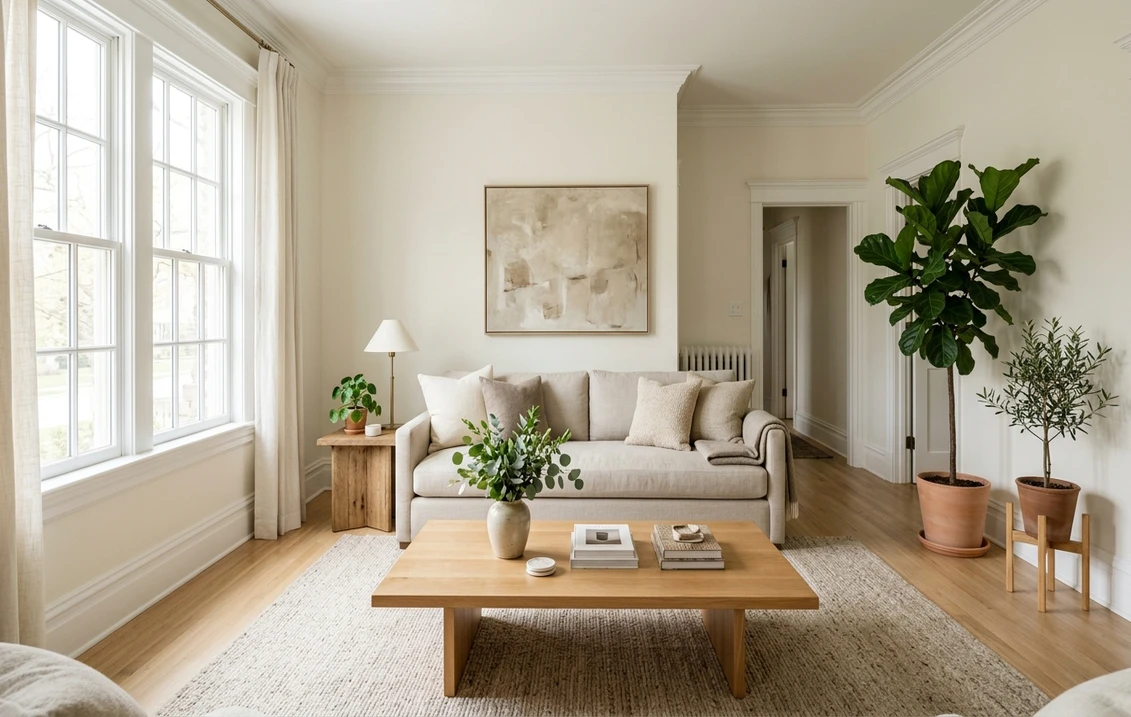
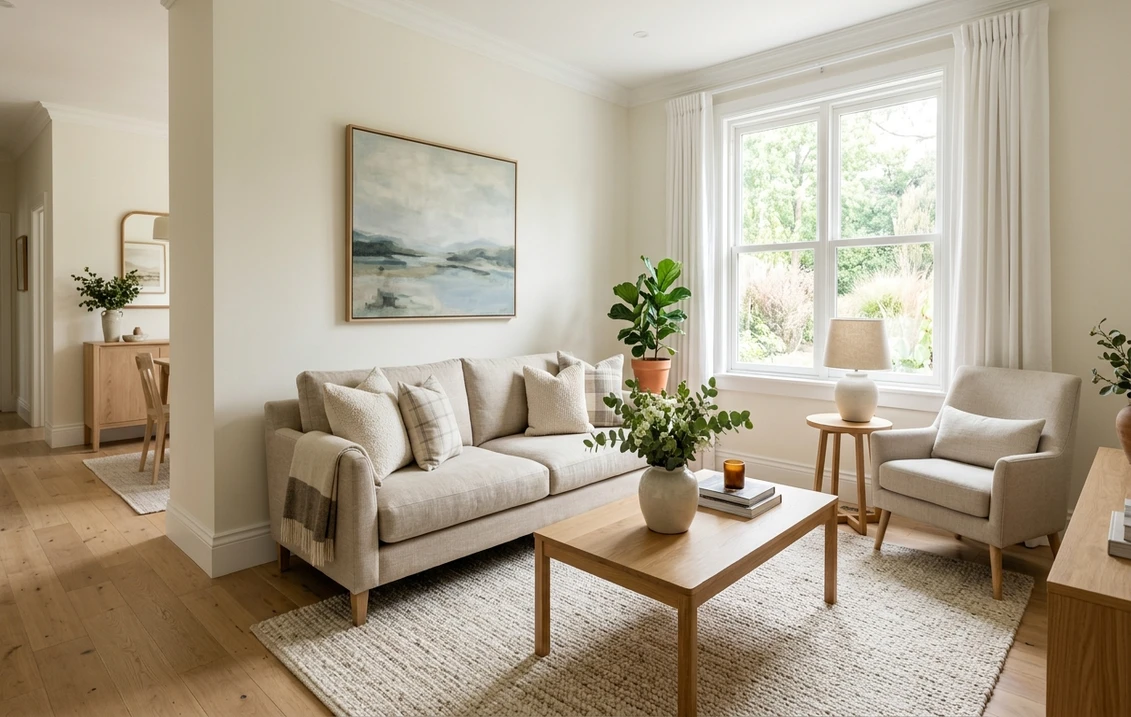
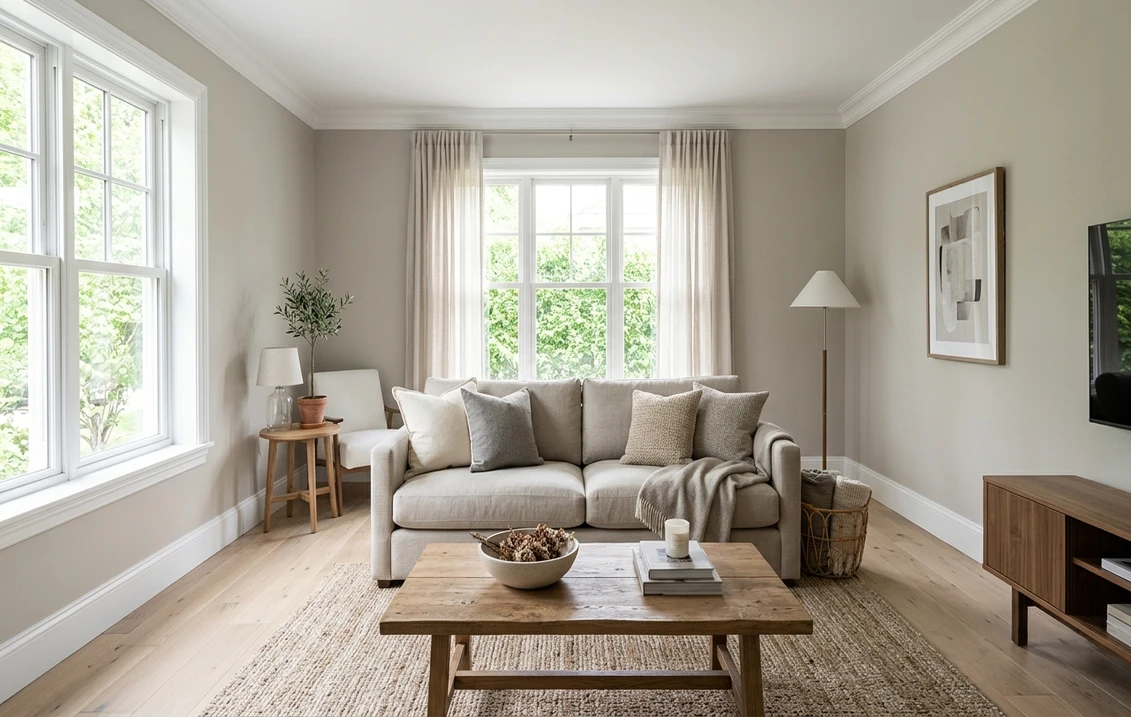
This is Manchester Tan's home turf. On a large connected wall plane it reads as a calm, warm backdrop that lets furniture, art, and wood tones do the talking. Pair it with warm-white trim and an oak or walnut floor and the room reads collected and traditional rather than builder-grade. For more whole-room schemes built around warm neutrals, see our top living room paint colors for 2026.
Primary bedrooms
Manchester Tan makes a restful bedroom because the warmth keeps it cozy at night under lamp light, while the gentle gray side keeps it from tipping into dated builder-beige. Think calm, grown-up retreat. If a bedroom is your project, our guide to calming master bedroom paint colors shows how it sits next to other restful neutrals.
Kitchens, dining rooms, and hallways
On kitchen and dining walls Manchester Tan plays beautifully with white, cream, and natural-wood cabinets, and it is a forgiving pick for long windowless hallways where its warmth keeps the space from feeling like a tunnel. For how it sits among other warm-toned families, our beige paint colors and undertones guide is a useful map.
Where to think twice
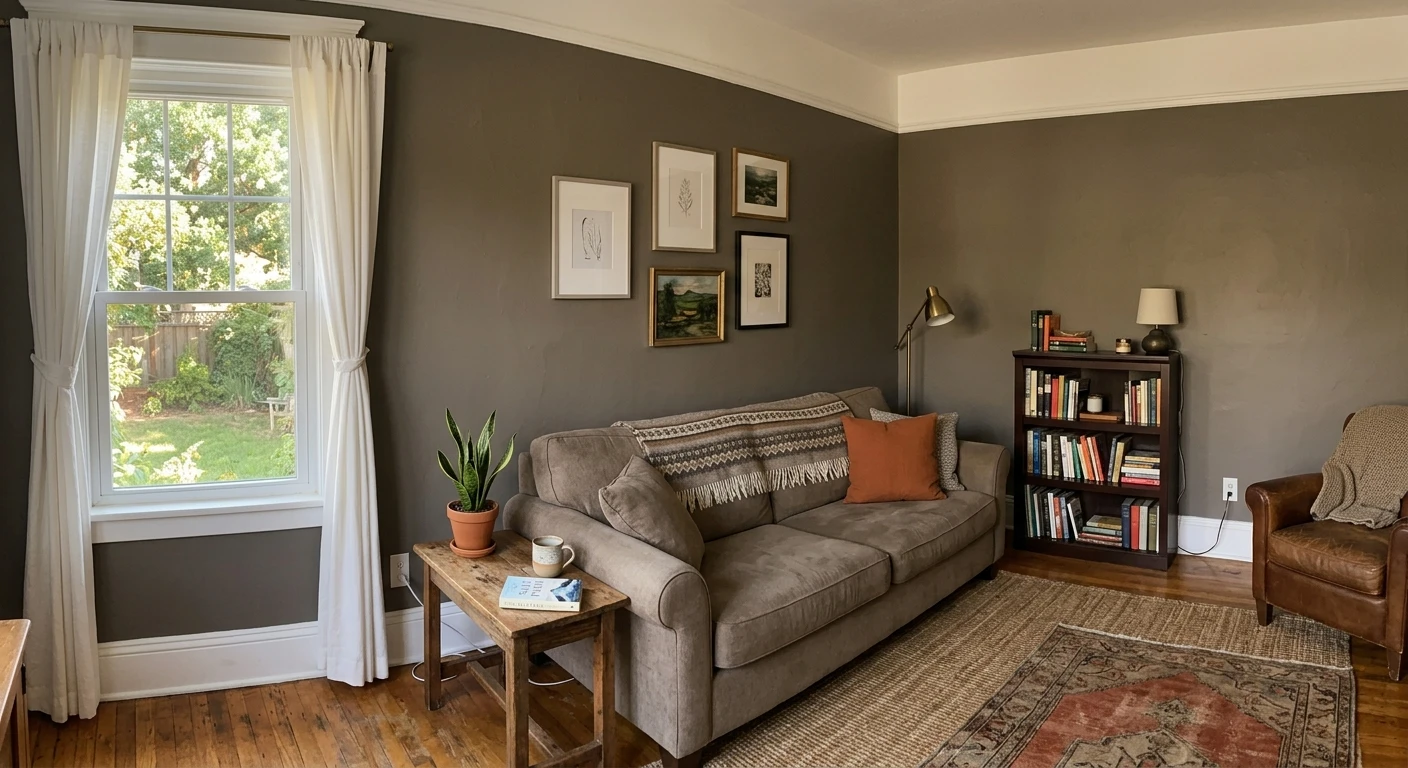
Small, dim, north-facing rooms with no warm light source are where Manchester Tan can fall flat and let the olive-green creep in. A windowless powder room or a basement under cool LEDs mutes its warmth and leaves it looking drab. There, a lighter greige like Pale Oak or a warmer bulb (2700K) rescues it. To place it against its neighbors first, our interior paint color families guide shows where tan sits in the bigger picture.
Trim, ceiling, and decor pairings
A warm tan body color lives or dies on what sits next to it. Get the trim right and Manchester Tan looks intentional and historic; get it wrong and it can look dingy.
- Warm trim (most harmonious): BM White Dove (OC-17, LRV 85) is the designer default. Its soft, slightly warm white flatters Manchester Tan instead of exposing the tan as dirty. This is the safe, cohesive pick for traditional and transitional rooms.
- Crisp trim (cleaner, brighter): BM Chantilly Lace (OC-65, LRV 90) gives a brighter, more current edge and sharpens the contrast. It can read slightly cool next to the tan, so cut in a sample line first and judge it on the wall.
- Avoid: a stark blue-white next to Manchester Tan. The cool contrast makes the walls read muddy and pulls the olive-green forward by comparison.
- Ceilings: a clean warm white (or the trim color) keeps the room bright. A heavy cool-white ceiling over Manchester Tan amplifies any cool-light flatness.
- Floors and decor: warm oak, walnut, rattan, brass, and natural linen reflect warmth back onto the walls and bring out the tan. Cool gray-washed floors do the opposite and leave the room flat.
For accents and millwork drama, a deep warm green such as BM Essex Green, or a soft black on doors and built-ins, reads sophisticated against the warm tan. If you want a lighter, more modern neutral in the same family, our Benjamin Moore Pale Oak OC-20 review covers the softer cousin most people cross-shop with Manchester Tan.
See walls, trim, and floor together in one preview, free.
Manchester Tan vs the colors people confuse it with
Almost every Manchester Tan search ends in a comparison. The four that matter most indoors:
| Color | Approx LRV | Read vs Manchester Tan |
|---|---|---|
| Manchester Tan (HC-81) | 64 | Baseline: warm tan-greige, olive whisper |
| Pale Oak (OC-20) | 70 | Lighter, softer, more gray with a pink whisper, less tan |
| Shaker Beige (HC-45) | 56 | Deeper and clearly more golden-beige, cozier and darker |
| Grant Beige (HC-83) | 57 | Same depth as Shaker Beige but taupe-greige instead of gold, with a pink-gray that can show in cool light |
| Stonington Gray (HC-170) | 59 | Cool gray with blue undertone, the opposite temperature |
In plain painter terms: choose Manchester Tan when you want clear warmth with a hint of tan. Reach for Pale Oak when you want a barely-there neutral, Shaker Beige when you want cozier and deeper, and Stonington Gray only if you actually want gray to read as gray rather than warmth. Grant Beige is the trickiest of the four, because it lands within a point of Shaker Beige on the light scale yet behaves nothing like it: warmth without the gold, and a pink-gray that can surface where Manchester Tan would show olive. Our Benjamin Moore Grant Beige HC-83 review covers when that trade is worth making. Spelling note: Manchester Tan paint, Manchester Tan undertones, and Manchester Tan HC 81 all point to this same HC-81.
One comparison is missing from that table because it crosses the aisle. The Sherwin-Williams color homeowners cross-shop against HC-81 is Agreeable Gray (SW 7029), and it lands closer on the light scale than any Benjamin Moore neighbor above: LRV 60 against 64, a four-point gap you will not read on a finished wall. What separates them is direction, not depth. Manchester Tan is tan first, with an olive whisper behind it; Agreeable Gray is a cream-based greige sitting nearer the gray end of that range, so it reads as a neutral where HC-81 reads as visible warmth. If your samples keep looking too tan but the depth was right, that is the swap to try.
How to test Manchester Tan before you commit
A 3-inch fan-deck chip is the number-one reason people pick a tan that disappoints: it reads lighter and yellower than a rolled wall and cannot show the undertone shift across a day. Two better methods:
- Paint a large swatch: roll a 12-by-12-inch sample (or a peel-and-stick sample) on two different walls and check it mid-morning, mid-afternoon, and at night under your normal bulbs. Give it a second coat so the undertone reads true, and watch for the olive in any dim corner.
- Preview it digitally first: upload a real photo of your room and apply Manchester Tan (plus a lighter and a deeper alternative) before you buy any samples, narrowing three contenders to one worth painting. Pricing context for the full repaint is in our interior house painting cost guide for 2026.
Preview Manchester Tan against a lighter and a deeper neutral, side by side, free.
Frequently asked questions
Is Manchester Tan warm or cool?
Manchester Tan (HC-81) is a warm color. It is a light tan-greige with a dominant warm tan-beige undertone and only a faint olive-green that surfaces in cool, indirect light. In most rooms it reads as a soft warm tan; in a north-facing or dimly lit space it can look slightly greener or flatter, but it never turns pink or lavender the way some beiges do.
What is the LRV of Manchester Tan?
Manchester Tan has an approximate Light Reflectance Value of 64 on the Benjamin Moore color data, with a hex approximation of #D6CBB4 (RGB 214, 203, 180). That makes it a light warm tan-greige: bright enough to keep a room open, but with enough depth to feel grounded rather than washed out like a high-LRV off-white.
What are the best rooms for Manchester Tan?
Open-plan living rooms, primary bedrooms, kitchens, dining rooms, and windowless hallways are where Manchester Tan shines, because its warmth and light reflectance flatter wood and cream together. It is least reliable in small, windowless, or north-facing rooms with only cool light, where the olive-green can creep in; a lighter greige or a 2700K bulb helps there.
What trim color goes with Manchester Tan?
BM White Dove (OC-17) is the most harmonious trim because its soft, slightly warm white flatters Manchester Tan instead of exposing the tan as dirty. BM Chantilly Lace (OC-65) is the crisper, brighter option for more contrast. Avoid a stark blue-white next to it, which makes the walls read muddy and pulls the olive forward by comparison.
What is the difference between Manchester Tan and Pale Oak?
Manchester Tan (HC-81) is warmer and more clearly tan, while Pale Oak (OC-20) is lighter, softer, and more of a near-neutral greige with a faint pink-gray whisper. Choose Manchester Tan for visible warmth and a hint of tan; choose Pale Oak when you want a barely-there neutral. Manchester Tan also has a published exterior profile for siding and facades.
Preview Manchester Tan on your actual walls under your own light before buying a single sample.
Disclaimer: Benjamin Moore, Manchester Tan (HC-81), Pale Oak (OC-20), Shaker Beige (HC-45), Stonington Gray (HC-170), White Dove (OC-17), Chantilly Lace (OC-65), and Essex Green are trademarks of Benjamin Moore & Co. FacadeColorizer is an independent paint visualization service and is not affiliated with, endorsed by, or sponsored by Benjamin Moore. LRV and hex values are approximate published references; color reproduction on screens approximates the manufacturer's chip, so always confirm with a manufacturer sample under your own light before purchase. Sources: Benjamin Moore HC-81 Manchester Tan color data 2026, Benjamin Moore OC-20 Pale Oak and HC-45 Shaker Beige color data 2026, The Spruce neutral-paint undertone coverage, designer field reports compiled by FacadeColorizer.
Trademarks mentioned (Sherwin-Williams, Benjamin Moore, Behr, Caparol, Brillux, Sto, Alpina, Valspar, PPG, Glidden, Dulux, Crown Trade, Sandtex, Farrow & Ball, Johnstone's, Leyland) are property of their respective owners. FacadeColorizer is independent and not affiliated with any of them. Nominative fair use under Lanham Act §1125.