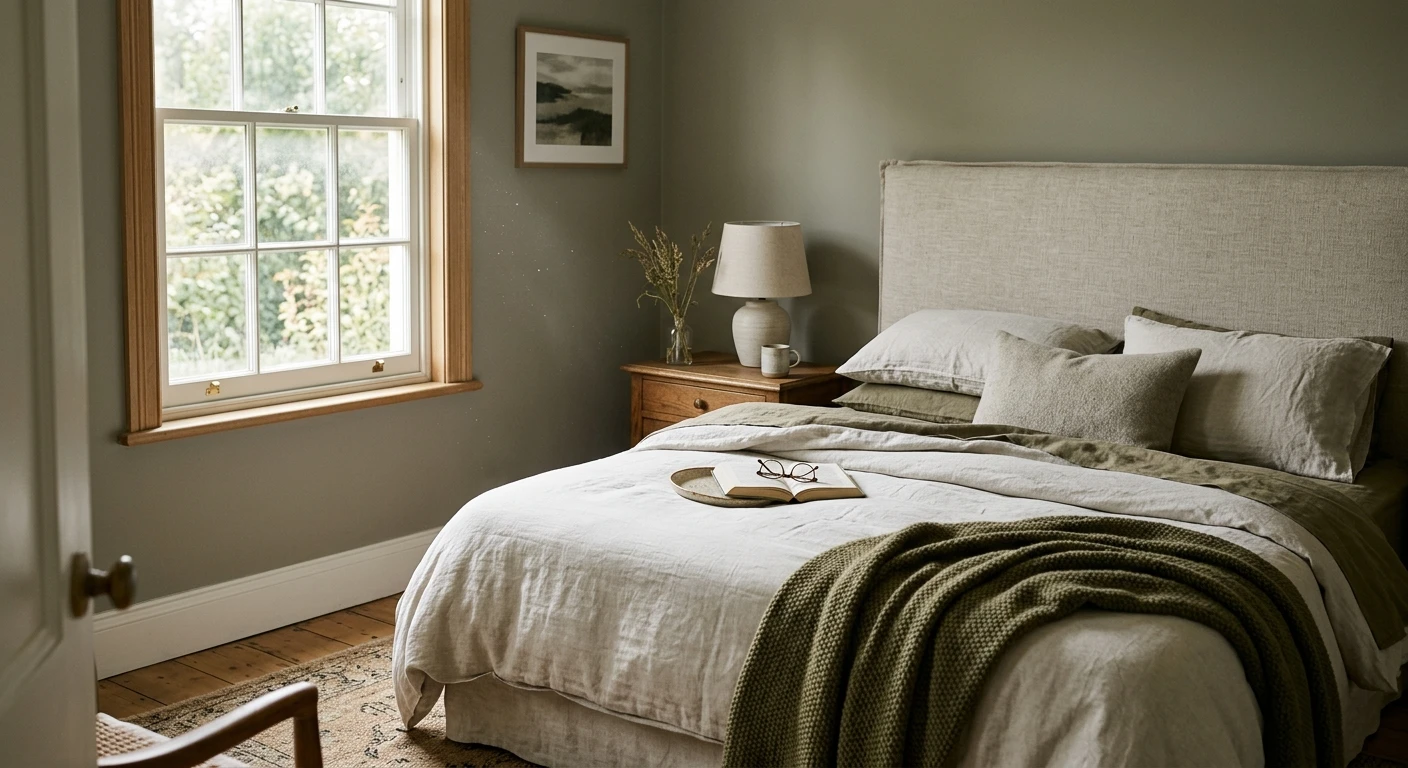
Try it on your room

A client handed me a fan deck last spring with one chip dog-eared and a sticky note that read "calm, not minty." It was Benjamin Moore Acacia Haze (1484), and that note basically writes the whole review. This is a muted gray-green sage that has been quietly winning kitchen islands, dining rooms, and home offices, precisely because it stays soft instead of loud. The question I hear most is whether it reads too gray or too green on the wall. The honest answer leans on your light, and here is exactly how it behaves indoors.
Quick orientation before the deep dive. Acacia Haze 1484 has a published LRV of roughly 38 and a hex approximation of #9A9A86 (RGB 154, 154, 134). That is a mid-tone, desaturated sage: gray and green carried in near-equal measure, with the faintest dusty warmth underneath. It is not a chalky pastel and not a bold forest. This profile is one stop in our wider Benjamin Moore interior paint colors guide, and it sits inside the broader family covered in our sage green interior paint shades and pairings. Think of this page as the close-up on one specific chip.
Upload a photo of your actual room and preview Acacia Haze under your own light in about 30 seconds, free.
Acacia Haze at a glance: the numbers that matter
Before opinions, here are the values to take to a paint counter. Treat the hex and LRV as close approximations of the published Benjamin Moore data, not lab-exact figures:
| Spec | Acacia Haze 1484 |
|---|---|
| Brand and number | Benjamin Moore 1484 |
| LRV (Light Reflectance Value) | Approximately 38: a true mid-tone, deeper than a pastel, lighter than a saturated green |
| Hex / RGB (approx.) | #9A9A86 / 154, 154, 134: red and green channels nearly tied, blue lowest, the signature of a gray-green |
| Color family | Muted, grayed sage green |
| Undertones | Balanced gray-green primary, with a faint dusty-warm (almost khaki) base |
| Recommended base | A mid or medium tint base holds the depth; a light base can wash the color toward gray |
Try it on your house
No photo? Try a sample
Sources: Benjamin Moore 1484 Acacia Haze color data 2026; The Spruce sage-paint coverage; designer field reports compiled by FacadeColorizer.
The takeaway from those numbers: Acacia Haze is a grown-up sage. At LRV 38 it carries real weight, which is why it works as an enveloping color in a small study but can feel heavy across a large, low-light room. The near-tie between the red and green channels keeps it balanced rather than committing to either, which is both the whole appeal and the source of every "is it gray or green" debate online.
Acacia Haze undertones, decoded
Acacia Haze undertones are best described as a gray-green with a quiet warm floor under it. People who call it "too gray" and people who call it "too green" are usually just standing in two different rooms. Here is what is happening underneath.
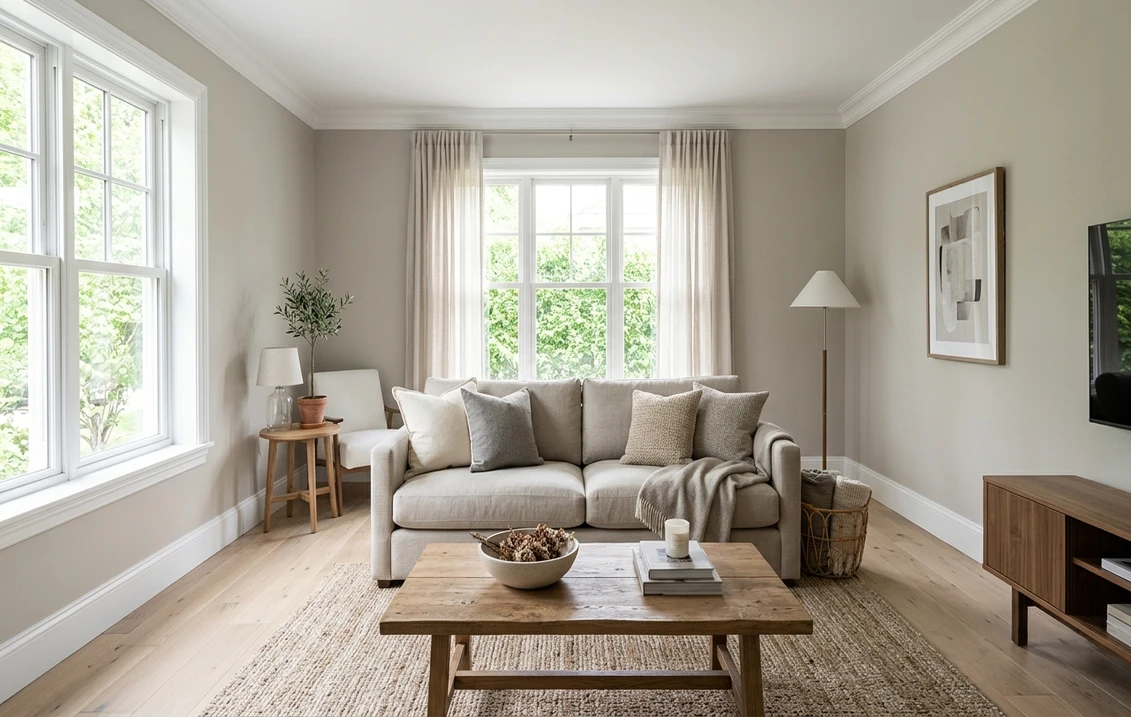
The gray and green sit close to even, so neither runs the show. What tips the balance is the light hitting the wall. In warm or bright light, the green wakes up and the color reads as a soft, dusty sage. In cool, flat light, the warm wavelengths get subtracted and the gray steps forward, so the same paint can look almost like a muted greige. Underneath both reads is a faint khaki warmth that keeps Acacia Haze from going cold or minty. It does not flash blue, and it does not turn pistachio.
One painter's heads-up. Acacia Haze photographs greener and brighter than it lives. So if you are judging from someone's kitchen reveal online, assume the real wall lands a half-step grayer and quieter than the photo promised. That gap is exactly why a sample on your own wall matters with this color.
| Indoor light | How Acacia Haze reads |
|---|---|
| South-facing (bright, warm) | Its best read: a soft, sunlit sage with the green gently forward |
| West-facing (warm afternoon) | Warmest and greenest in late-day sun, can flirt with a khaki cast |
| East-facing (cool after noon) | Fresh sage in the morning, settling grayer by afternoon |
| North-facing (cool, indirect) | Grayest and most muted; the green recedes and it can read like a greige |
| Artificial light at night | Warm 2700K bulbs revive the sage and cozy it up; cool 4000K bulbs push it gray and flat |
Sources: Benjamin Moore 1484 color data 2026; The Spruce undertone coverage; designer field reports compiled by FacadeColorizer.
Free AI visualizer. Test Acacia Haze on your real walls before buying a single sample pot.
Best rooms for Acacia Haze
Acacia Haze paint earns its keep where you want calm with a little backbone. At LRV 38 it is a color you wrap a room in, not one you use to bounce light around. Here are the spaces where it consistently delivers:
Kitchen islands and lower cabinets
This is where I see Acacia Haze most. On a two-tone kitchen with white or cream uppers and an Acacia Haze island, the sage grounds the room without shouting. It plays beautifully with brass hardware, white oak, and honed marble. For where this lands among the year's most popular cabinet tones, see our roundup of green interior paint shades for 2026.
Dining rooms
A dining room is one of the few rooms where you can lean into a deeper, moodier wall, and Acacia Haze rewards it. By candle and warm bulb at night the sage softens and feels intimate, exactly the mood you want around a table. Pair it with warm wood and a brass fixture and it reads collected rather than dark.
Home offices, studies, and powder rooms
Small rooms are where Acacia Haze shines as an enveloping color. In a study or a windowless powder room, that mid-tone depth turns into an asset: the walls feel considered and calm instead of flat. A green like this in a small space reads as a design choice, not a default. Our broader sage green interior paint shades guide shows how it sits next to lighter and deeper neighbors.
Where to think twice
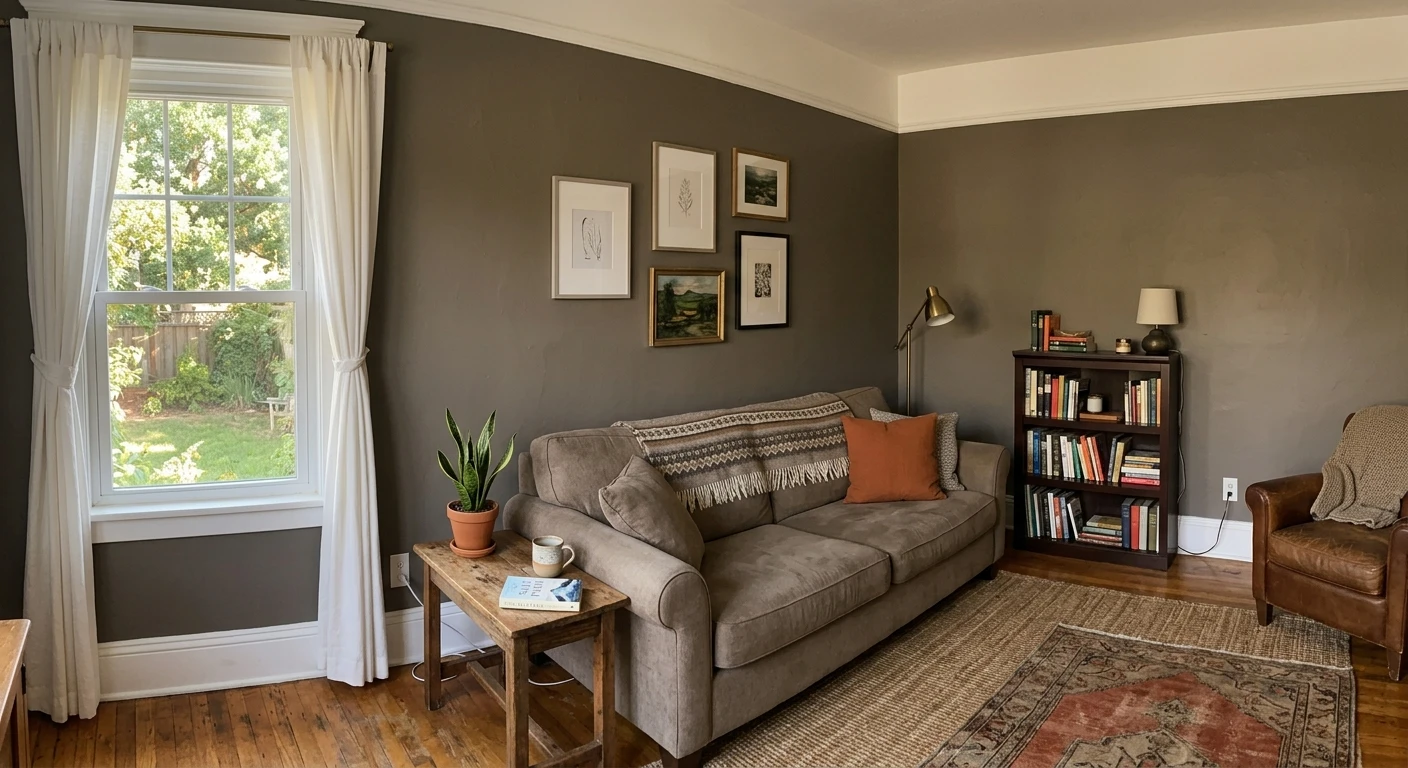
Large, north-facing living rooms with little natural light are where Acacia Haze can fall flat and read drab gray-brown. At LRV 38 it eats light rather than reflecting it, so a big dim space can feel heavy. There, a lighter sage like Clary Sage, or simply a warmer bulb, keeps the green alive. To compare it against its sage neighbors first, our colors that go with sage green guide is a useful map.
Trim, ceiling, and decor pairings
A mid-tone sage lives or dies on what sits next to it. Get the trim right and Acacia Haze looks intentional; pair it with the wrong white and it can suddenly look dirty or cold.
- Warm white trim (most harmonious): Benjamin Moore White Dove (OC-17, LRV 85) is the designer default. Its soft, creamy bias flatters the warm floor in Acacia Haze instead of fighting the green. This is the safe, cohesive pick for traditional and transitional rooms.
- Soft greige trim (tone-on-tone): a quiet warm greige like Pale Oak (OC-20) keeps the contrast low and lets the sage feel enveloping and layered rather than framed. Best for a calm, modern-organic look.
- Avoid: a stark blue-white trim. The cool contrast can drag Acacia Haze toward gray-brown and make the walls read muddy by comparison.
- Ceilings: a clean warm white (or the trim color) keeps a room with Acacia Haze walls from feeling closed in. A heavy cool-white ceiling amplifies the gray side.
- Floors and decor: white oak, walnut, rattan, brass, cream linen, and terracotta all bounce warmth back onto the wall and bring out the sage. Cool gray-washed floors do the opposite and leave it flat.
For accent moments, a warm near-black on interior doors or window sash reads sophisticated against the soft sage, and unlacquered brass is the hardware that makes Acacia Haze look custom. If you want the full pairing logic for greens, our guide to green interior paint shades for 2026 lays out the family.
See walls, trim, and floor together in one preview, free.
Acacia Haze vs the sages people confuse it with
Almost every Acacia Haze search ends in a comparison. The ones that matter most indoors:
- vs SW Evergreen Fog (SW 9130): Evergreen Fog is a touch grayer-green and the more famous of the two. Choose Acacia Haze for a softer, warmer mid-sage; choose Evergreen Fog for a cooler, more architectural gray-green.
- vs SW Clary Sage (SW 6178): Clary Sage is lighter and clearly greener, friendlier in a bright family space. Acacia Haze is deeper and more grounded. Pick Clary Sage to keep a room airy, Acacia Haze when you want the walls to hold the room.
- vs SW Pewter Green (SW 6208): Pewter Green is darker and grayer, closer to a true muted green. Acacia Haze is the lighter, more balanced gray-green. Reach for Pewter Green on cabinetry when you want real depth.
- vs BM Aegean Teal (2136-40): Aegean Teal is bluer and more saturated. Acacia Haze stays in the gray-green sage lane with none of the teal pull.
Spelling note: acacia haze 1484, BM acacia haze, and benjamin moore acacia haze all point to this same color.
How to test Acacia Haze before you commit
A 3-inch fan-deck chip is the number-one reason people pick a sage that disappoints: it reads greener and brighter than a rolled wall, and cannot show the gray-to-green swing across a day. Two better methods:
- Paint a large swatch: roll a 12-by-12-inch sample (two coats, so the depth is honest) on two different walls and check it mid-morning, mid-afternoon, and at night under your normal bulbs. Watch the dim corners for that drab gray-brown read, and watch the sunny wall for the khaki lean.
- Preview it digitally first: upload a real photo of your room and apply Acacia Haze (plus a lighter and a deeper sage) before you buy any samples, narrowing three contenders to one worth painting. Pricing context for the full repaint is in our interior house painting cost guide for 2026.
Preview Acacia Haze against a lighter and a deeper sage, side by side, free.
Frequently asked questions
Is Acacia Haze gray or green?
Acacia Haze 1484 is both: it is a balanced gray-green sage, with the gray and green channels sitting close to even. In warm or bright light the green steps forward and it reads as a soft, dusty sage; in cool, flat, or north light the gray takes over and it can read almost like a muted greige. A faint warm khaki floor keeps it from ever going cold or minty.
What is the LRV of Acacia Haze 1484?
Acacia Haze has a Light Reflectance Value of approximately 38, with a hex approximation of #9A9A86 (RGB 154, 154, 134). That makes it a true mid-tone: deep enough to carry real weight and feel enveloping in a small room, but it can read heavy in a large, low-light space where it absorbs more light than it gives back.
What are the best rooms for Acacia Haze?
Kitchen islands and lower cabinets, dining rooms, home offices, studies, and powder rooms are where Acacia Haze shines, because its mid-tone depth flatters wood and brass and feels enveloping in a contained space. It is least reliable in large, north-facing rooms with little natural light, where it can read drab gray-brown; a lighter sage or a warmer 2700K bulb helps there.
What trim color goes with Acacia Haze?
Benjamin Moore White Dove (OC-17) is the most harmonious trim because its soft cream bias flatters the warm floor under Acacia Haze. A quiet warm greige like Pale Oak (OC-20) gives a low-contrast, tone-on-tone look. Avoid a stark blue-white trim, which can drag the sage toward gray-brown and make the walls look muddy by comparison.
What is the difference between Acacia Haze and Evergreen Fog?
Both are muted gray-green sages, but Acacia Haze (BM 1484) is a softer, slightly warmer mid-sage, while Sherwin-Williams Evergreen Fog (SW 9130) reads cooler and a touch grayer-green and is generally lighter on a wall. Choose Acacia Haze for a warmer, grounded sage; choose Evergreen Fog for a cooler, more architectural gray-green.
Preview Acacia Haze on your actual walls under your own light before buying a single sample.
Disclaimer: Benjamin Moore, Acacia Haze (1484), White Dove (OC-17), Pale Oak (OC-20), and Aegean Teal (2136-40) are trademarks of Benjamin Moore & Co. Sherwin-Williams, Evergreen Fog (SW 9130), Clary Sage (SW 6178), and Pewter Green (SW 6208) are trademarks of The Sherwin-Williams Company. FacadeColorizer is an independent paint visualization service and is not affiliated with, endorsed by, or sponsored by Benjamin Moore or Sherwin-Williams. LRV and hex values are approximations of the manufacturer's published data. Color reproduction on screens approximates the manufacturer's chip; always confirm with a manufacturer sample under your own light before purchase. Sources: Benjamin Moore 1484 Acacia Haze color data 2026, Benjamin Moore OC-17 White Dove and OC-20 Pale Oak color data 2026, The Spruce sage-paint and undertone coverage, designer field reports compiled by FacadeColorizer.
Trademarks mentioned (Sherwin-Williams, Benjamin Moore, Behr, Caparol, Brillux, Sto, Alpina, Valspar, PPG, Glidden, Dulux, Crown Trade, Sandtex, Farrow & Ball, Johnstone's, Leyland) are property of their respective owners. FacadeColorizer is independent and not affiliated with any of them. Nominative fair use under Lanham Act §1125.