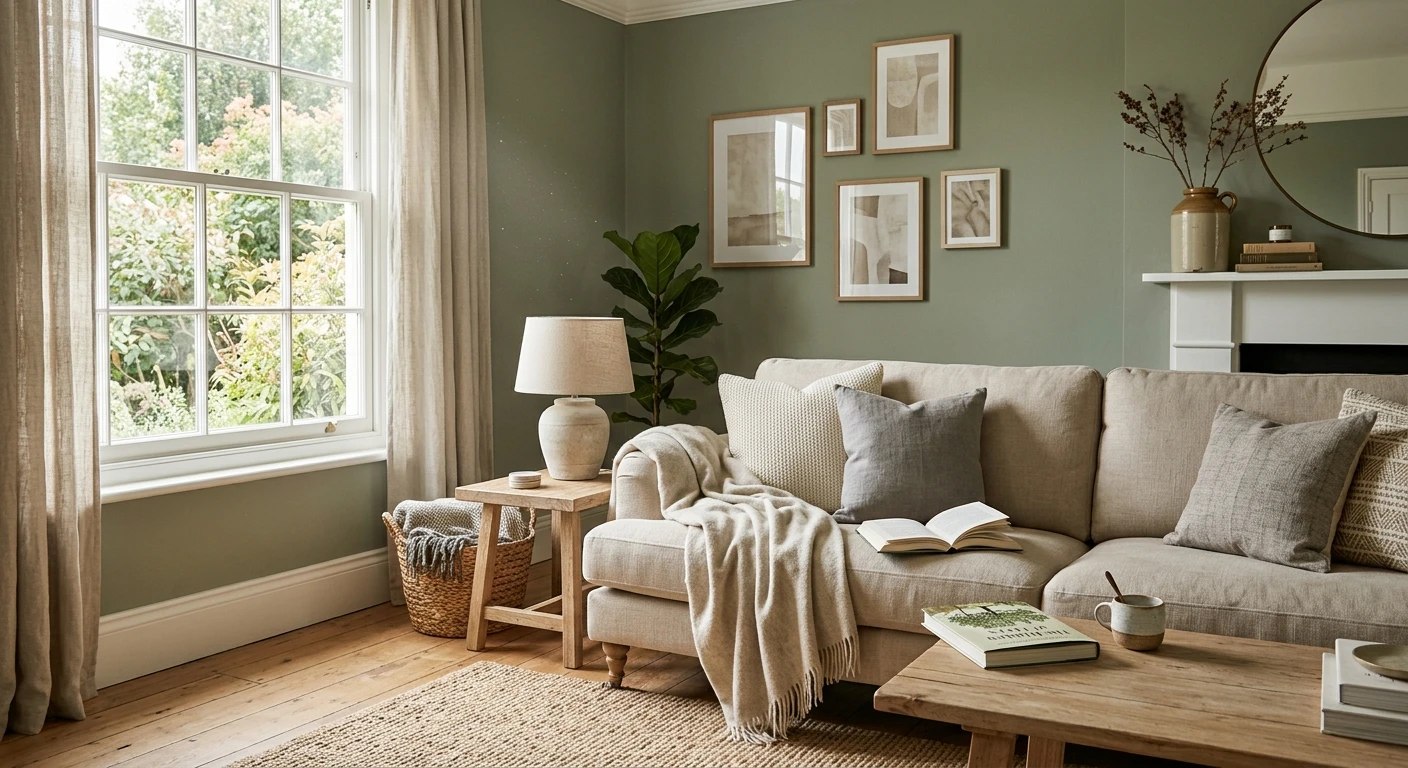
Try it on your room

A homeowner emailed me last spring: "I painted it sage and it came out like split pea soup." The chip looked dusty and calm in the store; rolled out under her warm bulbs, the wall read loud and a little institutional. That gap between the chip and the room is the whole story of this family. Green paint colors run from a barely-there gray-green that acts like a neutral to a deep forest that swallows the light, and the undertone hiding inside each one decides whether your room reads serene or queasy. This is the map I wish she had read first: how green splits into sage, gray-green, and deep forest, the best shades by LRV, and the room each one belongs in.
Green is the neutral of the moment. It borrows the calm of gray, the warmth of beige, and a connection to the outdoors no other color delivers, which is why it has become the most popular "non-neutral neutral" in American homes. For how the color families relate, start with our interior paint color families guide. This page zooms all the way into green.
Upload a room photo and preview the top green shades under your real light in about 30 seconds.
The one thing that makes green hard: undertone
Green is a secondary color, mixed from blue and yellow, so every green leans one way or the other. That lean is the undertone: invisible on a 3-inch chip, unmistakable once a whole wall is rolled. Too much yellow goes "baby food" or olive-cafeteria; too much blue can tip teal or cold. A green softened with gray reads sophisticated and calm, which is why the dusty, muted sages have taken over.
Three undertone leans cover almost every interior green you will meet:
- Yellow-green (warm): the lively, grassy, apple end. Cheerful in the right room but the first to read garish or dated; use it in small doses, not as a whole-house wall color.
- Gray-green (muted, balanced): the most popular and most forgiving, because the gray mutes the saturation and keeps it from going loud. Home to the dusty sages and moody fog-greens. Example: Sherwin-Williams Evergreen Fog (SW 9130).
- Blue-green (cool): leans toward teal, sea glass, and deep emerald. Crisp and a little dramatic, beautiful with brass, but it can read cold in low light. Example: Sherwin-Williams Sea Salt (SW 6204), right on the green-blue line.
The practical rule I give every client: never choose a green from the chip alone, and never under the fluorescent light at a paint counter, which makes every green look colder than it will at home. Take it to the wall, and watch it for a day.
Sage vs gray-green vs forest: pick a depth first
Before you shortlist a single name, decide how deep you want to go. Depth (measured by LRV) eliminates most of the aisle and prevents the most common regret: a dark forest closing in a small room.
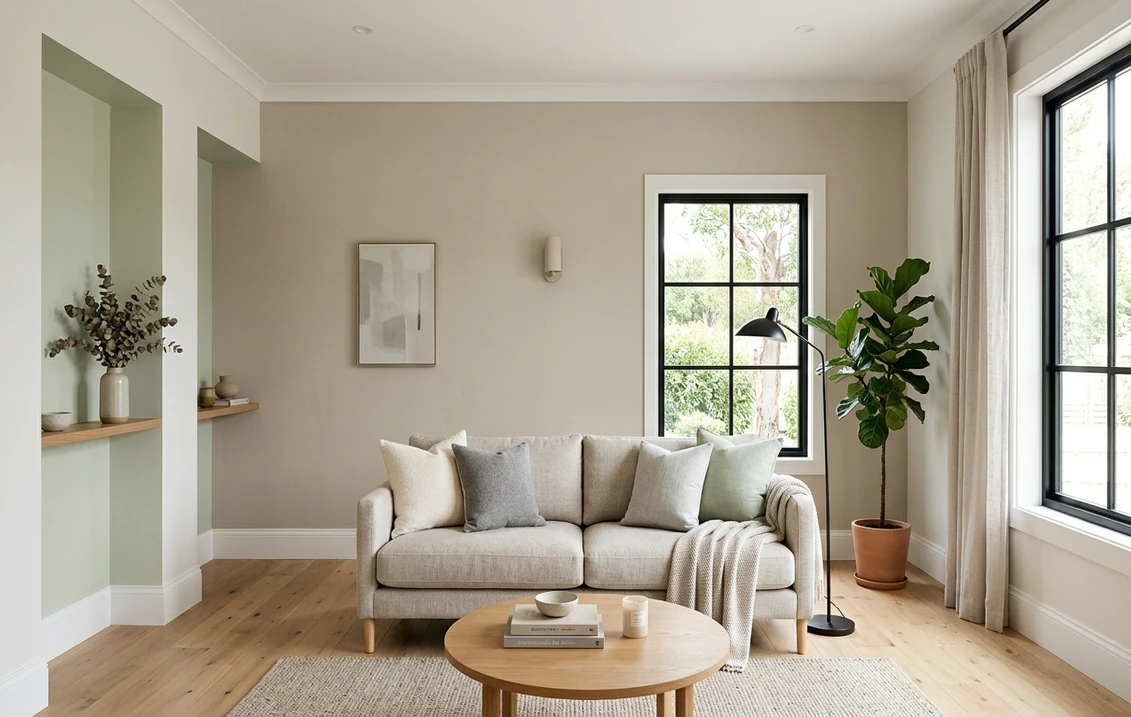
Choose a light sage or soft gray-green (LRV roughly 50 to 65) when you want green to behave like a calming neutral: an all-over wall color in a bedroom, bathroom, or open living space that reads restful rather than bold. These are the safe, livable greens, broken down shade by shade in our soft sage interior shades and pairings guide. Choose a mid or muted gray-green (LRV roughly 25 to 45) when you want green to actually read as color: a sage that grounds a dining room, office, or feature wall without going dark. Choose a deep forest or hunter green (LRV under 15) for drama on cabinetry, a library wall, or a moody accent; the deep end is gorgeous but unforgiving in a dim room, so it earns its place on accents far more than on every wall. If what you are after is the whole room reading calm rather than one wall reading green, our calming color palettes roundup builds twelve schemes out of exactly these light sages and green-blues, with Sea Salt (SW 6204, LRV 63) anchoring most of the spa-leaning ones.
The best green paint colors for 2026, by LRV
Light Reflectance Value (LRV) runs from 0 (black) to 100 (pure white) and tells you how much light a color bounces back. For greens the usable range is huge: a soft gray-green at LRV 63 keeps a small bathroom open, while a forest at LRV 12 grounds cabinetry. Below are the greens US designers specify most, sorted light to dark.
| Color (code) | LRV | Undertone | Reads as | Best for |
|---|---|---|---|---|
| SW Sea Salt (6204) | 63 | Green-gray-blue | Soft, coastal, near-neutral | Bathrooms, bedrooms, airy living rooms |
| BM Saybrook Sage (HC-114) | ~46 | Gray-blue green | Balanced mid sage | Whole rooms, exteriors, cabinetry |
| SW Clary Sage (6178) | 41 | Warm gray-green | A true, livable sage | Dining rooms, offices, feature walls |
| SW Evergreen Fog (9130) | 30 | Muted gray-green | Moody, sophisticated sage | Accent walls, cabinets, studies |
| SW Pewter Green (6208) | 12 | Deep gray-green | Rich, almost-charcoal green | Cabinetry, built-ins, dramatic accents |
Try it on your house
No photo? Try a sample
Sources: Sherwin-Williams and Benjamin Moore official technical data sheets (LRV values), 2026; The Spruce green-paint roundups; designer reference palettes. Saybrook Sage LRV is an approximate published value.
A quick read on that table: if you want a green you cannot mess up, Sea Salt or Clary Sage are the safest all-wall picks; for the dusty designer look, Evergreen Fog is the reliable mid-tone star; and Pewter Green, the darkest here, is the best partner for green cabinetry against a warm white wall. Two deep dives settle the favorites room by room: the Evergreen Fog undertones and rooms guide for the muted gray-green, and the Sea Salt undertones and rooms guide for the airy coastal green.
How green shifts from morning to night
Green carries both blue and yellow, so the light pulls it one way or the other all day. The same sage wall can look fresh and cool at 8 a.m. and almost golden at sunset. North light mutes warm sages and pushes a balanced green toward gray. Warm-white bulbs at 2700K bring the yellow back out; cool "daylight" bulbs at 4000K and up strip the warmth, making green read sharper and grayer.
Best rooms for green walls
Green flatters nearly every room because it reads restful and connects to the outdoors. The smart move is to match its depth and temperature to the room.
Bedrooms
A soft sage or gray-green is one of the most restful bedroom colors there is, calmer than a gray and warmer than a blue. Keep it light (Sea Salt, Clary Sage) for a soothing retreat, and go deeper only if the room has good light.
Bathrooms and powder rooms
This is where the coastal greens shine. A soft green-gray reads spa-like next to white tile and brass, and a powder room can take a deeper, moodier sage since you are not in it all day. Cool LEDs can drain a sage gray, so watch the bulbs.
Kitchens and cabinetry
Green has become the top cabinet color in the country, and the deep end is the reason. A forest like Pewter Green on a lower run, with white uppers and brass hardware, is one of the most-pinned kitchen looks going. See our green kitchen cabinet paint colors guide for the full playbook.
Dining rooms, offices, and accent walls
This is where mid and deep greens earn their keep. A sage like Evergreen Fog or a forest accent turns a dining room intimate and an office focused. For the deep, near-black end, our dark and near-black walls guide covers the moodiest greens.
Trim, ceiling, and what to pair with green
Green is generous about pairings, but the trim still has to agree with its temperature. A warm sage wants a warm white; a cool, blue-leaning green can take a crisper white. Mismatch them and the wall reads muddy or the trim reads dirty.
- Warm white trim (most harmonious): SW Alabaster (SW 7008) or BM White Dove (OC-17) let a sage read soft instead of going cold against the green.
- Crisp white trim (cleaner): SW Pure White (SW 7005) suits the cooler, blue-leaning greens and the deep forests, keeping the contrast sharp.
- Wood and natural fiber: warm oak, walnut, rattan, jute, and linen are green's best friends; they echo the outdoors and make a sage feel collected.
- Metals: brass and antique gold are the classic green pairing; black metal suits the deeper, cooler greens for a sharper modern edge.
- Ceilings: a clean warm white keeps a green room bright. Skip a heavy cool-white ceiling over a warm sage, which amplifies any flat, gray read.
For the full pairing playbook, including accent colors and the exact whites and woods that work with each green, our what pairs with green walls guide covers the combinations room by room. The trim white deserves more care than "warm white" suggests, because warm whites are not one thing. A greige-leaning one such as Alabaster carries a faint green-gray base that surfaces in cool light, which is the last thing you want framing a sage; a yellow-based white like Creamy or Greek Villa holds its warmth in the same north room. Our guide to choosing a cozy white paint color splits them into three undertone groups so you can tell which one you are holding.
When green is the wrong call
Green is not always right. A warm yellow-green in a south-facing room flooded with afternoon sun can tip straight into olive-cafeteria, and no second coat saves it; a grayer, muted sage serves that room better. A deep forest on every wall of a small, north-facing den reads heavy and dim by 3 p.m. when it would have been stunning on just the cabinets. And a trendy gray-green chosen only from a Pinterest photo, untested in your own light, is exactly how the "split pea soup" emails happen. If your samples keep reading loud or muddy, that is your room telling you to mute the green or shift its temperature, not to push through.
Upload your room and compare soft sage, mid sage, and deep forest side by side under your light.
How to test a green before you commit
Green shifts so much with light that skipping the test is how people end up repainting. A fan-deck chip reads roughly 25 to 35 percent lighter than the rolled wall and cannot show whether the green will flash olive or go gray. Do this instead:
- Paint a 12-inch swatch (or a peel-and-stick sample) on at least two walls, including the one that gets the least light, and let it dry fully before you judge it.
- Look at it three times: morning, midday, and after dark under your actual bulbs. Afternoon sun is where a warm sage flashes olive; the night check is where it can go flat and gray.
- Hold it against your trim, floor, and any wood, not bare drywall, since that context decides whether the green reads fresh or muddy.
- Or skip the wall test first with a digital visualizer: upload a photo of your room and apply several greens to narrow the field before you buy sample pots.
Previewing first pays off twice. For materials, labor, and square-foot pricing, see our interior house painting cost guide for 2026. That is the whole map: pick a depth, check the undertone against your own light, and a green you love is hard to miss.
Frequently asked questions
What is the most popular green paint color right now?
Muted gray-greens lead the category. Sherwin-Williams Evergreen Fog (SW 9130, LRV 30) and soft coastal greens like Sea Salt (SW 6204, LRV 63) are among the most-painted interior greens in the US, because the dialed-in gray keeps the color from reading loud. Clary Sage (SW 6178) is a reliable all-wall sage on the warmer end.
How do I tell if a green is warm or cool?
Hold the sample next to a sheet of plain white paper on the wall it will go on. Against true white, a warm green looks slightly yellow or olive, a cool green looks slightly blue or teal, and a muted gray-green looks dusty and almost neutral. Check it in daylight and again at night under your bulbs, because the undertone becomes obvious once a full wall is rolled.
What is the best green for a small or low-light room?
Stay light and muted. A soft gray-green at LRV 55 or higher, such as Sea Salt, keeps a small or north-facing room open and reads almost like a neutral. Avoid a deep forest on every wall of a small dim space, since it will close the room in; save the dark greens for cabinetry or a single accent wall there.
What colors go with green walls?
Warm whites (SW Alabaster, BM White Dove) for trim, natural wood and rattan, and brass or antique gold metals are green's most reliable partners. Deeper, cooler greens also take a crisp white and black metal well. The key is matching the trim white to the green's temperature so the wall does not read muddy.
Why did my sage paint turn out looking yellow or olive?
The green had too much yellow in its undertone, and warm light or strong afternoon sun pushed it further. Sages with a higher yellow base flash olive in bright warm rooms. Choose a grayer, more muted sage, test it under your actual light, and check it in the afternoon sun before you commit, which is when the olive shift shows up.
See the best 2026 green shades on your actual room before buying a single sample pot.
Disclaimer: Sherwin-Williams, Sea Salt (SW 6204), Clary Sage (SW 6178), Evergreen Fog (SW 9130), Pewter Green (SW 6208), Alabaster (SW 7008), and Pure White (SW 7005) are trademarks of The Sherwin-Williams Company. Benjamin Moore, Saybrook Sage (HC-114), and White Dove (OC-17) are trademarks of Benjamin Moore and Co. FacadeColorizer is an independent paint visualization service and is not affiliated with, endorsed by, or sponsored by Sherwin-Williams or Benjamin Moore. Color reproduction on screens only approximates the manufacturer's chip; always confirm with a physical sample under your own light before purchase.
Trademarks mentioned (Sherwin-Williams, Benjamin Moore, Behr, Caparol, Brillux, Sto, Alpina, Valspar, PPG, Glidden, Dulux, Crown Trade, Sandtex, Farrow & Ball, Johnstone's, Leyland) are property of their respective owners. FacadeColorizer is independent and not affiliated with any of them. Nominative fair use under Lanham Act §1125.