Try it on your room

Look up on a historic street in Charleston or Savannah. A surprising number of porch ceilings glow a soft, watery blue-green, the same shade you spot on shutters and door frames. That color has a name and a story: it is the haint blue color family. One of the most beloved and most misunderstood shades in the Southern palette, it has quietly migrated from the porch ceiling to sunrooms, bathrooms, and bedrooms across the country.
This is a full profile of haint blue as a color you can actually buy and use: the undertone, the Light Reflectance Value (LRV) range that defines it, the shades worth knowing by name, and where it belongs beyond the porch. For how this soft blue-green sits beside the gray and green families, start with our interior paint color families guide.
Upload a photo of your porch ceiling or room and preview real shades under your own light, free.
Where haint blue comes from
Haint blue is not one paint chip. It is a tradition that lives inside a narrow band of soft, slightly green light blues, the colors of shallow water and a hazy summer sky. The practice belongs to the Gullah Geechee people, descendants of enslaved West and Central Africans along the South Carolina and Georgia coast, who believed spirits could not cross water. Painting a porch ceiling or doorframe a sky-water blue confused a haint into thinking it had reached open water.
Choosing one today comes down to a couple of truths. There is no single "official" formula. Every major brand carries several shades that fit, and what unites them is softness and a blue-green tilt rather than a bold sky blue. A clean primary blue reads jarring overhead, while the historic shades are grayed-down, chalky, and gentle.
The undertone: blue, green, and a little gray
The signature of haint blue is that it refuses to commit. Hold it against a white card and you see blue; tip it toward daylight and a green whisper appears; under warm indoor light a soft gray settles in. That tri-part character (blue base, green lean, gray quieting) is why it feels calm rather than loud. Three undertone families circulate under the umbrella:
- Blue-green (the classic). The most traditional read, like still water at dawn; Benjamin Moore Palladian Blue and Sherwin-Williams Rainwashed live here. The safest choice for a porch ceiling.
- Sky-blue (the bright end). A touch more pure blue and a bit lighter, closer to a clear morning sky. Cheerful and crisp, but can edge toward "baby blue" in a small or flatly lit room.
- Aqua and teal-leaning (the bold end). More green and more saturated, the tradition with personality. Better for a small accent (a door, a bathroom) than a whole ceiling.
To see how that green whisper behaves elsewhere, our sage green interior shades and pairings guide covers the green side of this family, and the blue gray paint guide covers what happens when the same base is grayed down further.
LRV: why the shade stays airy overhead
LRV measures how much light a color reflects, from 0 (black) to 100 (pure white), and it is printed on every chip. Authentic haint blues sit high, typically LRV 55 to 75. That high reflectance is the whole point on a porch ceiling: it bounces daylight back down and reads as a soft wash rather than a heavy color. Drop below about 50 and you lose the airy, sky-like quality.
| Shade | Code | LRV | Undertone read |
|---|---|---|---|
| BM Palladian Blue | HC-144 | 61 | Soft blue-green; the most-cited haint blue |
| SW Rainwashed | SW 6211 | 59 | Spa blue-green-gray; gentle and calm |
| SW Atmospheric | SW 6505 | 61 | Light sky-blue with a green whisper |
| BM Woodlawn Blue | HC-147 | 56 | Classic robin-egg; slightly clearer blue |
| SW Sea Salt | SW 6204 | 63 | Green-leaning; the softest, most neutral pick |
| BM Beach Glass | 1564 | 66 | Pale aqua; light and watery |
Try it on your room
No photo? Try a sample
LRV values from Sherwin-Williams and Benjamin Moore technical color data, 2026. Codes are manufacturer references; cross-check on a sample before buying.
A practical reading: for a true-to-tradition porch ceiling, Palladian Blue (HC-144) and Rainwashed (SW 6211) are the two most reached-for names in the country, both around LRV 60. For the softest, almost-neutral version, Sea Salt (SW 6204); for a clearer robin-egg, Woodlawn Blue (HC-147).
Does haint blue actually keep bugs away?
Every porch-painter asks this. The folk claim is that haint blue keeps wasps, dirt daubers, and spiders from nesting because the ceiling "looks like sky." There is a kernel of truth wound together with a lot of myth:
- The sky theory is not well supported. Most paper wasps and mud daubers build under porches regardless of ceiling color; entomologists have not found that blue specifically deters them.
- The real factor was historic. Old haint blue was milk paint mixed with lye, a genuine insect repellent, so the deterrent came from the paint chemistry, not the color. Modern acrylic haint blue contains no lye.
- Why the belief persists. A freshly painted, smooth ceiling gives wasps less to grab, and porch ceilings get repainted often, knocking down nests before they establish. The blue gets the credit.
So pick haint blue for how serene and historically rich it looks overhead, and let that be reason enough. If bugs are the goal, a fresh coat of any color plus regular maintenance does the real work.
Free AI paint visualizer. Test Palladian Blue, Rainwashed, and Sea Salt before buying a sample.
Beyond the porch: where it works indoors
The porch ceiling is the origin story, but a soft blue-green this calm is too useful to leave outside. Indoors, its watery softness becomes a restful backdrop:
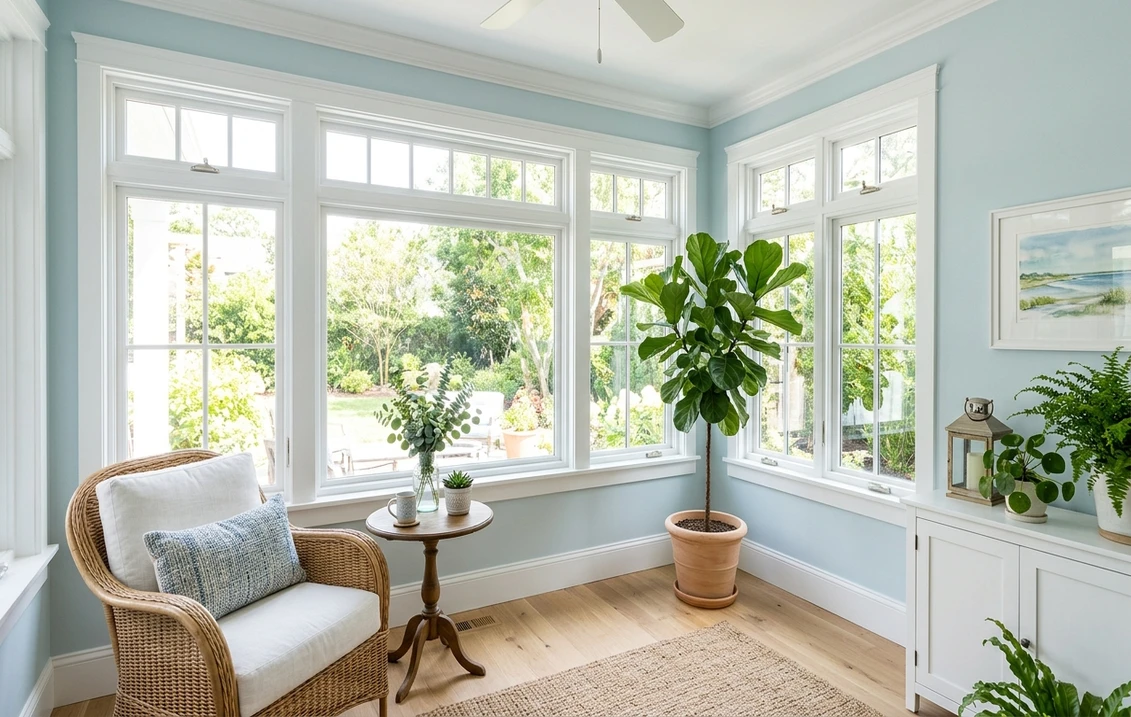
- Sunrooms and screened porches. The natural bridge from outside to in. Walls or a ceiling in Palladian Blue keep the porch tradition, and high daylight lets the green undertone sing without going icy.
- Bathrooms. A spa color at heart, clean and watery beside white tile, marble, and polished nickel. With little daylight, lean to the greener, grayer picks (Rainwashed, Sea Salt) so walls do not turn baby blue under vanity bulbs.
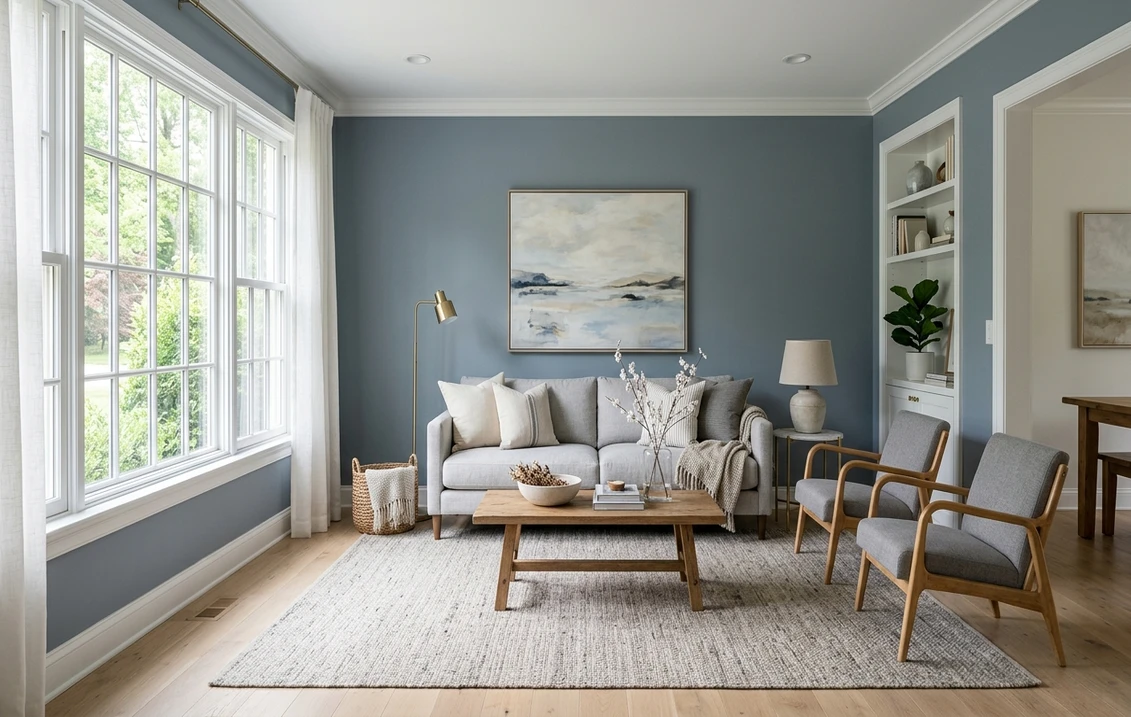
- Bedrooms and nurseries. The recessive, sky-like quality makes a room feel like a retreat. Woodlawn Blue or Atmospheric reads restful rather than cold, and pairs with warm wood to stay cozy.
- Kitchens and entryways. On lower cabinets with warm white uppers and brass hardware, the look is fresh and coastal; in an entryway it nods to the original threshold tradition.
How light changes this blue-green
Few colors shift with the light the way this soft blue-green does. A covered porch is a special case, shaded yet flooded with bright bounced light. Indoors, orientation is what decides the read:
- North-facing: cool, indirect light pushes it bluer, so it can drift icy. Favor a greener pick like Sea Salt or Rainwashed.
- South and west: warm direct sun brings the green undertone forward; a clear sky-blue like Woodlawn Blue stays balanced.
- East-facing: fresh and blue in the morning, soft and neutral by afternoon, usually the most flattering light.
- Evening, warm LED: 2700K bulbs gray it down toward soft sage; 3000K to 3500K bulbs keep it watery after dark.
Trim, ceiling, and decor pairings
Haint blue is forgiving, but the surrounding colors decide whether it reads "historic and serene" or "dated pastel":
- Trim and columns: a soft warm white (Benjamin Moore White Dove OC-17, or Sherwin-Williams Alabaster SW 7008) keeps the blue gentle; bright cool whites make it look colder and more saturated.
- On a porch: white beadboard, white railings, and natural wood floors are the classic Lowcountry trio, the warm wood balancing the cool ceiling.
- Warm wood and brass: indoors, white oak, honey, or walnut floors plus brass or aged-bronze fixtures give the cool blue a warm counterweight.
- Greens and naturals: it sits beautifully beside soft sage, rattan, jute, and linen, and flatters a warm greige on adjoining walls.
- Accents: coral, soft terracotta, navy, and crisp white all play well; avoid cool gray-blues that compete for the same lane.
To keep the rest of the house warm against a cool haint-blue accent, a transitional neutral on the main walls usually does the job, the case our greige paint colors guide makes in detail, with the light gray paint colors guide a useful companion for trim and adjoining walls.
See the walls, warm white trim, and wood floors together, free.
Haint blue vs. its look-alikes
A few neighbors borrow its look and get mistaken for it. Baby blue is the sweeter, purer pastel; haint blue runs grayer and greener, which reads historic instead of nursery-cute. Blue gray is mostly gray with a moody lean, while haint blue stays lighter and more luminous, the difference between a stormy slate and shallow water. Seafoam and spa greens tip past the line into clearly green. Haint blue holds just enough blue to read as a soft sky.
The line you pick shifts the undertone (BM tends a touch clearer, SW a touch grayer). Our Sherwin-Williams vs Benjamin Moore comparison covers how each brand handles soft cool tones, and our best interior paint colors of 2026 guide shows where this blue-green fits the year's direction.
How to test haint blue before you commit
A soft blue-green changes more than almost any other family between the chip and the wall, so do not trust a fan-deck card:
- For a porch ceiling, paint a large swatch directly on the beadboard; a shaded overhead surface reads very differently from a vertical wall.
- Indoors, paint a 12 by 12 inch swatch (or peel-and-stick samples) on two walls, one near the window and one across the room, and check it morning, midday, and after dark under your own bulbs.
- Sample one greener-grayer pick (Sea Salt) and one clearer-blue pick (Woodlawn Blue) to see the family's range in your light.
Want to skip the paint entirely? Upload a photo, drop several shades onto it, and watch which one stays a soft sky while another flashes baby blue. To budget the surrounding repaint, our interior house painting cost guide breaks down pricing.
See which shade stays a soft sky and which goes baby blue in your light, before buying samples.
Frequently asked questions
What exactly is haint blue?
Haint blue is a tradition, not a single paint color. It refers to a family of soft, light blue-green shades historically painted on porch ceilings and door frames by the Gullah Geechee communities of the Lowcountry, who believed restless spirits ("haints") could not cross water. Today any soft, grayed blue-green in roughly the LRV 55 to 75 range qualifies.
What are the best haint blue paint colors?
The two most-cited names are Benjamin Moore Palladian Blue (HC-144, LRV 61) and Sherwin-Williams Rainwashed (SW 6211, LRV 59), both balanced blue-greens ideal for a porch ceiling. For the softest, greenest version, Sherwin-Williams Sea Salt (SW 6204, LRV 63); for a clearer robin-egg blue, Benjamin Moore Woodlawn Blue (HC-147, LRV 56). Each reads differently by light, so confirm on a sample.
Does haint blue paint really keep bugs and wasps away?
Not because of the color. Original haint blue was milk paint mixed with lye, a genuine insect repellent, so old porches saw fewer nests. Modern acrylic haint blue contains no lye, and the color itself does not deter wasps or mud daubers. A freshly painted, smooth ceiling and frequent repainting are the real reasons, so choose haint blue for the look, not as pest control.
What trim color goes with haint blue?
A soft warm white is the traditional partner. Benjamin Moore White Dove (OC-17) or Sherwin-Williams Alabaster (SW 7008) keeps the contrast gentle and lets haint blue read as a soft sky rather than a saturated pastel, while bright cool whites push it colder. On a porch, white beadboard, white columns, and natural wood floors are the classic Lowcountry pairing.
Upload your porch or room photo and compare shades side by side under your own light before committing.
Disclaimer: Sherwin-Williams, Benjamin Moore, and the color names and codes referenced throughout are trademarks of their respective owners. FacadeColorizer is an independent paint visualization service and is not affiliated with, endorsed by, or sponsored by Sherwin-Williams, Benjamin Moore, or Behr. Color reproduction on screens approximates the manufacturer's chip; always confirm with a manufacturer sample under your own lighting before purchase. Sources: Sherwin-Williams and Benjamin Moore technical color data sheets 2026, The Spruce and Southern Living haint blue references, Gullah Geechee cultural history, and published designer undertone guidance.
Trademarks mentioned (Sherwin-Williams, Benjamin Moore, Behr, Caparol, Brillux, Sto, Alpina, Valspar, PPG, Glidden, Dulux, Crown Trade, Sandtex, Farrow & Ball, Johnstone's, Leyland) are property of their respective owners. FacadeColorizer is independent and not affiliated with any of them. Nominative fair use under Lanham Act §1125.