Try it on your room

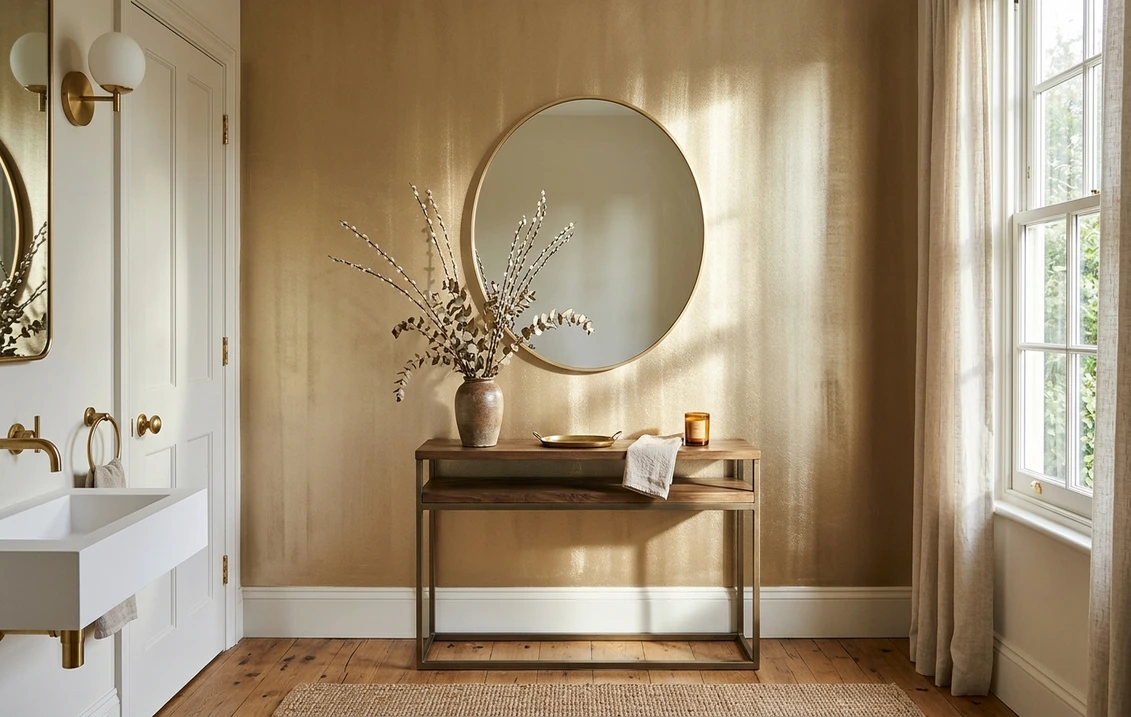
At nine in the morning, a wall painted in metallic champagne reads as a soft warm neutral. Come back at sunset and it lights up like brushed bronze. Same wall, same paint. That shape-shifting is the whole point of metallic, and exactly why it trips people up. Unlike a flat solid color, a metallic is a color plus a reflective effect: never one shade, but a range that moves with your viewing angle and the light hitting it.
Used well, metallic gives a powder room, a dining accent wall, or a tray ceiling a depth no matte color can touch. Used carelessly, it shows every roller line and reads cheap. This profile treats metallic the way the rest of our interior paint color families guide handles the neutrals: the best tones, how light changes them, the rooms that suit them, the pairings, and how to test before you commit a wall.
Upload one photo and preview a gold, silver, or bronze metallic accent wall under your actual light, free.
What metallic paint is, and the tones to know
A metallic paint is a tinted base loaded with fine reflective flakes, traditionally aluminum or mica, sometimes mixed with pearlescent pigments. Those flakes bounce light instead of absorbing it the way ordinary pigment does, so the finish has two readings at once: a base color in shade, and a brighter, almost lit-from-within highlight wherever light strikes at the right angle. The more light, the more "metal" you see.
The category spans three products, from true metallic wall paint to a troweled metallic glaze to a subtle pearl topcoat (covered below). Here is the thing to grasp first. A metallic is closer to a finish family than a color family, so the same champagne tone can land anywhere from "barely shimmering greige" to "full liquid gold" depending on the product, coats, and light. It also means metallics do not sort by LRV the way solid colors do: their reflectance swings with the viewing angle, so the real decision is metal tone. Warm tones flatter most US homes and forgive imperfection; cool tones read modern and crisp but reveal every flaw. The tones designers reach for most, warmest to coolest:
| Metallic tone | Reads as | Best for |
|---|---|---|
| Champagne / soft gold | Warm neutral in shade, gentle gold in light; most livable | Dining walls, tray ceilings, powder rooms |
| Antique / rich gold | Saturated, glamorous, yellow-warm | Foyers, formal dining, statement ceilings |
| Copper | Warm red-orange; cozy and earthy | Range hoods, bar walls, fireplace surrounds |
| Bronze / oil-rubbed | Deep brown-bronze; moody and grounded | Libraries, dens, dark powder rooms |
| Pewter / graphite | Cool gray metal, smoky shimmer | Modern accent walls, ceilings, niches |
| Silver / platinum | Bright, cool, contemporary; least forgiving | Modern entries, ceilings, glam baths |
Try it on your room
No photo? Try a sample
Sources: Modern Masters Metallic Collection technical data, Behr Premium Plus Metallic product data, The Spruce and Bob Vila metallic finish references, 2026.
Rule of thumb: if you want a metallic that behaves almost like a neutral, stay in the champagne-to-soft-gold band. Those warm tones sit comfortably beside a warm greige and read as "luxe texture" rather than "shiny wall." The closer you get to bright silver or platinum, the more the finish becomes a statement and the more flawless your prep has to be, because cool metallics broadcast every dimple.
Why light changes a metallic so much
Every paint shifts with light, but a metallic shifts twice as hard because it has two variables: the color of the light (warm or cool) and its angle (which controls how much the flakes flash). The same wall can look like three finishes across a day.
- Direct, raking light (low morning or late-day sun crossing the wall at a sharp angle) is when a metallic is most dramatic: the flakes light up and you see full metal.
- Flat, head-on light (midday, or a lamp aimed at the wall) mutes the effect: a silver looks almost gray, a gold almost beige.
- North-facing, cool, indirect light keeps a metallic subdued all day. Warm tones (champagne, copper, bronze) stay inviting; cool ones (silver, pewter) read flat and steely, the same logic that governs light gray, amplified by the sheen.
- Warm bulbs (2700K) deepen gold, copper, and bronze, so metallics shine in evening rooms; cool 4000K to 5000K bulbs keep silver and pewter crisp but can make warm golds look brassy.
So you cannot judge a metallic from a chip, or from one midday glance. That is exactly why so many of these walls end up opposite a window.
Free AI paint visualizer. See how champagne, copper, or pewter reads in your own room.
Best rooms (and walls) for metallic paint
Think accent, not whole-room. Four walls of metal overwhelm a space and exaggerate every flaw. Where it earns its keep is on smaller surfaces and focal points, the spots where shimmer pulls its weight:
- Powder rooms. The single best use. A small windowless room is where a bold metallic (rich gold, bronze, copper) becomes a jewel box, and the limited footage keeps the effect from tiring the eye.
- Dining accent walls. One champagne or soft-gold wall behind a buffet reads warm and elegant in candlelight and evening bulbs.
- Tray ceilings and insets. A metallic recessed ceiling catches lamplight and gives a dining room or primary bedroom a hotel-suite feel without painting a wall.
- Foyers and stair walls. An entry is a "moment," so a feature wall here sets a tone the instant you walk in, kept alive by light from the door or sidelight.
- Niches, fireplace surrounds, and bar backs. Contained architectural features take metallic well; the focal intent is obvious.
Where to be careful: large open-plan walls, drywall that was not skim-coated smooth, and bedrooms where you want calm rather than glint. If you love metal but want it quieter, a soft pearl or shimmer finish gives a sheen without the full drama.
The application reality: where metallics succeed or fail
No other paint lives or dies on prep and technique the way a metallic does. The same flakes that throw off the shimmer turn merciless about whatever sits underneath:
- Surface prep. A metallic shows every nail pop, seam, and roller ridge, so walls need to be smooth, ideally skim-coated, sanded, and sealed with a tinted base coat close to the metallic's color. Skip this and the shimmer turns flaws into spotlights.
- Application and coats. True metallic paint is best rolled in one consistent direction with a thin nap (or sprayed) over two to three coats kept wet edge to wet edge, so the flakes lie uniformly; change direction mid-wall and you see it forever as a band of different sheen. Glazes are forgiving the opposite way: the variegated look is the point, so a crosshatch trowel or rag motion hides imperfection.
Match the product to the look: a true metallic paint over a smooth base coat gives the cleanest sheet of metal (least forgiving of prep); a glaze over a satin base gives hand-applied depth and hides flaws (the pro's pick for powder rooms and ceilings); a pearl or mica shimmer gives a quiet glow on larger surfaces. Dedicated lines come from specialty makers like Modern Masters, while big-box brands like Behr offer metallic and pearl options. This is the honest reason metallic walls are a popular job to hire out, and our interior house painting cost guide covers how specialty finishes and extra coats change the math.
Trim, wall, and decor pairings
A metallic is loud all by itself. So everything around it should stay quiet and deliberate, letting the metal be the star instead of fighting the room.
- Adjacent walls: keep them a flat solid in a calm neutral. A warm metallic loves a soft warm white or a greige; a cool silver or pewter sits cleaner beside a blue-gray or crisp gray.
- Trim: a simple satin white frames the wall without competing; avoid a second shiny element beside it, as two sheens jostling cheapen both.
- Metals in the room: match the family. Gold and champagne walls want brass or gold hardware; copper wants warm bronze or aged brass; pewter and silver want polished nickel or chrome.
- Pairing colors: warm golds and copper sing against deep, moody backdrops, charcoal, navy, forest green, even a deep sage, where the metal reads as a luxe accent. Silver and pewter pair coolly with white, gray, and black.
- Decor: let the wall stand mostly bare or hold a single large mirror or piece of art. A busy gallery wall buries the very effect you paid for.
Upload your room and preview gold, copper, and pewter walls side by side, free.
How to test metallic before you commit
A metallic is the worst paint to judge from a small chip, because a chip cannot show how the finish flashes and shifts across a real wall under real light. Two reliable ways to test:
- Paint a real sample board. Roll or trowel the actual product onto a 2-foot poster board (over your planned base coat), prop it against the intended wall, and watch it across the day: raking morning light, flat midday, evening lamps. Move around it; the angle changes everything.
- Preview the look digitally first. Before buying specialty paint, upload a photo of the room into our visualizer and audition a metallic-look accent wall in gold, copper, or pewter to settle the tone and placement before you spend.
Nail down three things before the can ever opens: the tone (warm vs cool), the wall (one focal surface near a light source), and the product (smooth metallic, troweled glaze, or soft pearl). Get those three right, and a metallic becomes one of the highest-impact choices in the house. If you are also picking the surrounding flat colors, our Sherwin-Williams vs Benjamin Moore interior comparison and our best interior paint colors for 2026 roundup show where a shimmer accent fits alongside the year's neutrals.
Preview several metallic accent walls before buying specialty paint, free.
Frequently asked questions
Is metallic paint hard to apply yourself?
True metallic wall paint is harder than a flat color: it shows lap marks and wall flaws, so it needs smooth, sealed walls and consistent same-direction coats. A metallic glaze over a base coat is far more forgiving, since the variegated look hides imperfection. A small powder room is the most DIY-friendly place to start.
What is the most popular metallic paint color for walls?
Warm champagne and soft gold are the most-used interior metallics: they read as a warm neutral in shade and only turn full gold in direct light, which makes them flexible and flattering. Copper and bronze are next for cozier spaces; silver and pewter suit modern, cool-toned rooms but demand flawless prep.
Should I paint a whole room in metallic paint?
Usually not. Four walls of metal overwhelm a space and exaggerate every imperfection. The exceptions are small powder rooms, where the limited footage keeps the effect from tiring the eye, and a quiet pearl or shimmer finish. For most rooms, one focal wall, a tray ceiling, or a niche is the right dose.
Why does my metallic wall look different from the chip?
Because a chip cannot show the two things that define a metallic: how the flakes flash at different viewing angles, and how the color shifts between warm and cool light. The same wall reads as plain base color in flat midday light and as full metal in raking morning or evening light. Test the actual product on a large sample board before committing a wall.
See a gold, copper, or pewter accent wall on your own space before buying specialty paint.
Disclaimer: Modern Masters, Behr, Benjamin Moore, and Sherwin-Williams are trademarks of their respective owners. FacadeColorizer is an independent paint visualization service and is not affiliated with, endorsed by, or sponsored by any paint manufacturer. Metallic finishes vary widely by product, base coat, number of coats, and application method, and screen previews approximate, but cannot fully reproduce, the live reflective effect of real metallic flake; always confirm with a manufacturer sample board before purchase. Sources: Modern Masters Metallic Collection technical data 2026, Behr Premium Plus Metallic product data 2026, The Spruce and Bob Vila metallic finish references, designer application guidance.
Trademarks mentioned (Sherwin-Williams, Benjamin Moore, Behr, Caparol, Brillux, Sto, Alpina, Valspar, PPG, Glidden, Dulux, Crown Trade, Sandtex, Farrow & Ball, Johnstone's, Leyland) are property of their respective owners. FacadeColorizer is independent and not affiliated with any of them. Nominative fair use under Lanham Act §1125.