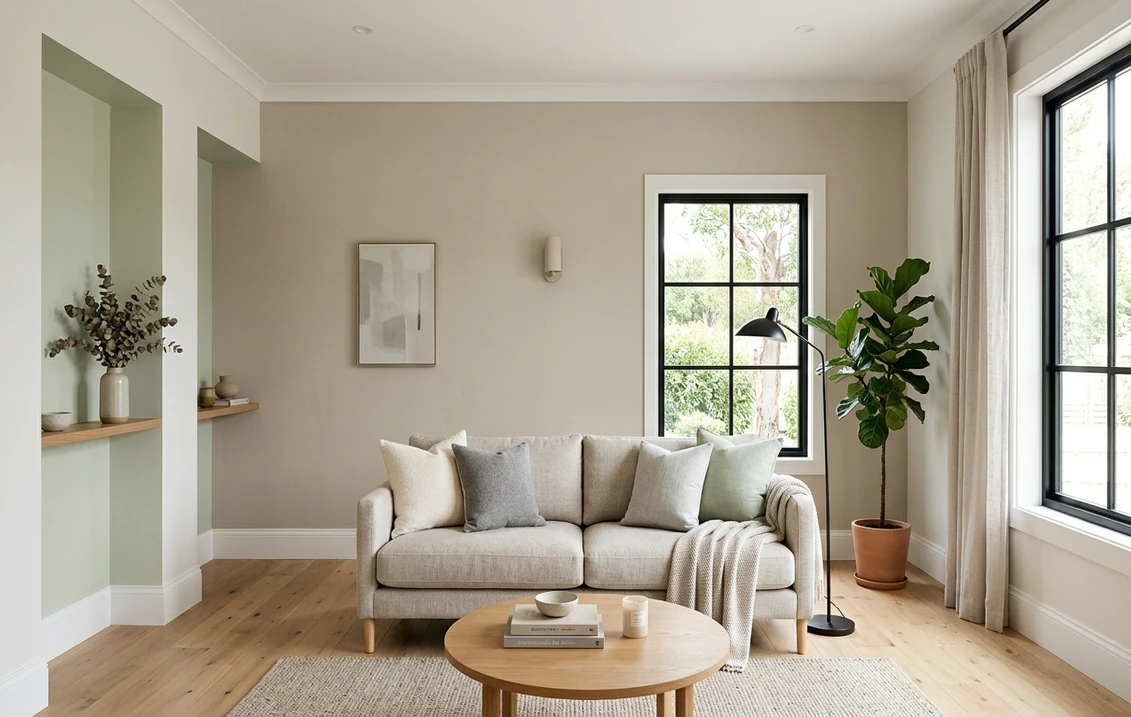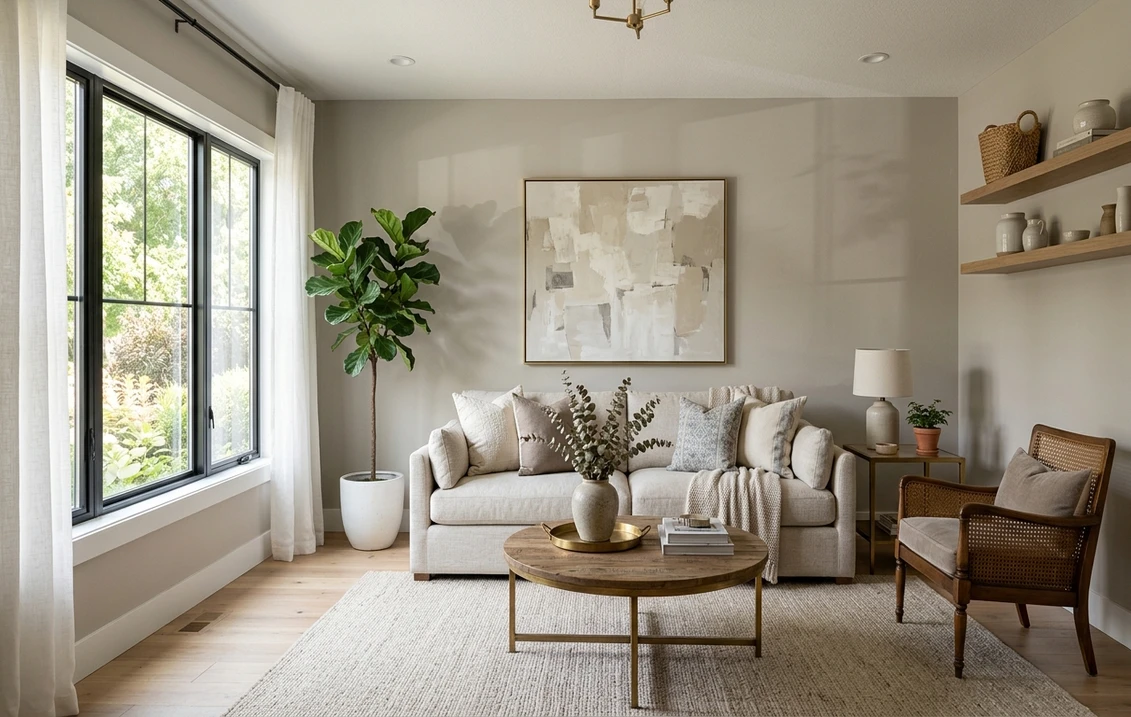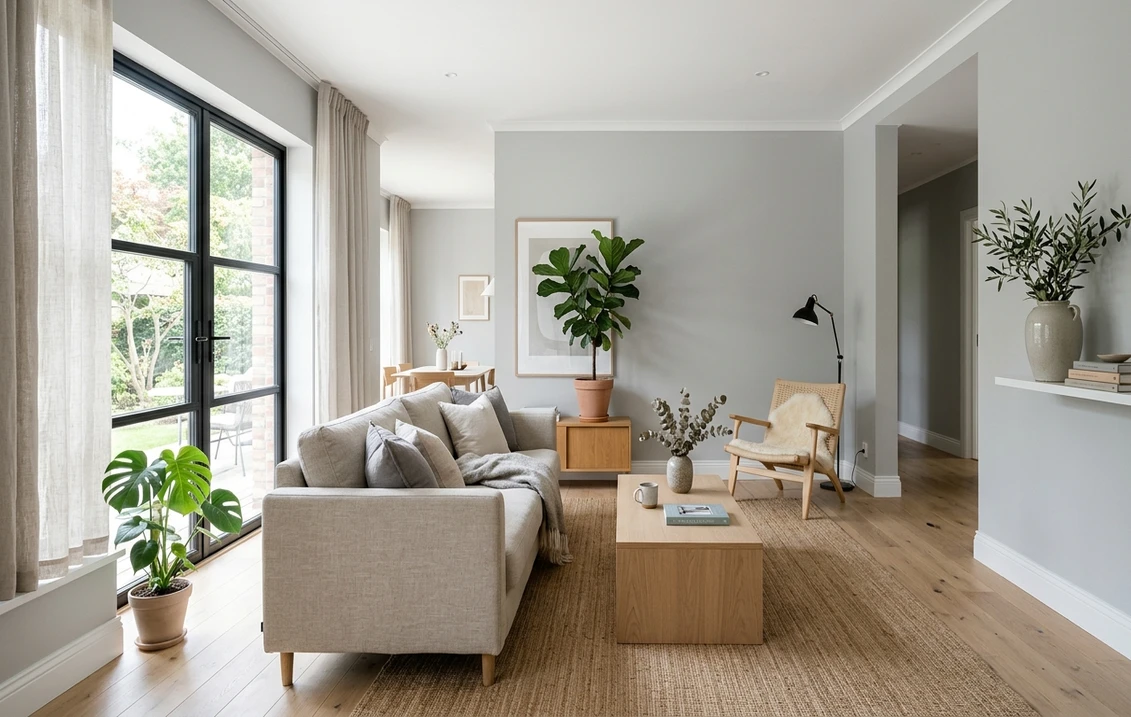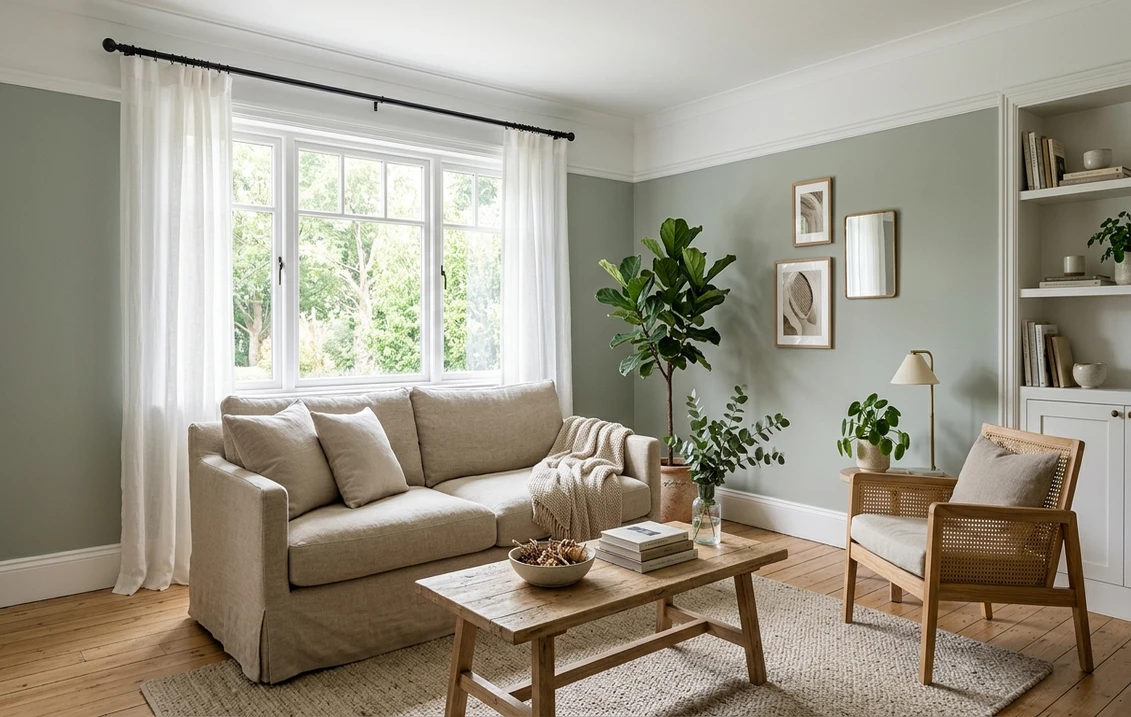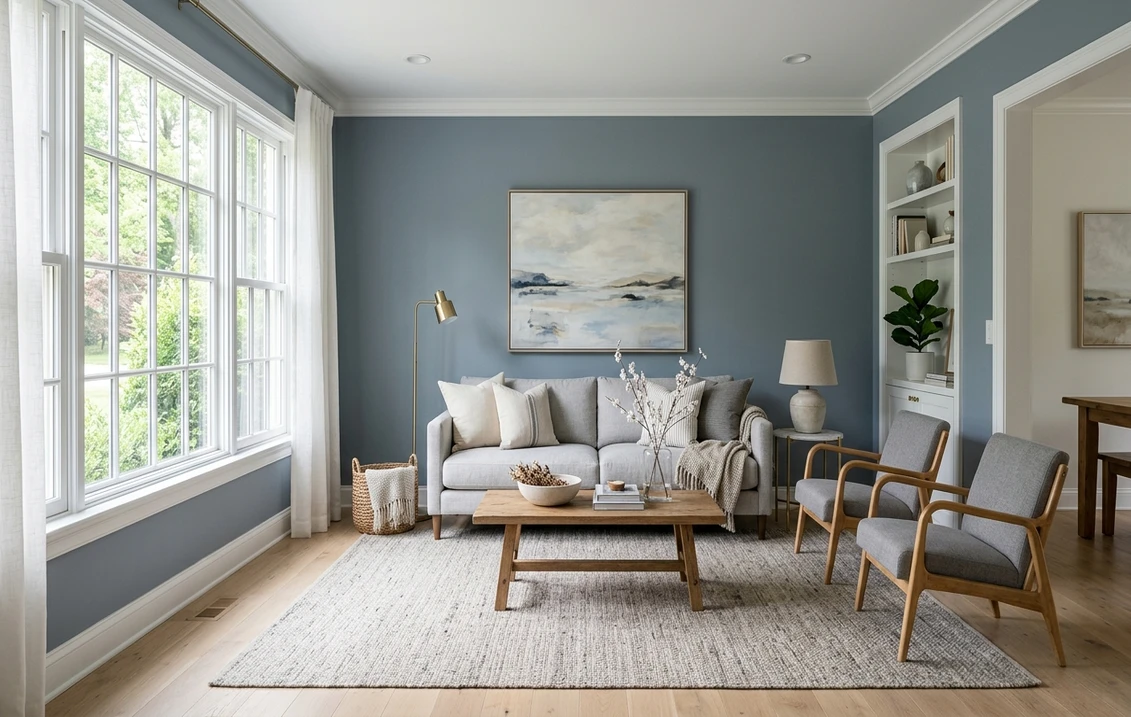
Try it on your room

That sophisticated stormy slate swatch you fell for at the store? In your actual bedroom it can read baby blue at 9 a.m. and tip almost purple after dark. That swing is the defining trait of blue gray paint. It is a chameleon that lives on the knife edge between blue, gray, and sometimes green or violet. Get the undertone and the light right and nothing in the fan deck is calmer. Get them wrong and you repaint.
This is a deep profile of the blue gray family for interior walls: what the undertone actually is, the Light Reflectance Value (LRV) range that decides how much blue shows, the shades worth knowing by name, the best rooms, and the trim and decor that keep it from sliding into nursery territory. For how this family sits next to greens, neutrals, and warm whites, start with our interior paint color families guide.
Upload a photo of your room and preview real blue gray shades under your actual light, free.
What "blue gray" actually means on a chip
A blue gray is a gray pulled toward blue, or a blue grayed down so far it no longer reads as a true blue. The pigment is mostly black and white, with a small dose of blue and, in most formulas, a trace of green or violet riding along. That trace is the part nobody mentions, and it is what surprises you on the wall. Two things decide which side of the family a shade lands on:
- Chroma (how saturated it is). Low chroma reads as a moody neutral that behaves like a gray; higher chroma reads as an obvious blue and lights up under bright sun.
- The secondary undertone. A green whisper (think slate, sea glass) feels organic and calm. A violet whisper can flip lavender at dusk or under warm bulbs. A cleaner blue base stays crisp but goes more obviously blue in strong light.
This is why blue gray is the family most likely to "not look like the chip." It is a low-chroma color whose tiny undertone gets amplified or canceled by your light, trim, and even your floor.
LRV: the number that predicts the surprise
LRV measures how much light a color reflects, on a 0 (black) to 100 (pure white) scale, and it is printed on every chip. For blue gray it does double duty: it tells you how light or dark the wall will feel, and it loosely predicts how much blue shows. Lighter blue grays (higher LRV) flash bluer in bright light because there is less black holding the blue down. Deeper ones read as committed, moody slate and stay closer to neutral.
| Shade | Code | LRV | Undertone read |
|---|---|---|---|
| SW Krypton | SW 6247 | 53 | Soft blue gray, slight green; very neutral |
| BM Coventry Gray | HC-169 | 48 | Balanced, reliable, low drama |
| SW Misty | SW 6232 | 63 | Light, airy, blue-green whisper |
| BM Smoke | 2122-40 | 53 | Clear blue gray; can flash blue in sun |
| SW Stardew | SW 9138 | 43 | Muted blue-green; spa-calm |
| BM Van Deusen Blue | HC-156 | 15 | Deep navy-leaning; dramatic |
Try it on your room
No photo? Try a sample
LRV values from Sherwin-Williams and Benjamin Moore technical color data, 2026. Codes are manufacturer references; cross-check on a sample before buying.
Want a blue gray that behaves like a true neutral? Stay in the LRV 40 to 55 band and reach for a low-chroma pick like Coventry Gray or Krypton. If instead you want the blue unmistakable, go lighter (Misty, LRV 63) and accept that it will lean blue, or go very deep (Van Deusen Blue, LRV 15) for a confident slate-navy. The in-between is where shades turn wishy-washy.
How light flips a blue gray (and where it goes wrong)
Daylight is not neutral, and blue gray is the family most sensitive to that fact. How each orientation treats it:
- North-facing: cool, indirect sky light (roughly 7,500 to 10,000 K) adds blue, so blue gray reads bluest and coolest. Pick a grayer, slightly green shade (Krypton, Stardew) so it does not tip into baby blue, or lean in with a deep slate that owns the coolness.
- South and west: warm direct sun (3,000 to 4,500 K) mutes the blue. A clean blue gray like Smoke holds its color; a very gray pick can look like generic builder gray by 2 p.m.
- East-facing: blue early, neutral by afternoon. Most blue grays look their best here.
- Evening, warm LED: 2700K bulbs add yellow that can push a violet-leaning blue gray toward gray-lavender. If your shade has purple in its base, this is where it shows. Try 3000K to 3500K bulbs to keep it honest after dark.
The classic failure mode is a violet-based blue gray in a north room under warm bulbs: blue by day, lavender at night, never settled. The fix is almost always a green-gray base instead of a violet one. There is a second fix nobody suggests: stop fighting the lavender and choose it deliberately. A grayed lavender at LRV 60 or above behaves like a cool off-white with a mood rather than a color, and it stays put under warm bulbs because the violet is the point rather than an accident. Our guide to purple paint colors indoors covers where that soft end works and where a purer lilac goes wrong. The same physics governs warm whites and light grays in cool rooms, which we cover in the light gray paint colors guide and the off-white paint colors guide.
Best rooms for blue gray, shade by shade
Bedrooms
The strongest use case. The cool, recessive quality that makes blue gray tricky in a kitchen is exactly what makes a bedroom feel like a quiet retreat. A soft grayed shade like SW Krypton (LRV 53) or BM Coventry Gray wraps the room without going cold. For a moodier primary suite, a deep pick such as Van Deusen Blue (HC-156, LRV 15) reads as enveloping rather than dark with warm wood and brass.
Bathrooms
Blue gray gives a bathroom a clean, spa-like feel beside white tile, marble, and polished nickel. Lighter blue-green grays like SW Stardew (SW 9138) or SW Misty keep a small bathroom open. Because bathrooms often have little daylight, lean to the green-gray side so it does not read icy under vanity lighting.
Home offices and studies
Cool tones support focus, and blue gray reads as more original than plain gray on camera. A mid-tone like Smoke (2122-40) or Coventry Gray gives a study gravity without darkening it. Here a bluer read is a feature, not a bug.
Living rooms and kitchens
Use it with intent. On a south or west living-room wall it can be a grounded neutral; on a north wall it can chill the most-used room in the house. In kitchens it shines on cabinetry (lowers especially) with warm white uppers and brass hardware. If you want this family warmer across an open-plan floor, a transitional neutral often serves better, the case our greige paint colors guide makes in detail.
Free AI paint visualizer. Test Krypton, Coventry Gray, and a deep slate on your real room before buying a sample.
Trim, ceiling, and decor that keep it sophisticated
What separates "designer blue gray" from "nursery blue" is rarely the wall color itself. It is the company that color keeps. A few pairings earn their place again and again:
- Trim: a soft warm white (BM White Dove OC-17, or SW Alabaster SW 7008) keeps contrast gentle and stops the blue from looking stark. A bright cool white like SW Extra White pushes the wall bluer, a study goal but colder in a bedroom.
- Ceiling: over a deep blue gray, a white ceiling can feel like a hard lid. The wall color at 50 percent strength makes a moody room feel intentional and larger.
- Wood and warmth: blue gray loves a warm counterweight. White oak, walnut, honey floors, and brass balance the coolness; all-cool finishes can tip a room icy.
- Greens to pair: blue gray sits beautifully beside soft sage, which is why slate-and-sage is a recurring 2026 palette. See our sage green interior shades and pairings guide.
- Accents: warm terracotta, mustard, blush, and rattan keep blue gray from feeling clinical; black and brass read modern.
Blue gray vs. its neighbors
- Blue gray vs. true gray: a true gray is neutral and recedes; blue gray carries a mood and a temperature. If a gray sample looks boring, a blue gray often fixes it without committing to obvious color.
- Blue gray vs. greige: greige is warm, cozy, and flexible; blue gray is cool, crisp, and serene. They solve opposite problems, greige to warm a space up, blue gray to calm it down.
- Blue gray vs. light gray: a light gray with a blue undertone is just the airy end of this same family. The line between them is chroma.
Both Sherwin-Williams and Benjamin Moore field deep blue gray benches, and the line you pick quietly shifts the exact undertone you end up living with. Our Sherwin-Williams vs Benjamin Moore comparison covers coverage, washability, and cool tones, and our best interior paint colors of 2026 guide shows the wider direction this family fits into.
How to test blue gray before you commit
No family surprises people more than this one, so a tiny fan-deck chip will not cut it. Here is the test that catches the surprise early:
- Paint a 12 by 12 inch swatch (or use peel-and-stick samples) on two walls, one near the window and one across the room.
- Check it morning, midday, and after dark under your own bulbs. A blue gray that looks perfect at noon can go lavender at 9 p.m.
- Hold a pure white card next to it; against true white the undertone becomes obvious.
- Sample one grayer pick and one bluer pick so you see the family's range in your light.
The fastest no-paint shortcut is a digital preview: upload a photo and apply several blue gray shades to see which stays a calm slate and which flashes blue. To plan the surrounding repaint once you have chosen, our interior house painting cost guide breaks down per-room and per-square-foot pricing.
See which blue gray stays slate and which flashes blue in your room, before buying samples.
Frequently asked questions
Why does my blue gray paint look more blue (or purple) than the chip?
Blue gray is a low-chroma color, so its small undertone gets amplified or canceled by your light. Cool north-facing daylight adds blue and makes it read bluer; warm sun cancels blue and makes it read grayer. If the shade has a violet base, warm 2700K bulbs can push it toward lavender at night. A green-gray-based blue gray instead of a violet-based one usually fixes the surprise.
What is a good LRV range for blue gray walls?
For blue gray that behaves like a calm neutral, stay around LRV 40 to 55 (for example BM Coventry Gray HC-169 at 48 or SW Krypton SW 6247 at 53). Lighter than about 60 (like SW Misty at 63) and the blue becomes more obvious; deeper than about 20 (like BM Van Deusen Blue HC-156 at 15) and it reads as a confident slate-navy rather than an in-between.
What are the best blue gray paint colors to know by name?
Reliable, low-drama picks: Benjamin Moore Coventry Gray (HC-169) and Sherwin-Williams Krypton (SW 6247). Lighter and airier: SW Misty (SW 6232); muted mid-tone blue-green: SW Stardew (SW 9138). Clearer blue: BM Smoke (2122-40). For a dramatic, deep room: BM Van Deusen Blue (HC-156). Always confirm the exact undertone on a sample, because each reads differently by light.
What rooms work best for blue gray?
Bedrooms, bathrooms, and home offices are the sweet spot, because the cool, calming quality suits rest and focus. It also looks great on kitchen lower cabinets with warm white uppers. Use it carefully in living rooms and kitchens with north light, where it can chill a high-traffic space; a warmer neutral like greige often serves those rooms better.
What trim color goes with blue gray walls?
A soft warm white like Benjamin Moore White Dove (OC-17) or Sherwin-Williams Alabaster (SW 7008) keeps the contrast gentle and stops blue gray from looking stark or nursery-like. A bright cool white like SW Extra White pushes the walls bluer, which works in a study but reads cold in a bedroom. Balance cool walls with warm wood, brass, or aged bronze.
Upload your room photo and compare blue gray shades side by side under your own light before committing.
Disclaimer: Sherwin-Williams, Benjamin Moore, and the color names and codes referenced throughout are trademarks of their respective owners. FacadeColorizer is an independent paint visualization service and is not affiliated with, endorsed by, or sponsored by Sherwin-Williams, Benjamin Moore, or Behr. Color reproduction on screens approximates the manufacturer's chip; always confirm with a manufacturer sample under your own lighting before purchase. Sources: Sherwin-Williams and Benjamin Moore technical color data sheets 2026, The Spruce paint color references, and published designer undertone guidance.
Trademarks mentioned (Sherwin-Williams, Benjamin Moore, Behr, Caparol, Brillux, Sto, Alpina, Valspar, PPG, Glidden, Dulux, Crown Trade, Sandtex, Farrow & Ball, Johnstone's, Leyland) are property of their respective owners. FacadeColorizer is independent and not affiliated with any of them. Nominative fair use under Lanham Act §1125.