Try it on your room

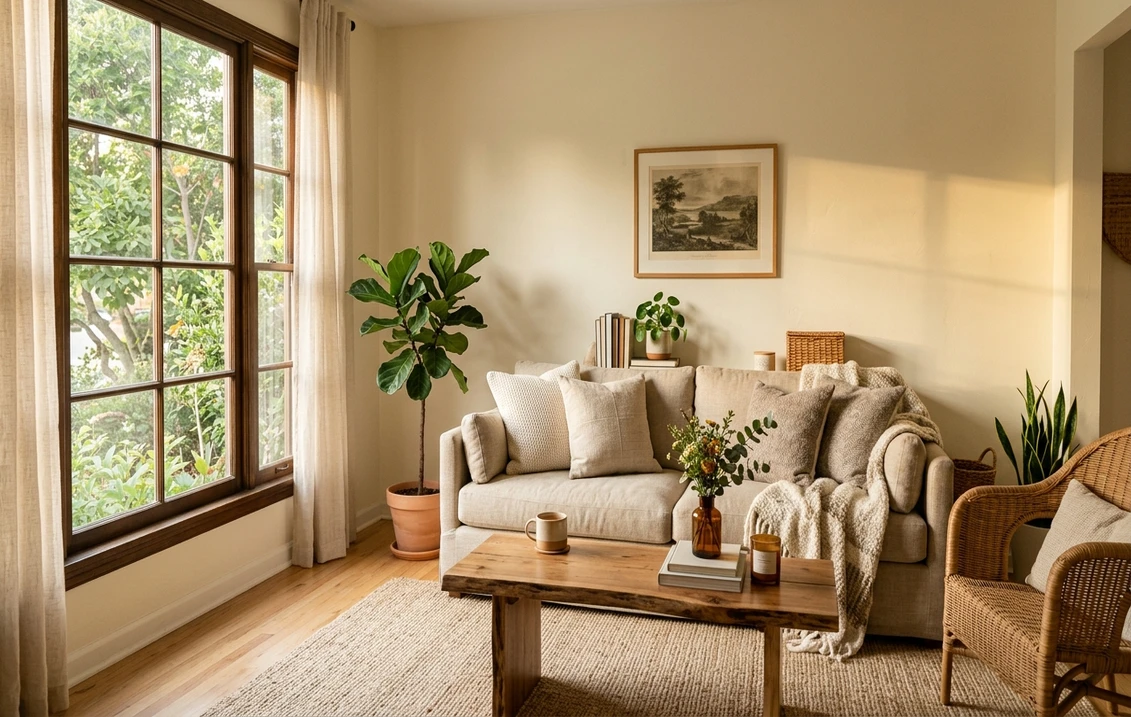
Ever notice how one white room feels like a hospital corridor and another like a sunlit kitchen on a Sunday morning? Same color name, opposite mood. That second feeling is what a warm white is built to deliver. Where a pure or cool white carries a blue or gray base that reads crisp but clinical, a warm white leans on a soft yellow, cream, or barely-there red base that makes a room feel cozy, lived-in, and forgiving of imperfect light. That is the reason warm whites run American kitchens, trim, and whole-house palettes.
This profile breaks down the warm white family: what makes a white "warm," the real undertones inside the most-painted shades, the LRV values that set how bright a room feels, the light directions where warm white shines or turns buttery, and the trims and floors that keep it crisp instead of muddy.
Upload a room photo and preview the top warm white shades under your real light in about 30 seconds, free.
What makes a white "warm"
There is no such thing as a perfectly neutral white in a paint can. Every white is tinted, and that tiny tint is its undertone. A warm white sits on the yellow-to-red side of the wheel (a soft yellow or cream, sometimes a whisper of beige or peach), while a cool white leans toward blue, gray, or green. That warmth is what makes a wall feel soft and enveloping rather than sterile.
Warm whites split into three loose undertone groups, and knowing which one you have predicts how a sample behaves on your wall:
- Yellow-cream warm whites: the classic cozy whites. A gentle yellow base gives a buttery, candlelit feel that can edge toward gold in a very bright south room. Example: Sherwin-Williams Creamy (SW 7012).
- Soft neutral warm whites: warm but restrained, with only a faint yellow-beige base and a touch of gray to keep them from going cream. The most versatile group and the safest whole-house pick. Example: Benjamin Moore White Dove (OC-17).
- Greige-leaning warm whites: a barely-there green-gray base grounds them, the most "designer" look, but in cool light that gray base can surface. Example: Sherwin-Williams Alabaster (SW 7008).
Warm white sits one step lighter than greige. For the full map of how whites, greiges, and grays relate, see our interior paint color families guide. If your samples keep reading too yellow, you may want a warm-neutral greige instead, covered in our greige paint colors guide.
The best warm white paint colors for 2026
At the deeper end of the warm whites sits Bone White OC-143, LRV 72.13, which Benjamin Moore describes as a gentle buff; the maker's own coordinating list pairs it with Mayonnaise OC-85 (88.07), a bright white with a touch of creamy yellow, as the trim. Our Bone White review compares it with Linen White (80.94) and Navajo White (78.26) by the published figures.
Light Reflectance Value (LRV) measures how much light a color bounces back, from 0 (black) to 100 (pure white). Warm whites typically land between LRV 80 and 88: bright enough to read as white, soft enough to dodge the glare of a builder-grade bright white in the low 90s. Below, the warm whites most specified by US designers.
| Color (code) | LRV | Undertone | Best for |
|---|---|---|---|
| BM White Dove (OC-17) | 85 | Soft warm, faint yellow-gray | The safe whole-house default; trim and cabinets |
| SW Alabaster (7008) | 82 | Warm, slight green-gray base | Walls and trim in warm-to-neutral light |
| SW Creamy (7012) | 81 | Warmer yellow-cream | North and east rooms wanting cozy warmth |
| BM Simply White (OC-117) | 91 | Bright, mild yellow warmth | A clean white that still reads warm; trim |
| SW Greek Villa (7551) | 84 | Warm, peachy-yellow | Cool north rooms where other whites fall flat |
| BM Swiss Coffee (OC-45) | 84 | Creamy yellow-beige | Cozy bedrooms and traditional spaces |
Try it on your room
No photo? Try a sample
Sources: Sherwin-Williams and Benjamin Moore official technical data sheets (LRV values), 2026; The Spruce white paint roundups; professional designer reference palettes.
One warm white sits just below that LRV band: Ivory Lace SW 7013, which Sherwin-Williams publishes at LRV 78.79, a cream-leaning white a few points deeper than Creamy. It suits rooms where the whites above look too bright; see our Sherwin-Williams Ivory Lace SW 7013 profile.
In plain terms: if you want one warm white for the whole house and cannot test every room, Benjamin Moore White Dove (OC-17) is the lowest-risk pick in the country, which is why it dominates trim and cabinet specs. If your home runs dark or north-facing, lean warmer toward Creamy (SW 7012) or Greek Villa (SW 7551). And if the brief is the opposite, maximum brightness without giving up the warmth, Benjamin Moore Simply White OC-117 is the top of this table: it bounces light like a bright white while keeping a soft yellow base, with the caveat that the same base can glow gold under warm bulbs or late west light.
How warm white shifts with light and room direction
A warm white is more sensitive to light direction than almost any other color, because its identity rests on a very small amount of warm pigment: add warm light and that pigment glows, subtract it with cool light and the white flattens or surfaces its gray-green base. The same can of warm white paint genuinely looks like a different color from one room to the next.
- South-facing (warm light most of the day): warm whites look their best and brightest. Watch the yellow-cream shades (Creamy, Swiss Coffee), since strong sun can push them toward butter; soft neutral whites like White Dove stay balanced.
- North-facing (cool blue light, no direct sun): the toughest test. Cool light strips warmth, so greige-leaning whites like Alabaster can flash gray or faintly green. Choose a warmer, yellow-base white (Creamy, Greek Villa) to hold a cozy feel.
- East-facing: golden at sunrise, cooler and neutral by afternoon. Most warm whites handle the swing gracefully; White Dove and Alabaster are reliable.
- West-facing: cool in the morning, then very warm and almost peach at sunset. Lovely for living rooms, but the late amber glow is tricky for a workspace.
Artificial light is just as decisive. Warm-white LED bulbs (2700K) flatter every warm white and deepen the cozy effect, while cool-white or "daylight" bulbs (4000K and up) drain the warmth and make it read closer to plain white, or even slightly gray, after dark.
Free AI paint visualizer. Upload your real photo to see how a warm white reads in your light before buying a sample.
Best rooms for warm white walls
Few wall colors stretch as far as warm white. No surprise, then, that "warm white through the whole house" is one of the most common briefs we hear. Still, it pulls its weight harder in some rooms than others.
Kitchens and cabinetry
Warm white's natural home: a creamy white softens hard counters and stainless steel and reads timeless on cabinets rather than stark. White Dove is the most-painted warm white for US kitchen cabinets, with Alabaster the SW equivalent.
Bedrooms
Wrap a bedroom in warm white and it goes quiet and restful, layered with linen, natural wood, and a few soft neutrals. In a north-facing bedroom, lean to a warmer shade (Creamy, Swiss Coffee) so it feels cozy at 7 a.m.
Living rooms and open-plan spaces
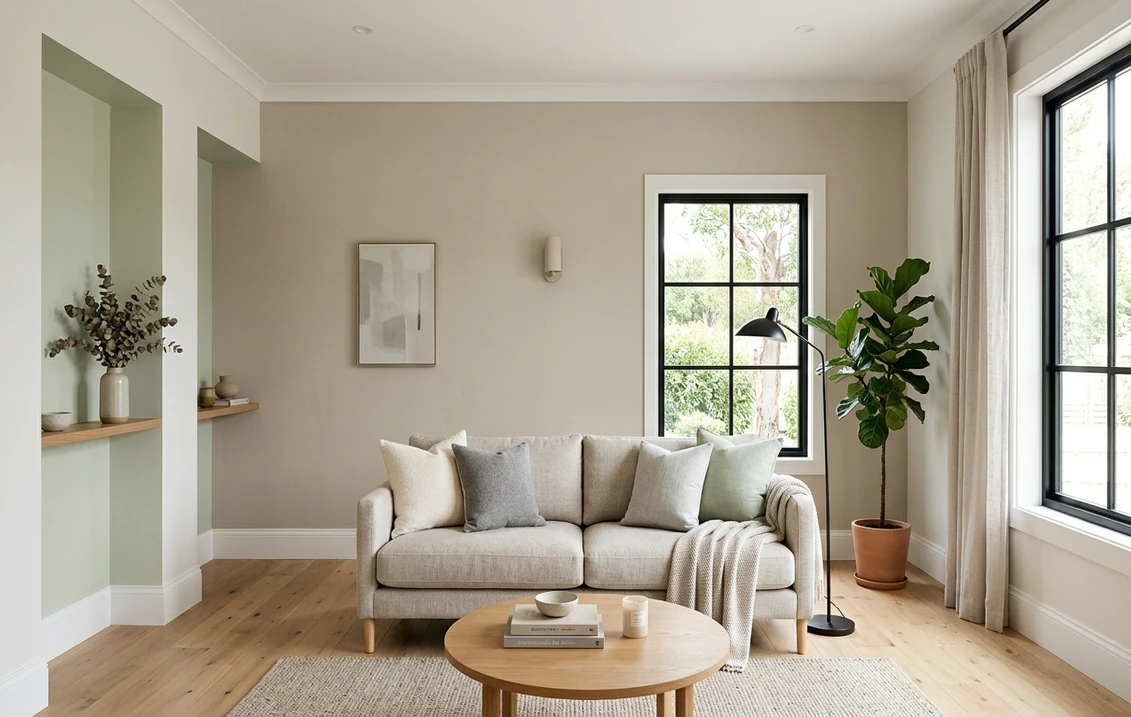
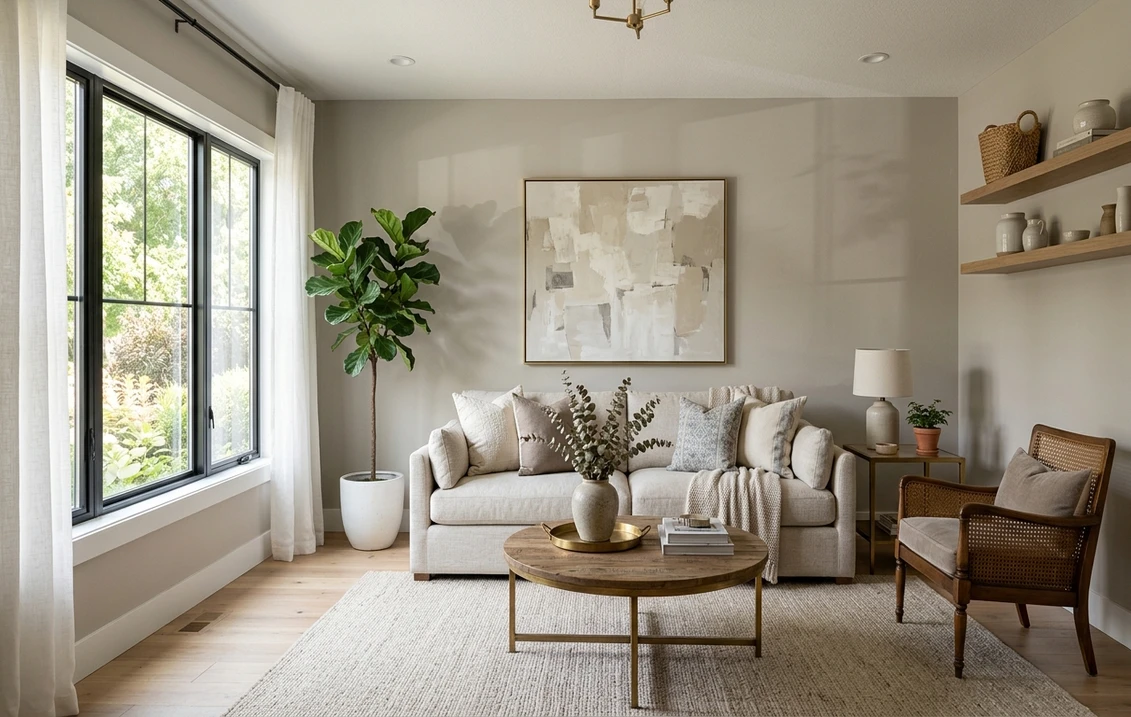
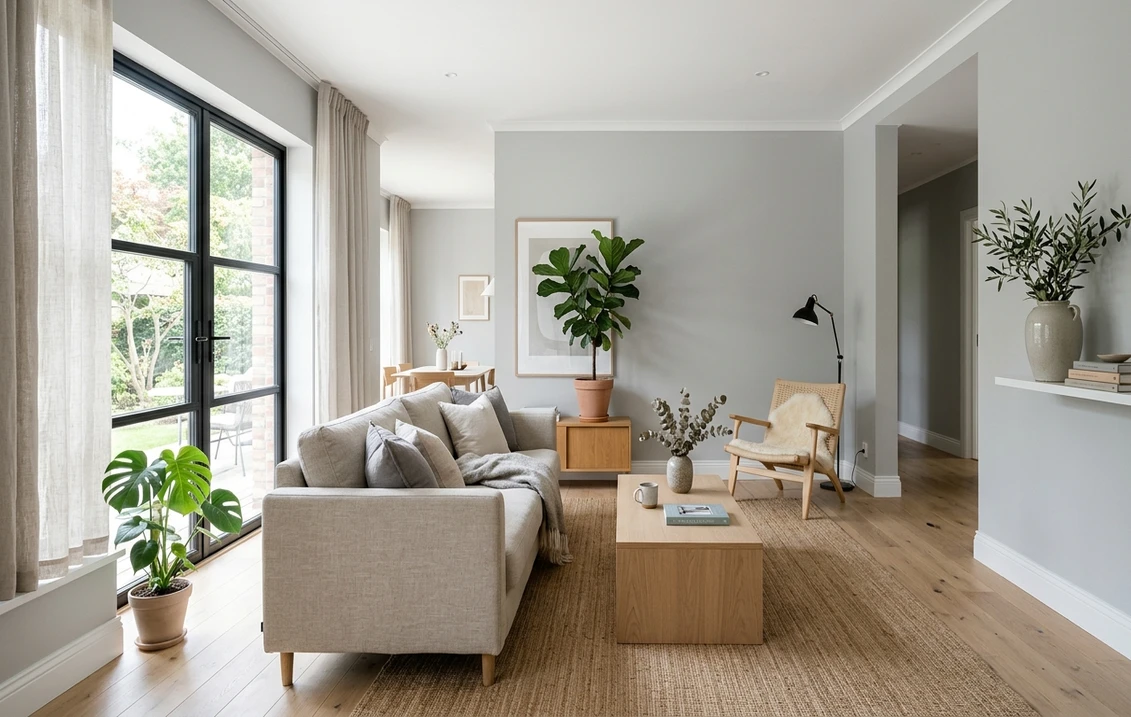
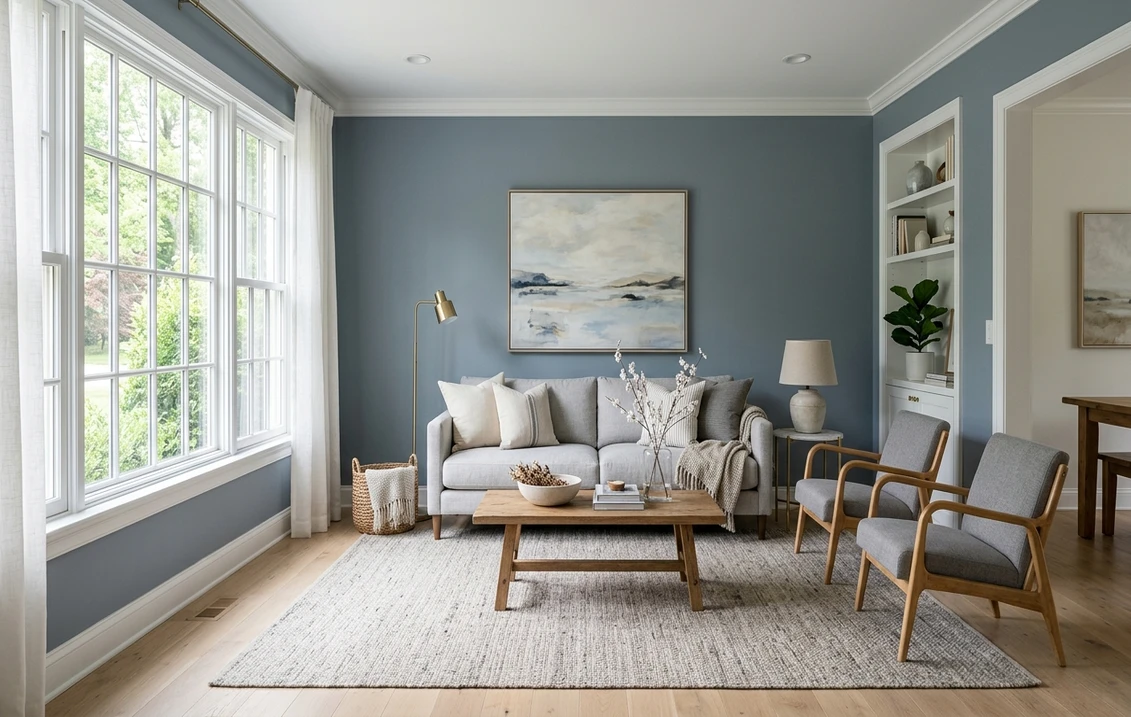
Warm white is a quiet backdrop that lets wood, brass, leather, and color accents stand out, and it flows beautifully between zones in an open plan. Even when the walls go a color, it is still my first pick for trim and ceilings. It keeps greiges, sages, and blue-grays from tipping cold.
Trim, ceiling, and decor pairings
The classic mistake is pairing warm white walls with a stark, blue-based "pure white" trim, which makes the wall look dingy by contrast. The reliable rule: keep walls and trim in the same warm family, and let LRV, not undertone, create the contrast.
- Tonal (walls and trim both warm white): the softest, most current look. Use the same color in different sheens, or step the trim up a few LRV points. White Dove walls with Simply White trim, or Alabaster walls with Pure White trim, read clean without going cold.
- Avoid: a stark blue-white trim like Benjamin Moore Chantilly Lace (LRV 90) against a yellow-cream wall such as Creamy; the contrast can make the wall look distinctly yellow.
- Ceiling: a warm white ceiling (the trim white, or the wall color lightened) keeps the warmth consistent overhead; a stark white ceiling can look disconnected.
- Wood floors: white oak, natural maple, and honey-toned wood bounce warm light onto the walls and amplify the cozy effect.
- Metals and accents: brass, aged bronze, and matte black all read beautifully against warm white; black hardware in particular keeps a creamy room from feeling too soft.
- Color accents: sage green, muted blue, terracotta, and charcoal all sit cleanly on warm white. Our sage green interior shades guide pairs naturally with warm white trim, and for a cooler companion in an adjoining room, see our blue-gray paint colors guide.
One of those accents deserves a second look, because it is the only one that shares a base with the white itself. In front of a green wall, a greige-leaning warm white such as Alabaster carries the same faint green-gray core as the paint it is framing, and in cool north light the two can blur into each other; a yellow-base white like Creamy (SW 7012) or Greek Villa (SW 7551) stays clearly separate. How much this matters depends on the green: our roundup of the most popular green paint colors runs from Sea Salt at LRV 63 down to Pewter Green at LRV 12, and the darker the green, the less the trim undertone shows.
Sheen pulls its weight here as well. Flat and matte finishes mute a warm white's undertone, which is exactly what you want on walls. Satin and semi-gloss bounce back more light and can nudge a creamy wall a touch yellower. That extra glow earns its place on trim and cabinets, but preview it first.
Warm white vs cool white: which one your room needs
Name what you want the room to feel like, then match the undertone to the light it has. For cozy, inviting, soft, choose warm white every time (in a sunny room, a soft neutral like White Dove balances better than a yellow-cream like Creamy, which can tip toward butter). For a crisp, modern, gallery-like space, a cool or pure white reads sharper and more architectural, where a warm white can look slightly soft. And in cool north light where you still want white, pick the warmest white you can (Creamy, Greek Villa) to fight the blue cast.
There is a resale angle too. Warm whites read clean to buyers and photograph beautifully, so they keep turning up in our best interior paint colors for 2026 picks. Weighing one brand against another? Our Sherwin-Williams vs Benjamin Moore interior comparison breaks down how SW Alabaster and BM White Dove differ in real rooms.
How to test a warm white before you commit
A warm white lives or dies on light, so a fan-deck chip is not enough: it reads roughly 25 to 35% lighter than the rolled wall and cannot show how the warmth shifts, which is why a chip-perfect white so often disappoints. Paint a 12-inch swatch on two walls including the one that gets the least daylight, hold it against your trim, cabinets, and floor rather than bare drywall, and look morning, midday, and after dark under your actual bulbs. Faster still, narrow six options to two with a digital visualizer before buying a single sample pot.
For the materials, labor, and square-foot pricing behind the repaint, see our interior house painting cost guide. And if your samples keep reading too cool and flat rather than cozy, you may want a true light gray instead, covered in our light gray paint colors guide.
Frequently asked questions
What is the best warm white paint color?
For a single low-risk choice, Benjamin Moore White Dove (OC-17, LRV 85) is the most popular warm white in the US: its soft, faintly warm base reads clean without going cream, the safe default for walls, trim, and cabinets. Sherwin-Williams Alabaster (SW 7008, LRV 82) is the closest SW equivalent, and Creamy (SW 7012) is the pick when you want noticeably more warmth.
How is warm white different from cool or pure white?
Every white has an undertone. A warm white carries a soft yellow, cream, or red base that makes a room feel cozy and inviting; a cool or pure white carries a blue, gray, or green base that reads crisp and more clinical. Warm whites flatter wood and warm light in everyday living spaces, while cool whites suit modern, gallery-like rooms with plenty of light.
Does warm white work in a north-facing room?
Yes, but choose carefully. North light is cool and mutes warmth, so greige-leaning whites like Alabaster can flash gray or faintly green. Lean toward a warmer, yellow-base white such as Sherwin-Williams Creamy (SW 7012) or Greek Villa (SW 7551) to keep the space feeling cozy rather than cold.
What trim color goes with warm white walls?
Keep trim in the same warm family and let brightness, not undertone, create the contrast. A tonal pairing works best: White Dove walls with Simply White trim, or Alabaster walls with Pure White trim. Avoid a stark blue-based white like Chantilly Lace against a creamy wall, since the cool contrast can make the wall look yellow instead of crisp.
See the best 2026 warm white shades on your actual room before buying a single sample pot.
Disclaimer: Sherwin-Williams, Alabaster, Creamy, Greek Villa, and Pure White are trademarks of The Sherwin-Williams Company. Benjamin Moore, White Dove, Simply White, Swiss Coffee, and Chantilly Lace are trademarks of Benjamin Moore and Co. Behr is a trademark of its respective owner. FacadeColorizer is an independent paint visualization service and is not affiliated with, endorsed by, or sponsored by Sherwin-Williams, Benjamin Moore, or Behr. Color reproduction on screens approximates the manufacturer's chip; always confirm with a manufacturer sample before purchase. Sources: Sherwin-Williams and Benjamin Moore official technical data sheets 2026 (LRV values), The Spruce white paint roundups, and professional designer reference palettes.
Trademarks mentioned (Sherwin-Williams, Benjamin Moore, Behr, Caparol, Brillux, Sto, Alpina, Valspar, PPG, Glidden, Dulux, Crown Trade, Sandtex, Farrow & Ball, Johnstone's, Leyland) are property of their respective owners. FacadeColorizer is independent and not affiliated with any of them. Nominative fair use under Lanham Act §1125.