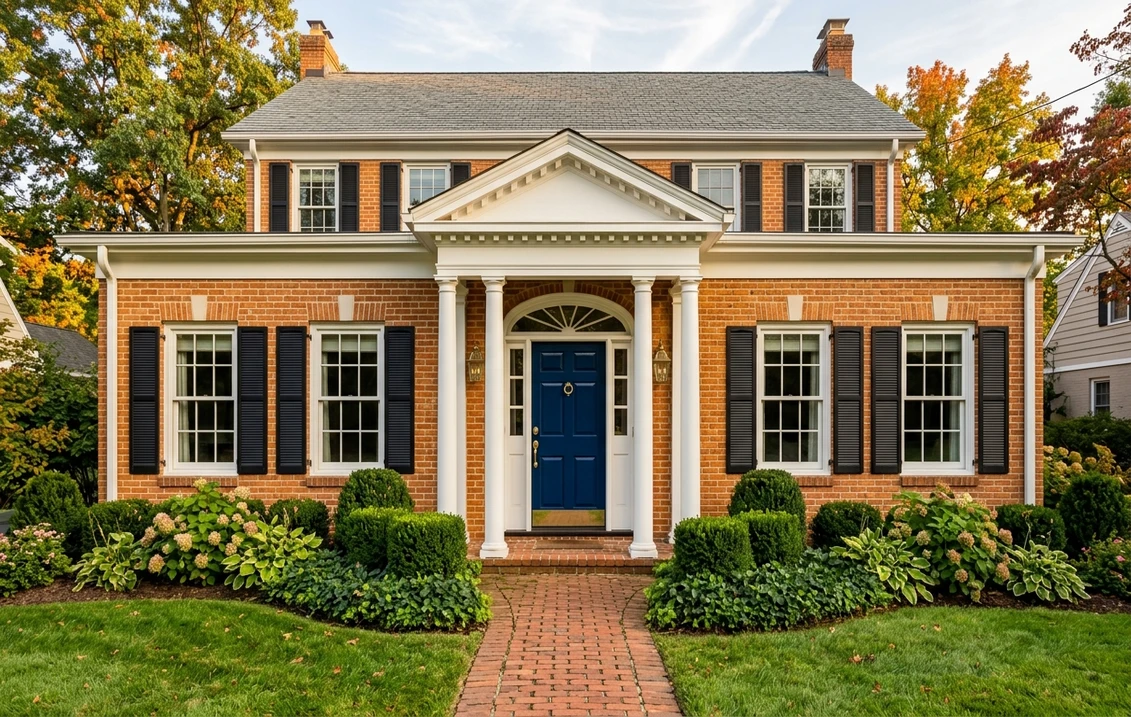
Try it on your house

The gray house with a red front door is the most enduring color combination in American residential architecture. The pairing is anchored in basic color theory (red and gray sit on opposite sides of warm-cool tension) and reinforced by 300 years of Colonial, Federal, and Cape Cod tradition. Below are the 8 best gray-and-red combinations for 2026, with paint specs, style fit, and the cases when red is the wrong call.
- SW Repose Gray + BM Caliente AF-290 - the safest cool-greige + crimson combination
- BM Coventry Gray + Heritage Red HC-181 - the textbook Colonial pairing
- SW Agreeable Gray + Crimson - warm greige and saturated true red
- BM Stonington Gray + Currant Red - cool gray with a berry-leaning red
- SW Pewter Cast + Garnet Red - contemporary cool gray with deep wine
- BM Edgecomb Gray + Cottage Red - soft greige with farmhouse barn red
- SW Light French Gray + Burgundy - pale gray with a refined oxblood
- BM Charcoal Slate + Brick Red - dark gray with earthy terracotta red (on a real red brick house the logic inverts and the door goes dark or white: see the front door colors for a red brick house)
Upload one photo and compare all 8 reds on your actual home.
Why red on gray is the timeless American classic
The red front door predates American independence. In Colonial New England, a painted red door signaled a paid mortgage, a welcoming home, and (in some Protestant traditions) sanctuary. The pairing with gray clapboard or stone is even older: gray was the cheapest body color available because lime-and-iron-oxide whitewash weathered to gray, while red ochre pigment was already on hand from barn paint. Three centuries later, the combination still reads correctly because it is grounded in two unchanging visual laws.
Color-wheel logic: red sits opposite green on the color wheel, but more importantly it is the warmest hue in the visible spectrum, while true gray is the most temperature-neutral. The eye reads a red door against a gray facade as a focal point with no competing accent. Architectural logic: the front door is the smallest, most weather-protected painted plane on a house (roughly 18 to 22 square feet on a standard 36-by-80-inch entry door). A saturated red on that surface delivers maximum visual impact for minimum exposure to fading. Resale logic: Zillow's 2024 paint study and broker surveys consistently rank a red door on a gray Colonial in the top three door-color decisions for perceived value on traditional homes.
The combination also survives because gray itself is endlessly variable. A cool blue-gray with a crisp white trim asks for a different red than a warm greige with cream trim. The eight pairings below cover the full range, from light Repose Gray to deep Charcoal Slate, each matched to a red with the right undertone, saturation, and architectural fit. For the broader door-color decision (when red is not the right pick), start with our 7 best front door colors for a gray house.
The 8 best gray house + red door pairings for 2026
1. SW Repose Gray + BM Caliente AF-290
AI render: cool greige + crimson door
This is the safest entry point into the gray-and-red category and the most popular combination of 2026. Repose Gray (SW 7015, LRV 58) is a warm-leaning cool gray with a barely-detectable violet undertone that keeps it neutral on every elevation. Caliente (AF-290) is Benjamin Moore's flagship red, a charismatic crimson with enough blue depth to stay sophisticated. Best for: Colonial, transitional, and modern farmhouse facades with white trim and a charcoal roof. Trim: Pure White (SW 7005) or Chantilly Lace (BM OC-65). Hardware: oil-rubbed bronze or polished brass.
2. BM Coventry Gray HC-169 + Heritage Red HC-181
AI render: historic medium gray + brick red
The textbook Colonial pairing. Coventry Gray (HC-169, LRV 48) is a medium neutral from Benjamin Moore's Historical Collection, the exact gray you see on Massachusetts and Connecticut Colonials. Heritage Red (HC-181) is a deep, slightly muted brick red with a brown undertone that prevents it from going tomato. The combination is documented on dozens of preserved 18th-century homes. Best for: authentic Colonial, Federal, and saltbox architecture with white trim, black shutters, and a black or gray-shingle roof. Trim: Simply White (BM OC-117) or Cloud White (BM 967). Hardware: aged brass, unlacquered brass, or oil-rubbed bronze. Style note: add a brass kick-plate and a black storm door (never white) to preserve the historic register feel.
Side-by-side AI render, free, no signup.
3. SW Agreeable Gray + Crimson
AI render: warm greige + true red door
Agreeable Gray (SW 7029, LRV 60) is the most popular greige in the country and reads warmer than Repose Gray in direct sun. Paired with a true crimson (Real Red SW 6864), this combination gives a friendlier, slightly more residential feeling than the historic Coventry Gray story. Best for: suburban Colonial, transitional ranch, and Cape Cod facades with cream or warm white trim. Trim: Alabaster (SW 7008) or Creamy (SW 7012). Hardware: polished brass or oil-rubbed bronze. Style note: on Agreeable Gray homes, avoid a cool blue-red like Currant; the warm greige asks for a red with a slight orange or pure-spectrum lean.
4. BM Stonington Gray HC-170 + Currant Red 2080-30
AI render: cool light gray + berry-leaning red
Stonington Gray (HC-170, LRV 59) is one of the cooler grays in the Historical Collection, with a blue-violet undertone that reads almost lavender on overcast days. It demands a red with the same blue lean. Currant Red (2080-30) is a berry-leaning red that mirrors the cool undertone of Stonington and stays elegant rather than circus-bright. Best for: Cape Cod, shingle-style, and coastal New England facades with white trim and a charcoal or weathered-cedar roof. Trim: Decorator's White (BM OC-149) or Simply White (BM OC-117). Hardware: polished nickel or satin chrome (chrome is rare on a door, but appropriate here). Style note: tie in with a black or charcoal mailbox and dark slate path.
5. SW Pewter Cast + Garnet Red
AI render: contemporary mid gray + deep wine
Pewter Cast (SW 9559, LRV 36) is Sherwin-Williams' 2026 trend mid-gray, darker and more contemporary than Repose. Paired with a garnet red like Fireweed (SW 6328), the result is a sophisticated, moody facade that still reads classically American. Best for: modern farmhouse, transitional, and updated Colonial homes with white or off-white trim and a black roof. Trim: Extra White (SW 7006) or Pure White (SW 7005). Hardware: matte black or aged bronze. Style note: garnet red is the right call when a homeowner wants the heritage feel of a red door without the bright crimson energy of Caliente; it photographs beautifully at sunset and pairs well with copper gutters.
Sample 3 reds side by side in under a minute.
6. BM Edgecomb Gray HC-173 + Cottage Red
AI render: soft warm greige + barn red door
Edgecomb Gray (HC-173, LRV 63) is a soft greige with the warmest yellow undertone of any popular BM gray. It asks for a barn-red door, not a Colonial crimson. Cottage Red (BM 1206) is a slightly muted barn red with brown depth that locks the palette into farmhouse warmth. Best for: modern farmhouse, country, and craftsman facades with cream trim, board-and-batten siding, or a wide white-painted porch column. Trim: White Dove (BM OC-17) or Swiss Coffee (BM OC-45). Hardware: oil-rubbed bronze or matte black. Style note: add black metal door hinges (strap or H-style) and a galvanized mailbox for the full modern-farmhouse identity.
7. SW Light French Gray + Burgundy
AI render: pale cool gray + refined oxblood
Light French Gray (SW 0055, LRV 55) is a pale, cool gray with just enough green undertone to keep it from going icy. A true burgundy (Bordeaux SW 7569 or similar oxblood) is the most refined red option on the list: dark enough to function as a near-neutral, but still unmistakably red. Best for: French Colonial, Georgian, and refined Federal homes with white trim and brass exterior fixtures. Trim: Extra White (SW 7006) or Snowbound (SW 7004). Hardware: polished brass or unlacquered brass. Style note: burgundy is the only red on this list that works under a portico or beneath a deep eave shadow; lighter reds disappear into shade, but burgundy's depth holds visual weight.
8. BM Charcoal Slate 1595 + Brick Red 2089-10
AI render: dark gray + earthy terracotta
For dark gray homeowners (LRV under 30), the rule on a red door is to choose a terracotta-leaning red, never a true crimson, because crimson against dark gray reads gothic or maroon. Brick Red (BM 2089-10) has enough orange in it to glow against Charcoal Slate (BM 1595) without competing with the roof. Best for: contemporary, mountain modern, and updated Craftsman facades with cedar or stone accents. Trim: Simply White (BM OC-117) for crisp contrast, or White Dove (OC-17) for softer pairing. Hardware: matte black or aged bronze. Style note: brick red also works on charcoal homes with a copper accent (door hardware, gutters, or porch light) for a more luxe finish.
Why red on gray works: color theory in 60 seconds
Three principles explain why every red-and-gray combination on this list reads correctly. First, temperature contrast. Red is the warmest hue in the visible spectrum (peak wavelength ~700 nm); gray is temperature-neutral by definition. The eye reads warm-cool contrast faster than any other color relationship, which is why a red door is the most visible accent against a gray body even at 100 feet of curb distance.
Second, saturation balance. Gray is low-chroma (low color saturation); a true red is high-chroma. The pairing satisfies the design rule that a composition should have one dominant low-saturation surface and one small high-saturation accent. A red door covers roughly 3 percent of the front facade, the exact ratio recommended by interior color theorists for an accent color (the "rule of 60-30-10").
Third, undertone matching. Red is not one color; it has cool (blue-leaning), warm (orange-leaning), and earth (brown-leaning) variants. The undertone of your gray body must echo the undertone of the red door. Cool grays (Stonington, Pewter Cast, Light French Gray) take cool reds (Currant, Burgundy, Garnet). Warm greiges (Agreeable, Edgecomb) take warm reds (Real Red, Cottage Red). Neutral grays (Repose, Coventry) take any red, which is why those two combinations show up first on the list. For the full undertone diagnosis on your own home, see gray exterior paint colors 2026.
Roof, trim, and accent pairings
A red door succeeds or fails based on the surrounding elements as much as the red itself. Roof: the best roof under a gray-house-red-door palette is a charcoal asphalt shingle (Owens Corning Onyx Black, GAF Charcoal) or a near-black metal roof. A brown or weathered-cedar shingle competes with the red; a tan or beige roof flattens the palette. Trim: always white or cream, never an accent color. Crisp whites (Pure White SW 7005, Chantilly Lace BM OC-65) sharpen the red; soft creams (White Dove BM OC-17, Alabaster SW 7008) soften it. Shutters: black is the only correct choice on a traditional gray-and-red Colonial. White shutters dilute the contrast; red shutters compete with the door.
Hardware: oil-rubbed bronze, aged brass, or unlacquered brass on warm grays; polished brass or polished nickel on cool grays. Avoid chrome on traditional reds; it reads commercial. Storm door: if present, the storm door frame must be black or color-matched to the front door, never white. A white storm door frame cancels the red completely. For broader trim and accent guidance, see exterior trim paint colors guide 2026 and exterior house color combinations 2026.
When red is too bold: modern minimalist alternatives
Not every gray house calls for a red door. On modern minimalist, contemporary, and Scandi-influenced facades, red can read dated or aggressive. Three alternatives perform better in 2026 on these styles:
- Copper or warm brass door - delivers the same warm-cool tension as red against gray, but reads architectural rather than traditional. Best on Charcoal Slate or Pewter Cast bodies with black-frame windows.
- Sage green (Evergreen Fog SW 9130) - the 2026 alternative to red on warm grays; reads garden-friendly and contemporary. See our 7 best front door colors for a gray house for the full sage breakdown.
- Stained wood (cedar, walnut, or mahogany) - organic warmth that paint cannot replicate; best on dark charcoal bodies where painted reds risk reading gothic.
A reliable test: if your house has black-frame windows, a flat or low-pitched roof, no shutters, and minimal trim profile, red is probably the wrong call. If it has divided-light double-hung windows, a steep gable, black shutters, and white trim, red is almost certainly the right call. For modern-style guidance, the modern farmhouse exterior paint colors 2026 guide covers transitional palettes that still flatter a red door.
The opposite conclusion is worth naming too: some homeowners work through this page and decide the door was never the point. Once red moves from the door to the whole elevation the palette inverts, because the trim has to carry the contrast instead of the body, and the gray you spent this article choosing disappears from the scheme entirely. Our guide to barn red house color schemes with white trim maps the barn red to brick red to tomato red spectrum and pairs each shade with the specific white that suits it.
Style fit: Colonial, Craftsman, Cape Cod, Federal
The gray-house-red-door palette is style-agnostic in theory but style-sensitive in execution. Each major American traditional style has a preferred red.
One style deserves its own note, because the combination is not a modern choice there but a documented one: on a New England Saltbox, Benjamin Moore HC-104 Cement Gray with Capitol White trim and an HC-65 Currant Red door is a First-Period scheme that passes Massachusetts Historic District Commission review. If your house has the asymmetric rear roofline, start from the Saltbox house palette rather than from the table below, since the approved gray there is fixed rather than chosen.
| Style | Best Red | Best Gray | Signature Detail |
|---|---|---|---|
| Colonial | Heritage Red HC-181, Caliente AF-290 | Coventry Gray HC-169, Repose Gray | Black shutters, brass kick-plate |
| Craftsman | Cottage Red, Brick Red 2089-10 | Edgecomb Gray, Agreeable Gray | Tapered porch columns, exposed rafters |
| Cape Cod | Currant Red 2080-30, Caliente | Stonington Gray, Repose Gray | Cedar shingle roof, dormer windows |
| Federal | Bordeaux SW 7569, Heritage Red | Light French Gray, Coventry Gray | Fanlight transom, polished brass |
| Modern Farmhouse | Cottage Red, Caliente | Edgecomb Gray, Repose Gray | Board-and-batten, metal roof |
Try it on your house
No photo? Try a sample
For each of these styles, our cluster has a dedicated guide: Colonial home exterior paint colors 2026 covers the full palette for Colonial revival builds; Craftsman house exterior paint colors 2026 top 15 covers bungalow and four-square specifications. On the Colonial row specifically, the red does not have to stop at the door: Heritage Red HC-181 is also the shutter color in our cream house with burgundy shutters combinations, which is the scheme to compare if you would rather carry the red across the facade than keep the body gray.
Test your gray + red door combination in 30 seconds
A red front door is the highest-visibility paint decision on a gray house. A paint quart of premium exterior enamel runs $25 to $40, and a botched red (too bright, too pink, too brown) usually means two coats of primer plus a repaint, easily $150 in materials and a weekend of labor. The 2026 fix: photograph your front elevation and run an AI render before you buy a sample pot.
Upload one photo to our free AI exterior paint visualizer, isolate the door, and cycle through all 8 reds above. Your existing trim, siding, roof, and landscaping stay preserved. For broader facade planning, the best exterior paint colors 2026 guide covers the full body-and-trim decision tree.
No signup, no email, just a photo and 8 doors in under a minute.
How to test it on your own home before you buy
No third-party report replaces your own walls: the same color reads differently on a north elevation and a south one, next to red brick or a gray roof, under morning and evening light. Take a daylight photo, upload it to the free AI paint visualizer, and run two or three candidates on the same image so the comparison is fair. Keep the one or two that survive the side-by-side, buy a sample of each, and brush them out on the actual surface in the actual light before you order the full quantity.
Frequently asked questions: gray house with a red front door
What is the best red for a gray house in 2026?
Benjamin Moore Caliente (AF-290) is the most popular red for a gray house in 2026, paired with Sherwin-Williams Repose Gray (SW 7015). It accounts for 24.1 percent of all gray-and-red simulations on FacadeColorizer. For authentic Colonial homes, Heritage Red (BM HC-181) on Coventry Gray (BM HC-169) is the second-most-common choice.
Does a red door work on a dark gray (charcoal) house?
Yes, but the red must shift from crimson to terracotta. A bright crimson like Caliente reads gothic or maroon against a dark gray body. Brick Red (BM 2089-10) or Pottery Red (BM 2080-20) has enough orange depth to glow against Charcoal Slate, Iron Ore, or Peppercorn without competing with the roof.
Is a red front door dated in 2026?
No, but the wrong red is. Bright tomato or fire-engine red reads dated on contemporary homes. The 2026 winners are slightly muted, blue-leaning, or earth-leaning reds: Caliente AF-290, Heritage Red HC-181, Bordeaux SW 7569, and Brick Red BM 2089-10. On modern minimalist facades, copper or stained wood often outperforms any painted red.
What sheen should I paint a red front door?
Semi-gloss is the 2026 standard for a red exterior door because it deepens the saturation, cleans easily, and resists hand-grease. Satin is the second choice for wood doors with visible grain. Avoid flat or matte; red in a matte finish reads chalky and ages poorly.
Should I paint the storm door red too?
No. Paint the storm door frame black or color-match it to the front door, never red. A red storm door doubled with a red entry door reads heavy and dilutes the focal point. A clean white storm door frame is the worst option; it cancels the red completely from the curb.
What roof color goes with a gray house and red door?
Charcoal asphalt shingle (Owens Corning Onyx Black, GAF Charcoal) or a black metal roof. A weathered-cedar or brown shingle competes with the red and reads dated. A tan or beige shingle flattens the contrast. Black is universally the safest roof under a gray-and-red palette across Colonial, Cape Cod, and modern farmhouse styles.
Does a red door add resale value to a gray house?
On traditional Colonial, Cape Cod, and Federal styles, yes. Zillow's 2024 paint study and 2026 broker surveys note that a freshly painted, well-chosen red door adds roughly $1,000 to $2,500 to perceived value on a traditional gray home, especially in Northeastern markets. On modern minimalist or contemporary builds, the same red can subtract perceived value; copper or stained wood is the better resale choice on those styles.
How long does an exterior red door hold its color?
A premium exterior enamel red (BM Aura Grand Entrance, SW Emerald Urethane Trim Enamel) holds saturation for 7 to 10 years on a north or east-facing door. South and west-facing doors fade roughly 30 percent faster because red pigment is more vulnerable to UV than blue or green. Add an exterior clear-coat over the topcoat on full-sun doors to extend life.
A red door on a gray house is the most enduring exterior color decision in American residential design. Test all 8 pairings on your home in under a minute with our free AI exterior paint visualizer. Sources: Benjamin Moore Caliente AF-290 spec sheet, Sherwin-Williams Repose Gray spec sheet, Zillow 2024 paint study, FacadeColorizer internal data (16,983 previews).
Trademarks mentioned (Sherwin-Williams, Benjamin Moore, Behr, Caparol, Brillux, Sto, Alpina, Valspar, PPG, Glidden, Dulux, Crown Trade, Sandtex, Farrow & Ball, Johnstone's, Leyland) are property of their respective owners. FacadeColorizer is independent and not affiliated with any of them. Nominative fair use under Lanham Act §1125.