Try it on your house

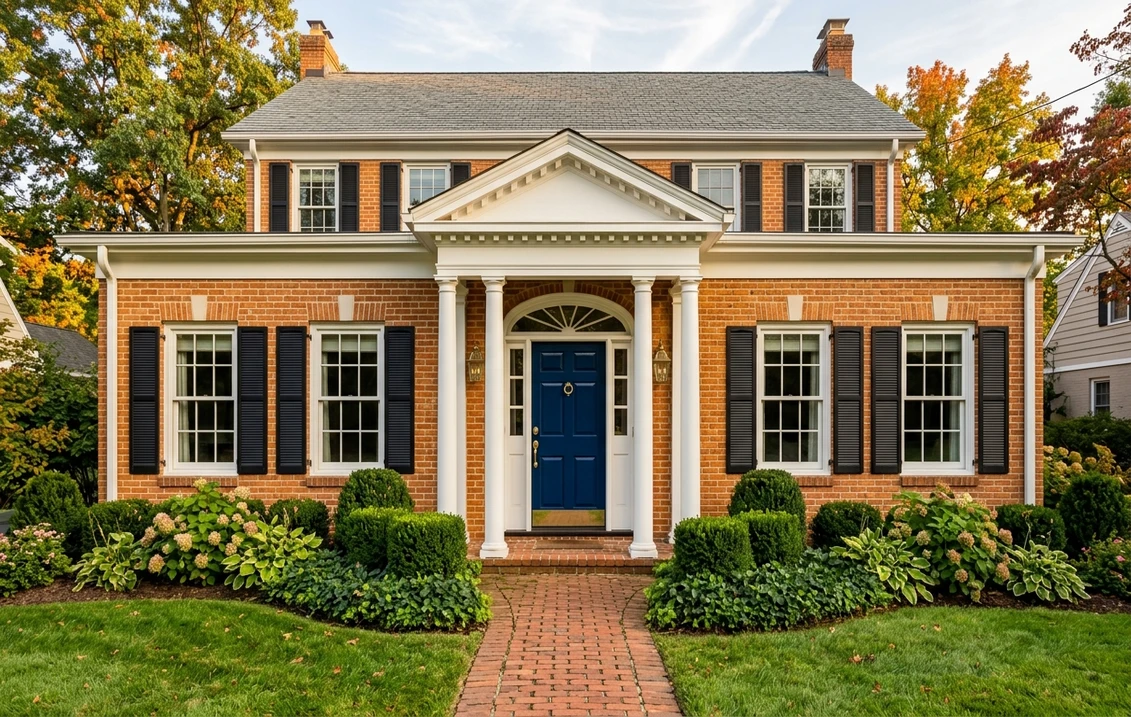
Quick answer: the safest front door colors for a red brick house are true black (Sherwin-Williams Tricorn Black, LRV 3), a soft black (Iron Ore, LRV 6), navy (Benjamin Moore Hale Navy, LRV 8; Sherwin-Williams Naval, LRV 4), near-black green (Benjamin Moore Essex Green, LRV 6) and, for a lighter contrast, a warm white (Alabaster, LRV 82) or a neutral white (Pure White, LRV 84). Which one wins depends on the undertone of the brick: orange-red brick loves deep green and navy, blue-red brick loves black and white, brown-red brick loves navy and cream. Before you buy a quart, put the color on the door in a photo of your own house with the free exterior paint visualizer.
Red brick is the fixed element that decides everything else on the facade, and the front door is the one surface you can change in an afternoon. That makes the door the highest-leverage paint decision on a brick house: a quart of enamel, a Saturday, and the whole elevation reads differently. The catch is that "red brick" is not one color. It runs from orange to burgundy to brown, and a door color that sings on one brick goes muddy on another. This guide sorts the seven colors that reliably work by the brick they belong with, gives the published LRV of each so you can judge contrast, brings in the only large buyer study on door color, and covers the sheen, product and door-material rules that decide whether the finish still looks right in three summers.
First, read the undertone of your brick
Stand across the street at midday and compare the brick to a plain white sheet of paper. Most American red brick falls into one of four families, and each has a natural partner.
- Orange-red brick (the common 1950s to 1990s ranch and colonial brick): the warmth wants a cool, dark complement. Deep green and navy are the classic answers; black works; white can look stark unless it is a warm white.
- Blue-red or burgundy brick (older Northeastern and Midwestern brick, many "used brick" veneers): already cool, so it takes black and crisp white beautifully and can fight a blue door. Deep green stays safe.
- Brown-red and variegated brick (tan, rust and brown flashed together): the busiest brick; the door needs to be calm. Navy, black and a warm cream read best; avoid a third warm color like red or orange.
- Painted, whitewashed or limewashed brick: the brick has stopped dictating; the door is now paired with the paint color. The painted brick exterior guide covers that case, and a black or deep green door is the default on a white or cream brick house.
The other fixed elements matter too: white or cream trim, the color of the shutters, the roof and the mortar. A door that matches the shutters is the traditional move; a door that contrasts with them is the modern one. Both work, as long as the door and the shutters are not two different dark colors.
The 7 front door colors that work on red brick
| Color | LRV | Character | Best brick |
|---|---|---|---|
| Tricorn Black, Sherwin-Williams SW 6258 | 3 | True neutral black, no purple or brown cast | Any red brick; sharpest on blue-red brick with white trim |
| Iron Ore, Sherwin-Williams SW 7069 | 6 | Soft charcoal black with a faint warm-green cast | Orange-red and brown-red brick, where a true black looks hard |
| Hale Navy, Benjamin Moore HC-154 | 8.36 | Gray-leaning navy, reads dark blue in sun, near-black in shade | Orange-red and brown-red brick; the classic colonial pairing |
| Naval, Sherwin-Williams SW 6244 | 4 | Saturated true navy, bluer than Hale Navy | Orange-red brick that needs a stronger cool counterweight |
| Essex Green, Benjamin Moore HC-188 | 6.39 | Near-black forest green with a cool, slightly blue lean | Orange-red brick (complementary) and burgundy brick; historic houses |
| Alabaster, Sherwin-Williams SW 7008 | 82 | Warm cream-white | Brown-red and orange-red brick with cream trim; farmhouse and cottage looks |
| Pure White, Sherwin-Williams SW 7005 | 84 | Neutral, very slightly warm white | Blue-red brick with bright white trim, when the door should match the trim |
Try it on your house
No photo? Try a sample
Every LRV above is the manufacturer's published figure (Tricorn Black, Iron Ore, Naval, Hale Navy, Essex Green). The number tells you the contrast you are buying: a door at LRV 3 to 8 against brick that typically sits between 15 and 30 reads as a dark accent, a door at LRV 82 or 84 reads as a bright one, and nothing in the middle (a mid-tone gray, a medium blue) makes the door disappear into the brick. That is the practical reason the list has no mid-tones.
Free first HD render, 3 variations, no account.
What the Zillow buyer study says about door color
The only large, controlled study of door color and buyer behavior is Zillow's 2022 analysis, in which recent and prospective buyers were randomly shown the same front door painted in one of eleven colors and scored each on perception, likelihood to buy and the price they would pay (Zillow, June 2022). Two findings map directly onto a red brick house. A black front door was associated with the highest offer, an estimated 6,449 dollars more than expected on the typical US home value used in the study; slate blue was the color most buyers said they would likely buy, at a smaller premium. And pale pink cost about 6,516 dollars. The study measured perception, not resale data, and the premiums scale with the home value it assumed, so read it as a ranking rather than a price list: high-contrast, saturated darks reassure buyers, pastels do not. On red brick, that ranking and the color theory above point the same way.
Trim, shutters and hardware: the door is never alone
- White trim. With bright white trim, a black or navy door gives the classic three-color scheme (brick, white, dark). With cream trim, choose Iron Ore or Hale Navy over Tricorn Black or Naval; the softer darks sit better next to cream.
- Shutters. Door and shutters in the same dark color is the traditional, safe scheme and reads calm. Door in one dark and shutters in another (navy door, black shutters) is the one combination to avoid: two competing darks on a busy brick field. If the shutters are black and you want a navy door, repaint the shutters or keep the door black.
- Hardware. Brass and aged bronze warm up navy and green; black hardware on a black door disappears, which is either the goal (a monolithic modern door) or a mistake (a colonial that wanted a brass knocker). Satin nickel reads cold on warm brick and is the least flattering choice here.
- Storm door. A full-view storm door in the trim color keeps the front door color visible; a dark storm door in front of a dark door doubles the mass. It also traps heat, which matters for the door material below.
The trim question on brick has its own rules, especially when the brick is brown-red or the house has a mix of brick and siding; the brick house trim paint ideas guide works through them, and the brick house makeover guide shows what a new door and trim do to a tired orange-brick elevation without painting the brick at all.
Sheen, product and the door material
A front door takes sun, rain and hands, so it wants an exterior enamel, not wall paint: a 100 percent acrylic or waterborne alkyd exterior enamel in semi-gloss or gloss. Semi-gloss is the safe default; gloss gives the lacquered, English look on a paneled door but shows every brush mark and needs a flawless surface. Two coats over a bonding primer on a previously painted door, three thin coats for a dark color over a light one.
The material changes the rules more than most people expect. Wood doors take any color, but a dark color on a south- or west-facing wood door will move the joints and check the finish sooner; plan on repainting more often. Steel doors handle dark colors well. Fiberglass doors are the one to be careful with: Therma-Tru, the largest fiberglass door maker, asks in its painting instructions for a quality exterior acrylic latex, and its warranty guidance does not recommend dark colors on PVC lite frames, dentil shelves and similar components exposed to direct sun, nor installation behind a storm door, because of heat build-up; it also requires the door to be finished within six months of installation to keep the warranty. In plain terms: on a fiberglass door that faces the afternoon sun, or that sits behind a storm door, Iron Ore or Hale Navy is a safer choice than Tricorn Black or Naval, and the manufacturer's sheet outranks any color article, including this one.
Black door or navy door?
Upload one photo of the house, paint the door Tricorn Black, then Hale Navy, then Essex Green, and compare the three renders against your actual brick, trim and shutters before you buy a single quart.
Compare three door colors on my houseHow to test a door color properly
- Render it first. A door is a small area on a large brick field, and a chip cannot show the proportion. A render on a photo of your own facade shows the door in context, with the shutters and trim you already have.
- Paint a sample board, not the door. A two-foot square of primed plywood in the finalist color, hung on the door for three days, seen at 9 a.m., noon and dusk. Dark colors shift most between sun and shade.
- Check it from the street, not the porch. Buyers and neighbors see the door from thirty feet. Contrast that looks strong up close is often just right at that distance.
- Check the HOA before, not after. Many associations keep an approved door-color list; navy and black are on almost all of them, greens and whites usually, anything brighter rarely. The front door colors for a gray house pillar covers the approval process and the wider door palette if your house is not brick after all.
Painting the door: the one-day sequence that lasts
- Take the door off its hinges if you can. A door painted flat on sawhorses gets a level, run-free finish; a door painted in place gets drips on the panels' lower edges. Remove the hardware rather than taping around it.
- Clean and degloss. Wash with a mild detergent, rinse, then scuff-sand the old finish with 220-grit so the primer has something to bite. Test a spot with tape: if the old paint lifts, strip it back to a sound layer.
- Prime the bare spots, or the whole door when changing families. A bonding primer on bare fiberglass or steel, a stain-blocking primer on bare wood, and a tinted gray primer under any dark color: it halves the number of topcoats a black or navy needs over a white door.
- Two thin coats, panels first. Brush the panel recesses and moldings, then roll the flat rails and stiles with a small foam or microfiber roller and tip off with the brush in the direction of the grain. Respect the recoat time on the can.
- Let it cure before it closes against the weatherstrip. Enamel dries to the touch in hours and hardens over days; a door closed too soon sticks to the seal and pulls the film. Leave it ajar or place wax paper on the stop for the first night.
- Rehang in the shade. A freshly painted dark door in full sun on day one can blister; morning or an overcast day is the time to put it back.
Colors that fight red brick
- Red on red: a red door on red brick only works if it is a much darker or much bluer red than the brick, and even then the brick's undertone has to cooperate. The red front door guide shows where a red door belongs: on gray, white and cream houses.
- Orange, coral, terracotta: too close to the brick; the door vanishes or clashes.
- Mid-tone gray and medium blue: the LRV problem above; no contrast, no presence.
- Pastels: pale pink, mint and baby blue read as an afterthought on brick and scored worst with buyers.
- Yellow: a mustard door can work on brown-red brick in a craftsman scheme, but it is the hardest color here to get right; test it twice.
If the door is a Benjamin Moore project because the rest of the house is, the ranked list of the brand's Benjamin Moore front door colors adds the greens, reds and blues beyond the two Historical Collection picks used here.
Sources and references
- Sherwin-Williams color pages: Tricorn Black SW 6258, Iron Ore SW 7069, Naval SW 6244, Alabaster SW 7008, Pure White SW 7005 (published LRV values).
- Benjamin Moore color pages: Hale Navy HC-154 and Essex Green HC-188 (published LRV values).
- Zillow, Slate blue, black front doors can sell homes for as much as $6,449 more (June 2022 buyer study, methodology and figures).
- Therma-Tru, painting tips for fiberglass entry doors and FAQs (finish deadline for warranty, dark colors and direct sun, storm doors).
Color names and codes are trademarks of their owners; LRV figures are the manufacturers' published values and screen renderings remain approximations. Door warranty conditions are those of the door manufacturer and prevail over this guide.
Frequently asked questions
What is the best front door color for a red brick house?
Does a black front door increase home value?
Can I paint a fiberglass front door black?
Should the front door match the shutters on a brick house?
What sheen should a front door be painted?
Trademarks mentioned (Sherwin-Williams, Benjamin Moore, Behr, Caparol, Brillux, Sto, Alpina, Valspar, PPG, Glidden, Dulux, Crown Trade, Sandtex, Farrow & Ball, Johnstone's, Leyland) are property of their respective owners. FacadeColorizer is independent and not affiliated with any of them. Nominative fair use under Lanham Act §1125.