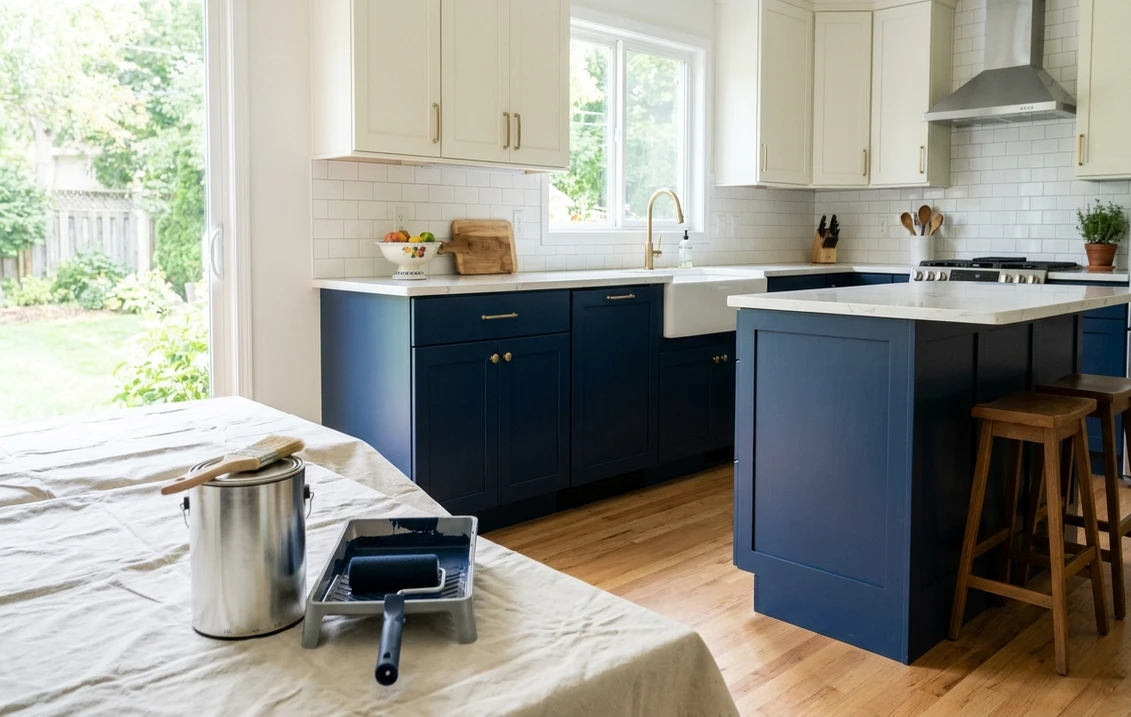
Try it on your room

Benjamin Moore Advance is a waterborne alkyd enamel made for cabinets, doors and trim: it is designed to flow and level like an oil paint while cleaning up with soap and water, and its data sheets show the price of that flow. Advance comes in Satin, Semi-Gloss and High Gloss, covers 400 to 500 sq ft per gallon and needs 16 hours between coats, at least 5 to 7 days before heavy use and up to 30 days to reach optimum hardness. Sherwin-Williams Emerald Urethane Trim Enamel, an alkyd-based enamel sold for the same cabinets, doors and trim, recoats in 4 hours and states a lifetime limited warranty, but covers 350 to 400 sq ft. Benjamin Moore's site listed Advance at $88.99 a gallon on October 28, 2026. On paper, Advance suits a patient project with doors laid flat in a ventilated room; if the kitchen must be back in service within days, Emerald Urethane's faster clock matters more.
How this review works: every figure comes from the makers' data sheets, guides and product pages, read on October 28, 2026. Calculations made from them are ours and labeled as such. No paint was applied for this page and no durability test is claimed.
Opens the interior tool with the Benjamin Moore palette and "Cabinets" preselected. How it works: our interior paint visualizer.
Advance at a glance: the three sheens on their data sheets
Benjamin Moore publishes one data sheet per sheen: Satin 792, Semi-Gloss 793 and High Gloss N794. All three share a waterborne alkyd vehicle, Gennex tint bases 1X to 4X, a wet film of 3.2 to 4.0 mils, 400 to 500 sq ft per gallon, "1 to 2 coats", touch dry in 4 to 6 hours and recoat after 16 hours at 77°F and 50% relative humidity. What changes:
| Sheen (product) | Gloss at 60° | Dry film per coat | Volume solids | VOC | Where |
|---|---|---|---|---|---|
| Satin 792 | 25 to 35 | 1.2 to 1.5 mils | 38.4% | 48.5 g/L | Interior, 50 to 90°F |
| Semi-Gloss 793 | 50 to 60 | 1.1 to 1.4 mils | 35.2% | 43.2 g/L | Interior, 50 to 90°F |
| High Gloss N794 | 85+ | 1.3 to 1.6 mils | 39.5% | 44 g/L | Interior and exterior (primed metal, masonry, cedar or redwood trim; not pine) |
Try it on your room
No photo? Try a sample
The Advance Semi-Gloss product page lists cabinets, doors, trim and kitchens among its projects and says the paint "cures to a hard, furniture-quality finish". The Advance range page showed $35.99 to $88.99 for each sheen, with $88.99 on the gallon pages. Neither the pages nor the data sheets state a warranty term. An older Advance Matte (791) data sheet is still online, but the range page lists only these three sheens.
What "waterborne alkyd" means for your cabinets
Classic oil enamels carry their alkyd resin in a solvent such as mineral spirits. Advance disperses an alkyd in water instead, so it thins and cleans up with water. Benjamin Moore's older Advance Matte and Primer data sheets state that the film "dries by evaporation, oxidation": the water leaves first, then the alkyd keeps hardening as it reacts with air. That second stage explains the long clock and the line on every current sheet, "full hardness and adhesion develop over time".
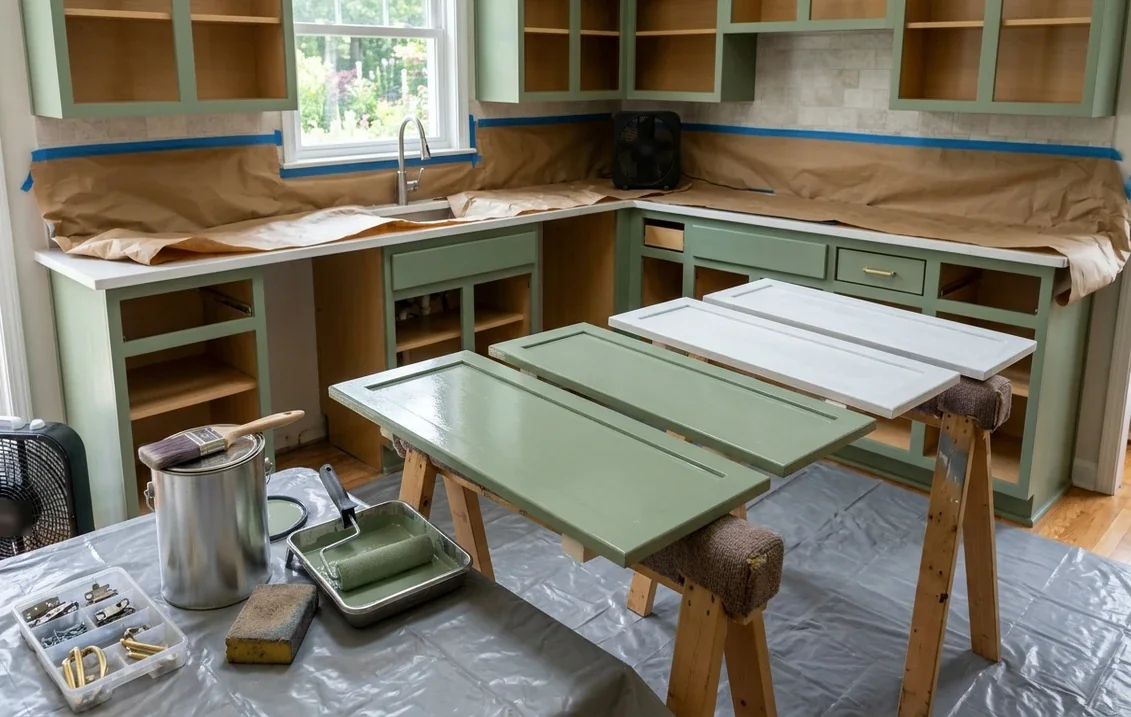
- Flow and leveling. The sheets list "excellent flow and leveling" and "extended open time". The Advance cabinet refinishing guide asks you to paint doors lying flat "so Advance can level out completely".
- Some yellowing remains possible. Advance yellows less than conventional alkyds, the sheets say, but "a slight amount of yellowing may occur", faster in dark or poorly ventilated areas and more visible in lighter colors. In a white kitchen, think of cabinet interiors and a dim pantry.
Sherwin-Williams says Emerald Urethane resists yellowing compared to traditional oil-based coatings. Neither maker publishes a yellowing measurement.
Advance vs Sherwin-Williams Emerald Urethane Trim Enamel
Emerald Urethane figures come from its semi-gloss data sheet (K38) and satin data sheet (K37), both dated March 2026, and its product page.
| Spec | BM Advance | SW Emerald Urethane Trim Enamel |
|---|---|---|
| Resin | Waterborne alkyd | Waterbased urethane modified alkyd |
| Sheens | Satin, Semi-Gloss, High Gloss | Satin, Semi-Gloss, Gloss |
| Gloss at 60° (satin / semi-gloss) | 25 to 35 / 50 to 60 | 35 to 45 / 60 to 70 (deep and black bases 55 to 65) |
| Spread rate per gallon | 400 to 500 sq ft | 350 to 400 sq ft |
| Semi-gloss film per coat (wet / dry), volume solids | 3.2 to 4.0 / 1.1 to 1.4 mils, 35.2% | 4 / 1.3 mils, 33% |
| Touch / recoat (77°F, 50% RH) | 4 to 6 h / 16 h | 1 h / 4 h |
| Return to service, cure | At least 5 to 7 days before heavy abrasion; up to 30 days to optimum hardness and final sheen | Not stated on the data sheet |
| VOC | 43.2 to 48.5 g/L by sheen | Less than 50 g/L |
| Exterior use | High Gloss only | Doors, trim and small areas, not the main body of a house |
| Warranty stated by the maker | None on the page or data sheet | Lifetime Limited Warranty |
| Gallon price on the maker's site, Oct 28, 2026 | $88.99 | Not shown without signing in |
Why Advance covers more square feet. A US gallon is 231 cubic inches, so spread 1 mil thick it covers about 1,604 sq ft. Divided by Advance's 4.0 and 3.2 mils of wet film, that gives 401 and 501 sq ft: exactly the published 400 to 500. Emerald Urethane's 4 mils gives the top of its range. In dry paint per coat the two are close (our calculation at mid-range): about 1.27 mils for Advance Semi-Gloss and 1.32 for Emerald Urethane. Advance's extra coverage comes from a thinner recommended wet coat, not a thicker film. Per gallon, it holds about 7% more solids in semi-gloss (35.2% against 33%) and 28% more in satin (38.4% against 30%).
Note that Emerald's satin and semi-gloss are both shinier than Advance's; our guide to semi-gloss paint for kitchen cabinets explains what those gloss numbers look like on a door.
The 16-hour recoat: what it does to a kitchen schedule
Doors painted on both faces multiply the waiting: Benjamin Moore's guide says to let the paint dry to the touch before turning a piece over. One primer coat and two topcoats on both faces, at 77°F and 50% relative humidity (our planning, built only on the published times):
| Day | Advance | Emerald Urethane |
|---|---|---|
| 1 | Prime both faces and frames, sand | Prime both faces and frames, sand |
| 2 | Coat 1 on backs and frames; flip after 4 to 6 hours; coat 1 on fronts | Coats 1 and 2 on backs, 4 hours apart; flip; coats 1 and 2 on fronts |
| 3 | Light sanding; coat 2 on backs; flip after 4 to 6 hours; coat 2 on fronts | No published return-to-service time |
| 4 to 9 | At least 5 to 7 days before heavy abrasion | Handle gently |
That is three painting days and a rehang around day 8 to 10 for Advance, against two painting days for Emerald Urethane. The older Advance Matte and Primer sheets include a drying chart: under 50% humidity and between 70 and 90°F, Advance dries normally; above 50% humidity or between 50 and 70°F, it dries slower unless you ventilate with a fan or run the air conditioning to lower the humidity; above 85% humidity or below 50°F, do not apply it. Extra ventilation matters "especially when the paint is applied over sealed, hard, non-porous surfaces", which describes a primed cabinet door. Our interior paint drying time guide explains dry, recoat and cure for any paint.
Cure: why dry cabinets still mark for weeks
Every current Advance sheet says not to expose the finish to heavy abrasion or return shelves to service for at least 5 to 7 days, and that it could take up to 30 days to reach optimum hardness "and final sheen": judge the finish after a month, not the morning after. The cabinet guide asks for several days of cure before reassembling. Rehang gently, add felt or rubber bumpers where doors close, and wipe spills with a damp cloth rather than scrubbing during the first weeks. Both makers claim block resistance (painted surfaces less likely to stick together); neither publishes a number.
Which primer goes under Advance
Unlike Aura, which Benjamin Moore sells as a paint and primer, Advance's data sheets do not describe it as self-priming. New surfaces should be fully primed, with the primer tinted toward the finish color for a big color change, and cabinet surfaces roughened by sanding (220 grit or coarser) before priming. By substrate:
- Wood cabinets. The cabinet guide recommends Fast Sanding Primer (507) tinted to the finish color: 30-minute dry, sanding and recoat after 1 hour, 350 to 450 sq ft per gallon. The current data sheets also name Fresh Start High-Hiding All Purpose Primer (046) or Fresh Start Undercoater and Primer/Sealer (032).
- Previously stained cabinets. A stain-blocking primer may be required, the guide says. The 046 data sheet covers most bleeding stains, tannin included, but not knots or pine sap.
- MDF, Thermofoil and laminate. Fresh Start 046. On hard, non-porous surfaces, its maximum adhesion and hardness may take 3 to 4 days to develop.
- Old oil enamel. Sand glossy alkyds before applying Advance.
- Never lacquer-based primers or undercoaters: the guide says they can impede how Advance adheres.
The guide's prep: degrease before sanding, sand with 150 to 220 grit along the grain, vacuum and wipe with a tack cloth, prime, then sand the primer with 220 grit or finer. Under Emerald Urethane, Sherwin-Williams' interior wood system is one coat of Premium Wall & Wood Primer, with ProBlock Quick Dry Oil-Based Primer for persistent tannin stains. The full sequence is in our step-by-step guide to painting kitchen cabinets; oak grain has its own page, our painted oak cabinets before and after guide.
Advance or Aura for cabinets?
Benjamin Moore also lists cabinets among the projects of Aura Interior Semi-Gloss, a 100% acrylic. Side by side with its N528 data sheet:
| Semi-gloss | Advance 793 | Aura N528 |
|---|---|---|
| Gloss at 60° | 50 to 60 | 50 to 60 |
| Spread rate / dry film per coat | 400 to 500 sq ft / 1.1 to 1.4 mils | 400 to 450 sq ft / 1.4 to 1.5 mils |
| Touch / recoat | 4 to 6 h / 16 h | 1 h / 1 h |
| Cure statement | 5 to 7 days before heavy abrasion, up to 30 days to optimum hardness | Washable after two weeks |
| Gallon price, Oct 28, 2026 | $88.99 | $108.99 |
Same gloss range, so the choice is chemistry against time. Aura lays a slightly thicker film and recoats in an hour; Advance costs $20 less per gallon and is the one built around alkyd leveling, the property that hides brush marks on a door laid flat. Per 100 sq ft per coat at mid-range, that is about $20 for Advance against $26 for Aura (our calculation). Our Benjamin Moore Aura Interior review covers Aura's other sheens.
What ANSI/KCMA A161.1 can and cannot tell you
To carry the KCMA A161.1 Quality Certification Seal, a manufacturer's cabinet design is tested to simulate a lifetime of use. KCMA's summary, ROI of Cabinet Durability: Reducing Project Risk With A161.1, counts 14 tests, including a 25,000-cycle door and drawer test, 24 hours of exposure to household liquids such as vinegar, grape juice, coffee and alcohol, and a high-humidity "hotbox" the finish must survive without blistering or discoloration.
The seal certifies factory cabinets, not a paint applied in your kitchen, and neither the Advance nor the Emerald Urethane data sheets cite A161.1: a "KCMA-grade" claim about a DIY finish is unverified. You can still borrow the household-liquids idea as a comparison: on a scrap panel painted with your full system and cured for 30 days, leave drops of vinegar, coffee and rubbing alcohol under a cup for 24 hours, then look for whitening or softening.
How much Advance does a kitchen need?
A worked example (our calculation): 18 doors of about 15 by 30 inches painted on both faces (112 sq ft), 8 drawer fronts of 15 by 6 inches (5 sq ft) and about 55 sq ft of face frames, end panels and island back come to roughly 175 sq ft per coat, 350 sq ft for two topcoats. At 400 to 500 sq ft per gallon, Advance needs 0.7 to 0.9 gallon: one gallon, $88.99 on October 28, 2026. Emerald Urethane needs 0.9 to 1.0 gallon at 350 to 400 sq ft, so one gallon with little margin. One coat of Fast Sanding Primer takes 0.4 to 0.5 gallon. Keep the leftover topcoat: Sherwin-Williams notes that touching up with the same batch and application method helps the repair blend in, and the logic holds for any enamel. For labor and the full budget, see our kitchen painting cost guide.
Settle the color before you sand 18 doors
Three painting days and a week of cure are a lot to spend on a color you end up disliking. Upload a photo of your kitchen and compare Benjamin Moore colors on your own cabinets first.
Try Benjamin Moore colors on my cabinetsBrushing, spraying, ventilation and lead
Use a nylon/polyester brush (natural bristles absorb water, the guide warns). For spraying, the guide generally recommends an HVLP gun with a fine-finish tip and allows thinning with water up to 6% by volume; the data sheets list HVLP at 20 PSI with a 1.8 tip and airless at 1,500 to 2,500 PSI with a 0.011 to 0.015 tip. Emerald Urethane needs no reduction (2,000 PSI, 0.013 to 0.017 tip). Trim and interior doors follow the same logic: see our guide to painting interior doors, trim and baseboards.
Low VOC is not zero VOC. The EPA notes that many VOCs are consistently higher indoors, up to ten times higher than outdoors, and advises more ventilation when using products that emit them (EPA, VOCs and indoor air quality). In a home built before 1978, the old cabinet finish may contain lead. The EPA's Renovation, Repair and Painting program requires anyone paid to disturb paint in pre-1978 housing to be certified; homeowners working in their own home are generally outside the rule but should follow the lead-safe practices for DIYers: plastic sheeting, misting before sanding, HEPA attachments on power tools and a HEPA vacuum. Our low-VOC interior paint guide compares certifications across brands.
Who should choose Advance, and who should pick Emerald Urethane
- Advance, if the doors can stay off for a week or more. Three painting days plus 5 to 7 days before heavy use is the published schedule in good conditions.
- Advance, if you brush or roll and want the door to level. Flow and leveling are what the line is built around.
- Advance, for a softer semi-gloss (50 to 60) or a true high gloss (85+).
- Emerald Urethane, when the kitchen has to work again quickly. A 4-hour recoat fits both coats on both faces in one day, on paper.
- Emerald Urethane, if a written warranty matters. Sherwin-Williams states a lifetime limited warranty; Advance's pages state none.
- Neither in a cold or damp room. Advance should not go on above 85% humidity or below 50°F; Emerald Urethane asks for more than 50°F.
For other cabinet enamels, see our guide to the best paint for kitchen cabinets; for the color itself, our complete guide to kitchen cabinet colors and, where the yellowing note matters most, our page on white kitchen cabinet paint colors.
See the color on your cabinets before you open the can
Pick a Benjamin Moore shade, upload one photo of your kitchen and compare two or three finalists on your own doors in about 30 seconds.
Preview my kitchen cabinetsSources and references
- Benjamin Moore, Advance data sheets Satin 792, Semi-Gloss 793 and High Gloss N794: all sheen specs, cure, primers and spray settings.
- Benjamin Moore, older sheets for Advance Matte 791 and Advance Primer 790: drying mechanism and humidity chart.
- Benjamin Moore, Advance Cabinet Refinishing Guide: finishes, sanding, primers, spraying, return to service.
- Benjamin Moore, Advance range page and Semi-Gloss product page: sheens, projects, prices on October 28, 2026.
- Benjamin Moore, Fast Sanding Primer 507 and Fresh Start 046 data sheet: primer times, coverage, stain blocking, adhesion.
- Benjamin Moore, Aura Semi-Gloss N528 data sheet and product page.
- Sherwin-Williams, Emerald Urethane Trim Enamel semi-gloss (K38) and satin (K37) data sheets and product page: specs, primers, sheens, warranty.
- Kitchen Cabinet Manufacturers Association, KCMA Quality Cabinet Certification and ROI of Cabinet Durability (A161.1): scope of the seal and finish tests.
- U.S. EPA, VOCs and indoor air quality, RRP program and lead-safe renovations for DIYers.
Frequently asked questions
Is Benjamin Moore Advance good for kitchen cabinets?
How long does Benjamin Moore Advance take to dry and cure?
Do you need a primer under Benjamin Moore Advance?
Is Advance better than Sherwin-Williams Emerald Urethane Trim Enamel?
How much Benjamin Moore Advance do I need for kitchen cabinets?
Does Benjamin Moore Advance yellow?
Can you spray Benjamin Moore Advance?
Trademarks mentioned (Sherwin-Williams, Benjamin Moore, Behr, Caparol, Brillux, Sto, Alpina, Valspar, PPG, Glidden, Dulux, Crown Trade, Sandtex, Farrow & Ball, Johnstone's, Leyland) are property of their respective owners. FacadeColorizer is independent and not affiliated with any of them. Nominative fair use under Lanham Act §1125.