Try it on your room

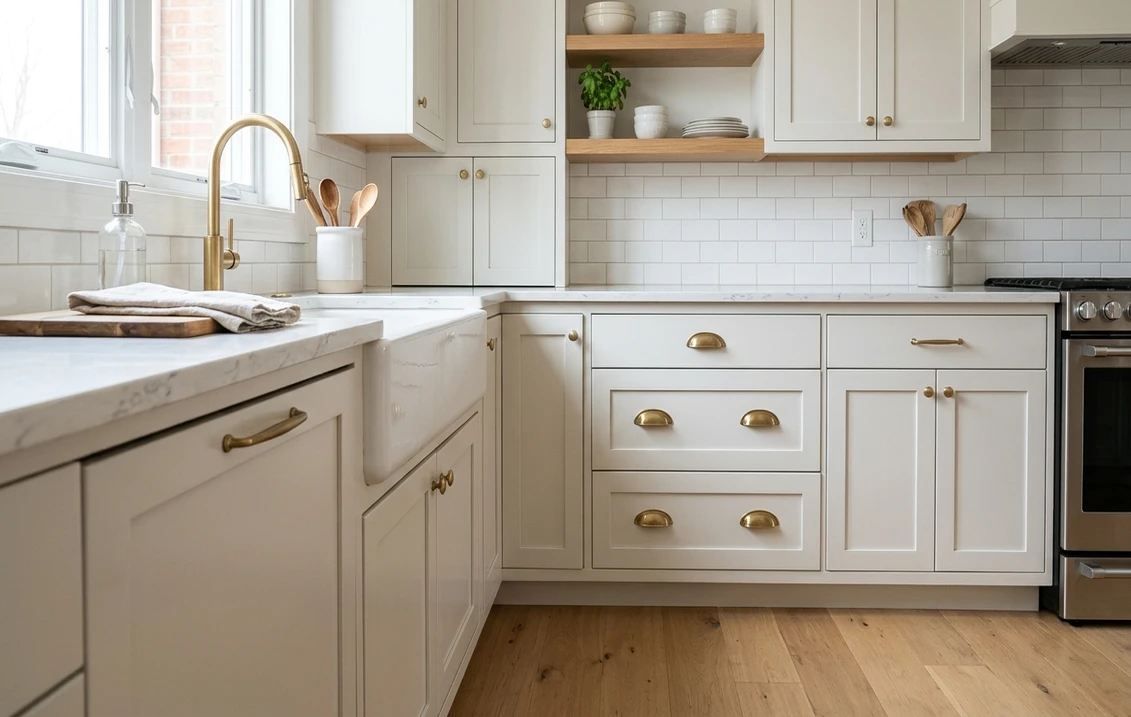
Yes, semi-gloss is the right default for painted kitchen cabinets, as long as it is a cabinet enamel and the doors are well prepared. Semi-gloss is a measured range, not a vague word: the Master Painters Institute defines it as 35 to 70 gloss units at a 60-degree angle. Two common cabinet enamels sit inside that band, Sherwin-Williams Emerald Urethane Trim Enamel semi-gloss at 60 to 70 units and Benjamin Moore ADVANCE semi-gloss at 50 to 60. Semi-gloss wipes clean more easily than satin and shrugs off kitchen grease; the price is that it shows dents, open grain and brush marks more. Choose satin instead when the doors are old, dented or open-grained oak and you do not plan to fill them.
Every sheen, recoat and coverage figure below comes from the manufacturers' product data sheets, and the gloss-level definitions from the MPI scale as reproduced in a New York State construction specification. Links are in the text and in the sources at the end.
The link opens the interior tool with "Cabinets and furniture" preselected. How it works: our interior paint visualizer.
What "semi-gloss" means: the gloss scale behind the label
Paint makers measure shine with a gloss meter, following the test method ASTM D523: a beam of light hits the dry film at a set angle and the meter reports how much is reflected, in gloss units. The Master Painters Institute (MPI) turns those readings into seven gloss levels. The New York State Office of General Services reproduces them, citing MPI's Maintenance Repainting Manual, in its maintenance repainting specification (Section 09 01 90.52):
| MPI gloss level | Common name | Gloss at 60 degrees | Sheen at 85 degrees |
|---|---|---|---|
| 1 | Matte or flat | 5 units or less | 10 units or less |
| 2 | Velvet | 10 or less | 10 to 35 |
| 3 | Eggshell | 10 to 25 | 10 to 35 |
| 4 | Satin | 20 to 35 | 35 or more |
| 5 | Semi-gloss | 35 to 70 | not specified |
| 6 | Gloss | 70 to 85 | not specified |
| 7 | High gloss | more than 85 | not specified |
Try it on your room
No photo? Try a sample
Two things stand out. First, semi-gloss is the widest band on the scale, from just above satin to just below gloss, so two semi-gloss paints can look quite different. Second, the same specification describes interior latex semi-gloss as the product for trim, doors and walls "where washability is required", naming kitchens and bathrooms. That is the core reason semi-gloss became the cabinet default: it is the sheen built to be wiped.
Semi-gloss in real cabinet enamels: the data sheet numbers
Here is what two widely sold cabinet enamels publish on their data sheets: Sherwin-Williams Emerald Urethane Trim Enamel (semi-gloss product data sheet and satin product data sheet) and Benjamin Moore ADVANCE (semi-gloss 793 technical data sheet and satin 792 technical data sheet).
| Product and sheen | Gloss at 60 degrees | Recoat (77°F, 50% RH) | Coverage per gallon | Resin |
|---|---|---|---|---|
| Emerald Urethane Trim Enamel, satin | 35 to 45 | 4 hours | 350 to 400 sq ft | Waterbased urethane modified alkyd |
| Emerald Urethane Trim Enamel, semi-gloss | 60 to 70 (deep and black bases 55 to 65) | 4 hours | 350 to 400 sq ft | Waterbased urethane modified alkyd |
| ADVANCE, satin 792 | 25 to 35 | 16 hours | 400 to 500 sq ft | Waterborne alkyd |
| ADVANCE, semi-gloss 793 | 50 to 60 | 16 hours | 400 to 500 sq ft | Waterborne alkyd |
Read across the brands and the labels stop lining up. ADVANCE semi-gloss (50 to 60) is a step softer than Emerald Urethane semi-gloss (60 to 70). And Emerald Urethane satin, at 35 to 45, starts exactly where the MPI semi-gloss band begins: it is noticeably shinier than ADVANCE satin (25 to 35). So if a neighbor's "satin" cabinets look too shiny or not shiny enough for you, ask which product they used before you pick your own label. The gloss number is the honest comparison.
Note the deep-base line too: Sherwin-Williams lists its deep and black semi-gloss bases at 55 to 65 units instead of 60 to 70, so a navy or black cabinet in the same product can read a touch less glossy than a white one. Both products describe themselves for cabinet work: Sherwin-Williams' Emerald Urethane Trim Enamel page lists cabinets, doors and trim and claims excellent blocking resistance (painted surfaces less likely to stick together), and Benjamin Moore's ADVANCE semi-gloss page lists cabinets among its projects and says it cures to a hard, furniture-quality finish. For how these compare with other cabinet products, see our guide to the best paint for kitchen cabinets.
Semi-gloss vs satin vs gloss on cabinets
Sherwin-Williams' paint sheen guide lays out the logic: it recommends semi-gloss in kitchens for easy cleaning, describes gloss as suited to surfaces that need durability and a striking look, such as cabinets and doors, and says flat or eggshell finishes are best for hiding imperfections. The higher the sheen, the easier the cleaning and the less forgiving the surface. On cabinets, that translates into:
| Sheen | Cleaning grease and fingerprints | Hiding dents, grain, brush marks | Best cabinet use |
|---|---|---|---|
| Eggshell | Weak for kitchen grease | Very good | Not recommended for kitchen cabinets |
| Satin | Good | Good | Older or open-grain doors, uppers, a softer modern look |
| Semi-gloss | Very good | Fair: shows flaws in raking light | Smooth doors, lowers near the sink and range, white and light colors |
| Gloss and high gloss | Excellent | Poor: every flaw shows | Flat slab doors with near-perfect prep, often sprayed |
Sheen also changes color slightly. The same sheen guide notes that sheen can make a color look a little lighter or darker depending on the light, so judge a semi-gloss sample on a cabinet door, not on a matte chip. For the full room-by-room picture, our interior paint finish guide compares all six finishes on walls and trim.
What a kitchen finish has to survive (the KCMA benchmark)
Factory cabinets have a published benchmark. Before a cabinet design can carry the KCMA A161.1 quality certification seal, the Kitchen Cabinet Manufacturers Association tests its structure, drawers, doors and finish to simulate a lifetime of use. KCMA's own summary of the standard, ROI of Cabinet Durability: Reducing Project Risk With A161.1, gives the flavor: wall cabinets take a 600-pound load test, doors and drawers are opened and closed 25,000 times under load, and the finish is exposed for 24 hours to household liquids such as vinegar, grape juice, coffee and alcohol, and must come through high-humidity "hotbox" conditions without blistering or discoloration.
The seal applies to manufacturers' cabinet lines, not to a can of paint, and a brushed-on enamel is not certified to it. But the list is a useful map of where a repaint gets attacked: spills and splashes on lower doors, steam above the dishwasher and kettle, and hands on the edges near pulls. Those are exactly the spots where a semi-gloss pays off, because it wipes clean with less scrubbing, and exactly where an under-cured film fails first.
When semi-gloss is the right call, and when satin wins
Pick semi-gloss when most of these are true:
- The doors are smooth. Maple, MDF, birch or previously painted doors that sand smooth take semi-gloss well. Shaker profiles are fine; the inside corners need care, not a lower sheen.
- The kitchen gets cooked in. Lowers next to the range, sink and trash pull-out collect grease and splashes; semi-gloss wipes clean with less pressure.
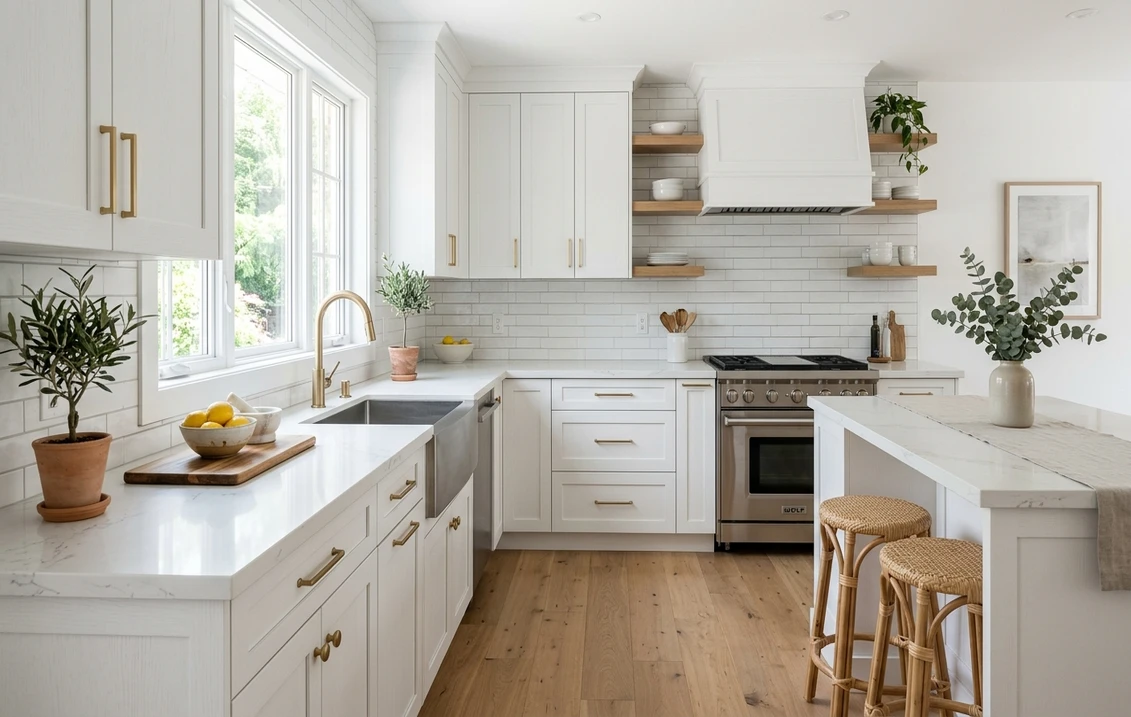
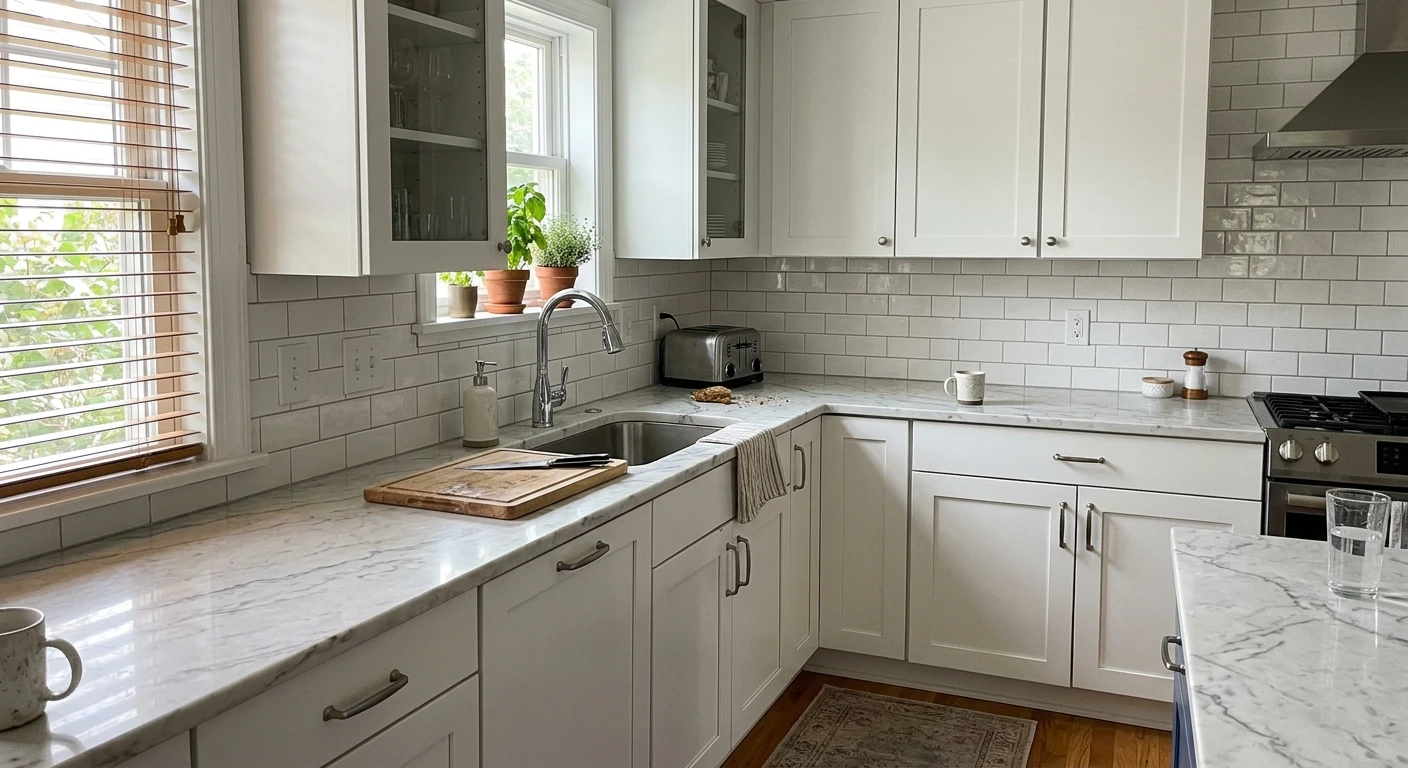
- The color is white or light. Light colors hide dust and small scratches better, and a semi-gloss white reads clean and crisp. Our list of white paint colors for kitchen cabinets covers the usual candidates.
- You can spray or lay off well. Both makers stress flow and leveling (Sherwin-Williams on the Emerald Urethane data sheet, Benjamin Moore in its ADVANCE cabinet guide); thin coats on doors laid flat give that leveling a chance to work.
Pick satin when the surface is the problem. Oak with open grain shows every pore through a shiny film, so either fill the grain first or accept the texture under a satin; our page on painting oak cabinets shows both routes. Old doors with dings, veneer seams or repairs that will not sand perfectly flat also look better in satin. Very dark colors are a judgment call: the deep bases are a little less glossy on paper, but dust and fingerprints are more visible on a deep, shiny surface, which is the usual argument for satin on black kitchen cabinets.
A middle path for two-tone kitchens: semi-gloss on the lowers and island, where the abuse is, and satin on the uppers, where light rakes across the doors and flaws show most. Keep the same product line so the two finishes age the same way. Our guide to two-tone kitchen cabinet combinations covers the color side of that split.
Prep for a semi-gloss finish that does not show every flaw
Because semi-gloss exaggerates the surface underneath, prep decides the result. Benjamin Moore's ADVANCE cabinet refinishing guide spells out the sequence, and the Sherwin-Williams data sheet asks for the same basics (wash off contamination, sand glossy surfaces dull, seal stains with the right primer):
- Remove and label. Take off doors, drawers, shelves and hardware, and mark each door where the hinge sits.
- Degrease before sanding. Wipe every surface with a degreaser; the guide warns that sanding a dirty surface drives grime into the wood and hurts primer adhesion.
- Sand. 150- to 220-grit, with the grain, until the old finish is dull. Fill old screw holes if you are moving hardware.
- Remove all dust. Vacuum, then a tack cloth.
- Prime for the substrate. Benjamin Moore names its Fast-Sanding Primer (507) tinted toward the finish color for wood, Fresh Start High-Hiding All-Purpose Primer (046) for laminate, and warns against lacquer-based primers or undercoaters under ADVANCE. Previously stained cabinets may need a stain-blocking primer.
- Sand the primer. 220-grit or finer, paying attention to drips in inside corners.
- Apply thin coats and sand between them. Paint doors lying flat so the enamel can level, and sand lightly between top coats.
Application details from the data sheets: ADVANCE can be thinned with water up to 6 percent for spraying, and the guide recommends an HVLP gun with a fine-finish tip. Emerald Urethane needs no reduction and lists a 0.013 to 0.017 inch tip for airless spraying. For the full walk-through with laminate notes, see our step-by-step guide to painting kitchen cabinets.
One safety point for older homes. If the house was built before 1978, the existing cabinet paint may contain lead, and sanding it creates hazardous dust. The EPA's Renovation, Repair and Painting program requires paid contractors who disturb paint in those homes to be certified and to follow lead-safe practices. Homeowners doing their own kitchen are generally outside the rule, but should test first.
Dry, recoat and cure: the schedule that protects the sheen
The two products work on very different clocks, and that shapes the whole project:
- Emerald Urethane semi-gloss is dry to the touch in 1 hour and recoatable in 4 hours at 77°F and 50 percent humidity, per its data sheet, which adds that drying and recoat times depend on temperature, humidity and film thickness. Two coats in one day is realistic in good conditions.
- ADVANCE semi-gloss is dry to the touch in 4 to 6 hours and recoatable after 16 hours. Its data sheet says not to expose the finish to heavy abrasion or return shelves to service for at least 5 to 7 days, and that it can take up to 30 days to reach optimum hardness and final sheen.
That last line matters for a semi-gloss in particular: the sheen you see in week one is not the final sheen, and a film that is still soft marks easily where doors close against bumpers and where hands grab edges. Rehang gently, use soft bumpers, and hold off on scrubbing for the first weeks.
How much semi-gloss paint does a kitchen need?
A worked example, with assumptions stated so you can swap in your own counts: 20 doors of about 15 by 30 inches painted on both faces (about 3.1 square feet per face, so roughly 125 square feet), 10 drawer fronts of about 15 by 6 inches painted on the front (about 6 square feet), and about 60 square feet of face frames, end panels and island sides. That is roughly 190 square feet per coat, or 380 square feet for two coats.
- At Emerald Urethane's listed 350 to 400 square feet per gallon, that is about one gallon of topcoat.
- At ADVANCE's listed 400 to 500 square feet per gallon, also about one gallon, with a little left over.
- Add primer for the same area, plus a quart of topcoat for touch-ups and spray losses. Data sheet coverage assumes a brush or roller at the listed film thickness; spraying uses more.
A larger kitchen with 30 to 40 doors usually means two gallons. Keep the leftover: Sherwin-Williams' data sheet notes that touching up with the same batch and the same application method as the original coat improves the touch-up, and on a semi-gloss a mismatched patch is easy to see.
Choose the color before the sheen
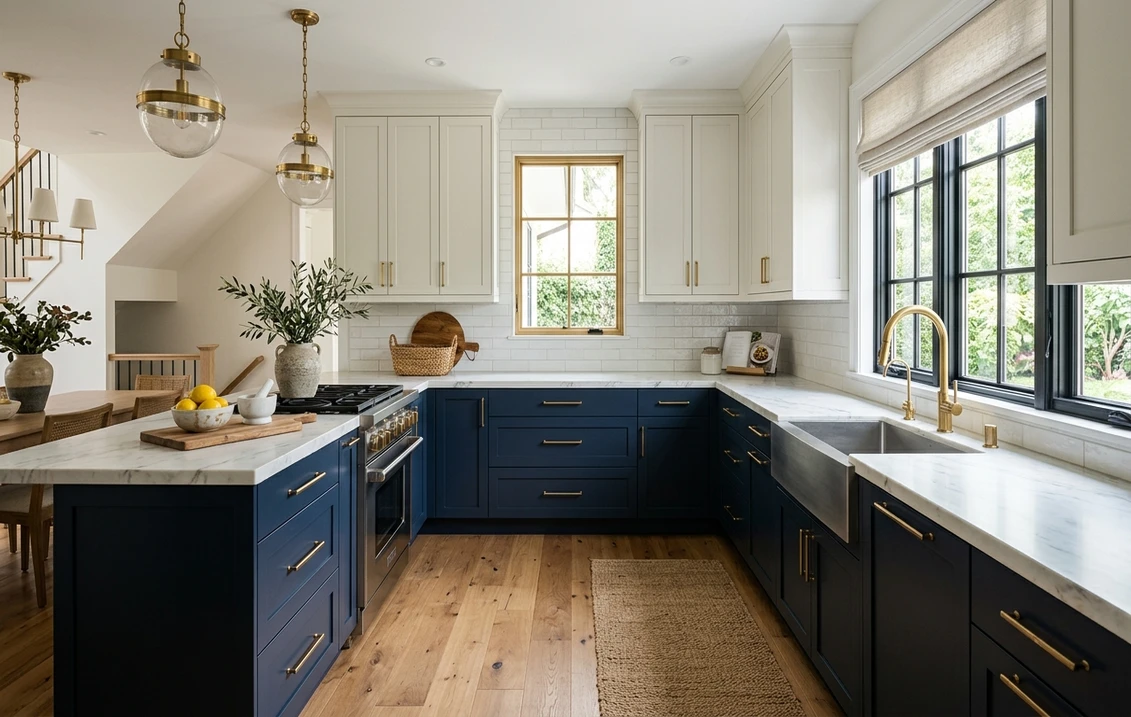
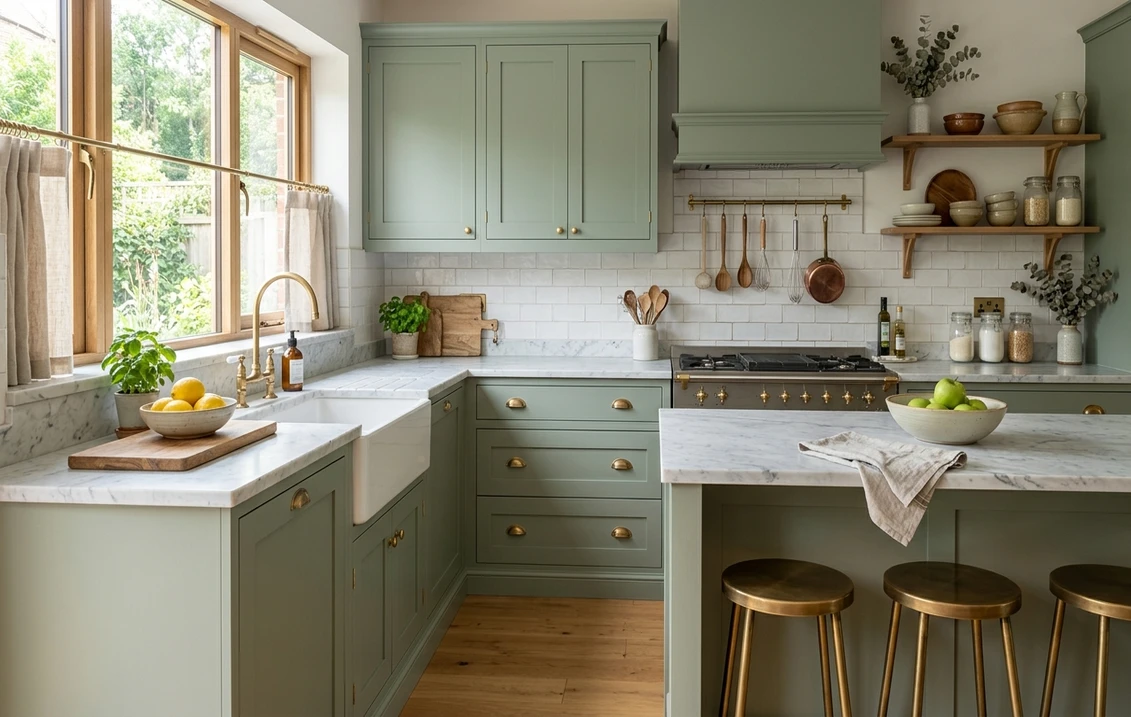
Sheen changes how a color reads, but the color still does most of the work. A near-neutral white such as Pure White SW 7005 (LRV 83.96 on its Sherwin-Williams page) gives a crisp semi-gloss kitchen; a mid-tone greige such as Felted Wool SW 9171 suits an island without darkening the room. Our pillar guide to kitchen cabinet colors walks through the main families by light and counter color. One limit to keep in mind: a photo simulation shows the color on your cabinets, not the sheen, so use it to settle the color and a painted sample door to settle the sheen.
Settle the cabinet color on your own kitchen first
Upload a photo of your kitchen, pick "Cabinets and furniture", and compare whites, greiges or a deep island color in a few seconds before you buy a gallon of semi-gloss.
Try cabinet colors on my kitchen photoSources and references
- New York State Office of General Services, MasterSpec Section 09 01 90.52, Maintenance Repainting: MPI gloss levels 1 to 7 with their ranges at 60 and 85 degrees per ASTM D523, and the intended use of interior semi-gloss where washability is required.
- Sherwin-Williams, Emerald Urethane Trim Enamel semi-gloss product data sheet (K38 series) and satin product data sheet (K37 series): gloss at 60 degrees, touch and recoat times, coverage, resin, spray tip, surface preparation.
- Sherwin-Williams, Emerald Urethane Trim Enamel product page: sheens offered, cabinet and trim uses, blocking resistance claim.
- Sherwin-Williams, Paint sheen guide: semi-gloss for easy cleaning in kitchens, gloss for cabinets and doors, flat and eggshell for hiding imperfections, sheen and perceived color.
- Benjamin Moore, ADVANCE semi-gloss 793 technical data sheet and satin 792 technical data sheet: sheen at 60 degrees, dry and recoat times, return to service, time to optimum hardness, spread rate.
- Benjamin Moore, ADVANCE Interior Paint, Semi-Gloss product page and ADVANCE cabinet refinishing guide: listed projects, sheens, primers by substrate, sanding grits, thinning and spraying advice.
- Kitchen Cabinet Manufacturers Association, KCMA Quality Cabinet Certification and ROI of Cabinet Durability: Reducing Project Risk With A161.1: what the ANSI/KCMA A161.1 tests cover, including the 24-hour household liquids exposure and humidity test on the finish.
- US Environmental Protection Agency, Lead Renovation, Repair and Painting Program: certification rules for paid work that disturbs paint in pre-1978 homes.
Frequently asked questions
Is semi-gloss paint good for kitchen cabinets?
Should kitchen cabinets be satin or semi-gloss?
What gloss level is semi-gloss?
How long before I can use cabinets painted in semi-gloss?
Can I paint semi-gloss over existing glossy cabinets?
How much semi-gloss paint do I need for kitchen cabinets?
Trademarks mentioned (Sherwin-Williams, Benjamin Moore, Behr, Caparol, Brillux, Sto, Alpina, Valspar, PPG, Glidden, Dulux, Crown Trade, Sandtex, Farrow & Ball, Johnstone's, Leyland) are property of their respective owners. FacadeColorizer is independent and not affiliated with any of them. Nominative fair use under Lanham Act §1125.