Try it on your room

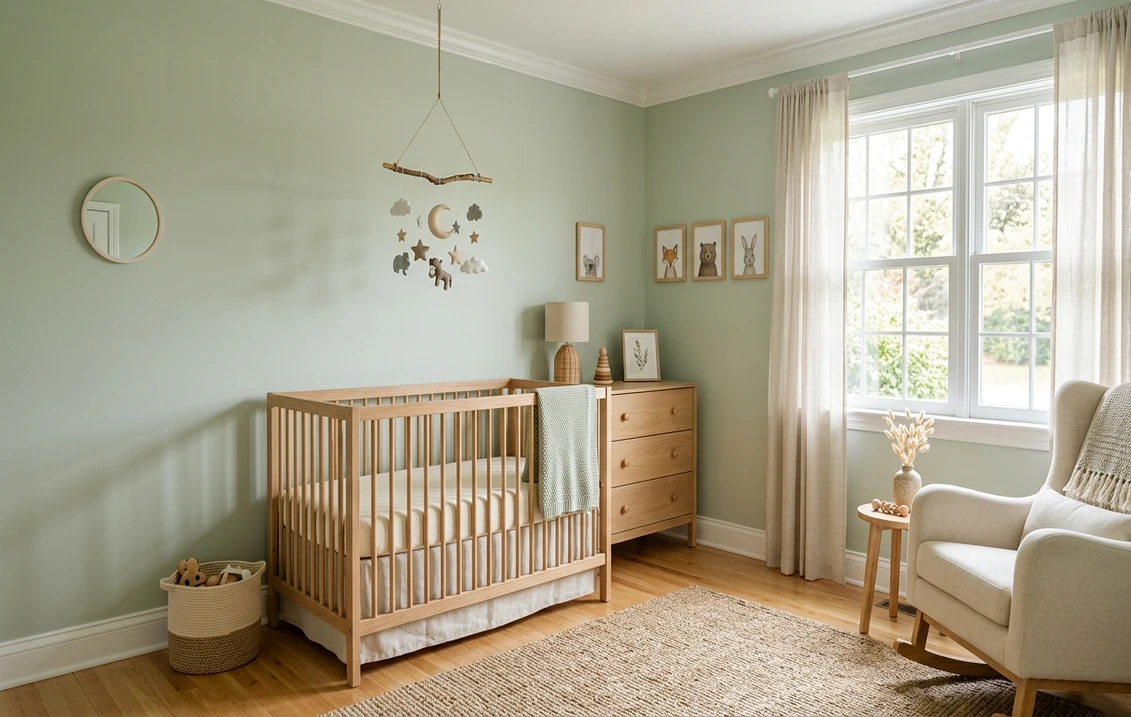
The best zero-VOC paint for a nursery or a pregnant household in 2026 is Benjamin Moore Natura (0 g/L, $69 to $78), with Sherwin-Williams Harmony (under 5 g/L, $73 to $85) the most durable pick and Behr Premium Plus Ultra (under 5 g/L, $42 to $48) the budget choice. All three are certified GreenGuard Gold. Choose any one, paint 4 weeks before move-in, ventilate continuously, and the room is safe for a baby. The compact table below ranks the top three; the full 8-brand comparison follows.
| Best for | Brand & Line | VOC (g/L) | Price/gal (2026) | Certification |
|---|---|---|---|---|
| Nursery / allergy | Benjamin Moore Natura | 0 | $69-$78 | GreenGuard Gold |
| Most durable | Sherwin-Williams Harmony | < 5 | $73-$85 | GreenGuard Gold |
| Budget DIY | Behr Premium Plus Ultra | < 5 | $42-$48 | GreenGuard Gold |
Try it on your house
No photo? Try a sample
According to the U.S. Environmental Protection Agency (EPA), indoor air can contain two to five times higher concentrations of volatile organic compounds than outdoor air, and freshly painted rooms can spike to 1,000 times background levels for several hours after application. For pregnant women, infants, asthma sufferers and chemically sensitive adults, the paint you choose is no longer cosmetic. It is an air quality decision.
This 2026 guide explains the federal and California VOC rules that govern interior paint (EPA TSCA, SCAQMD Rule 1113, California Prop 65), the third-party certifications that actually mean something (GreenGuard Gold, Green Seal GS-11, MPI X-Green), an off-gassing timeline from minute zero to day 30, and a head-to-head comparison of 8 zero and low-VOC brands (Sherwin-Williams Harmony, Benjamin Moore Natura, Behr Premium Plus Ultra, Clare, Backdrop, ECOS Paints, AFM Safecoat, Farrow & Ball Estate Emulsion). You will leave knowing what is safe for a nursery, what to use during pregnancy, and how much extra you really pay for cleaner air. For full pricing context, see our complete interior painting cost guide.
What VOCs are and why they matter indoors
Volatile organic compounds are carbon-based chemicals that evaporate at room temperature. In paint they include formaldehyde, toluene, xylene, ethylbenzene, methylene chloride, and dozens of glycol ethers. They give fresh paint its characteristic smell, and they keep evaporating long after the surface looks dry, a process called off-gassing.
Short-term exposure causes headaches, dizziness, eye and throat irritation, and asthma flare-ups. The EPA classifies several paint VOCs (formaldehyde, benzene) as known or probable human carcinogens, and California Prop 65 requires warning labels on products containing them. Pregnant women, children under 6, the elderly and people with respiratory conditions are the highest-risk groups, which is why pediatricians and OB-GYNs increasingly recommend zero-VOC paint for nurseries and bedrooms.
The U.S. regulatory landscape: EPA, SCAQMD, Prop 65
There are three layers of rules you need to understand before reading a paint label.
Federal floor: EPA TSCA & National AIM Rule
The EPA's National Volatile Organic Compound Emission Standards for Architectural Coatings (40 CFR Part 59) sets the federal ceiling. For interior flat paint the limit is 250 g/L; non-flat (eggshell, satin, semi-gloss) is 380 g/L. The Toxic Substances Control Act (TSCA) gives EPA authority over individual chemicals (methylene chloride was banned from consumer paint strippers in 2019). These federal numbers are very loose by today's standards: a paint can be "EPA-compliant" and still smell like a chemistry lab.
California: SCAQMD Rule 1113
South Coast Air Quality Management District Rule 1113 is the strictest standard in the country and is widely used as the de facto national reference for premium paint lines. Current limits: 50 g/L for flat, 100 g/L for non-flat interior coatings. CARB (California Air Resources Board) enforces a similar Suggested Control Measure across the state. If a paint is sold legally in Los Angeles, San Diego or the Bay Area, it meets these tighter caps.
California Prop 65 warnings
Proposition 65 requires a warning when a product contains any of 900+ listed chemicals known to cause cancer or reproductive harm. Many traditional paints carry the warning because of trace ethylbenzene, crystalline silica or titanium dioxide. A Prop 65 label is not a verdict, but a missing warning on a paint claiming "zero-VOC" is a strong positive signal.
"Zero-VOC" vs "Low-VOC": what the labels really mean
The terms are loosely defined. Under EPA guidance, "low-VOC" means under 50 g/L for flat and 100 g/L for non-flat. "Zero-VOC" means under 5 g/L as supplied (before tinting). Crucial nuance: colorants add VOCs. A zero-VOC base tinted to a deep navy can climb to 10-50 g/L. Ask for zero-VOC colorants (Sherwin-Williams CCE, Benjamin Moore Gennex) or stick to light tints.
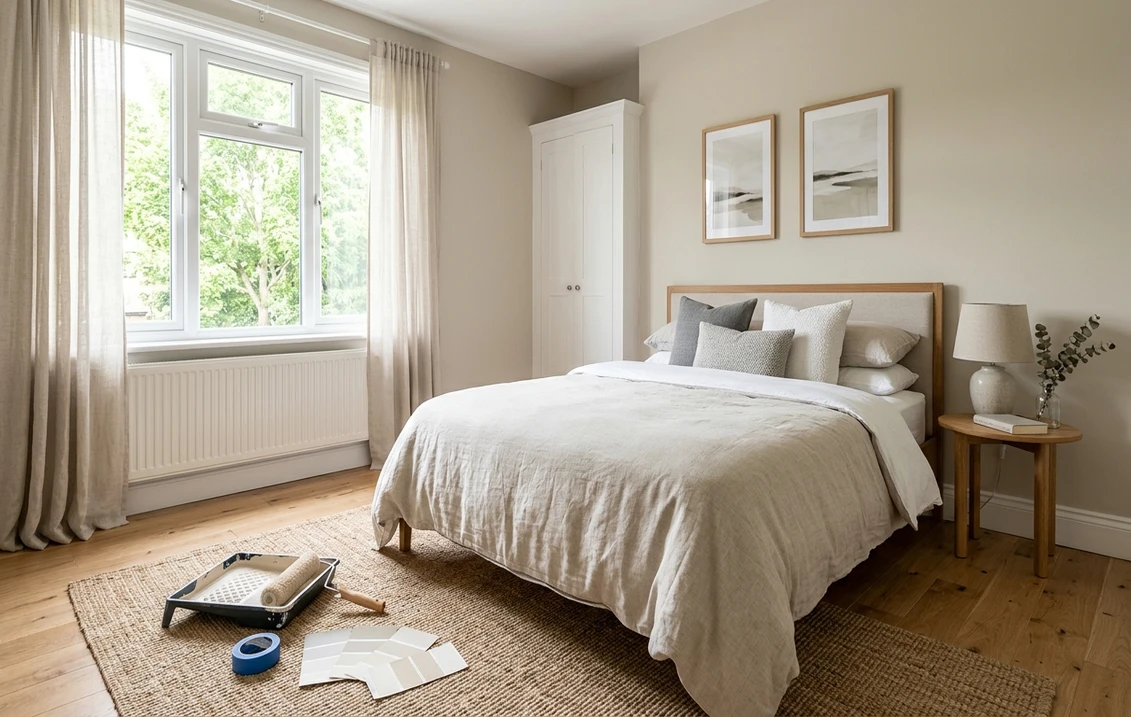
"Stick to light tints" is where most guides stop, and it is not much help if you did not want a white room. The variable that actually drives colorant load is pigment demand: depth and saturation together, not depth alone. A saturated accent color is the expensive one; a low-chroma mid-tone neutral takes far less colorant to hit its target, which is why a soft taupe or greige in the LRV 40s can be tinted into a zero-VOC base and stay much closer to its as-supplied rating than a deep jewel tone ever will. If you want real wall color in a nursery or a bedroom without leaving the certified range, that is the band to shop in. Benjamin Moore Smokey Taupe 983 (LRV near 47) is a representative example of what that compromise looks like on a wall. Step one notch lighter and the colorant demand falls further again: the two beiges homeowners most often weigh against each other, Natural Linen SW 9109 against Accessible Beige SW 7036, sit at LRV 66 and 58 and still read as color rather than white.
Test 100+ low-VOC Sherwin-Williams, BM & Behr shades on your real room photo
A useful example of how these labels appear on a real can is Sherwin-Williams ProMar 200 Zero VOC, the contractor line specified on most new-construction interiors: the manufacturer states it complies with LEED, MPI and GREENGUARD guidelines, and the HP version is UL/GREENGUARD Gold certified and LEED v4 emissions tested. Zero-VOC applies to the untinted base, so deep colors still depend on the colorant. Our ProMar 200 guide reads those claims in context.
Third-party certifications that actually mean something
Marketing claims are unregulated. Certifications are not. Look for at least one of these on the can.
GreenGuard Gold (UL 2818)
Run by UL Environment, GreenGuard Gold tests chemical emissions in a controlled chamber against limits designed for schools and healthcare. It caps total VOCs, formaldehyde, and 360 individual compounds. Gold is the stricter tier (formerly "Children & Schools") and is the gold standard for nurseries. Sherwin-Williams Harmony, Benjamin Moore Natura, Behr Premium Plus Ultra and ECOS all carry it.
Green Seal GS-11
Green Seal GS-11 is a lifecycle standard covering not just VOC content but also banned ingredients (no carcinogens, reproductive toxins, lead, mercury, hexavalent chromium, formaldehyde donors, alkylphenol ethoxylates). Required by GSA and many federal procurement contracts. More restrictive on ingredients than GreenGuard, slightly looser on emissions.
MPI X-Green and LEED v4.1
Master Painters Institute's X-Green rating is required by the U.S. Green Building Council for LEED v4.1 EQ Credit "Low-Emitting Materials". It combines CDPH Standard Method v1.2 emissions testing (the same protocol used in California schools) with an ingredient screen. Specify X-Green for any commercial or LEED-targeted residential project.
What the certifications actually mean (and what they do not)
The single most common mistake in 2026 is treating every green logo as interchangeable. They are not. Each certification answers a different question, and the gap between them decides whether a paint is right for a nursery, a chemically sensitive adult, or a LEED submittal. The table below maps each label to what it actually tests, who governs it, and the one limitation buyers tend to miss.
| Certification | What it tests | Governing body | Best signal for | The catch |
|---|---|---|---|---|
| GreenGuard Gold (UL 2818) | Actual chamber emissions: total VOCs, formaldehyde, 360 named compounds | UL Solutions | Nursery and indoor air quality | Tests the base, not always the tinted color you buy |
| Green Seal GS-11 | Banned ingredients (carcinogens, lead, mercury, formaldehyde donors) plus lifecycle | Green Seal | Ingredient safety and federal (GSA) jobs | Looser on real-world emissions than GreenGuard |
| MPI X-Green | CDPH v1.2 emissions plus ingredient screen | Master Painters Institute | LEED v4.1 and commercial specs | Rarely printed on consumer cans; ask the rep |
| Asthma & Allergy Friendly | Emissions plus respiratory-irritant screen for diagnosed asthma | AAFA + Allergy Standards Ltd. | Diagnosed asthma and allergy households | Held by very few lines (BM Natura in the US) |
| Declare / Red List Free | Full ingredient disclosure, screened against Living Building Challenge Red List | International Living Future Institute | Chemical sensitivity (MCS) and full transparency | Discloses content, does not itself measure emissions |
Three practical takeaways follow from that table. First, emissions and ingredients are different axes. GreenGuard Gold tells you how little a paint off-gasses in a sealed chamber; Green Seal and Declare tell you what is (and is not) in the can. A nursery wants low emissions, so GreenGuard Gold leads. A chemically sensitive adult often reacts to ingredients at levels below any emissions threshold, so a Declare or Red List Free disclosure matters more for them.
Second, almost every certification tests the untinted base. A GreenGuard Gold white base tinted to a deep saturated color with conventional colorant can leave the certified range entirely. For a certified result on a dark shade, confirm the store uses zero-VOC colorant (Benjamin Moore Gennex, Sherwin-Williams CCE) and ask whether the deep base itself still carries the listing.
Third, treat the certifications as a floor, not a finish line. The strongest 2026 lines stack two or three (GreenGuard Gold for emissions, Green Seal or Declare for ingredients, Asthma & Allergy Friendly for respiratory tolerance). If you can only verify one logo on the can, make it GreenGuard Gold for a nursery, and a Red List Free or Declare disclosure for severe chemical sensitivity.
Off-gassing timeline: when is a freshly painted room safe?
Even certified zero-VOC paints emit some compounds during cure. Here is what the data shows for a typical 12 by 12 ft bedroom with two coats and standard ventilation.
- 0-2 hours: Peak VOC concentration. 70-90% of total off-gassing for a true zero-VOC latex. Conventional paint emits 10-50x more. Keep windows open, fan running, no humans inside.
- 2-24 hours: Levels drop sharply but plasticizers and glycol ethers continue to evaporate. Avoid sleeping in the room. Asthma sufferers should stay out.
- 24-72 hours: Smell dissipates for zero-VOC paint; conventional paint still detectable. OK for healthy adults to re-enter; pregnant women and infants should still avoid prolonged exposure.
- 1-2 weeks: Sub-perceptible off-gassing continues. Safe for most occupants. Recommended waiting period for nurseries painted with zero-VOC products.
- 3-4 weeks: Full cure. Emissions effectively zero for certified low-VOC; conventional paint still measurable for several months.
A simple rule from the American Lung Association: paint pregnancy and nursery rooms 4 weeks before move-in with a GreenGuard Gold product, ventilate continuously, and run a HEPA-plus-activated-carbon air purifier in the space.
8 zero and low-VOC brand comparison (2026)
VOC is one column of the decision; the lab and owner ratings are the other. Our best interior paint brands ranking sets the Consumer Reports results and the J.D. Power satisfaction study side by side and says which premium line to buy for a living room, a kitchen or a deep color.
Pricing reflects gallon retail at Sherwin-Williams, Home Depot, Lowe's and direct-to-consumer sites in April 2026. Performance scores reference ASTM D2486 (scrub resistance) and ASTM D4946 (block resistance) from manufacturer technical data sheets and Consumer Reports 2025 testing.
| Brand & Line | VOC (g/L) | Certifications | Price/gal (2026) | Scrub (ASTM D2486) | Recommended use |
|---|---|---|---|---|---|
| Sherwin-Williams Harmony | < 5 | GreenGuard Gold, MPI X-Green, anti-microbial | $73-$85 | 600+ cycles | Nurseries, hospitals, schools |
| Benjamin Moore Natura | 0 | GreenGuard Gold, Asthma & Allergy Friendly | $69-$78 | 500+ cycles | Bedrooms, allergy households |
| Behr Premium Plus Ultra | < 5 | GreenGuard Gold, Green Seal GS-11 | $42-$48 | 450+ cycles | DIY budget, living rooms |
| Clare Paint | 0 | GreenGuard Gold | $56-$64 | 350+ cycles | DTC, design-forward bedrooms |
| Backdrop | < 5 | GreenGuard Gold, MPI X-Green | $58-$66 | 400+ cycles | DTC, accent walls, kids rooms |
| ECOS Paints Atmosphere Pro | 0 (no biocides) | GreenGuard Gold, Declare Red List Free | $72-$95 | 300+ cycles | MCS, chemical sensitivity |
| AFM Safecoat | < 10 | CDPH v1.2, MAS Certified Green | $65-$80 | 350+ cycles | Severe allergy, asthma |
| Farrow & Ball Estate Emulsion | < 1 | EU Ecolabel, Class A+ emissions | $120-$135 | 250+ cycles (matte) | Premium living rooms, low-traffic |
Cost premium: how much extra do you pay for clean air?
Across the eight brands above, the median zero-VOC premium is roughly 10-25% over the same brand's conventional flagship. Behr Premium Plus Ultra is the outlier at near parity with conventional Behr lines, while ECOS and AFM Safecoat carry a 30-40% premium because they also remove biocides and synthetic fragrances. For a typical 1,500 sq ft house repaint (15-18 gallons), the upgrade adds $150-$400 to the project, less than 1% of total interior repaint cost.
Health economists at Harvard's T.H. Chan School of Public Health have estimated that each $1 spent on indoor air upgrades returns $4-$9 in avoided asthma visits and productivity. For a nursery, the ROI is uncontroversial.
Performance compromises: are zero-VOC paints durable?
In 2009 the answer was "no, plan to repaint sooner". In 2026 it is "essentially yes, with two caveats".
Caveat 1 - block resistance. Zero-VOC formulations rely on softer acrylic resins. Stacked books on freshly painted shelves, or a couch pushed against a wall too soon after painting, can lift the film. Wait 14 days post-application before contact with painted surfaces, vs 7 days for conventional latex.
Caveat 2 - high-traffic kitchens and bathrooms. ECOS and AFM remove all biocides, which means in chronically humid bathrooms they are more vulnerable to mildew than Sherwin-Williams Harmony (which uses encapsulated antimicrobial). For bathrooms, choose Harmony or BM Aura Bath & Spa over biocide-free options.
Hide and coverage are now equivalent. Sherwin-Williams Harmony, Behr Premium Plus Ultra and BM Natura all hit one-coat coverage on light-over-light schemes per the manufacturer's own ASTM D344 tests.
Special cases: pregnancy, nurseries, asthma
Painting during pregnancy
The American College of Obstetricians and Gynecologists (ACOG) does not formally ban paint exposure but advises pregnant women to avoid painting themselves and to leave freshly painted spaces for at least 2-3 days with continuous ventilation. If painting cannot be delayed, the safest option is to hire a painter using a GreenGuard Gold zero-VOC paint, paint while the mother is away, and ventilate for 72 hours before re-entry.
Baby nursery recommendations
Top picks for nurseries, in order: Benjamin Moore Natura (zero-VOC, Asthma & Allergy Friendly certified, near-zero odor), Sherwin-Williams Harmony (formaldehyde-reducing technology, GreenGuard Gold), or Clare (DTC convenience, peel-and-stick swatches for color testing). Apply 4 weeks before due date, ventilate continuously, run an air purifier with activated carbon for 72 hours after final coat.
Asthma and chemical sensitivities
For diagnosed asthma, the Asthma & Allergy Friendly Certification Program (run by the Asthma and Allergy Foundation of America with Allergy Standards Ltd.) is the most relevant label. Currently held by BM Natura in the U.S. market. For severe multiple chemical sensitivity (MCS), ECOS Atmosphere Pro and AFM Safecoat remove not just VOCs but biocides, fragrances, and ammonia, which is the next tier up in tolerance.
Match the paint to the household: a 2026 decision table
Sensitivity is not one category. A newborn's developing lungs, a teenager with managed asthma, and an adult with diagnosed multiple chemical sensitivity each need a different threshold. The table maps the most common high-risk situations to a primary pick, the certification that matters most for that case, and the ventilation window we would hold to before the room is occupied.
| Situation | Primary pick | Certification to prioritize | Cure before occupancy |
|---|---|---|---|
| Newborn nursery | BM Natura or SW Harmony | GreenGuard Gold + Asthma & Allergy Friendly | 4 weeks, ventilate throughout |
| Painting during pregnancy | BM Natura (someone else applies) | GreenGuard Gold | Leave home 24-48h, re-enter when odor gone |
| Child with diagnosed asthma | BM Natura | Asthma & Allergy Friendly | 1-2 weeks, HEPA + carbon purifier |
| Multiple chemical sensitivity (MCS) | AFM Safecoat or ECOS Atmosphere Pro | Declare / Red List Free disclosure | 2-4 weeks; patch-test a sample board first |
| Humid nursery bathroom | SW Harmony or BM Aura Bath & Spa | GreenGuard Gold (with mildew resistance) | 2 weeks, run exhaust fan during cure |
A few edge cases deserve a direct word. For multiple chemical sensitivity, no published threshold reliably predicts an individual reaction, so the protocol is a patch test before a full room: have a helper paint a piece of drywall or poster board with two coats, let it cure for a week, then keep it in the living space for several days and watch for symptoms. This costs a quart and a week and is the single most useful step for an MCS household. Choose a paint with full ingredient disclosure (Declare or Red List Free) so a known trigger can be ruled out on paper before it is ever opened indoors.
For an asthmatic child, the trigger is often not the VOCs themselves but the residual odor and any added fragrance, so favor an unscented, Asthma & Allergy Friendly line and keep the child out of the home, not just the room, until the smell is undetectable. Replace or run the HVAC filter on high after painting, since ductwork can redistribute fresh-paint air through the whole house.
For a pregnancy timeline that cannot wait four weeks, sequence the work: paint the nursery first and earliest in the project, keep the door closed with a fan exhausting out a window, and finish lower-priority rooms last. That front-loads the longest possible cure onto the one room that matters most before the due date.
How to read a paint label like an indoor-air specialist
Five things to verify before you buy:
- VOC content in g/L (not just "low-VOC"). Look for "less than 5 g/L" or "0 g/L" with the colorant disclosure underneath.
- Certification logo, not just the word "green". GreenGuard Gold, Green Seal GS-11, MPI X-Green, or Asthma & Allergy Friendly. No logo = marketing claim.
- Prop 65 warning. Read it. A warning for "trace titanium dioxide" is universal and not concerning. A warning naming benzene, ethylbenzene or formaldehyde is.
- Zero-VOC colorants. Confirm the store tints with Gennex (BM), CCE (SW) or equivalent. A zero-VOC base tinted with conventional colorant can hit 50 g/L.
- Test report on request. Reputable brands publish CDPH v1.2 chamber test data. ECOS, AFM and Sherwin-Williams provide these on request; Clare and Backdrop publish them online.
Visualize Harmony, Natura & Clare zero-VOC shades on your room before you commit
Frequently asked questions about low and zero-VOC paint
Is zero-VOC paint really safe for pregnant women and babies?
True zero-VOC paint certified GreenGuard Gold emits less than 0.5 mg/m3 of total VOCs in chamber tests, which is below the threshold the EPA uses to flag indoor air concerns. ACOG and the American Academy of Pediatrics consider these products acceptable when applied with ventilation. The conservative protocol: paint 4 weeks before the baby's arrival, ventilate continuously for 72 hours, and use a HEPA + activated-carbon air purifier in the room. Avoid painting yourself if pregnant; have someone else apply, leave the home for 24-48 hours, and re-enter only after smell is gone.
How long does zero-VOC paint take to off-gas completely?
Most VOC release happens in the first 24 to 72 hours, which is why the smell fades quickly. However, sub-perceptible off-gassing of plasticizers and glycol ethers continues for up to 30 days as the paint fully cures. For healthy adults, the room is generally safe to occupy after 24 hours with ventilation. For infants, asthma sufferers and chemically sensitive individuals, wait 1-2 weeks minimum. Conventional non-zero-VOC paint can off-gas measurable VOCs for 3 to 6 months, which is the strongest argument for switching.
Does zero-VOC paint cost more, and is the durability worse?
The premium is typically 10-25% over a brand's conventional line, adding $150-$400 to a 1,500 sq ft repaint. Behr Premium Plus Ultra is near parity; ECOS and AFM Safecoat run 30-40% higher because they also exclude biocides and fragrances. On durability, modern zero-VOC formulas (Sherwin-Williams Harmony, BM Natura, Behr Premium Plus Ultra) match or exceed conventional paint in scrub resistance (ASTM D2486 600+ cycles). The two trade-offs: longer block-resistance window (wait 14 days before stacking books or pushing furniture against walls) and slightly weaker mildew resistance for biocide-free brands in humid bathrooms.
What is the difference between GreenGuard Gold and Green Seal GS-11?
GreenGuard Gold (UL 2818) measures actual chemical emissions in a controlled chamber, with strict caps on total VOCs, formaldehyde and 360 individual compounds. It is the most relevant certification for indoor air quality in nurseries, schools and healthcare. Green Seal GS-11 covers the full lifecycle: it bans certain ingredients outright (carcinogens, reproductive toxins, lead, mercury, formaldehyde donors) regardless of emissions. GS-11 is required by GSA federal procurement. The strongest paints (Behr Premium Plus Ultra, Benjamin Moore Natura) hold both. If you can only check one box, prioritize GreenGuard Gold for residential indoor air.
Free - No signup - 100+ Sherwin-Williams & Benjamin Moore zero-VOC shades
Choosing low- and zero-VOC paint is one of the highest-leverage indoor air decisions a homeowner makes. For a nursery or asthma household, prioritize GreenGuard Gold + Asthma & Allergy Friendly products (Benjamin Moore Natura, Sherwin-Williams Harmony), paint 4 weeks before move-in, ventilate continuously and run a HEPA+carbon purifier for the first 72 hours. Test your shade on your real room first with our free AI interior paint visualizer. Sources: U.S. EPA National AIM Rule (40 CFR 59), SCAQMD Rule 1113, California Prop 65, UL GreenGuard Gold (UL 2818), Green Seal GS-11, ACOG, American Lung Association, Consumer Reports paint testing 2025.
Trademarks mentioned (Sherwin-Williams, Benjamin Moore, Behr, Caparol, Brillux, Sto, Alpina, Valspar, PPG, Glidden, Dulux, Crown Trade, Sandtex, Farrow & Ball, Johnstone's, Leyland) are property of their respective owners. FacadeColorizer is independent and not affiliated with any of them. Nominative fair use under Lanham Act §1125.