Try it on your room

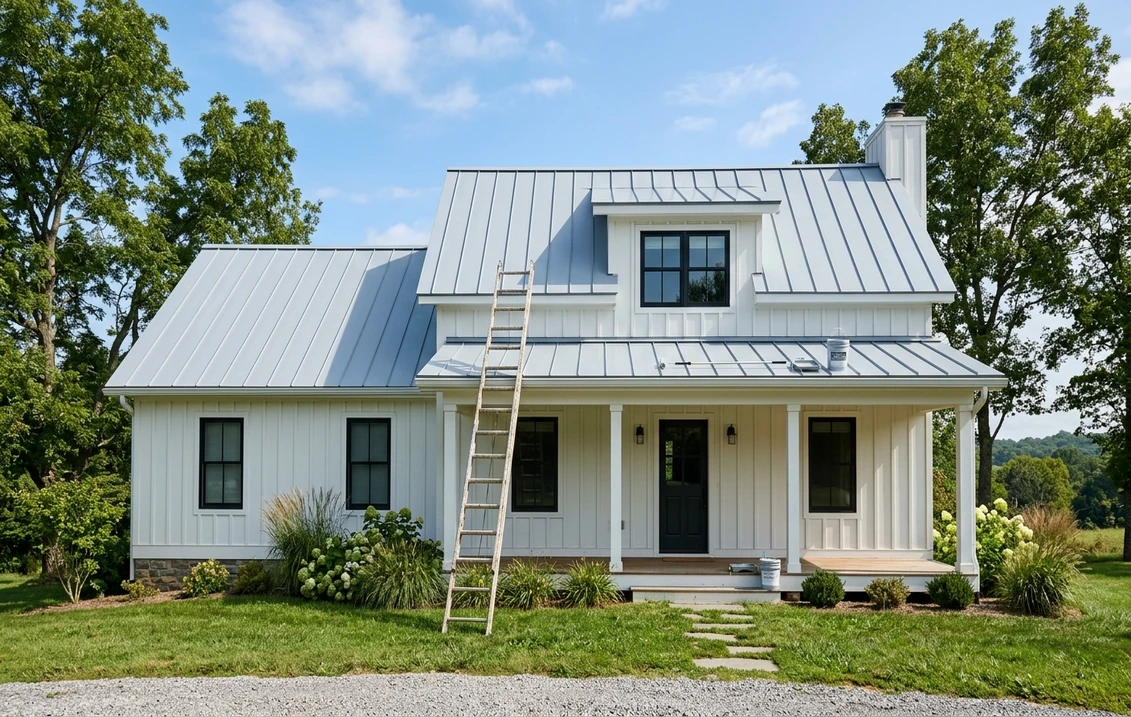
Quick answer: a metal roof is repainted with a water-based acrylic direct-to-metal (DTM) coating, two coats, after a pressure wash, rust removal and a rust-inhibitive primer on any bare or rusted steel. Galvanized panels in sound condition take the acrylic directly; factory-finished panels (baked-on polyester or Kynar) need a bonding primer first. A well-prepared repaint lasts 10 to 20 years. Lighter colors and "cool" pigmented darks keep the roof and the attic markedly cooler. Preview the color before you buy the paint: upload a photo of the house to the exterior paint visualizer and compare a gray, a bronze and a white roof on your own elevation.
A metal roof outlives its paint. The Metal Roofing Alliance puts the service life of a properly installed metal roof at 40 to 70 years, and in that time the factory finish will fade, chalk and, on older galvanized or "tin" roofs, start to rust at the seams and fasteners. Repainting is how you reset the clock without replacing panels that are structurally fine. This guide covers the decision in the order a roofing contractor would take it: is this roof a candidate, what is the metal under the old finish, which paint system, how to prepare it, which color, and how to do the work without falling off.
Should this roof be painted at all?
Three situations call for paint. The finish has chalked or faded unevenly and the house looks tired; the roof is a bare or galvanized panel roof that has started to show surface rust; or the color simply has to change because the siding did. Three situations do not. A premium factory finish (Kynar 500 or Hylar 5000 PVDF) that is still glossy and intact is better left alone: paint will never match its durability, and the slick surface is the hardest of all to bond to. Copper, zinc and weathering steel roofs are designed to patinate and must never be painted. And a roof with rust-through, pinholes or panels lifting at the seams is a replacement, not a paint job; paint hides the symptom for a season and the leak comes back.
Do the inspection from a ladder before you buy anything: look at fastener heads (rust bleeding from screws means the gaskets are gone), at panel overlaps (rust here means water is sitting in the seam), and at the underside from the attic if it is accessible (daylight through a pinhole is disqualifying). Fine Homebuilding's guide to refinishing a rusty metal roof puts the life of a properly prepared repaint at about 20 years, which is the benchmark to hold your own prep to.
Know your metal: galvanized, Galvalume, factory-finished or aluminum
The paint system depends on what the panel is made of and what is already on it, and the four common cases behave differently.
| Roof type | How to recognize it | Primer | Watch out for |
|---|---|---|---|
| Galvanized steel ("tin roof") | Dull gray spangle pattern, older barns and farmhouses, corrugated or 5V-crimp | None on sound zinc; rust-inhibitive primer on rusted spots only | Never an oil or alkyd paint: it reacts with the zinc and peels in sheets. White rust (zinc oxide powder) must be washed off first. |
| Galvalume (aluminum-zinc) | Brighter, finer spangle than galvanized; common since the 1990s | None if clean and etched by weathering; acrylic goes direct | New, unweathered Galvalume carries a passivation oil that must be degreased or weathered off. |
| Factory-finished steel (polyester, SMP, Kynar) | Colored panels, standing seam or ribbed, often chalky to the touch | Acrylic DTM bonding primer, one coat | Chalk must be washed off completely; paint over chalk fails within a year. Intact Kynar is better left unpainted. |
| Aluminum shingles or panels | Light weight, no rust, gray oxide bloom when bare | DTM acrylic primer or etch primer on bare metal | Same logic as painted aluminum siding: scuff, prime, acrylic topcoat. |
Try it on your house
No photo? Try a sample
The aluminum row follows exactly the sequence used on walls, and the aluminum siding painting guide goes into the primer and mil-thickness detail that applies to an aluminum roof as well. Metal roofs are one branch of a larger family of surfaces that break the normal painting rules; the specialty surface painting guide is the map of that family.
The paint system: acrylic DTM, two coats, and when a primer is mandatory
The modern standard for repainting a metal roof is a water-based, 100 percent acrylic direct-to-metal coating. It flexes with the panel through the daily heat cycle, it does not react with zinc, and it cleans up with water. The product most often specified by contractors is Sherwin-Williams Sher-Cryl HPA, a high-performance acrylic sold in gloss and semi-gloss; the company's product data lists two coats applied directly for galvanized roofs, and one coat of DTM bonding primer followed by two coats of Sher-Cryl for pre-finished panels with a baked-on finish. The same data warns that applying the acrylic to unprimed bare steel can cause pinpoint rusting, which is the technical reason a rust-inhibitive primer goes on every spot where the zinc or the old finish has worn through. Sherwin-Williams' Pro Industrial DTM Acrylic is the other common choice in the same family; Benjamin Moore, PPG and Rust-Oleum sell equivalents. Whatever the brand, the label must say direct-to-metal, exterior, and acrylic.
- Sound galvanized or Galvalume: clean, then two coats of acrylic DTM. No primer on intact zinc.
- Rusted spots on galvanized: wire-brush to bright metal, one coat of rust-inhibitive metal primer on the spot, then the two topcoats over the whole roof.
- Factory-finished panels: wash off chalk, scuff-sand glossy areas, one full coat of acrylic bonding primer, two topcoats.
- Low-slope roofs with ponding or seams that leak: a fibered or elastomeric acrylic roof coating (white by default) is a better product than paint; it is thicker, bridges small seams and is rated for reflectivity. It is a coating job, not a color job.
Sheen matters more on a roof than on a wall. Gloss and semi-gloss shed dirt and pollen, which is why the roof products come in those sheens; a flat finish holds grime and grows algae on the north slope. Expect the semi-gloss to read a step lighter in full sun than the chip suggests.
Free first HD render, 3 variations, no account.
Preparation: the 80 percent of the job that decides the 20 years
- Fix the roof first. Replace rusted or backed-out fasteners with new gasketed screws one size larger. Reseal panel end laps, flashings and penetrations with a polyurethane or high-grade sealant made for metal roofs. Paint is not a sealant.
- Pressure wash. Work from the ridge down at moderate pressure, and never aim the wand into a panel overlap or up under a seam: water driven into the lap sits there and starts the rust you are trying to stop. Add a cleaner for chalk and mildew, rinse until the water runs clear.
- Test for chalk and adhesion. Rub a dark cloth on a dry, washed panel: white residue means the chalk is not gone and the wash is repeated. On factory-finished panels, apply a strip of tape over the old finish and rip it off; if flakes come with it, the old finish is failing and needs full removal in that area.
- Remove rust and loose paint. Wire brush, scraper or a rotary wire wheel down to sound metal or bright zinc; feather the edges of old paint. Vacuum or blow off the dust.
- Prime the bare spots the same day they are exposed. Bright steel rusts overnight in humid weather. Full-roof bonding primer only on factory-finished panels, as in the table above.
- Check the weather window. Acrylic DTM data sheets generally ask for 50 degrees Fahrenheit and rising, no rain for 24 hours, and no application on a hot panel: a dark metal roof in July sun can be far hotter than the air, and the paint skins before it levels. Early morning and evening, or overcast days, are the roof painter's friends.
- Apply the two coats. Airless spray with back-rolling gives the most even film on ribbed panels; a 3/8-inch nap roller on flat pans with a brush for ribs and seams works on small roofs. Respect the recoat time on the label and apply the second coat within the window given, so the coats fuse.
On quantities, remember that the ribs and seams of a metal roof add surface area: budget 10 to 15 percent more paint than the flat plan area would suggest, and read the coverage figure on the data sheet for the specific product rather than a generic number. For a rough total, the painting estimate calculator gives an order of magnitude for the whole exterior that a roof line can be added to.
Color: what a roof color does to the house and to the attic
Two things decide a roof color: how it works with the siding, and how much heat it absorbs. The second is measured, not guessed. The Cool Roof Rating Council maintains a public directory of rated roof products with tested solar reflectance, thermal emittance and a Solar Reflectance Index (SRI) for each. On the SRI scale a standard black roof sits at 0 and a standard white roof at 100. A manufacturer's published example shows the spread inside one product line: a Solar White at SRI 82 against a Medium Bronze at SRI 31 (Sheffield Metals, cool metal roofing and SRI). The EPA's heat island program summarizes the effect: a cool roof can stay 50 to 60 degrees Fahrenheit cooler than a conventional roof at the summer peak, and in air-conditioned homes it can cut peak cooling demand by 11 to 27 percent.
Two facts specific to metal change the usual "white is coolest" advice. First, bare unpainted metal reflects well but has very low thermal emittance, so it holds the heat it absorbs; a painted metal roof performs better as a cool roof than a bare one. Second, "cool color" pigments that reflect in the near-infrared let a dark gray or bronze roof reflect far more heat than its shade suggests, which is why a dark roof from a rated product line can outperform an ordinary mid-tone paint. If heat matters where you live, choose the paint color from a CRRC-rated line or ask the manufacturer for the SRI of the exact color.
| Roof color family | Heat behavior | Works with | Watch out for |
|---|---|---|---|
| White and bone white | Coolest by far; the default for hot climates and low-slope roofs | Coastal, Southern and farmhouse styles; any siding color | Shows algae and dirt on shaded slopes; glare toward neighbors on steep pitches |
| Light gray and galvanized-look silver | High reflectance without the glare of white | White, cream, sage and navy siding; the classic farmhouse pairing | Can read blue next to warm beige; check the undertone against the siding |
| Slate and charcoal gray | Moderate; much better in a cool-pigment line | Modern and craftsman homes, white or mid-tone siding, black windows | Ordinary charcoal paint runs hot; ask for the SRI |
| Dark bronze and brown | Low reflectance unless cool-pigmented | Stone, cedar, tan and warm-white siding; mountain and ranch styles | Fades visibly in high-UV regions; keep the siding lighter than the roof |
| Forest and evergreen | Low to moderate | Log homes, cabins, cream and gray siding in wooded settings | Fights with brick reds; pick a blue-green rather than a yellow-green near brick |
| Barn red and terracotta | Moderate | White farmhouses, gray stone, agricultural buildings | Chalks faster than neutrals; expect to repaint sooner |
The roof is usually the largest single plane you see from the street, so its color sets the temperature of the whole scheme. A simple rule holds up: the roof should be darker than the body or clearly lighter than it, never a near match in a different undertone. If the siding is the fixed element, work from the roof outward with the most popular exterior house colors as the palette; if you are keeping a brown or bronze roof and repainting the walls instead, the paint colors for brown roof houses guide solves that pairing specifically.
Gray roof or bronze roof?
Upload one photo of the house, set the roof to a light gray, then to a dark bronze, and compare both renders against your actual siding, trim and landscaping before you order 30 gallons of paint you cannot return.
Compare two roof colors on my houseSafety: the rule contractors work under, and why you should too
Metal is the most slippery roof surface there is, and a freshly washed or freshly painted panel is worse. OSHA's construction standard 1926.501 requires that workers in residential construction at six feet or more above a lower level be protected by guardrails, safety nets or a personal fall arrest system, and OSHA's residential fall protection guidance spells out what that means on a pitched roof: a harness, a lanyard and an anchor rated for the load. The rule binds employers, not homeowners, but the physics is the same. For a do-it-yourself repaint that means a roof anchor screwed into a rafter, a harness, and shoes with soft rubber soles; never a wet roof, never a roof steeper than 4:12 without the anchor, and never alone. On anything above one story or steeper than 6:12, the honest advice is to hire the work out: the paint is the same, the ladder time is not.
Mistakes that shorten a metal roof paint job
- Oil-based paint on galvanized metal: the alkyd reacts with the zinc and the film peels in sheets within a year or two. Acrylic only.
- Painting over chalk: the paint bonds to the powder, not to the roof. Wash until the dark-cloth test comes back clean.
- Skipping the fasteners: rusted screws keep bleeding through the new finish and the gaskets keep leaking. Replace them first.
- Spraying into the laps: pressure-washing or spraying paint upward into a panel overlap drives water and paint into the seam. Always work down-slope.
- One thick coat instead of two thin ones: runs on the ribs and a film that cracks at the seams. Two coats at the data-sheet thickness.
- Painting in full sun: the acrylic skins on a hot panel before it levels, leaving lap marks and poor adhesion. Morning, evening or overcast.
- Choosing the color from a chip: a roof color reads lighter in the sky and against the whole house. Render it on the house first, then test a full panel.
Sources and references
- Metal Roofing Alliance, FAQs (service life of 40 to 70 years) and Energy savings (reflective and emissive finishes).
- Sherwin-Williams, Sher-Cryl HPA and Pro Industrial DTM Acrylic product pages and data (coat systems for galvanized and pre-finished metal, pinpoint rusting on unprimed steel).
- Fine Homebuilding, Refinishing a rusty metal roof (washing, seams, rust removal, primer, expected life of a repaint).
- Cool Roof Rating Council, resources for home and building owners (rated products directory, solar reflectance, thermal emittance, SRI).
- US Environmental Protection Agency, Using cool roofs to reduce heat islands (temperature and cooling-demand figures).
- Sheffield Metals, Cool metal roofing and SRI (SRI examples by color, emittance of bare metal).
- Occupational Safety and Health Administration, 29 CFR 1926.501, duty to have fall protection and Fall protection in residential construction.
Product names are trademarks of their owners. Application temperatures, recoat windows and coverage rates are those of the specific product's data sheet, which prevails over the general figures in this guide. FacadeColorizer is an independent visualization tool and is not affiliated with any paint or roofing manufacturer.
Frequently asked questions
What kind of paint do you use on a metal roof?
Do you need to prime a metal roof before painting?
How long does paint last on a metal roof?
What is the best color for a metal roof to keep the house cool?
Can I paint a Kynar or factory-coated metal roof?
Trademarks mentioned (Sherwin-Williams, Benjamin Moore, Behr, Caparol, Brillux, Sto, Alpina, Valspar, PPG, Glidden, Dulux, Crown Trade, Sandtex, Farrow & Ball, Johnstone's, Leyland) are property of their respective owners. FacadeColorizer is independent and not affiliated with any of them. Nominative fair use under Lanham Act §1125.