Try it on your room

Quick answer: Brick staining changes the color of brick by soaking a pigmented mineral solution into the pores and bonding it there, instead of laying a film on top the way paint does. The texture stays, the brick keeps breathing, and there is nothing to peel: the Brick Industry Association reports staining projects that have lasted 20 years or more with no maintenance. It only works on unpainted, unsealed, absorbent brick, it is permanent, and it can darken or shift a color more easily than it can lighten one. Expect roughly $1 to $4 per square foot installed for a standard job and $2 to $7.50 with heavy prep or a full color change. Paint or limewash remains the answer for brick that is already painted, glazed, or that you want bright white.
Painted brick has a known ending: a film that peels, a repaint every few years, and a surface that can never go back. Staining is the alternative that most homeowners hear about second, usually from a mason rather than a painter, and it deserves to be understood before the first gallon of masonry paint is bought. This guide explains what a masonry stain actually is, what the industry's own technical note says about where it works and where it does not, what it costs in 2026, which colors are realistic, and how to test your brick before you commit. If the goal is an opaque white or black finish, the sibling decision is covered in our painted brick exterior guide; this page is about keeping the brick looking like brick.
Upload one photo of your house and compare a color shift, a limewash and an opaque paint in about 30 seconds, free.
What brick staining is, and why it is not "thin paint"
The Brick Industry Association's Technical Note 6, Changing the Appearance of Brick Masonry (March 2025), is the reference document for every treatment that goes on brick, and it defines masonry stains simply: they "are used to change the color of the masonry while maintaining its natural texture", giving semi-opaque to opaque coverage. The note adds that staining "has been a widely accepted industry practice for more than 50 years" and "has been used by nearly all brick manufacturers in the United States for color correction of brickwork" in every North American climate, hot, humid, high-rainfall and freezing. Stains "can be mineral-based or non-mineral-based", and "generally mineral-based stains are preferred due to their high water vapor permeability".
That last point is the whole difference from paint. A mineral stain is pigment carried in a silicate solution; the BIA describes mineral-based treatments as products that "penetrate the pores of the brickwork while maintaining the water vapor permeance", that "form a chemical bond" with the brick, and that "naturally have no volatile organic compounds". Dyebrick, one of the mineral stain brands sold in the US, describes its product as "earth-based iron oxide pigments combined with a modified pure mineral silicate system" that, "once mixed with the fixing agent and applied to suitable masonry, reacts with and bonds to the surface", forming "a permanent mineral bond with suitable, absorbent masonry" while staying "Class 1 vapour permeable" with an Sd value below 0.05 m, according to the Dyebrick product description. Acrylic paint, by contrast, "forms a film on the surface of the brick" and is "typically identified as vapor semi-permeable rather than fully vapor permeable", which is why the BIA warns that heavy applications or too many coats "will further lower the permeability of the walls" and that painting brick "creates a recurring exterior maintenance task".
Three practical consequences follow. First, the texture stays: stained brick looks like brick of a different color, not like a smooth painted wall. Second, the brick keeps breathing, which is the property that protects it through freeze-thaw cycles and rain. Third, the change is permanent: the BIA lists permanence as the first factor to weigh, and warns that some treatments "may be difficult or impossible to remove without damaging the brickwork due to the bond formed". A stain is not a trial run.
Which brick can be stained, and the water test that tells you
Because a stain works by absorption, the brick has to absorb. The BIA is explicit: "because masonry stains rely on absorption into the pores of the brick, a water test must be performed prior to staining to qualitatively evaluate the surface absorption behavior of the brick". The test is simple: splash or spray clean water on a dry section of wall and watch. Brick that darkens and drinks the water within seconds will take a stain; brick that beads water is sealed, glazed or too dense. The note continues: "glazed brick cannot be stained due to the impermeability of the exposed surfaces. There are also some unglazed brick with dense surfaces that will not successfully receive masonry stains". Dyebrick's own rule is the same: the stain "works on most unpainted, unsealed and absorbent brick types" but "compatibility and colour must always be tested first", using sample pots on a test patch left for at least 60 minutes.
- Good candidates: common red, orange, tan and buff clay brick that has never been painted or sealed; blended brick where you want to unify the range; new brick that came out the wrong color; mortar joints, which most stains can color separately.
- Not candidates: painted brick (the film has to come off first, which the BIA notes usually requires "a proprietary chemical solution specifically formulated for brickwork", never sandblasting); glazed brick; brick previously treated with a sealer or water repellent, which "must be removed prior to application of a new treatment"; and, per the note, functioning fireboxes, pavers and floors.
- Check first: the BIA's evaluation list before any treatment covers loose or damaged units, deteriorated mortar, cracks "wider than the thickness of a business card", missing flashing or clogged weeps, efflorescence and any sign of water penetration. All of these get repaired and the wall dried before a stain goes on, with "at least 30 days for the mortar to cure" on new or repointed masonry.
What colors a stain can reach
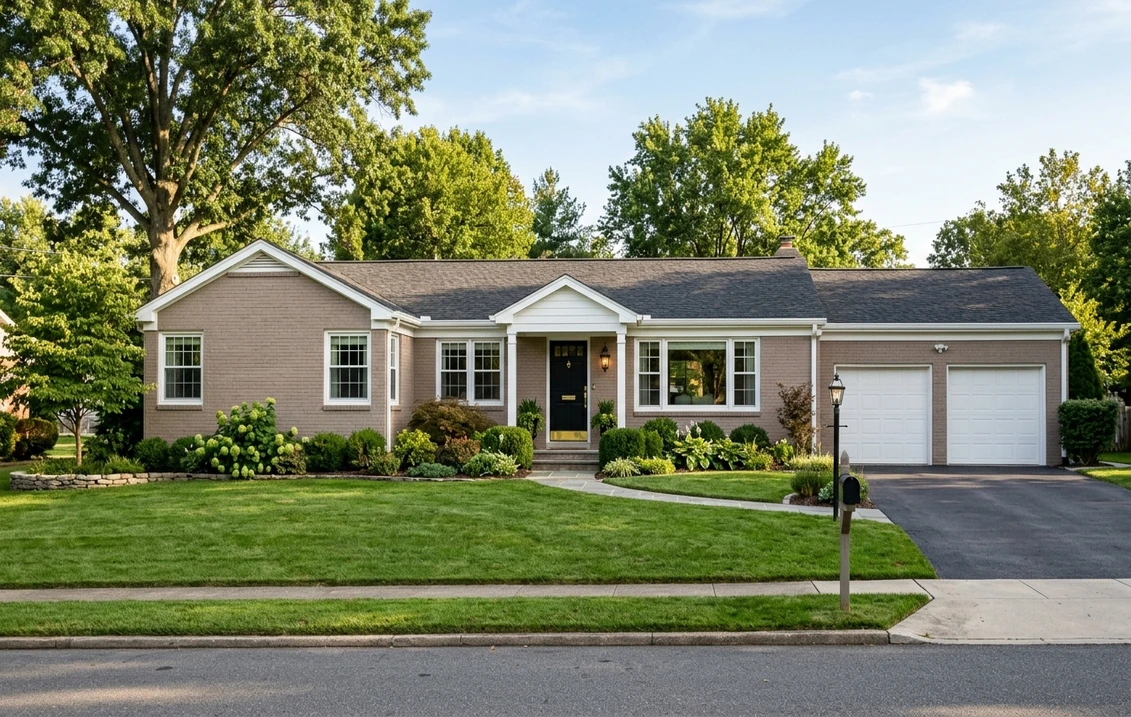
A stain adds pigment to whatever the brick already is, so the starting color is part of the result. Darkening is easy and reliable: red brick to a deep brown, charcoal or black-brown; tan brick to a warm gray or taupe; orange brick to a muted terracotta. Shifting hue is possible with semi-opaque coverage, which is how a mason blends a new addition into fifty-year-old brick. Lightening is the hard direction. Multiple coats or opaque mineral stains can take red brick toward gray or greige, but a bright white or a pale cream over dark red brick is where staining stops and limewash or mineral paint begins; the BIA's own examples of the opaque, matte white look are limewash and mineral paint, not stain. Sherwin-Williams' guide to choosing brick stain colors frames the choice by "the type of brick you're working with, the extent of color change you're aiming for and the overall aesthetic", and distinguishes semi-transparent stains for "subtle enhancement" from opaque stains for a "complete color transformation"; it also recommends a masonry primer on highly porous brick that would "absorb stains unevenly", which is a film-forming route and worth knowing before you assume every "stain" product is mineral.
The colors that photograph best on stained brick are the ones that read as natural brick: warm charcoal, mocha, greige, weathered gray, soft terracotta. The BIA's advice applies to all of them: "use mock-ups or sample panels to approve appearance", keep the samples until the job is done, and judge them dry, "as the treatment may appear different when wet". To narrow the field before a mason comes out, our brick house makeover guide shows the finishes side by side, and the trim question that follows any brick color change is handled in brick house trim paint ideas.
Free AI visualizer, no signup: one HD preview plus three variations.
Brick staining cost in 2026
| Source | Per square foot, installed | Notes |
|---|---|---|
| Angi (2026 cost guide) | $1 to $4, average about $2.50 | Labor and materials; depends on stain quality, brick condition and access. Angi puts painting brick at $1.50 to $4.50 per square foot. |
| Homewyse (May 2026 national average) | $1.12 to $2.27 | Basic labor, light scraping, two coats of oil-based semi-transparent stain; favorable site conditions. |
| LatestCost (2026) | $2 to $7.50 | Labor $2.50 to $7.50, materials $0.60 to $3.40, optional sealer $0.25 to $2; whole house $4,000 to $16,000, average $9,000 for 1,500 to 2,200 sq ft with a color change; prep and repairs $1,000 to $6,000 extra. |
Try it on your house
No photo? Try a sample
Sources: Angi, How much does it cost to stain a brick exterior; Homewyse, cost to stain brick; LatestCost, cost to stain brick. Regional labor rates and the amount of repair drive most of the spread.
Read the three figures together and the pattern is clear: a straightforward tone-down on sound brick sits around $2 to $3 per square foot, a full color change with a mineral system and repointing can run two to three times that, and the material is a small part of the bill. What changes the economics is the life cycle. The BIA notes that masonry stains "do not require maintenance" and cites projects "where the stain has lasted 20 years or more", and that qualified applicators "should offer a warranty of 15 years or more"; Stayntech, a mineral stain manufacturer, writes that painted brick "will begin to peel in as little as three to five years" while stained brick "is maintenance-free" (Stayntech, should I paint or stain my brick home). A stain that costs the same as paint up front and is never redone is the cheaper finish over the life of the house; the cost trade-offs of leaving brick alone, painting it or using a mineral finish are worked through in our paint or leave natural decision guide.
Stain vs paint vs limewash vs mineral paint
| Treatment | How it works (BIA TN 6) | Look | Breathability and life | Reversible? |
|---|---|---|---|---|
| Mineral masonry stain | Pigment penetrates pores and bonds chemically | Brick texture intact, semi-opaque to opaque, matte | High permeability; no maintenance; 20-plus years reported | No |
| Limewash | Slaked lime forms calcite bonded to the masonry | Nonuniform, weathers, semi-opaque to opaque, Old-World | Permeability unchanged; 5 to 10 years or more, easy recoat | Partly, with water in the first days |
| Mineral (silicate) paint | Potassium silicate silicifies with the substrate | Fully opaque, matte, softens texture | Permeability unchanged; warranties of 15 years or more | No |
| Acrylic latex paint | Film on the surface, adhesion only | Opaque, any sheen, smooths texture | Semi-permeable; recurring repaints | Only by chemical stripping |
| Diluted paint ("faux limewash") | Diluted acrylic film | Semi-opaque, mimics limewash | Less durable than limewash; peels and flakes | Damp cloth before it dries |
Choose stain when you want a different brick color and to never think about it again. Choose limewash when you want the mottled, aged white look and accept that it weathers; our lime wash brick technique guide covers mixing ratios and coats. Choose mineral paint for an opaque, matte, breathable color that stain cannot reach, such as a true white or a saturated black. Reserve acrylic paint for brick that is already painted or for a wall assembly where breathability does not govern, and go in knowing the maintenance cycle. The BIA's summary sentence is the one to remember: coatings "with a water vapor permeability of 0.98 or higher allow natural evaporation to occur", and once painted, exterior masonry "will require repainting every three to five years".
How a stain job is done, step by step
- Evaluate and repair. Loose units, failed mortar, cracks wider than a business card, flashing and weeps get fixed first; repointing "is recommended to be performed by a mason experienced with repair and restoration". New mortar cures at least 30 days.
- Remove old treatments. Sealers, water repellents and paint come off with a product formulated for brick; the BIA advises against sandblasting and against pressure high enough to damage the brick, and recommends a trial removal on an inconspicuous area.
- Clean. "Scrubbing with a stiff-bristled, non-metallic brush and soapy water or low-pressure washing is sufficient" in many cases; no muriatic acid, which "can cause damage and staining that cannot be removed or repaired". Efflorescence is removed and watched for recurrence.
- Dry and test. At least 24 hours after cleaning, longer in humid weather; the plastic-sheet test (4 mil sheet taped to the wall for 16 hours) shows whether moisture is still coming through. Then the water absorption test and a sample panel in the chosen color, judged dry.
- Apply per the manufacturer. Mineral stains are proprietary; the BIA's instruction is to follow the maker's method exactly, typically brushing the mixed stain onto clean, dry, absorbent masonry, one unit or one area at a time, with mortar joints stained separately if their color changes too. Minimum surface temperature per ASTM D6237 is 40°F, and no application within 5°F of the dew point.
- Do not seal by default. Sealing reduces permeability; the BIA notes a colorless coating is sometimes used over a non-mineral stain to even out the wet look, but a mineral stain generally needs none.
Common mistakes
- Staining over a sealed or painted wall. The stain has nothing to soak into and either beads up or sits as a weak film.
- Skipping the sample panel. Blended brick needs a panel that "incorporate[s] the full range of colors" or the finished wall will not match the test.
- Treating a wet wall. Efflorescence and staining after the job are almost always moisture that was there before it; the BIA's rule is to address "sources of moisture penetration" first.
- Expecting a stain to lighten dramatically. Going from dark red to white is a limewash or mineral-paint job.
- Hiring on price alone. The BIA's benchmark for applicators is "a minimum of three years of experience applying masonry stains" and a warranty of 15 years or more; ask for both.
One last consideration is the rest of the house. A brick color shift changes what trim, siding and door colors work, and the combinations that hold up around stained or natural brick are collected in our siding and brick color combinations guide. The umbrella page for every non-drywall surface, from brick to floors, is the specialty surface painting guide.
One HD preview plus three variations, no signup.
Sources and references
- Brick Industry Association, Technical Note 6, Changing the Appearance of Brick Masonry (March 2025): definition and history of masonry stains, mineral versus non-mineral treatments, water vapor permeance, the water test, glazed and dense brick, surface preparation, removal of prior treatments, cleaning, mock-ups, applicator experience and warranty benchmarks, limewash, mineral paint and acrylic paint characteristics.
- Dyebrick, mineral brick stain: silicate chemistry, mineral bond, Class 1 vapour permeability, suitable surfaces, sample-pot testing.
- Stayntech (Brick Imaging), should I paint or stain my brick home: breathability, longevity of paint versus stain.
- Sherwin-Williams, how to choose brick and masonry stains: semi-transparent versus opaque stains, water-, oil- and solvent-based types, masonry primer on porous brick.
- Angi, how much does it cost to stain a brick exterior (2026): $1 to $4 per square foot, average $2.50; painting comparison.
- Homewyse, cost to stain brick (May 2026): $1.12 to $2.27 per square foot, scope of a basic job.
- LatestCost, cost to stain brick (2026): labor, material and sealer ranges, whole-house totals, prep and repair costs.
Disclaimer: Dyebrick, Stayntech, Sherwin-Williams and other product names are trademarks of their respective owners. FacadeColorizer is an independent service, not affiliated with any of them. Costs are published 2026 estimates that vary by region, brick condition and scope; confirm with local quotes. Staining is permanent: test on a sample panel and consult the brick or stain manufacturer before treating a whole wall.
Frequently asked questions
Is staining brick better than painting it?
How much does brick staining cost?
Can all brick be stained?
Can you stain brick a lighter color or white?
Is brick stain permanent?
Does stained brick need sealing?
Trademarks mentioned (Sherwin-Williams, Benjamin Moore, Behr, Caparol, Brillux, Sto, Alpina, Valspar, PPG, Glidden, Dulux, Crown Trade, Sandtex, Farrow & Ball, Johnstone's, Leyland) are property of their respective owners. FacadeColorizer is independent and not affiliated with any of them. Nominative fair use under Lanham Act §1125.