Try it on your room

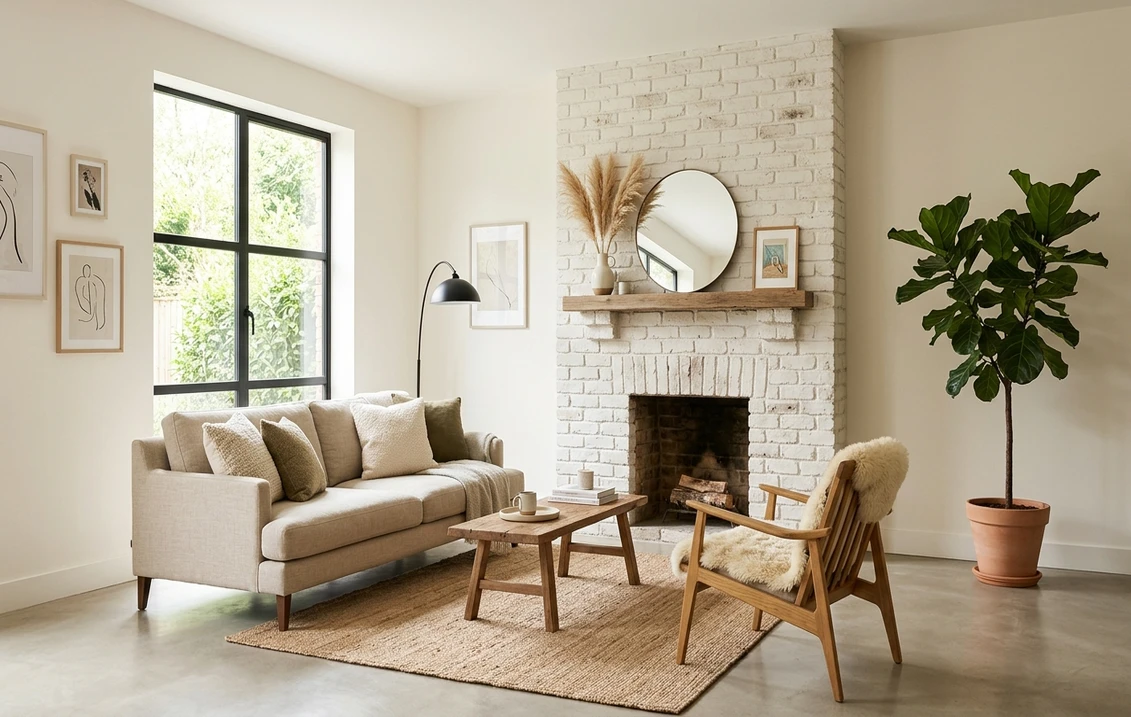
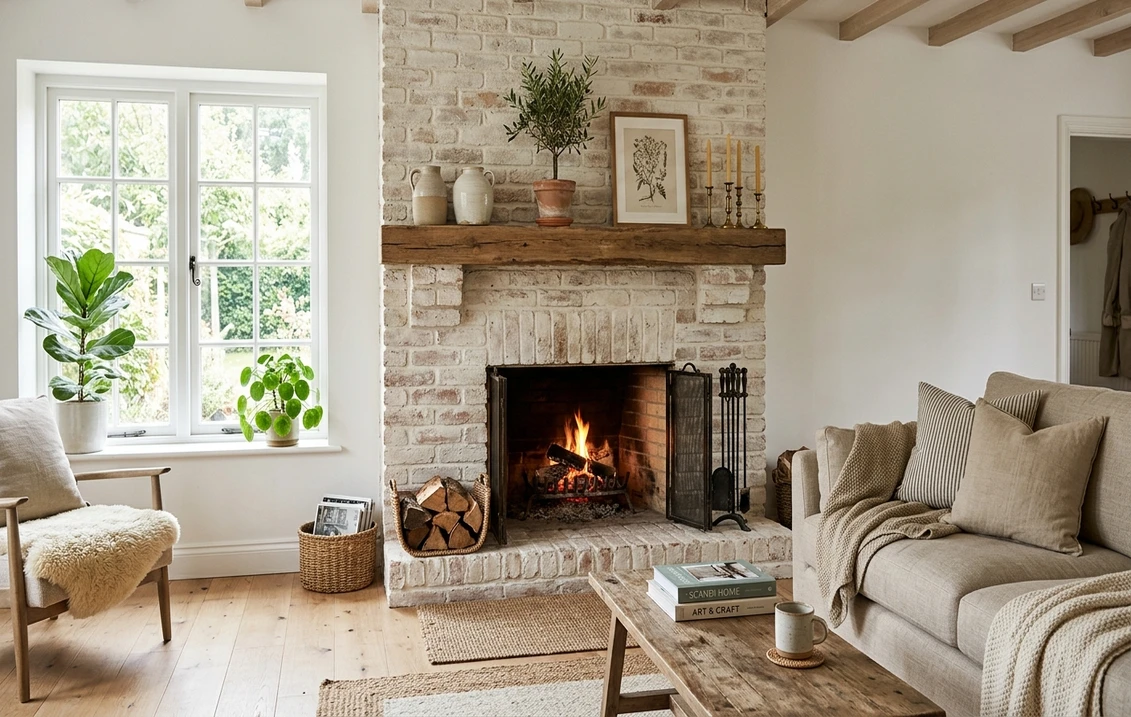
That 1970s red brick fireplace swallows every bit of light in the room, demolition is off the table, and you are stuck looking at it. Whitewashing is the $60 weekend answer: a thinned, translucent white coat that lets the texture and a hint of the original brick read through, instead of the flat, painted-over look of solid paint. Done right, white wash brick turns an orange-red focal wall into a soft, weathered, cottage-style surface that brightens the whole room. Done wrong, it streaks, chalks, or goes a dull pinkish gray.
This guide treats whitewash the way we treat any color decision: which white to start from, how its undertone shifts on brick, how it behaves under different light, what it pairs with, and how to test a patch first. Brick is the most unforgiving surface in the house to repaint, so that front-end testing matters here more than on drywall.
Upload a photo of your fireplace and preview a whitewash in 30 seconds, free, before you mix a single drop.
What "whitewash" actually means on brick
The word gets used loosely for three finishes that look related from across the room but behave very differently up close. Mix up the terms and you walk out of the store with the wrong product, then wonder why the result fought you.
| Technique | What it is | Look and reversibility |
|---|---|---|
| Paint whitewash | Latex wall paint thinned roughly 1:1 with water | Translucent, brick texture shows; sits on top, hard to remove later |
| Limewash | Slaked lime (calcium hydroxide) plus water and pigment | Chalky, matte, mineral; bonds into the brick, can be partly washed back within hours |
| German smear (mortar wash) | Thinned white mortar troweled over the brick and joints | Heavier, Old-World, partly buries the brick face; permanent |
Try it on your room
No photo? Try a sample
Sources: Romabio Classico Limewash technical data 2026; The Spruce, "How to Whitewash Brick" 2025; Bob Vila brick finishing reference 2025.
For an interior fireplace, "whitewash" almost always means the paint method (cheapest, most forgiving for a first-timer) or limewash (the breathable, mineral option that looks the most authentically old and scrubs back lighter while wet). German smear is a separate, heavier look covered on our hub page below.
Pick the right white to start from
Whitewash is not one color. It is whatever white you thin, seen at 40 to 70 percent strength over an orange-red base that pushes back through the coat. That brick warms every white, so a paint that looks crisp on a swatch lands one to two steps warmer on the wall. Start from these:
- Sherwin-Williams Pure White (SW 7005), LRV 84: the safe default. A clean, barely-warm white that holds its identity when the brick warms it, reading as a soft white rather than cream.
- Sherwin-Williams Alabaster (SW 7008), LRV 82: a warm off-white. Over red brick it leans creamy and cottage-like. Choose it on purpose if you want warmth.
- Benjamin Moore Chantilly Lace (OC-65), LRV 90+: the brightest, coolest option. Best when the brick is very orange and you want maximum correction toward clean white, though it can read stark in a warm room.
- Romabio Classico Limewash, Bianco White: the most-cited US limewash for brick. A soft, chalky white, mineral and matte. Reach for it if you want true limewash, not thinned paint.
Still narrowing the white? Our interior color families guide breaks down warm versus cool whites, and the best interior paint colors roundup shows what is trending.
Outdoors the rules tighten: exterior brick must stay vapor permeable, so the diluted-paint whitewash that works on a fireplace is the least durable option on a facade. For an exterior, read our guide to a white painted brick house, which compares authentic limewash, mineral paint and acrylic on the Brick Industry Association criteria.
How the undertone shifts on brick (and by light)
Whitewash never lands the way it looks in the can. Two things pull it off course: the brick underneath, showing through by design, and the light in the room. Standard red-clay brick carries an orange-red mass tone with buff or pink mortar between, so at half coverage the eye blends "white plus terracotta" into a warm peach or oatmeal, not a pure white. Light pushes it further still. Here is how a Pure White whitewash at half strength tends to land:
- South or west room, afternoon sun: warm and creamy. The brick's orange comes forward and the whitewash reads as oatmeal, the most flattering cottage look.
- North-facing room, no direct sun: cooler and grayer. The blue cast mutes the brick warmth, and a thin coat can read pinkish gray where mortar shows. Push coverage heavier, or start from a warmer base like Alabaster.
- Evening, warm 2700K bulbs: the warmest reading of the day, close to a pale buff. A whitewash that looked cool in the store feels cozy here.
So a bright south room earns you a cooler, brighter white that still picks up warmth from the brick. A dim north room with a thin coat is where the dreaded "dirty pink" comes from. The fix is the same either way: heavier coverage, warmer base.
Coverage ratio: how white do you want it?
The dial that controls how far the undertone resolves is the paint-to-water ratio. Forget a single "right" mix. Think of it as a slider that runs from barely-touched to nearly solid:
- 1 part paint to 3 parts water: a faint veil. The brick still dominates; you are knocking the orange back a notch. Best when the brick is a color you mostly want to keep.
- 1 part paint to 1 part water: the classic whitewash, a roughly even read of white and brick. The look in most magazine cottage fireplaces.
- 2 parts paint to 1 part water: heavy whitewash leaning toward solid, brick reading as faint texture under a mostly-white surface. Good for very orange or busy brick.
Mix more than you think you need and keep the ratio identical between batches, because a different dilution reads as a visible seam. Limewash works the same way but ships closer to ready-to-use; thin it lightly per the manufacturer sheet and build translucency by wiping back.
Step by step: whitewashing an interior fireplace
The method below is the paint whitewash, the most beginner-friendly route. Plan a half-day for a standard surround.
- Clean the brick. Vacuum, then scrub with warm water and dish soap (trisodium phosphate for soot near the firebox). Porous brick holds grime that blocks adhesion. Let it dry overnight.
- Tape, drape, and mix. Mask the mantel, hearth, and floor (thinned whitewash splatters), then combine your white with water at the target ratio (1:1 if unsure) and make enough for the whole surround in one go.
- Work in small sections. Brush the mix onto a two-foot square, then immediately blot and drag with a damp cotton rag to control how much brick shows. Work fast; the thin coat grabs quickly.
- Build, do not flood. Too transparent? Let it dry and add a second light pass rather than loading the first coat. Layering keeps the texture; flooding looks like solid paint. If solid, opaque color is what you actually want, the painted brick fireplace guide covers the stain-blocking primer and paint that make it last.
- Step back often. Whitewash reads different wet than dry, and different from across the room. Check from the doorway between sections.
- Seal only if you want to. A matte masonry sealer locks the finish and eases dusting near a working fire, but it deepens the color and removes the chalky charm. Most whitewash is left unsealed.
Budget is modest: a quart of paint, a brush, and rags run well under $60. The bigger cost is undoing a result you dislike. For where a fireplace sits inside a wider repaint, our interior house painting cost guide has the per-room numbers.
Trim, mantel, and decor pairings
A whitewashed fireplace is a warm, textured neutral, which makes it easy to build a room around. The pairings that consistently work:
- Wood mantel: a warm reclaimed or stained-oak mantel is the classic counterpoint. The wood reads as intentional warmth and keeps the whitewash from feeling washed out. Walnut and honey oak both work.
- Surrounding walls: keep them within a step of the whitewash. A greige or soft white wall lets the fireplace stay the textured hero; a stark bright-white wall can make a warm whitewash look dingy.
- Trim and floors: match the existing white trim or go a touch crisper, and keep flooring warm. Light oak reflects warmth back onto the brick; cool gray flooring fights the cottage look.
- Accents: black metal (fire screen, sconces), woven baskets, greenery, and matte ceramics all read well against the chalky surface. The look leans Scandinavian-farmhouse.
Choosing the surrounding wall white at the same time? The brand head-to-head in our Sherwin-Williams vs Benjamin Moore interior comparison helps you match the whitewash base to a coordinating wall paint. Fireplace brick is one of several specialty surfaces: for masonry floors see our concrete floor and basement ceiling paint guide, and the bathtub refinishing color guide applies the same test-first discipline to another hard surface.
Test before you commit
Brick is permanent in a way drywall is not. A thinned whitewash soaks into the pores; reversing it means heavy stripping or painting solid over the top, which kills the texture. So test properly:
- Mix a small test batch at your target ratio and brush a one-foot patch on a lower corner of the fireplace, not a scrap brick. Real brick, real mortar, and real light are what matter.
- View it at three times of day: morning, mid-afternoon, and at night under your bulbs. The pink-gray surprise only shows up at certain light.
- Let it dry fully and try two ratios side by side. Wet whitewash looks more translucent than the dried result, and a 1:1 patch next to a 2:1 patch settles the coverage decision instantly.
The zero-mess version of that test is digital: upload a clear photo of your fireplace into our paint visualizer and preview a whitewash, lighter and heavier, before you tape anything off. It will not replace a physical patch for the final call, but it rules out the directions you would have hated in seconds. For the full menu of specialty-surface methods, including German smear and sealing, see our specialty surface painting guide.
See a whitewash on your actual brick under your actual light, free.
Frequently asked questions
What is the right paint-to-water ratio to whitewash brick?
No ratio is the correct one. It is a style slider you set to taste. A 1:3 mix gives a faint veil that mostly keeps the brick, 1:1 is the classic balanced whitewash, and 2:1 leans near-solid with only faint texture showing. Start at 1:1 if unsure, and keep the ratio identical between batches so seams do not show.
What is the difference between whitewash and limewash on brick?
Whitewash usually means latex paint thinned with water; it sits on top of the brick, is translucent, and is hard to remove later. Limewash is slaked lime plus pigment, a mineral coating that bonds into the brick, dries chalky and matte, stays breathable, and can be wiped back lighter while still wet. Romabio Classico Limewash in Bianco White is the most-cited US product for brick.
Why does my whitewashed brick look pink or gray instead of white?
The brick's orange-red and the buff or pink mortar blend through a thin coat, which the eye reads as warm peach or pinkish gray, and cool north-facing light makes it worse by muting the brick warmth. Fix it with more coverage (a heavier ratio or a second pass) or a warmer white base.
Do I need to seal whitewashed brick?
Only if you want to. A matte masonry sealer locks the finish and makes the surface easier to dust near a working fireplace, but you pay for it: the color deepens and the chalky look goes away. Most people leave a paint whitewash unsealed, and limewash is normally left unsealed so it stays breathable.
Can whitewashed brick be undone if I dislike it?
Not easily, and that is exactly why you test first. A thinned whitewash soaks into porous brick, so reversing it means aggressive stripping or painting solid over the top, which destroys the texture. Limewash is more forgiving: fresh limewash can be wiped or rinsed back lighter the same day, before it cures.
Preview a light or heavy whitewash on your brick before you commit to anything permanent.
Disclaimer: Sherwin-Williams, SW 7005 Pure White, and SW 7008 Alabaster are trademarks of The Sherwin-Williams Company. Benjamin Moore and OC-65 Chantilly Lace are trademarks of Benjamin Moore & Co. Romabio and Classico Limewash are trademarks of their respective owner. FacadeColorizer is an independent paint visualization service, not affiliated with or endorsed by Sherwin-Williams, Benjamin Moore, Behr, or Romabio. Screen color approximates the manufacturer's chip, and whitewash results vary with brick color, porosity, and dilution; always test a physical patch first. Sources: Romabio Classico Limewash technical data 2026, Sherwin-Williams SW 7005 and SW 7008 technical data sheets 2026, Benjamin Moore OC-65 technical data sheet 2026, The Spruce "How to Whitewash Brick" 2025, Bob Vila brick finishing reference 2025.
Trademarks mentioned (Sherwin-Williams, Benjamin Moore, Behr, Caparol, Brillux, Sto, Alpina, Valspar, PPG, Glidden, Dulux, Crown Trade, Sandtex, Farrow & Ball, Johnstone's, Leyland) are property of their respective owners. FacadeColorizer is independent and not affiliated with any of them. Nominative fair use under Lanham Act §1125.