Try it on your room

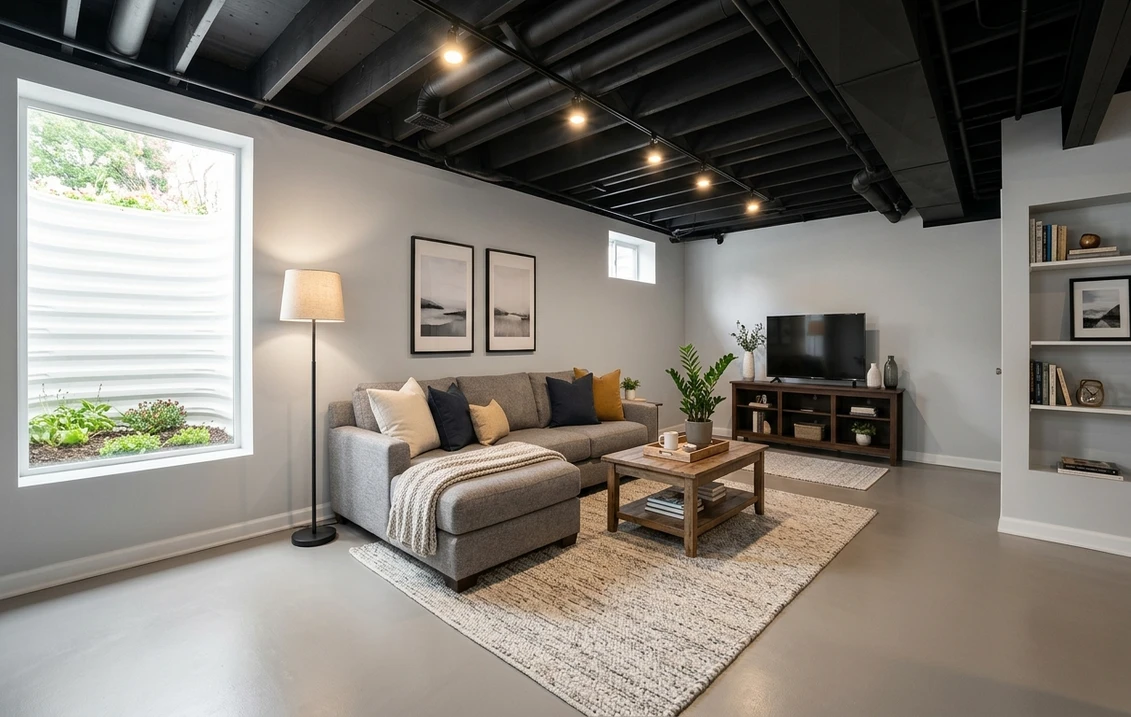
A raw gray slab underfoot, a low ceiling crowded with joists, pipes, and HVAC ducts, a couple of bare bulbs doing all the work. Sound like your basement? Right now it reads as storage. But two cans of paint, one for the floor and one for the ceiling, turn that same square footage into a usable family room without framing a single wall. The most-searched cement floor painting ideas (most people say cement and concrete interchangeably for the slab) pair a painted concrete floor with a matte black ceiling. The combination works because the two finishes do opposite jobs: the floor brightens and grounds the room, while the black overhead makes the mechanical clutter disappear.
This is a two-tone system, so this guide treats it as one: the floor gray that photographs clean, why black is the right answer overhead, the light reflectance values and undertones behind both, how the palette behaves with almost no direct sun, and how to test it first. For the wider question of which surfaces accept a coating and which fight it, this article sits under our specialty surface painting guide.
Upload a photo of your basement and see a gray painted floor with a black ceiling in 30 seconds, free.
The two-color logic: bright below, dark above
Why this specific order matters: reverse the palette, with a dark floor and a white ceiling, and every pipe gets spotlit against the bright background while the low ceiling feels even lower. Bright below and dark above is the combination that makes the room read as intentional, and the rest of this guide picks the right gray and the right black to pull it off.
The floor: which gray photographs clean
Bare concrete is rarely a neutral gray. Poured slabs skew blue-gray, green, or warm tan, and the color you coat over them either corrects that cast or amplifies it. For a basement family room, the target is a mid-to-light warm gray: light enough to bounce the available light, warm enough that it does not read cold and institutional under artificial light.
- Light warm gray (the safe default): an LRV in the high 40s to mid 50s, the "greige" lane. It brightens the room, hides dust and scuffs, and pairs with almost any sofa or rug. The tinted bases sold for garage and basement floors land here. Lowest-risk and best for resale.
- Cool medium gray (the modern lane): an LRV in the high 20s to mid 30s. More contemporary and hides dirt better, but it can slide toward gloomy under warm bulbs. Best with decent window wells or bright, cool LED.
- Natural concrete gray (the honest lane): a stain or tinted sealer that keeps the slab looking like polished concrete rather than painted-over, LRV usually low 30s to low 40s. This is the satin look in the photo above.
Whichever lane you pick, sheen matters as much as color on a floor. A satin or low-gloss finish reflects light and mops clean, the standard for living-area concrete; dead-flat hides imperfections but shows footprints. How sheen changes the way a gray reads carries straight over from walls, covered in our interior paint color families guide.
Floor coating types, compared
"Concrete floor paint" covers several different products, and the one you choose decides durability far more than the color does:
| Coating type | Look and durability | Best for |
|---|---|---|
| 1-part latex floor paint | Easiest to roll, lowest cost, wears at high-traffic spots over a few years | Low-traffic basements, a quick refresh, renters who want reversible |
| Epoxy (2-part) | Hard, glossy, chemical and abrasion resistant; needs etching and a dry slab | Family rooms, workshops, anywhere you want a tough, wipeable surface |
| Acid or water-based stain | Translucent, mottled, keeps the concrete character; sealed on top | The "polished concrete" look without grinding |
| Tinted sealer | Thin, even color, matte to satin; less build than paint or epoxy | A subtle, uniform gray that still reads as concrete |
Try it on your room
No photo? Try a sample
Sources: Behr and Rust-Oleum concrete and floor coating technical data sheets 2026; The Spruce concrete floor painting overview 2025.
One step comes before any of these, and you do not get to skip it: test the slab for moisture. Vapor rising through a below-grade slab is the number one reason a painted basement floor peels. The test itself is covered below.
Free AI visualizer. Upload your basement photo to compare light, medium, and natural concrete grays before you buy a kit.
The ceiling: why black, and which black
A black ceiling sounds counterintuitive in a dim basement, but black absorbs light better than any other color, so the depth of all that mechanical clutter flattens out and the joists, ducts, and pipes merge into one plane the eye stops noticing. Restaurants, breweries, and loft conversions have used the trick for decades.
The key choice is sheen, not which black. Use a flat or matte black: it absorbs light and hides the seams, fasteners, and dents in old ductwork, where any gloss would catch a highlight on every pipe and defeat the purpose. The two go-to picks are Benjamin Moore Black (2132-10) and Sherwin-Williams Tricorn Black (SW 6258), both true neutral blacks at an LRV around 3 with no strong blue or brown cast; Tricorn is the most popular architectural black in the United States. If full black feels heavy, a near-black charcoal like Benjamin Moore Soot (2129-20) or SW Iron Ore (SW 7069) recedes almost as well while feeling softer overhead.
For coverage, an airless sprayer is the realistic tool: it reaches the gaps a brush cannot and coats every joist and pipe to the same matte uniformity that sells the effect. Tricorn Black and BM Black both appear in our brand-level breakdown in the Sherwin-Williams vs Benjamin Moore interior comparison.
How the palette behaves in low basement light
Underground, color plays by other rules. Window wells are tiny or missing, so the brightest thing in the room is whatever bulb you screw in. That means the temperature of your artificial light, not the sun, decides how the floor and ceiling actually read.
- Warm bulbs (2700K to 3000K): push a warm gray floor toward cozy beige-gray and keep the room from feeling like a parking garage, the right call for a family room. A cool gray floor under warm bulbs can look muddy.
- Neutral and cool bulbs (3500K to 5000K): keep grays crisp and make a cool medium gray look its best, but can feel clinical. Better for a basement gym, laundry, or workshop than a TV room.
- The black ceiling barely moves: black reflects so little it reads black under any bulb; its only variable is sheen catching a fixture, which is why flat wins.
So in a dim basement, go warm twice over: a warm gray on the floor, warm bulbs overhead. For the broader 2026 palette and the warm-neutral direction interiors are trending, see our roundup of the best interior paint colors for 2026.
Pairing the floor and ceiling with walls and decor
Think of the floor and ceiling as the frame. Walls and furnishings are what you hang inside it. A few combinations that consistently hold up:
- Light gray or warm-white walls (the easy win): a soft warm white or pale greige wall, the pairing in the photo above. The safest, brightest choice in a dark basement.
- Warm wood and woven texture: warm oak shelving, a wood table, and a chunky wool rug add back the warmth a black ceiling can lack. Texture matters more here than in a sunlit room.
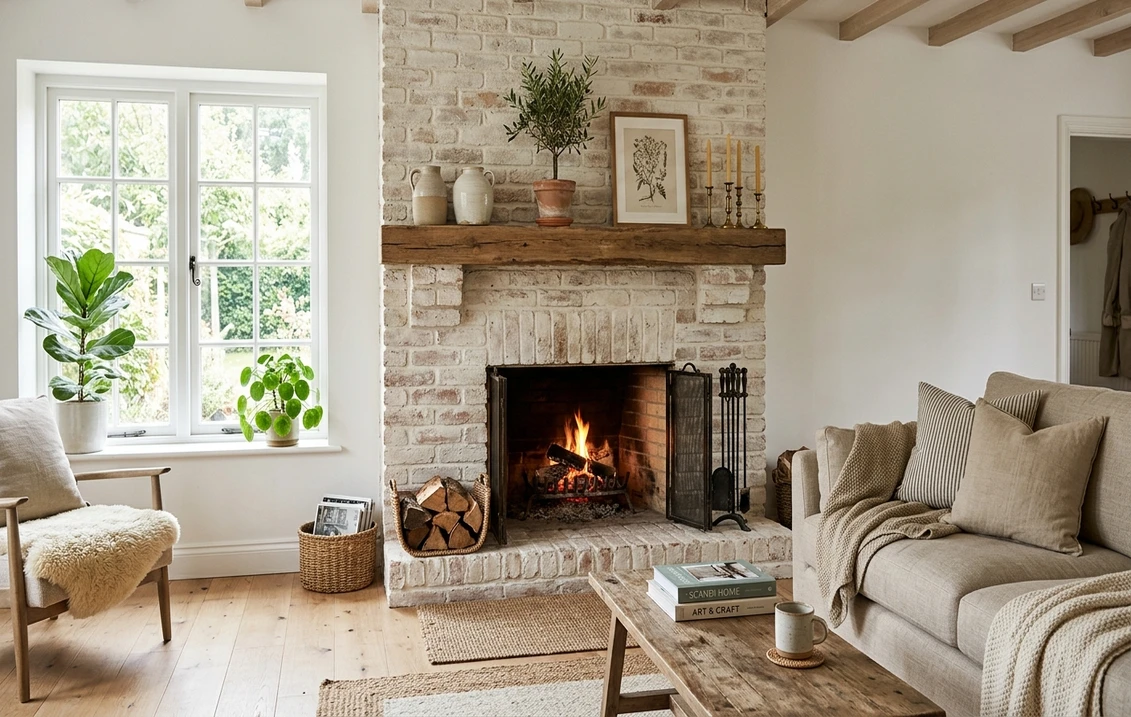
- One brick or stone wall, whitewashed: if your basement has an exposed brick or block wall, a soft whitewash brightens it and breaks up the gray, a technique that transfers directly from our guide on whitewashing interior brick.
- An area rug: it softens the hard concrete underfoot and adds the pattern a two-tone gray-and-black room can otherwise lack.
What the project costs and how to test it first
By basement-finishing standards, painting a floor and blacking out a ceiling is about as cheap as it gets. Framing and drywalling a basement runs tens of thousands of dollars. Floor paint plus ceiling paint? A materials cost in the low-to-mid hundreds, plus a sprayer rental. For where this fits against full-room repainting, see our interior house painting cost guide. Numbers vary by square footage, coating type, and prep, so treat any figure as a planning range and confirm locally.
Because both surfaces are large and hard to repaint, test before you commit. Three steps:
- Moisture first. Tape the plastic-sheet square to the bare slab for 24 to 48 hours. Condensation means fix the moisture before anything else.
- Swatch the floor in place. Coat a two-foot square of the actual slab with your candidate gray and check it morning, afternoon, and night under the bulbs you will use. A chip on the can lies about how a whole floor reads.
- Visualize the pair before you buy. The fastest no-paint preview is digital: upload a photo of your basement and apply a gray floor and black ceiling virtually to judge the balance before renting a sprayer.
See a light gray, medium gray, and black-ceiling basement side by side on your own room before you spend a dollar on paint.
Frequently asked questions
What color should I paint a basement concrete floor?
For a family-room basement, a light-to-medium warm gray is the safest choice. It reflects the limited natural light to brighten the room, hides dust and scuffs, and resells well. Lean warm rather than cool, because cool gray can read cold and gloomy under the warm bulbs most basements use. Reserve cool medium gray for rooms where you will run bright, cool LED lighting on purpose, such as a gym or workshop.
Should I paint my basement ceiling black or white?
Black is the better choice for an exposed, unfinished ceiling full of joists, ducts, and pipes. A flat black absorbs light and merges the clutter into one dark plane the eye stops noticing, which makes the room look finished. White does the opposite: it spotlights every pipe and emphasizes a low ceiling. White ceilings make sense only when the ceiling is already drywalled and smooth.
What is the best black paint for a basement ceiling?
A true neutral black in a flat or matte sheen. Benjamin Moore Black (2132-10) and Sherwin-Williams Tricorn Black (SW 6258) are the two go-to picks, both with an LRV around 3 and no strong undertone. Flat keeps light from glinting off the ductwork, and spraying coats every joist and pipe uniformly. If full black feels heavy, a near-black charcoal like SW Iron Ore recedes almost as well.
Will a painted concrete basement floor peel?
It can, and moisture is almost always the cause. Concrete below grade passes water vapor up through the slab, and vapor trapped under a coating lifts it. Before coating, tape a two-foot square of plastic sheeting tightly to the bare slab for 24 to 48 hours; condensation means you must fix the moisture first. Proper etching and a fully cured slab also matter, and a two-part epoxy on a clean, dry, prepped slab is the most durable choice.
Does a black basement ceiling make the room feel smaller?
It feels different rather than smaller. A black ceiling makes the plane recede so the joists and ducts disappear, which usually makes a low, busy basement feel calmer, not cramped. The trick is keeping the floor and walls light so the room still reflects plenty of light. A light gray floor and pale walls under a black ceiling read as intentional and open.
Upload your basement photo and preview a gray painted floor with a matte black ceiling before you rent a sprayer.
Disclaimer: Sherwin-Williams, Benjamin Moore, Behr, and Rust-Oleum and the color names referenced are trademarks of their respective owners. FacadeColorizer is an independent paint and color visualization service and is not affiliated with, endorsed by, or sponsored by any of them. LRV figures are approximate and based on published manufacturer reflectance values; exact appearance varies by coating brand, sheen, slab color, and applied film thickness. Cost references are general US estimates and vary by square footage, coating type, prep, and region; always confirm with local pricing and a moisture test before coating. Color reproduction on screens approximates a physical sample; confirm with an in-place swatch under your own lighting before committing. Sources: Sherwin-Williams and Benjamin Moore technical data sheets 2026, Behr and Rust-Oleum concrete and floor coating technical data 2026, The Spruce concrete floor painting and basement ceiling overviews 2025.
Trademarks mentioned (Sherwin-Williams, Benjamin Moore, Behr, Caparol, Brillux, Sto, Alpina, Valspar, PPG, Glidden, Dulux, Crown Trade, Sandtex, Farrow & Ball, Johnstone's, Leyland) are property of their respective owners. FacadeColorizer is independent and not affiliated with any of them. Nominative fair use under Lanham Act §1125.